Contents
Islamic words can be hard to follow when you are new to hadith. This glossary explains the Islamic words we use on alHadiths in one plain line each, with a link to the article where you can see the word in its hadith.
At a glance
- Terms: 75, in six groups
- Spelling: The common English spelling first, with other spellings in brackets
- How to use it: Find the word, read the line, then open the article to see it in a hadith
- New words: Added as new articles go live
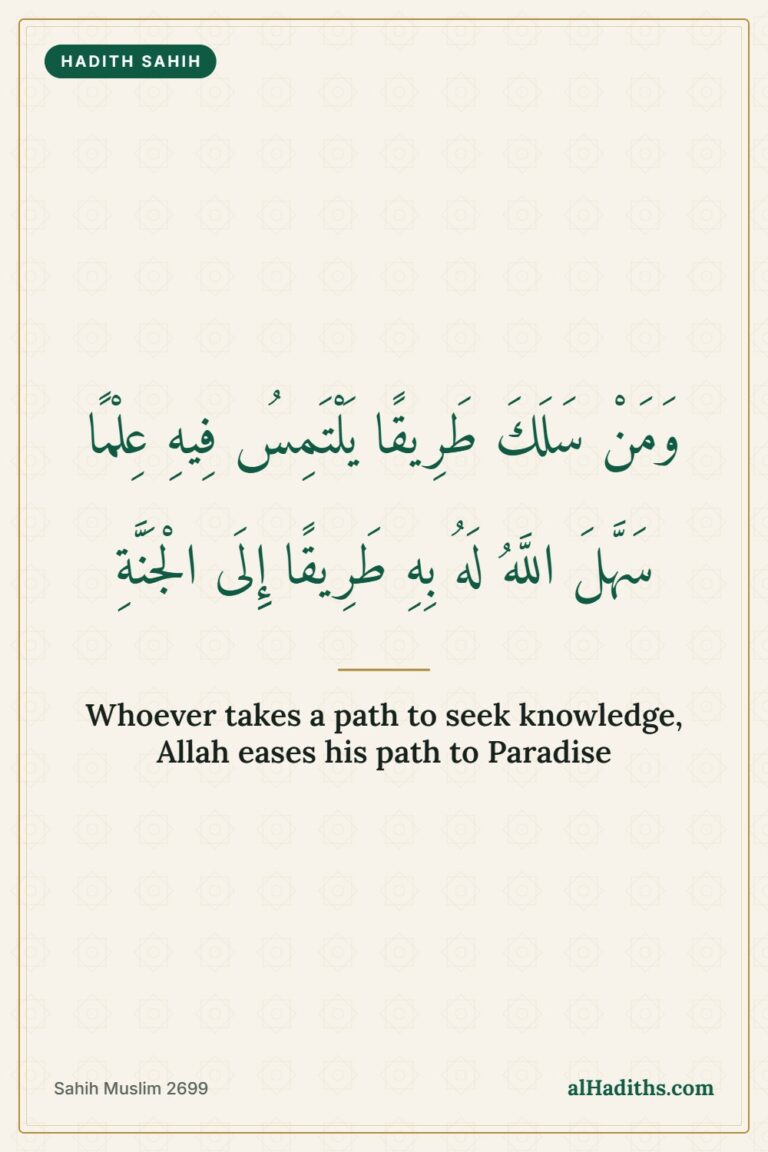
Learning these words is part of seeking knowledge, and Abu Hurairah (may Allah be pleased with him) narrated that the Prophet ﷺ said:
وَمَنْ سَلَكَ طَرِيقًا يَلْتَمِسُ فِيهِ عِلْمًا سَهَّلَ اللَّهُ لَهُ بِهِ طَرِيقًا إِلَى الْجَنَّةِ
“Whoever takes a path seeking knowledge, Allah makes easy for him, through it, a path to Paradise.”
Sahih Muslim 2699a · Narrated by Abu Hurairah · Translation adapted from Sunnah.com
Everyday Islamic words and phrases
Short phrases Muslims say every day, with their meaning.
- Alhamdulillah: “All praise is for Allah”, said in thanks, after eating, sneezing or good news. Read: Hadith about gratitude
- Allahu akbar: “Allah is the Greatest”; the words of the takbir that open every salah. Read: Every tasbih is charity
- Astaghfirullah: “I seek Allah’s forgiveness”; the simplest form of istighfar. Read: Sayyidul Istighfar
- Bismillah: “In the name of Allah”, said before eating, starting a task or reciting the Quran.
- Inshallah (in shaa Allah): “If Allah wills”, said about anything we plan to do in the future.
- La hawla wa la quwwata illa billah: “There is no power and no strength except with Allah.” Read: La hawla wa la quwwata illa billah
- Mashallah (maa shaa Allah): “What Allah has willed”, said when we see something good or admire a blessing.
- Radiyallahu anhu (may Allah be pleased with him): A prayer said after the name of a companion; “anha” for a woman.
- Subhanallah: “Glory be to Allah”, declaring Allah free of every fault; part of tasbih. Read: SubhanAllahi wa bihamdihi
- ﷺ (sallallahu alayhi wa sallam): “May Allah send His blessings and peace upon him”, written and said after the Prophet’s name. Read: Blessings on the Prophet ﷺ
Hadith words
The words you see under every hadith on this site.
- Da’if: A weak hadith: something in its chain or text falls short, so it is not used as proof. Read: How hadith grading works
- Hadith: A report of what the Prophet ﷺ said, did or approved. Read: How hadith grading works
- Hasan: A good hadith: accepted, with a chain slightly less strong than sahih. Read: How hadith grading works
- Isnad: The chain of narrators who passed a hadith down, one to the next. Read: How hadith grading works
- Kutub al-Sittah: The Six Books: the collections of Bukhari, Muslim, Abu Dawud, at-Tirmidhi, an-Nasa’i and Ibn Majah. Read: The six hadith books
- Matn: The text of a hadith itself, the words that come after the chain. Read: How hadith grading works
- Mawdu (maudu’): A fabricated hadith, falsely attributed to the Prophet ﷺ. Read: How hadith grading works
- Sahabah (companions): The people who met the Prophet ﷺ as believers and died as Muslims. Read: Prophet Muhammad ﷺ
- Sahih: An authentic hadith, with a connected chain of trustworthy narrators and no hidden flaw. Read: How hadith grading works
- Sunnah: The way of the Prophet ﷺ: his words, actions and approvals, which Muslims follow. Read: Hold fast to my Sunnah
Salah words
Words for the prayer and its parts. The Salah series has them all in context: Salah hub.
- Adhan: The call to prayer. Read: Dua after adhan
- Duha: The voluntary forenoon prayer, after the sun has risen high. Read: Duha prayer
- Eid prayer: The prayer of the two Eids, prayed in the morning of Eid al-Fitr and Eid al-Adha. Read: Eid prayer
- Fard: Obligatory, such as the five daily prayers. Read: Importance of salah
- Istikhara: A two-rak’ah prayer and dua asking Allah to guide a decision. Read: Istikhara prayer
- Iqamah: The second call, said just before the congregation stands to pray.
- Jama’ah: Praying together in congregation behind an imam. Read: Praying in congregation
- Janazah: The funeral prayer for a Muslim who has died. Read: Janazah prayer
- Jummah (Jumu’ah): The Friday congregational prayer, with a khutbah, in place of Dhuhr. Read: Importance of Jummah
- Khutbah: The sermon given before the Jummah prayer and after the Eid prayer. Read: Importance of Jummah
- Khushu: Humble, focused presence of the heart in prayer. Read: Khushu in salah
- Nafl: A voluntary act of worship beyond what is obligatory. Read: Nafl prayer
- Qasr: Shortening four-rak’ah prayers to two while travelling. Read: Qasr prayer
- Qiblah: The direction of the Ka’bah in Makkah, which Muslims face in prayer.
- Rak’ah: One unit of the prayer: standing, bowing, two prostrations. Read: How the Prophet ﷺ prayed
- Ruku: The bowing position in salah. Read: What to say in ruku and sujud
- Salah: The ritual prayer, five times a day; the second pillar of Islam. Read: Importance of salah
- Sujud: Prostration: forehead, nose, hands, knees and toes on the ground. Read: What to say in ruku and sujud
- Sujud sahw: Two prostrations of forgetfulness, for a mistake in the prayer. Read: Sujud sahw
- Sunnah prayers: Voluntary prayers the Prophet ﷺ kept before or after the obligatory ones. Read: Sunnah prayers
- Tahajjud: Voluntary prayer in the night, after sleeping. Read: Tahajjud hadith
- Takbir: Saying “Allahu akbar”; the first takbir opens the prayer. Read: How the Prophet ﷺ prayed
- Tarawih: The night prayer of Ramadan. Read: Tarawih prayer
- Tashahhud: The testimony recited while sitting in the prayer, beginning “at-tahiyyatu lillah”. Read: Dua after tashahhud
- Taslim: Saying “as-salamu alaykum wa rahmatullah” to end the prayer. Read: How the Prophet ﷺ prayed
- Witr: The odd-numbered prayer that closes the night’s prayers. Read: Witr prayer
- Wudu: Ablution: washing the face, arms, head and feet before prayer. Read: How to make wudu
Faith and character words
Words about belief, worship and good character.
- Adhkar: The plural of dhikr: set words of remembrance, such as the morning and evening adhkar. Read: Morning adhkar
- Bid’ah: An innovation in religion: a new act of worship with no basis in the Sunnah. Read: Hadith about bid’ah
- Dhikr: Remembering Allah with the heart and tongue. Read: Dhikr hub
- Dua: Calling on Allah: asking Him directly, in any language. Read: Dua hub
- Halal and haram: What Allah has made lawful, and what He has forbidden. Read: Halal is clear, haram is clear
- Ihsan: Excellence: worshipping Allah as though you see Him, and doing everything well. Read: Ihsan in all things
- Iman: Faith: belief in Allah, His angels, books, messengers, the Last Day and the divine decree. Read: Hadith of Jibril
- Islam: Submission to Allah; built on five pillars. Read: Five pillars of Islam
- Istighfar: Asking Allah for forgiveness. Read: Sayyidul Istighfar
- Mahram: A close male relative a woman can never marry, such as her father, brother or son. Read: Women’s travel in Islam
- Nasihah: Sincerity: wishing good for Allah’s religion and for people. Read: Religion is sincerity
- Niyyah: Intention: the aim in the heart behind an action. Read: Actions are judged by intentions
- Qana’ah: Contentment with what Allah has given. Read: Qana’ah
- Sadaqah: Voluntary charity, in money or in kind words and deeds. Read: The excellence of sadaqah
- Sadaqah jariyah: Ongoing charity whose reward continues after death. Read: Three deeds that continue after death
- Taqwa: Mindfulness of Allah that keeps a person from what He dislikes. Read: Fear Allah wherever you are
- Tawbah: Repentance: turning back to Allah after a sin. Read: Tawbah prayer
- Wali: A close friend of Allah, through faith and taqwa. Read: Friend of Allah
- Zuhd: Not letting the world take hold of the heart. Read: Zuhd hadith
Words about the Hereafter
- Akhirah: The Hereafter, the life after death.
- Jahannam: Hellfire, the place of punishment in the Hereafter. Read: Hellfire in Islam
- Jannah: Paradise, the reward of the believers in the Hereafter. Read: Jannah in Islam
Islamic calendar words
All of these are on our Islamic calendar with their expected dates.
- Arafah: The 9th of Dhul Hijjah, the main day of Hajj; others fast on it.
- Ashura: The 10th of Muharram, a Sunnah day of fasting.
- Hijri: The Islamic lunar calendar, counted from the Prophet’s migration to Madinah.
- Laylatul Qadr: The Night of Decree, in the last ten nights of Ramadan.
- Rajab: The 7th month, one of the four sacred months. Read: Rajab month
- Ramadan: The 9th month, the month of fasting.
Questions people ask about Islamic words
What does inshallah mean?
Inshallah (in shaa Allah) means “if Allah wills”. Muslims say it about anything they plan to do in the future.
What is the difference between sunnah and hadith?
A hadith is a report about the Prophet ﷺ. The Sunnah is his way of life, and we know it through authentic hadith. See how hadith grading works.
What does ﷺ mean after the Prophet’s name?
ﷺ stands for “sallallahu alayhi wa sallam”: may Allah send His blessings and peace upon him. Muslims say or write it each time his name is mentioned.
Missing a word you came across in a hadith? It will be added as new articles go live, in shaa Allah.
Save this to Pinterest so you can understand every hadith you read
Share the reward. Send this article to someone who needs it today — teaching a hadith or dua can become a lasting good deed for you, in shaa Allah.