Witr Prayer Hadith: 6 Authentic Hadith on Witr
Contents
Many people think of witr as the three rak‘ahs prayed after tarawih in Ramadan and forget it for the rest of the year. Yet the Prophet ﷺ spoke of it as a prayer Allah loves, one to close every night with. This witr prayer hadith collection brings together six authentic narrations: why witr matters, when to pray it, how short it can be, and the qunut dua the Prophet ﷺ taught his grandson.
Witr means “odd”: a prayer with an odd number of rak‘ahs that seals the night’s prayers. It belongs with the night prayer in our Tahajjud hadith, and with the daily advice in 3 Daily Sunnahs the Prophet ﷺ Advised.
At a glance
- Hadith: 6 authentic hadith
- Collections: Sahih al-Bukhari, Sahih Muslim, Sunan Abi Dawud
- Grade: Sahih (Bukhari, Muslim); Sahih (al-Albani) for Abu Dawud 1416 and 1425
- Topic: Witr, the odd-numbered prayer that ends the night
- Do it today: Pray at least one rak‘ah of witr tonight before you sleep
1. Allah is Witr and loves witr
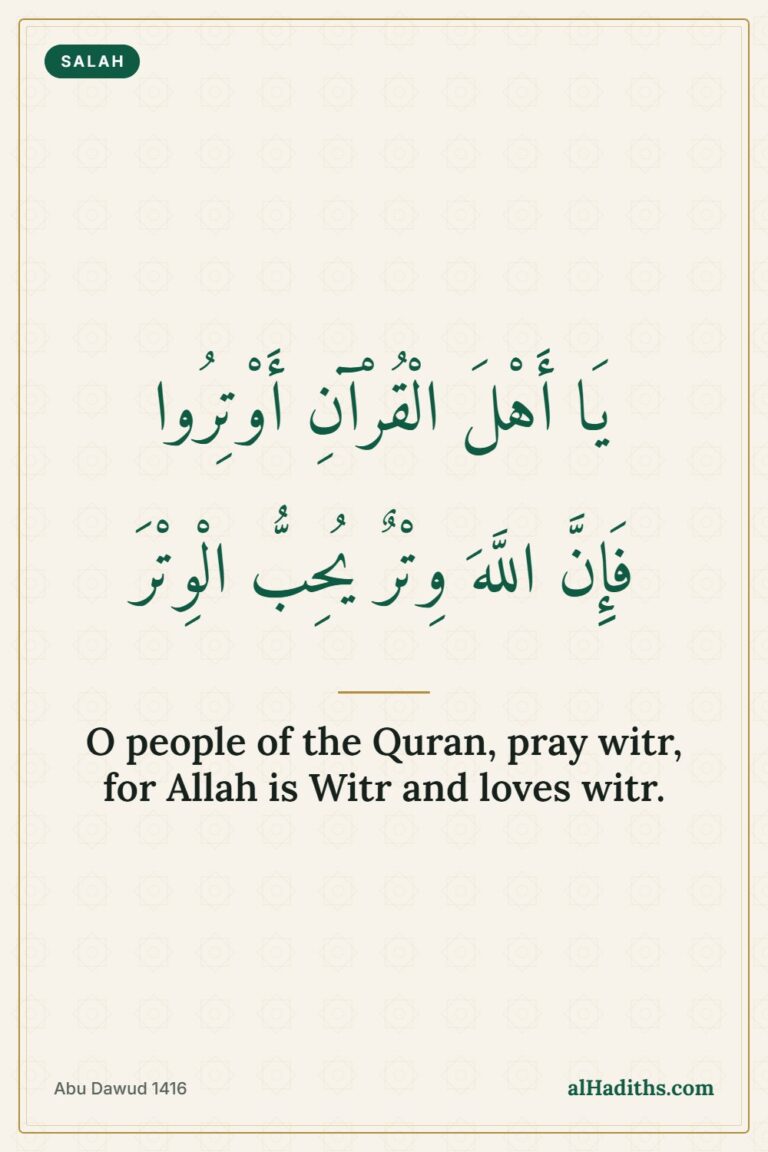
‘Ali ibn Abi Talib (may Allah be pleased with him) reported this call from the Prophet ﷺ to the people of the Quran.
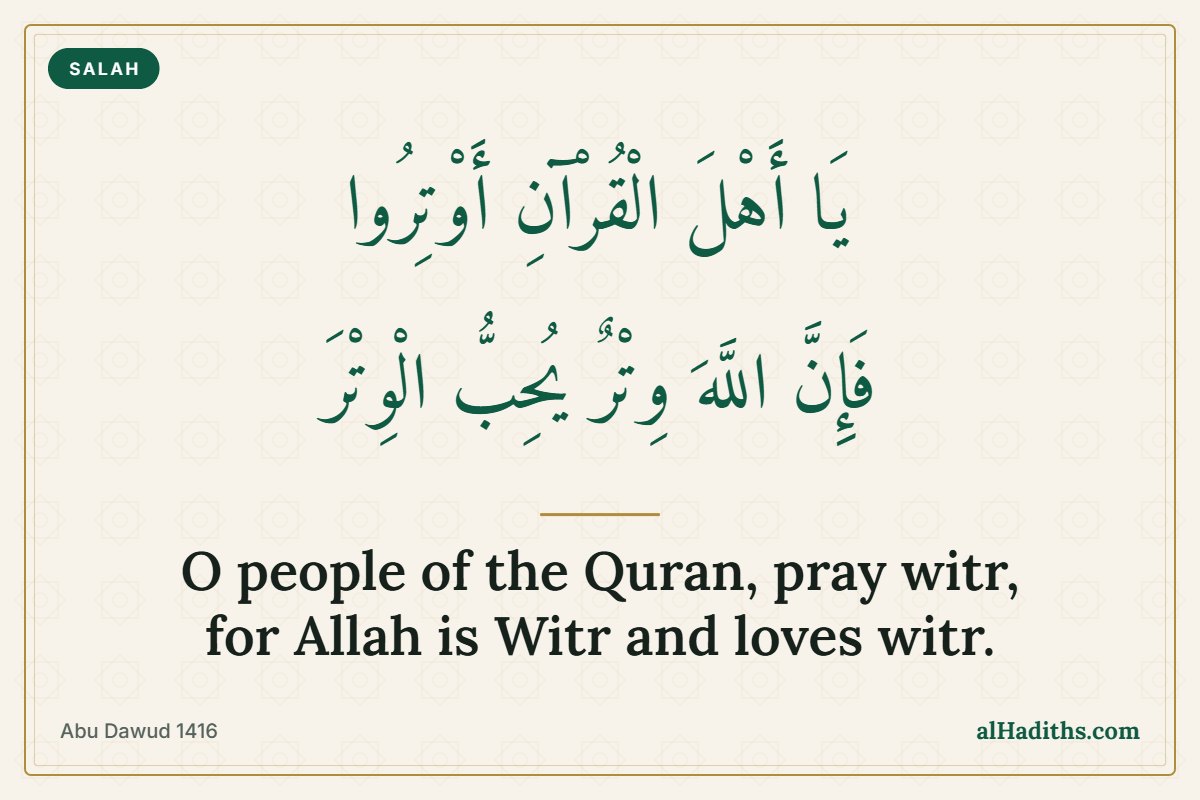
يَا أَهْلَ الْقُرْآنِ أَوْتِرُوا فَإِنَّ اللَّهَ وِتْرٌ يُحِبُّ الْوِتْرَ
The Prophet ﷺ said: “O people of the Quran, observe the witr, for Allah is single (Witr) and loves what is single.”
Sunan Abi Dawud 1416 · Sahih (al-Albani) · Narrated by ‘Ali ibn Abi Talib · Translation adapted from Sunnah.com
The reason given is about Allah Himself: He is One, without partner, and He loves what is odd in number. The call is addressed to the “people of the Quran”, those who read it and live by it, as if witr were part of what that title means.
Try this: if you recite some Quran each day, end the day with witr and recite a little of what you read in it.
2. Make witr the last prayer of the night
‘Abdullah ibn ‘Umar (may Allah be pleased with him) reported a short instruction about where witr belongs.
اجْعَلُوا آخِرَ صَلاَتِكُمْ بِاللَّيْلِ وِتْرًا
The Prophet ﷺ said: “Make witr as your last prayer at night.”
Sahih al-Bukhari 998 · Narrated by ‘Abdullah ibn ‘Umar · Translation adapted from Sunnah.com
Witr closes the night: whatever you pray after ‘Isha, witr comes last. Abu Hurairah was also advised to pray witr before sleeping (Bukhari 1178, in our Duha prayer hadith), which shows it can close the night early for the one who sleeps first.
Try this: if you pray any sunnah or night prayer after ‘Isha, leave witr until the end of it.
3. One rak‘ah that makes the night prayer odd
Ibn ‘Umar (may Allah be pleased with him) reported the Prophet’s ﷺ answer to a man who asked about the night prayer.
صَلاَةُ اللَّيْلِ مَثْنَى مَثْنَى، فَإِذَا خَشِيَ أَحَدُكُمُ الصُّبْحَ صَلَّى رَكْعَةً وَاحِدَةً، تُوتِرُ لَهُ مَا قَدْ صَلَّى
The Prophet ﷺ said: “The night prayer is offered as two rak‘ahs followed by two rak‘ahs and so on, and if anyone is afraid of the approaching dawn he should pray one rak‘ah and this will be a witr for all the rak‘ahs which he has prayed before.”
Sahih al-Bukhari 990 · Narrated by Ibn ‘Umar · Translation adapted from Sunnah.com
Ibn ‘Umar also reported it in its shortest form:
الْوِتْرُ رَكْعَةٌ مِنْ آخِرِ اللَّيْلِ
The Prophet ﷺ said: “Witr is one rak‘ah at the end of the night.”
Sahih Muslim 752a · Narrated by Ibn ‘Umar · Translation adapted from Sunnah.com (its English says “end of the prayer”; the Arabic says “end of the night”)
So even a single rak‘ah is witr. Other narrations describe the Prophet ﷺ praying witr with more rak‘ahs, and the schools of fiqh differ on how many rak‘ahs to pray and how to join them, so ask a qualified local scholar for the way to follow.
Try this: on a tired night, do not skip witr altogether: one rak‘ah is enough to keep the habit alive.
4. Early in the night or at its end?
Jabir ibn ‘Abdullah (may Allah be pleased with him) reported advice that fits both the early sleeper and the one who wakes for tahajjud.
مَنْ خَافَ أَنْ لاَ يَقُومَ مِنْ آخِرِ اللَّيْلِ فَلْيُوتِرْ أَوَّلَهُ وَمَنْ طَمِعَ أَنْ يَقُومَ آخِرَهُ فَلْيُوتِرْ آخِرَ اللَّيْلِ فَإِنَّ صَلاَةَ آخِرِ اللَّيْلِ مَشْهُودَةٌ وَذَلِكَ أَفْضَلُ
The Prophet ﷺ said: “If anyone is afraid that he may not get up in the latter part of the night, he should observe witr in the first part of it; and if anyone is eager to get up in the last part of it, he should observe witr at the end of the night, for prayer at the end of the night is witnessed (by the angels) and that is preferable.”
Sahih Muslim 755a · Narrated by Jabir · Translation adapted from Sunnah.com
HadeethEnc explains that praying witr early in the night is allowed, especially for someone who fears not waking, while the end of the night is better because it is witnessed by the angels.
Try this: be honest about your sleep. If you rarely wake before Fajr, pray witr after ‘Isha. If you set an alarm for tahajjud, save witr for after it.
5. Witr prayer dua qunoot
Al-Hasan ibn ‘Ali (may Allah be pleased with him), the grandson of the Prophet ﷺ, said the Prophet ﷺ taught him words to say in the witr.
اللَّهُمَّ اهْدِنِي فِيمَنْ هَدَيْتَ وَعَافِنِي فِيمَنْ عَافَيْتَ وَتَوَلَّنِي فِيمَنْ تَوَلَّيْتَ وَبَارِكْ لِي فِيمَا أَعْطَيْتَ وَقِنِي شَرَّ مَا قَضَيْتَ إِنَّكَ تَقْضِي وَلاَ يُقْضَى عَلَيْكَ وَإِنَّهُ لاَ يَذِلُّ مَنْ وَالَيْتَ وَلاَ يَعِزُّ مَنْ عَادَيْتَ تَبَارَكْتَ رَبَّنَا وَتَعَالَيْتَ
Allahumma-hdini fiman hadayt, wa ‘afini fiman ‘afayt, wa tawallani fiman tawallayt, wa barik li fima a‘tayt, wa qini sharra ma qadayt, innaka taqdi wa la yuqda ‘alayk, wa innahu la yadhillu man walayt, wa la ya‘izzu man ‘adayt, tabarakta Rabbana wa ta‘alayt.
“O Allah, guide me among those You have guided, grant me well-being among those You have granted well-being, take me into Your care among those You have taken into Your care, bless me in what You have given, and protect me from the evil of what You have decreed. For You decree, and nothing is decreed against You. The one You befriend is never humbled, and the one You take as an enemy is never honored. Blessed and Exalted are You, our Lord.”
Sunan Abi Dawud 1425 · Sahih (al-Albani) · Narrated by al-Hasan ibn ‘Ali · Translation adapted from Sunnah.com (wording modernized; the line on enemies, missing in its English, added from the Arabic)
The same dua is in Jami‘ at-Tirmidhi 464 and Sunan an-Nasa’i 1745, both graded Sahih (Darussalam). At-Tirmidhi wrote that nothing better is known from the Prophet ﷺ about the qunut in witr. He also recorded that scholars differ on it: some said the qunut is for the whole year and before ruku‘, and others that it is in the second half of Ramadan and after ruku‘.
Try this: learn the dua one line a night. In a week it will be yours.
Bringing it together: the importance of witr prayer
These hadith give witr a clear place: Allah loves it, it closes the night, one rak‘ah is enough, it can be prayed early by the one who fears sleeping through, and it carries a dua that asks for guidance, well-being and protection.
Reflection: it is moving that the dua the Prophet ﷺ taught for witr begins with a request for guidance. At the very end of the day, after everything we did right and wrong, the first thing we ask for is to be guided among those Allah has guided.
Questions people ask
Is witr prayer wajib?
Scholars differ. The Hanafi school holds that it is wajib, while most other scholars hold that it is a strongly recommended sunnah. Both sides agree it should not be neglected. Ask a qualified local scholar which view to follow.
How many rak‘ahs is witr?
At least one: Muslim 752a and Bukhari 990 describe a single rak‘ah as witr. Other narrations describe more, and the schools differ on the details.
When is dua qunoot said in witr?
At-Tirmidhi recorded the difference among scholars under hadith 464: some say the qunut is for the whole year before ruku‘, others in the second half of Ramadan after ruku‘. Follow the practice taught by a local scholar.
Can I pray witr before sleeping?
Yes. Muslim 755a allows witr early in the night for anyone who fears not waking up, and Abu Hurairah was advised to pray witr before sleeping (Bukhari 1178).
Key lessons from the witr prayer hadith
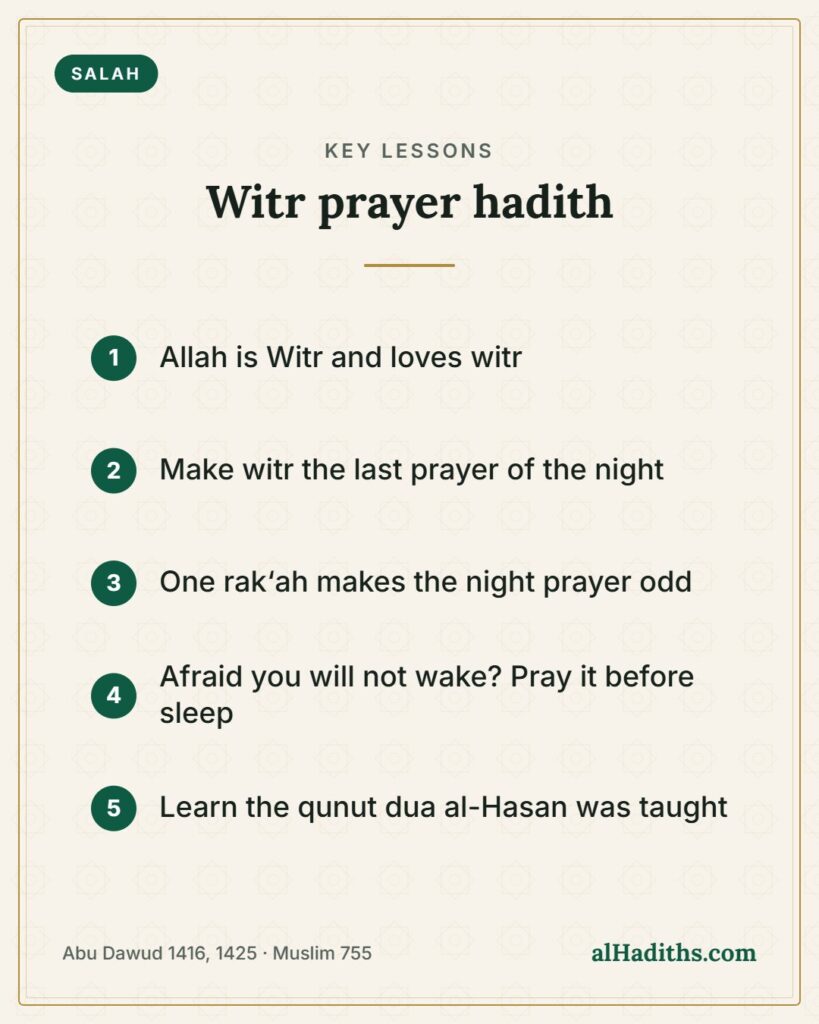
- Allah is Witr and loves witr (Abu Dawud 1416).
- Witr is the last prayer of the night (Bukhari 998).
- One rak‘ah is enough to make the night prayer odd (Bukhari 990, Muslim 752a).
- If you fear sleeping through, pray witr early; the end of the night is better if you can wake (Muslim 755a).
- The qunut dua taught to al-Hasan asks for guidance, well-being and protection (Abu Dawud 1425).
Part of our Salah series: see all our salah articles in one place.
Tonight, before you sleep or after you wake, close the night with witr, even if it is a single rak‘ah.
Save this to Pinterest so you can remember why witr matters and how to pray it
Share the reward. Send this article to someone who needs it today — teaching a hadith or dua can become a lasting good deed for you, in shaa Allah.