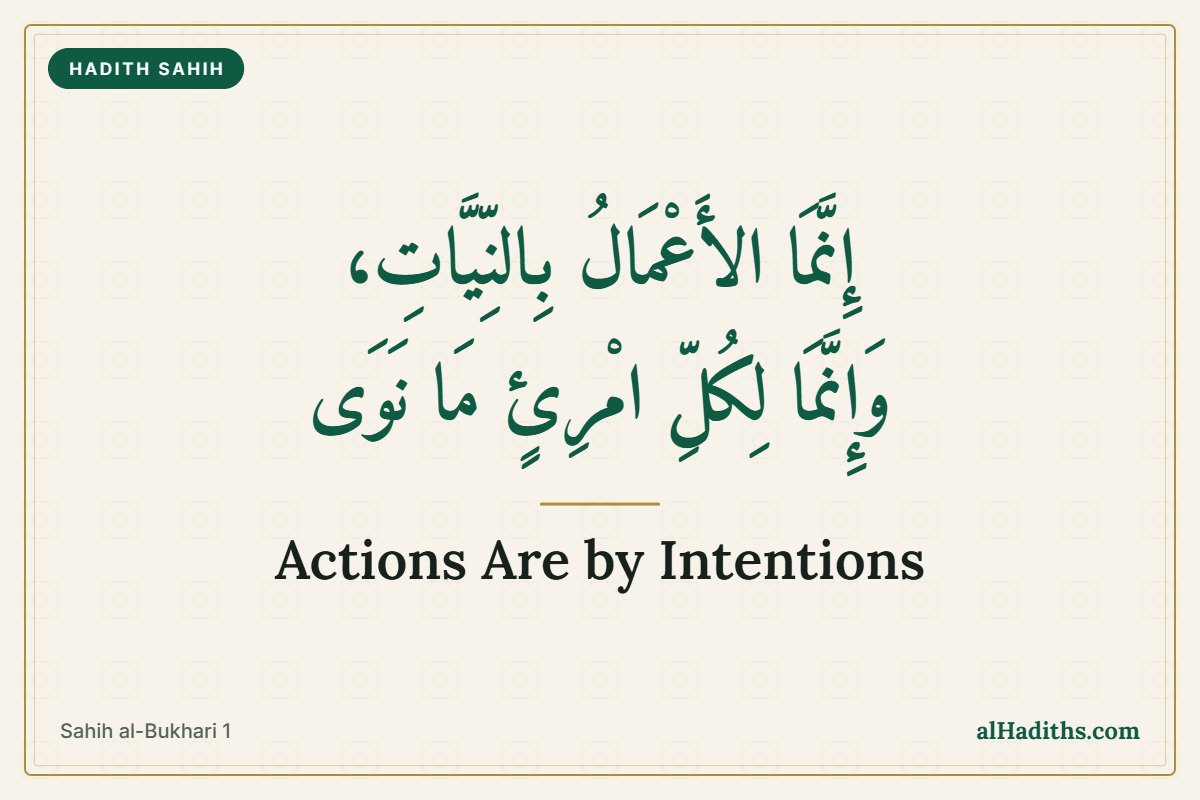
Actions Are Judged by Intentions: Hadith 1 of an-Nawawi
Two people pray side by side, give the same amount in charity, and work the same hours. From the outside their deeds look identical, yet in the sight of Allah they can be worlds apart. The difference is the one thing nobody else can see: the intention. The hadith actions are judged by intentions is so central that Imam al-Bukhari placed it at the very start of his Sahih.
At a glance
- Source: Sahih al-Bukhari 6689 (also Sahih al-Bukhari 1 and Sahih Muslim 1907a)
- Narrated by: ‘Umar ibn al-Khattab (may Allah be pleased with him)
- Grade: Sahih (Bukhari and Muslim)
- Topic: Intention (niyyah) and sincerity
- Put it into practice: Pause before a task and ask: who am I doing this for?
The hadith on intentions
‘Umar ibn al-Khattab heard the Prophet ﷺ say:
إِنَّمَا الأَعْمَالُ بِالنِّيَّةِ، وَإِنَّمَا لاِمْرِئٍ مَا نَوَى، فَمَنْ كَانَتْ هِجْرَتُهُ إِلَى اللَّهِ وَرَسُولِهِ فَهِجْرَتُهُ إِلَى اللَّهِ وَرَسُولِهِ، وَمَنْ كَانَتْ هِجْرَتُهُ إِلَى دُنْيَا يُصِيبُهَا أَوِ امْرَأَةٍ يَتَزَوَّجُهَا، فَهِجْرَتُهُ إِلَى مَا هَاجَرَ إِلَيْهِ
“The (reward of) deeds depend upon the intentions and every person will get the reward according to what he has intended. So whoever emigrated for the sake of Allah and His Messenger, then his emigration will be considered to be for Allah and His Messenger, and whoever emigrated for the sake of worldly gain or for a woman to marry, then his emigration will be considered to be for what he emigrated for.”
Sahih al-Bukhari 6689 · Narrated by ‘Umar ibn al-Khattab · Translation adapted from Sunnah.com
This is the well-known wording that opens Sahih al-Bukhari, innamal a’malu binniyyat:
إِنَّمَا الأَعْمَالُ بِالنِّيَّاتِ، وَإِنَّمَا لِكُلِّ امْرِئٍ مَا نَوَى
“The reward of deeds depends upon the intentions and every person will get the reward according to what he has intended.”
Sahih al-Bukhari 1 · Narrated by ‘Umar ibn al-Khattab · Translation from Sunnah.com (opening lines)
Imam Muslim narrates it too (Sahih Muslim 1907a). Starting a book of hadith with it is a good reminder for any reader to check why they are doing what they do.
The context: the emigration to Madinah
The example in the hadith is hijrah, the emigration of the early Muslims from Makkah to Madinah. Leaving home, family and wealth was one of the greatest sacrifices a person could make. Yet the hadith says even that journey counts for what was in the heart: for Allah and His Messenger ﷺ, or for some worldly goal.
If an act as great as hijrah is judged by its intention, so is every smaller deed in our day.
What it means for our deeds
Allah sees what is in the heart, not only what shows on the outside. The Prophet ﷺ said:
إِنَّ اللَّهَ لاَ يَنْظُرُ إِلَى صُوَرِكُمْ وَأَمْوَالِكُمْ وَلَكِنْ يَنْظُرُ إِلَى قُلُوبِكُمْ وَأَعْمَالِكُمْ
“Verily Allah does not look to your faces and your wealth but He looks to your heart and to your deeds.”
Sahih Muslim 2564c · Narrated by Abu Hurairah · Translation from Sunnah.com
Notice it says hearts and deeds. A good intention does not replace doing the deed properly; it is what gives the deed its value.
Intention can also turn everyday life into worship. The Prophet ﷺ told Sa’d ibn Abi Waqqas (may Allah be pleased with him):
إِنَّكَ لَنْ تُنْفِقَ نَفَقَةً تَبْتَغِي بِهَا وَجْهَ اللَّهِ إِلَّا أُجِرْتَ عَلَيْهَا حَتَّى مَا تَجْعَلُ فِي فَمِ امْرَأَتِكَ
“You will be rewarded for whatever you spend for Allah’s sake even if it were a morsel which you put in your wife’s mouth.”
Sahih al-Bukhari 56 · Narrated by Sa’d ibn Abi Waqqas · Translation from Sunnah.com
And Allah’s generosity goes further still: a good deed we intend but cannot do is already written for us.
إِنَّ اللَّهَ كَتَبَ الْحَسَنَاتِ وَالسَّيِّئَاتِ، ثُمَّ بَيَّنَ ذَلِكَ فَمَنْ هَمَّ بِحَسَنَةٍ فَلَمْ يَعْمَلْهَا كَتَبَهَا اللَّهُ لَهُ عِنْدَهُ حَسَنَةً كَامِلَةً، فَإِنْ هُوَ هَمَّ بِهَا فَعَمِلَهَا كَتَبَهَا اللَّهُ لَهُ عِنْدَهُ عَشْرَ حَسَنَاتٍ إِلَى سَبْعِمِائَةِ ضِعْفٍ إِلَى أَضْعَافٍ كَثِيرَةٍ، وَمَنْ هَمَّ بِسَيِّئَةٍ فَلَمْ يَعْمَلْهَا كَتَبَهَا اللَّهُ لَهُ عِنْدَهُ حَسَنَةً كَامِلَةً، فَإِنْ هُوَ هَمَّ بِهَا فَعَمِلَهَا كَتَبَهَا اللَّهُ لَهُ سَيِّئَةً وَاحِدَةً
“Allah ordered (the appointed angels over you) that the good and the bad deeds be written, and He then showed (the way) how (to write). If somebody intends to do a good deed and he does not do it, then Allah will write for him a full good deed (in his account with Him); and if he intends to do a good deed and actually did it, then Allah will write for him (in his account) with Him (its reward equal) from ten to seven hundred times to many more times: and if somebody intended to do a bad deed and he does not do it, then Allah will write a full good deed (in his account) with Him, and if he intended to do it (a bad deed) and actually did it, then Allah will write one bad deed (in his account).”
Sahih al-Bukhari 6491 · Narrated by Ibn ‘Abbas · Translation from Sunnah.com
Allah also tells us that sincerity is the heart of the religion:
وَمَآ أُمِرُوٓا۟ إِلَّا لِيَعْبُدُوا۟ ٱللَّهَ مُخْلِصِينَ لَهُ ٱلدِّينَ حُنَفَآءَ وَيُقِيمُوا۟ ٱلصَّلَوٰةَ وَيُؤْتُوا۟ ٱلزَّكَوٰةَ ۚ وَذَٰلِكَ دِينُ ٱلْقَيِّمَةِ
“And they were not commanded except to worship Allāh, [being] sincere to Him in religion, inclining to truth, and to establish prayer and to give zakāh. And that is the correct religion.”
Surah al-Bayyinah 98:5 · Translation: Saheeh International, from Quran.com
Reflection: the same act can be worship or just habit, depending on a few seconds of thought before it. Going to work, feeding our children, even resting so we can pray better: each can be for Allah if we mean it to be.
How to renew your intention
The hadith does not set a formula, so these are suggestions:
- Pause before you start a task and ask yourself who you are doing it for.
- Add a good intention to ordinary things: work to provide for your family, eat to have strength for worship, rest to wake up for Fajr.
- Re-check your intention halfway, especially when praise or recognition starts to matter.
- Keep some good deeds private, known only to you and Allah.
- Plan good deeds even when you are unsure you can finish them; the intention itself is rewarded.
As much as I can, I precede any intention with bismillah. It is a small habit, but it reminds me who I am really doing it for.
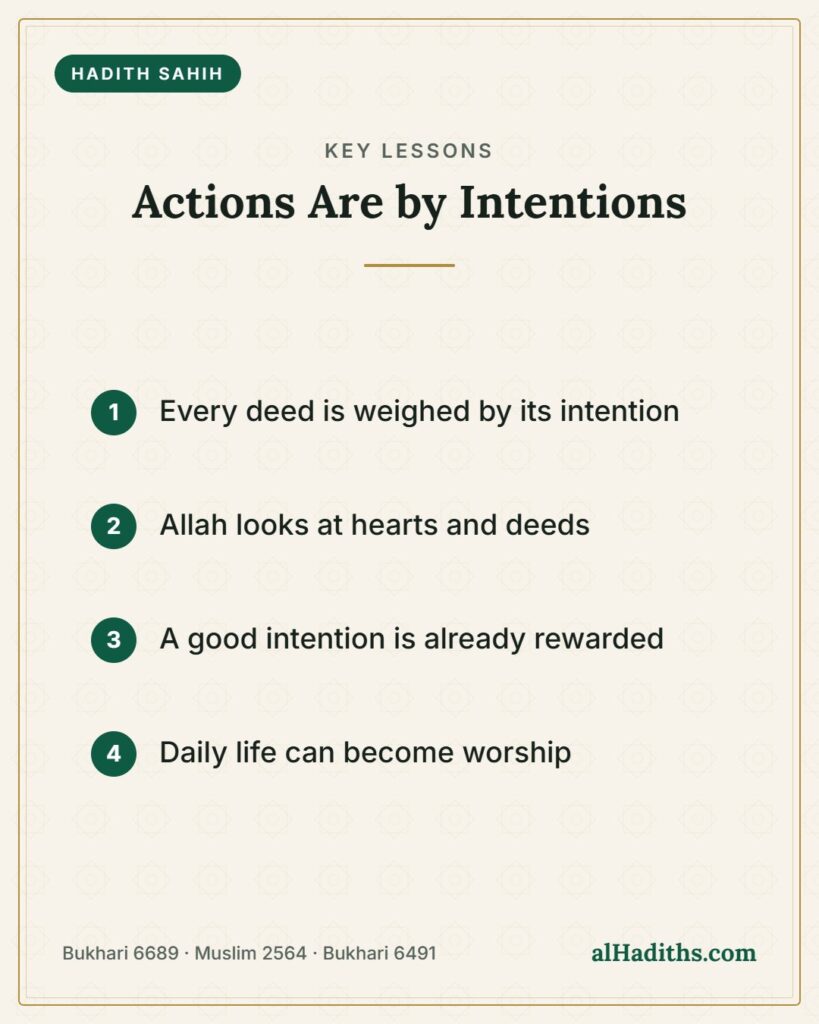
Key lessons
- Actions are judged by intentions, and each person gets what they intended.
- Allah looks at our hearts and our deeds, not our looks or our wealth.
- A good deed we intend but cannot do is still written for us.
- With the right intention, ordinary daily life becomes worship.
Questions people ask
What does ‘innamal a’malu binniyat’ mean?
It means “actions are only by intentions”: the reward of a deed depends on the intention behind it, and each person gets what they intended. It is the first hadith in Sahih al-Bukhari (Sahih al-Bukhari 1).
Do I have to say my intention out loud?
The hadith is about what a person intends. Whether an intention should be said aloud for acts such as salah or fasting is a fiqh question on which scholars differ, so please ask a qualified local scholar.
Do I get a reward for a good deed I intended but could not do?
Yes. The Prophet ﷺ said that if someone intends a good deed and does not do it, Allah writes it for them as a full good deed (Sahih al-Bukhari 6491).
One thing to do today: before your next task, whether it is work, cooking or driving the children to school, pause for a moment and make it for Allah.
Save this to Pinterest so you can renew your intention before your next task
Share the reward. Send this article to someone who needs it today — teaching a hadith or dua can become a lasting good deed for you, in shaa Allah.

3 Comments