Allah Has Prescribed Ihsan in All Things: Hadith 17
We often think of excellence as something for big moments: an exam, a project, an important prayer. Hadith 17 of Imam an-Nawawi’s collection widens it to everything. The Prophet ﷺ said that Allah has prescribed ihsan, excellence and kindness, in all things, and he chose the hardest example to make the point. Here is the ihsan hadith, what the scholars say it means, and how it reaches into everyday life.
At a glance
- Source: Sahih Muslim 1955a and Jami’ at-Tirmidhi 1409 (Hadith 17 of an-Nawawi’s 40)
- Narrated by: Shaddad ibn Aws (may Allah be pleased with him)
- Grade: Sahih (Sahih Muslim); Sahih (Darussalam) in at-Tirmidhi
- Topic: Ihsan: excellence and kindness in everything
- Put it into practice: Pick one ordinary task today and do it with full care
The hadith
Shaddad ibn Aws (may Allah be pleased with him) said there were two things he memorized from the Messenger of Allah ﷺ, who said:
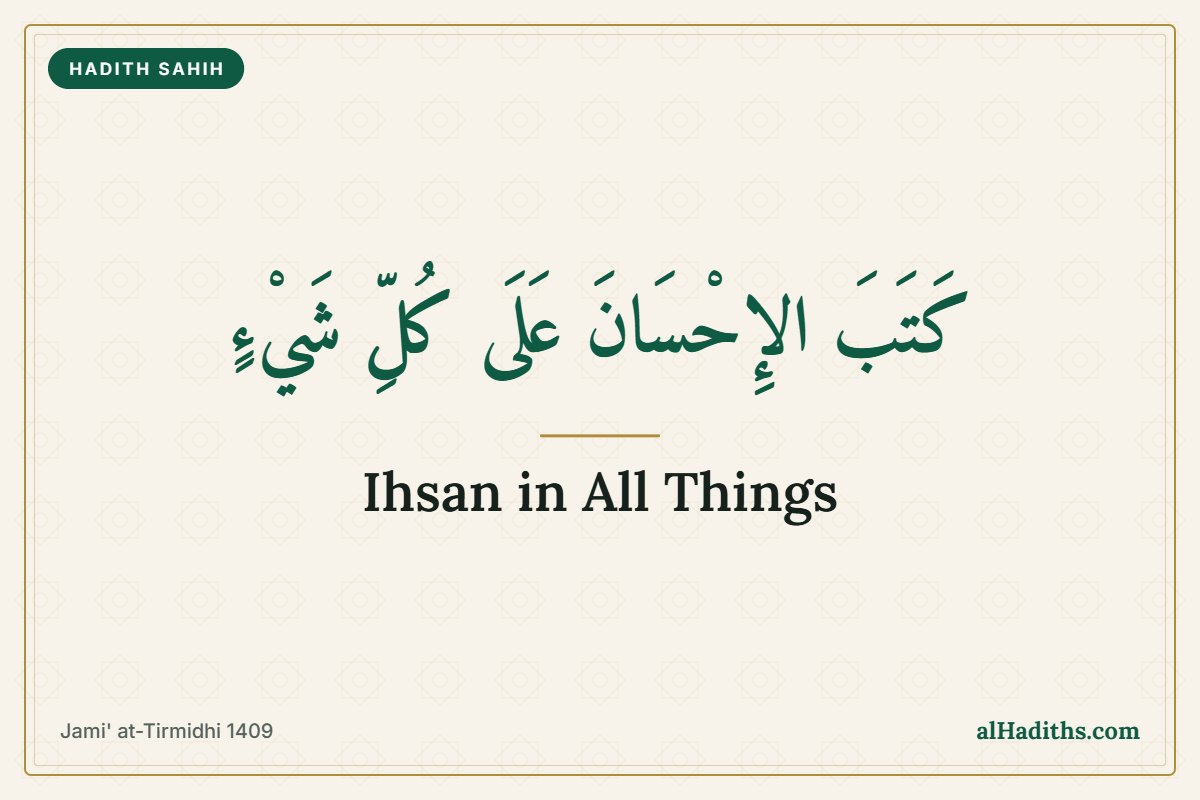
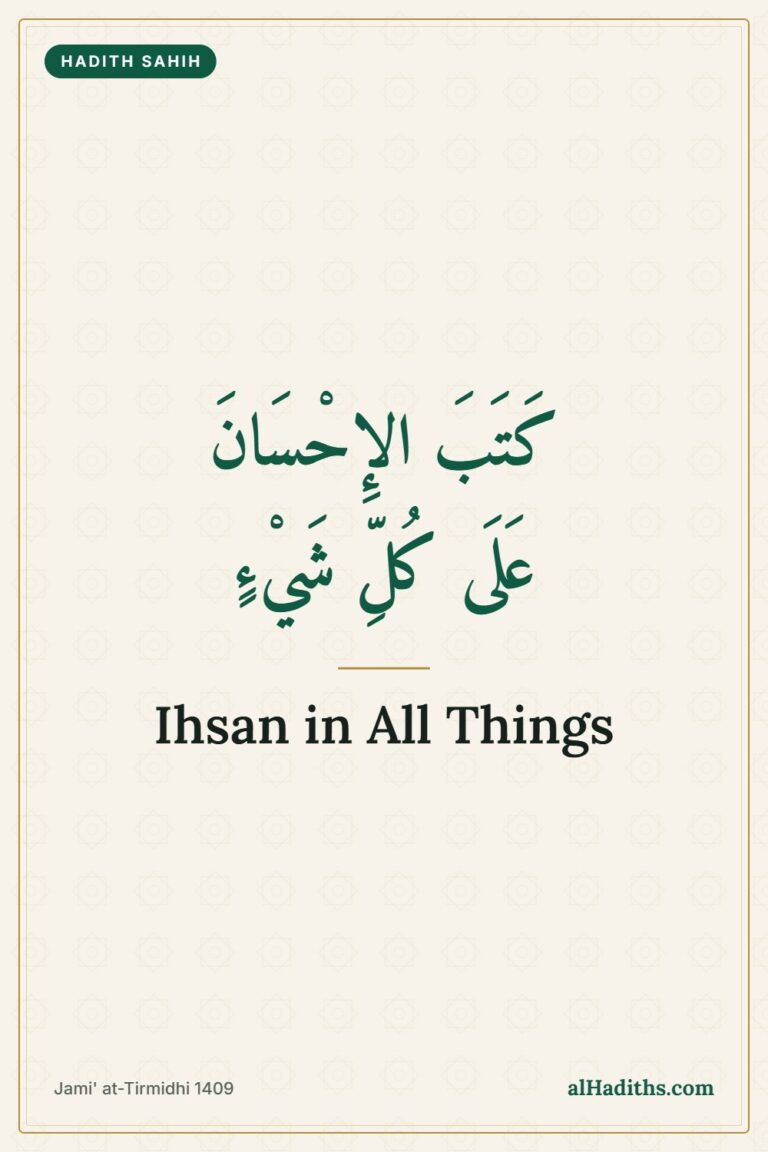
إِنَّ اللَّهَ كَتَبَ الإِحْسَانَ عَلَى كُلِّ شَيْءٍ فَإِذَا قَتَلْتُمْ فَأَحْسِنُوا الْقِتْلَةَ وَإِذَا ذَبَحْتُمْ فَأَحْسِنُوا الذِّبْحَةَ وَلْيُحِدَّ أَحَدُكُمْ شَفْرَتَهُ وَلْيُرِحْ ذَبِيحَتَهُ
“Indeed Allah has decreed Ihsan in everything. So when you kill, then do the killing well, and when you slaughter, then do the slaughtering well. Let one of you sharpen his blade, and let him comfort his animal (before slaughtering).”
Jami’ at-Tirmidhi 1409 · Narrated by Shaddad ibn Aws · Grade: Sahih (Darussalam) · Translation from Sunnah.com
Muslim recorded it in his Sahih (Sahih Muslim 1955a), and at-Tirmidhi called it hasan sahih. The card above uses at-Tirmidhi’s wording because it matches the text Imam an-Nawawi gives as Hadith 17 of his 40 Hadith.
What ihsan means
The Encyclopedia of Translated Prophetic Hadiths (HadeethEnc) explains ihsan as being constantly mindful of Allah in worshipping Him, doing good, and not harming any of His creation. In the Hadith of Jibril, the Prophet ﷺ described ihsan in worship as worshipping Allah as though you see Him. Hadith 17 shows that the same ihsan reaches beyond worship, into how we treat every created thing.
Ihsan in killing and slaughter
The Prophet ﷺ gave two examples, and HadeethEnc explains both:
- Killing: when a life is taken in lawful retribution, ihsan means choosing the easiest method, the one that causes the least suffering and is quickest.
- Slaughter: ihsan means being kind to the animal: sharpening the blade, not sharpening it while the animal is watching, and not slaughtering one animal while another is looking on.
Among the benefits it lists:
- The hadith shows Allah’s mercy and kindness toward His creation.
- Ihsan in killing and slaughter means doing it in the way the Shariah prescribes.
- The Shariah is complete and includes every kind of good, including mercy toward animals.
- It is forbidden to mutilate a person after killing him.
- Anything that causes suffering to animals is forbidden.
Legal retribution belongs to the lawful authorities and the courts, as we saw in Hadith 14. For the detailed rulings of slaughter, ask a qualified scholar.
Mercy to every living thing
The Prophet ﷺ told of a man who found a dog panting from thirst, climbed down a well, filled his shoe with water and gave the dog a drink. Allah thanked him and forgave him. The Companions asked whether there is reward even in serving animals, and he ﷺ said:
فِي كُلِّ كَبِدٍ رَطْبَةٍ أَجْرٌ
“Yes, there is a reward for serving any animate.”
Sahih al-Bukhari 2363 · Narrated by Abu Hurairah · Translation from Sunnah.com
Reflection: the Prophet ﷺ could have illustrated ihsan with prayer or charity. Instead he chose the moment an animal is slaughtered, a moment many would think needs no gentleness at all. If ihsan is required even there, then there is no task, no conversation and no piece of work left where it does not apply.
How to put it into practice
The hadith does not give a routine, so these are suggestions:
- Choose one ordinary task today, at work or at home, and do it with full care, for Allah.
- Be gentle with animals: give water and food, and never cause needless pain.
- Bring ihsan into worship by slowing down your salah and remembering that Allah sees you.
- Speak and deal with people well, even when you have to say no or correct them.
- Ask a qualified scholar about the rulings of slaughter if you need to perform one.
Key lessons
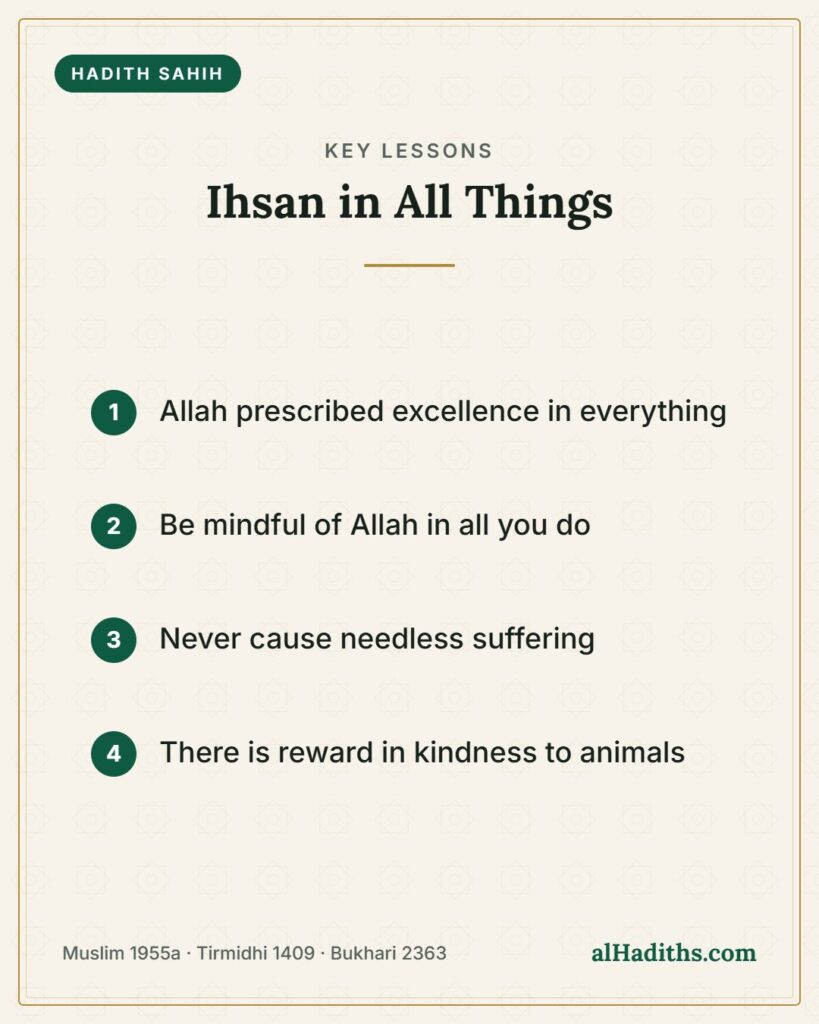
- Allah has prescribed ihsan, excellence and kindness, in all things.
- Ihsan means being mindful of Allah, doing good, and not harming His creation.
- Even in lawful killing and in slaughter, causing needless suffering is forbidden.
- There is reward in kindness to every living being.
Questions people ask
What does ihsan mean in Islam?
HadeethEnc describes ihsan as being constantly mindful of Allah in worship, doing good, and refraining from harming His creation (Encyclopedia of Translated Prophetic Hadiths (HadeethEnc)). In worship, the Prophet ﷺ described it as worshipping Allah as though you see Him.
What does “Allah has prescribed ihsan in all things” mean?
It means excellence and kindness are required in every act, even in lawful killing and in slaughtering an animal, which must be done in the way that causes the least suffering (Sahih Muslim 1955a, Encyclopedia of Translated Prophetic Hadiths (HadeethEnc)).
Does Islam teach kindness to animals?
Yes. The Prophet ﷺ told of a man forgiven for giving water to a thirsty dog, and said there is a reward for serving any living being (Sahih al-Bukhari 2363). HadeethEnc notes that anything causing suffering to animals is forbidden.
A question to carry with you today: which small thing in my day have I been doing carelessly, and how would it look if I did it with ihsan?
Save this to Pinterest so you can come back to this hadith.
Share the reward. Send this article to someone who needs it today — teaching a hadith or dua can become a lasting good deed for you, in shaa Allah.