The Hadith on Bid’ah: Hadith 5 of an-Nawawi
Can a deed done with a good intention still be rejected? The hadith about bid’ah answers that question. In the first hadith of Imam an-Nawawi’s 40, we learned that deeds are judged by their intentions. In the fifth, the Prophet ﷺ adds the other half: an act of worship also has to match what he taught.
At a glance
- Source: Sahih al-Bukhari 2697 (also Sahih Muslim 1718b)
- Narrated by: ‘A’ishah, the mother of the believers (may Allah be pleased with her)
- Grade: Sahih (Bukhari and Muslim)
- Topic: Following the Sunnah in worship; bid’ah
- Put it into practice: Before taking up a new act of worship, check its source
The hadith on bid’ah
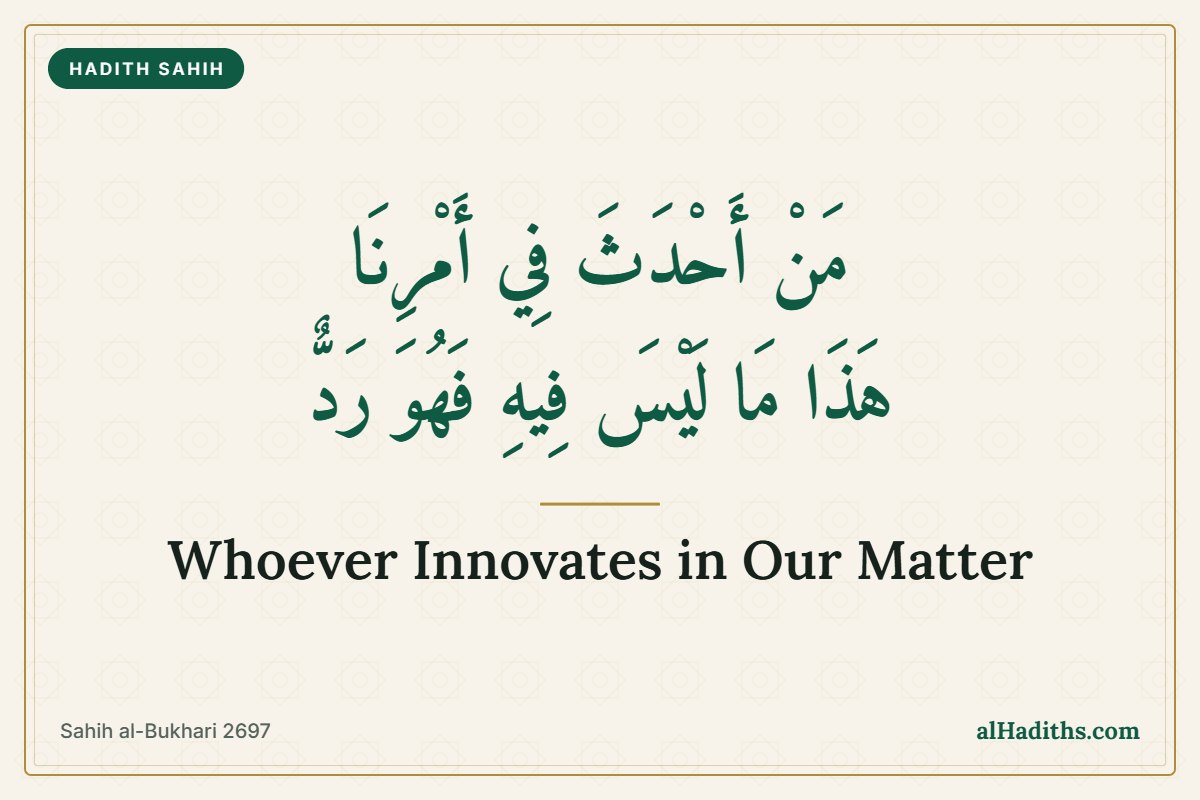
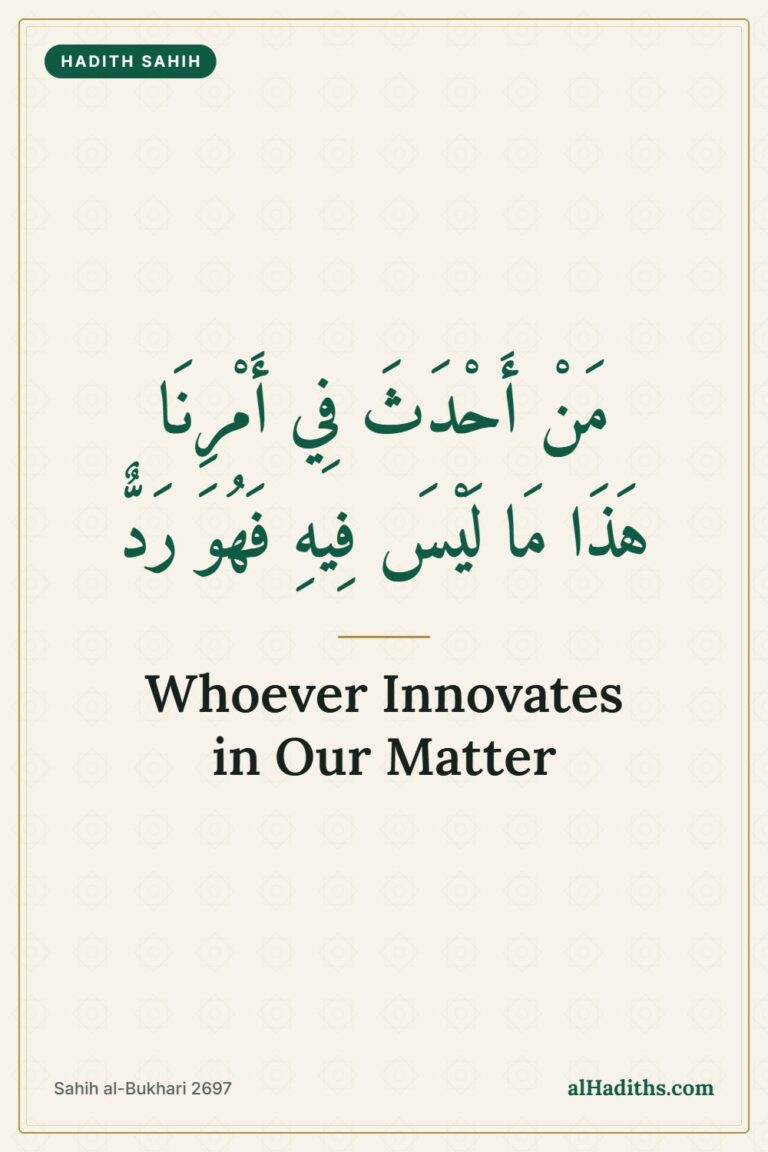
مَنْ أَحْدَثَ فِي أَمْرِنَا هَذَا مَا لَيْسَ فِيهِ فَهُوَ رَدٌّ
Allah’s Messenger ﷺ said, “If somebody innovates something which is not in harmony with the principles of our religion, that thing is rejected.”
Sahih al-Bukhari 2697 · Narrated by ‘A’ishah · Translation from Sunnah.com
Imam Muslim also records it in a second wording, which is even broader:
مَنْ عَمِلَ عَمَلاً لَيْسَ عَلَيْهِ أَمْرُنَا فَهُوَ رَدٌّ
“He who did any act for which there is no sanction from our behalf, that is to be rejected.”
Sahih Muslim 1718b · Narrated by ‘A’ishah · Translation from Sunnah.com
Imam an-Nawawi placed it as Hadith 5 of an-Nawawi’s 40 Hadith, right after the hadith of the stages of creation.
What the hadith means
The Arabic is short and precise: “in this matter of ours” refers to the religion the Prophet ﷺ brought, and “rejected” means it is not accepted. The first wording speaks about adding something new to the religion that is not from it. The second speaks about doing an act of worship that does not follow what he taught.
Put this hadith next to the hadith on intentions and the picture is complete. A deed needs a sincere intention for Allah, and it needs to follow the way the Prophet ﷺ showed us. A good intention does not turn a new form of worship into a Sunnah, and a Sunnah done to show off loses its value.
“Every innovation is error”
Jabir ibn ‘Abdullah (may Allah be pleased with him) described how the Prophet ﷺ would deliver his sermon, with his voice raised, as if warning of an approaching army. Among his words were:
أَمَّا بَعْدُ فَإِنَّ خَيْرَ الْحَدِيثِ كِتَابُ اللَّهِ وَخَيْرُ الْهُدَى هُدَى مُحَمَّدٍ وَشَرُّ الأُمُورِ مُحْدَثَاتُهَا وَكُلُّ بِدْعَةٍ ضَلاَلَةٌ
“The best of the speech is embodied in the Book of Allah, and the best of the guidance is the guidance given by Muhammad. And the most evil affairs are their innovations; and every innovation is error.”
Sahih Muslim 867a · Narrated by Jabir ibn ‘Abdullah · Translation from Sunnah.com
The Prophet ﷺ did not leave us to invent our own ways of drawing close to Allah. He taught us how to pray, what to say in dhikr, how to fast and how to make dua, and the safest path is to learn these from him.
What about ‘Umar’s “excellent bid’ah”?
People often ask about a narration in Sahih al-Bukhari 2010. During Ramadan, ‘Umar ibn al-Khattab (may Allah be pleased with him) saw people praying the night prayer in scattered groups in the mosque, so he gathered them behind one reciter, Ubayy ibn Ka’b. On a later night, seeing them praying together, he said:
نِعْمَ الْبِدْعَةُ هَذِهِ
“What an excellent bid’ah this is.”
Sahih al-Bukhari 2010 · Narrated by ‘Abdur-Rahman ibn ‘Abdul-Qari · Translation adapted from Sunnah.com
It is worth knowing the background. The Prophet ﷺ himself had led the night prayer in congregation in the mosque for a few nights in Ramadan, then stopped, saying he was afraid it would be made obligatory on the people (Sahih al-Bukhari 2012).
Scholars have explained ‘Umar’s words in different ways, and they have discussed in detail what does and does not count as bid’ah. We will not settle that discussion here. For any specific practice, please ask a qualified scholar you trust.
Reflection: this hadith is a protection, not a burden. The religion is complete, so we do not need to keep searching for new rituals. What the Prophet ﷺ taught is enough to fill a lifetime of worship.
How to put it into practice
- Check the source of a dua, dhikr or practice before you take it up, for example on Sunnah.com.
- Learn the Sunnah way of the worship you already do: salah, wudu, dhikr after prayer.
- Keep your intention sincere; following the Sunnah and sincerity go together.
- Ask a qualified scholar when you are unsure about a particular practice.
- Be gentle with others; share what you learn kindly rather than rushing to judge people.
Key lessons
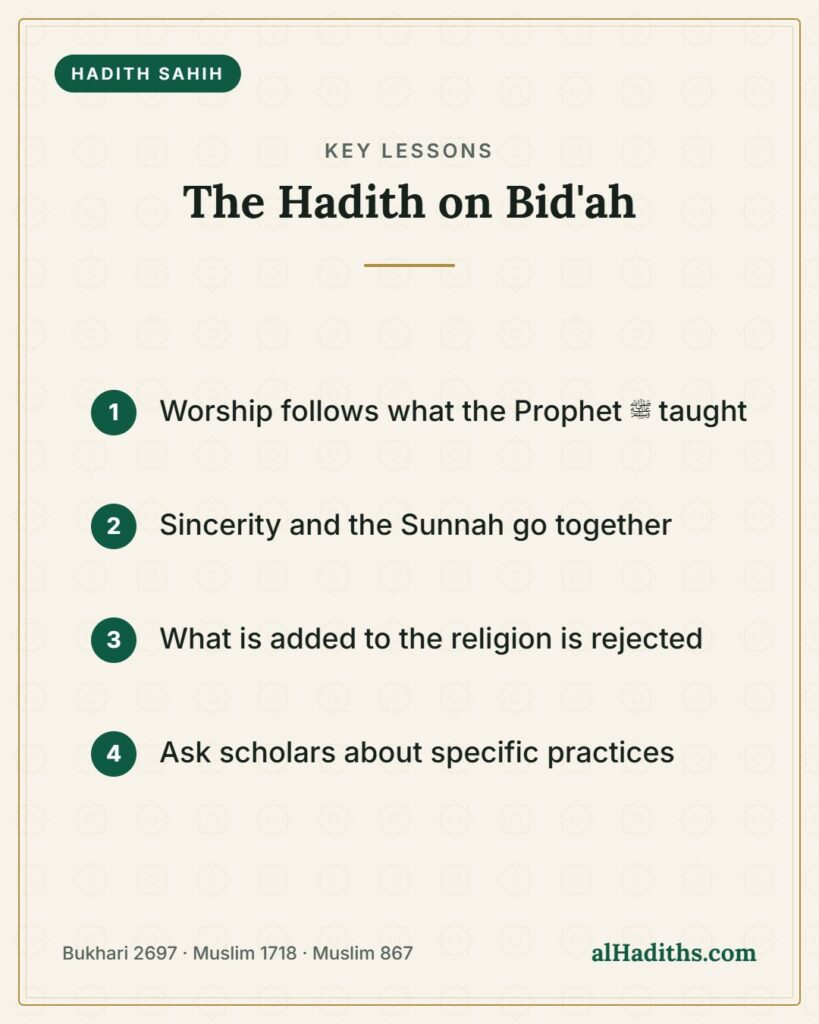
- Whatever is added to the religion that is not from it is rejected.
- A deed needs both a sincere intention and to follow the Sunnah.
- The Prophet ﷺ called the best guidance his guidance, and warned that every innovation is error.
- For questions about specific practices, ask qualified scholars.
Questions people ask
What does ‘whoever innovates in this matter of ours’ mean?
“This matter of ours” is the religion. The Prophet ﷺ said that whoever adds something to it that is not from it, that thing is rejected (Sahih al-Bukhari 2697).
What is the hadith about bid’ah?
‘A’ishah narrated that the Prophet ﷺ said whoever innovates something not in harmony with our religion, it is rejected (Sahih al-Bukhari 2697); and in his sermons he said every innovation is error (Sahih Muslim 867a).
Is every new thing a bid’ah?
The hadith speaks about adding to “this matter of ours”, meaning the religion. How it applies to particular new practices is something scholars have discussed in detail, so please ask a qualified scholar.
One thing to do today: the next time you come across a new dua or practice, pause and look for its source before you make it part of your worship.
Save this to Pinterest so you can check the source before adding a new practice
Share the reward. Send this article to someone who needs it today — teaching a hadith or dua can become a lasting good deed for you, in shaa Allah.