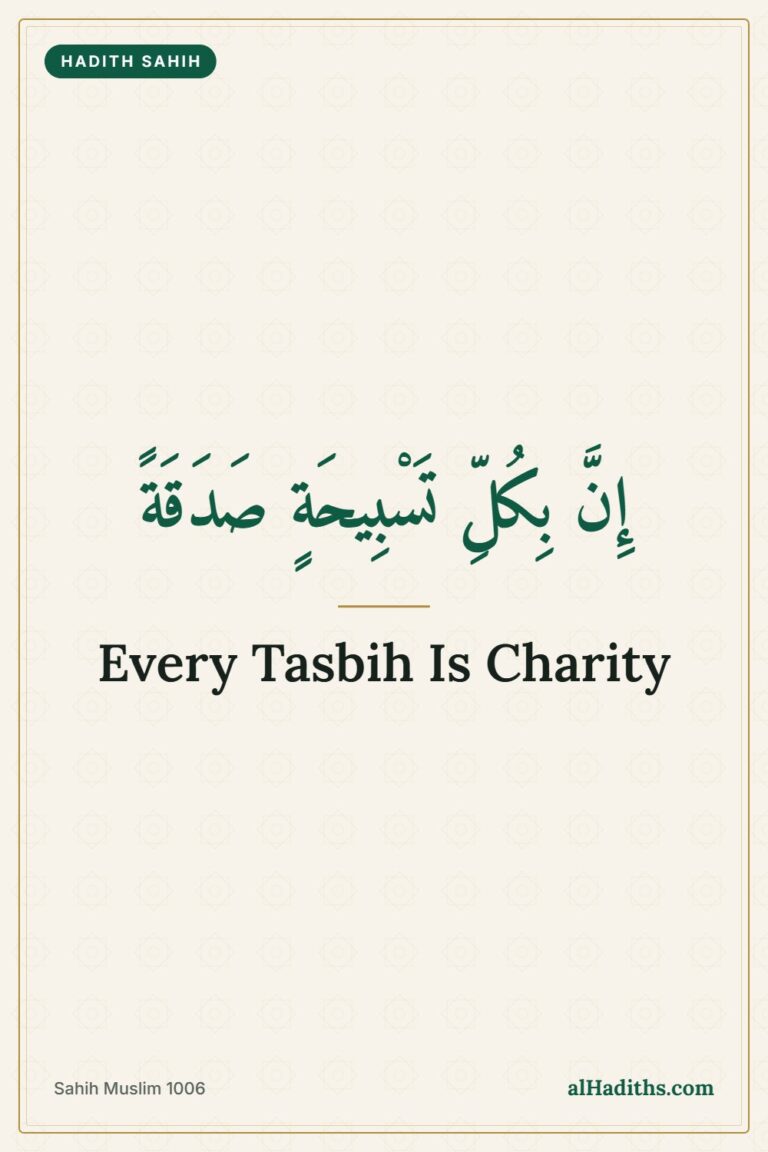
Every Tasbih Is Charity: Hadith 25 of an-Nawawi
What if you want the reward of charity but have little money to give? Some of the poorer Companions felt exactly that, and they brought their worry to the Prophet ﷺ. His answer is Hadith 25 of Imam an-Nawawi’s collection: every tasbih is charity, and so is every takbir, every word of praise, every la ilaha illallah, and much more. Here is the hadith, what the scholars say about it, and how to fill your day with charity that costs nothing.
At a glance
- Source: Sahih Muslim 1006 (Hadith 25 of an-Nawawi’s 40)
- Narrated by: Abu Dharr al-Ghifari (may Allah be pleased with him)
- Grade: Sahih (Sahih Muslim)
- Topic: Charity without money: dhikr, enjoining good, and lawful acts done with a good intention
- Put it into practice: Say SubhanAllah, Alhamdulillah, La ilaha illallah and Allahu Akbar today, knowing each one is charity.
The hadith
Abu Dharr (may Allah be pleased with him) reported that some of the Companions of the Messenger of Allah ﷺ said to him:
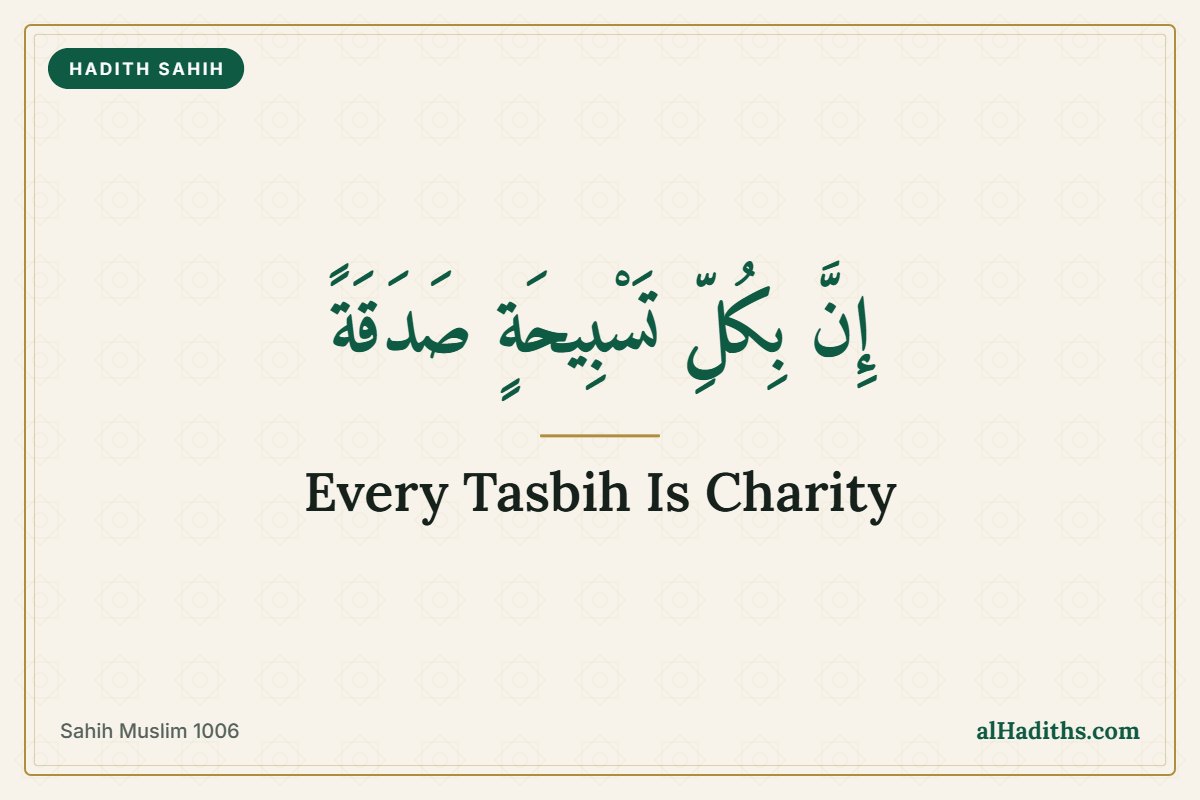
ذَهَبَ أَهْلُ الدُّثُورِ بِالأُجُورِ يُصَلُّونَ كَمَا نُصَلِّي وَيَصُومُونَ كَمَا نَصُومُ وَيَتَصَدَّقُونَ بِفُضُولِ أَمْوَالِهِمْ … أَوَلَيْسَ قَدْ جَعَلَ اللَّهُ لَكُمْ مَا تَصَّدَّقُونَ إِنَّ بِكُلِّ تَسْبِيحَةٍ صَدَقَةً وَكُلِّ تَكْبِيرَةٍ صَدَقَةٌ وَكُلِّ تَحْمِيدَةٍ صَدَقَةٌ وَكُلِّ تَهْلِيلَةٍ صَدَقَةٌ وَأَمْرٌ بِالْمَعْرُوفِ صَدَقَةٌ وَنَهْىٌ عَنْ مُنْكَرٍ صَدَقَةٌ وَفِي بُضْعِ أَحَدِكُمْ صَدَقَةٌ … أَيَأْتِي أَحَدُنَا شَهْوَتَهُ وَيَكُونُ لَهُ فِيهَا أَجْرٌ … أَرَأَيْتُمْ لَوْ وَضَعَهَا فِي حَرَامٍ أَكَانَ عَلَيْهِ فِيهَا وِزْرٌ فَكَذَلِكَ إِذَا وَضَعَهَا فِي الْحَلاَلِ كَانَ لَهُ أَجْرٌ
“Messenger of Allah, the rich have taken away (all the) reward. They observe prayer as we do; they keep the fasts as we keep, and they give Sadaqa out of their surplus riches. Upon this he (the Holy Prophet) said: Has Allah not prescribed for you (a course) by following which you can (also) do sadaqa? In every declaration of the glorification of Allah (i. e. saying Subhan Allah) there is a Sadaqa, and every Takbir (i. e. saying Allah-O-Akbar) is a sadaqa, and every praise of His (saying al-Hamdu Lillah) is a Sadaqa and every declaration that He is One (La illha ill-Allah) is a sadaqa, and enjoining of good is a sadaqa, and forbidding of that which is evil is a Sadaqa, and in man’s sexual Intercourse (with his wife, ) there is a Sadaqa. They (the Companions) said: Messenger of Allah, is there reward for him who satisfies his sexual passion among us? He said: Tell me, if he were to devote it to something forbidden, would it not be a sin on his part? Similarly, if he were to devote it to something lawful, he should have a reward.”
Sahih Muslim 1006 · Narrated by Abu Dharr · Translation from Sunnah.com
Imam an-Nawawi gives it as Hadith 25 of his 40 Hadith.
What “every tasbih is charity” means
The Encyclopedia of Translated Prophetic Hadiths (HadeethEnc) explains that the poorer Companions were not complaining about the rich. They wanted the same reward and could not give money, so the Prophet ﷺ guided them to kinds of charity they could afford:
- Words of remembrance: إِنَّ بِكُلِّ تَسْبِيحَةٍ صَدَقَةً وَكُلِّ تَكْبِيرَةٍ صَدَقَةٌ وَكُلِّ تَحْمِيدَةٍ صَدَقَةٌ وَكُلِّ تَهْلِيلَةٍ صَدَقَةٌ. Every SubhanAllah, Allahu Akbar, Alhamdulillah and La ilaha illallah counts as charity.
- Enjoining good and forbidding evil are each charity too.
- Lawful intimacy with one’s spouse: HadeethEnc explains this as a man’s intercourse with his wife. When the Companions were surprised, the Prophet ﷺ answered with an analogy: if it would be a sin when done in a forbidden way, then done lawfully it brings a reward.
HadeethEnc quotes Imam an-Nawawi: this shows that permissible actions can become acts of obedience through sincere intentions, such as fulfilling the rights of one’s wife and treating her kindly, hoping for a righteous child, and keeping both spouses chaste. Among the other benefits it lists: the Companions competed in good deeds, the doors of good are many, and Islam is easy, since every Muslim can find something to do in obedience to Allah. On intention, see actions are judged by intentions.
No good deed is too small
The Quran reminds us that even the smallest good is seen and counted:
فَمَن يَعْمَلْ مِثْقَالَ ذَرَّةٍ خَيْرًا يَرَهُۥ
“So whoever does an atom’s weight of good will see it,”
Surah Az-Zalzalah 99:7 · Translation: Saheeh International, from Quran.com
Reflection: what stands out to me is how the Companions turned envy into ambition. They did not resent the wealthy or ask for their money; they asked how they could earn the same reward. The answer opened doors that are open to all of us, rich or poor, every day: the tongue, a kind word of advice, and the ordinary parts of family life when they are done for Allah.
How to put it into practice
The hadith does not set a number, so these are suggestions:
- Fill small gaps with dhikr, such as waiting, walking or driving. See four heavy phrases of dhikr.
- Enjoin good gently: a reminder about the prayer, or a word that stops a wrong, given with kindness.
- Bring intention into ordinary life. Before work, a meal or time with your family, intend it for Allah.
- Remember your family: spending on them is also charity; see providing for your family.
Key lessons
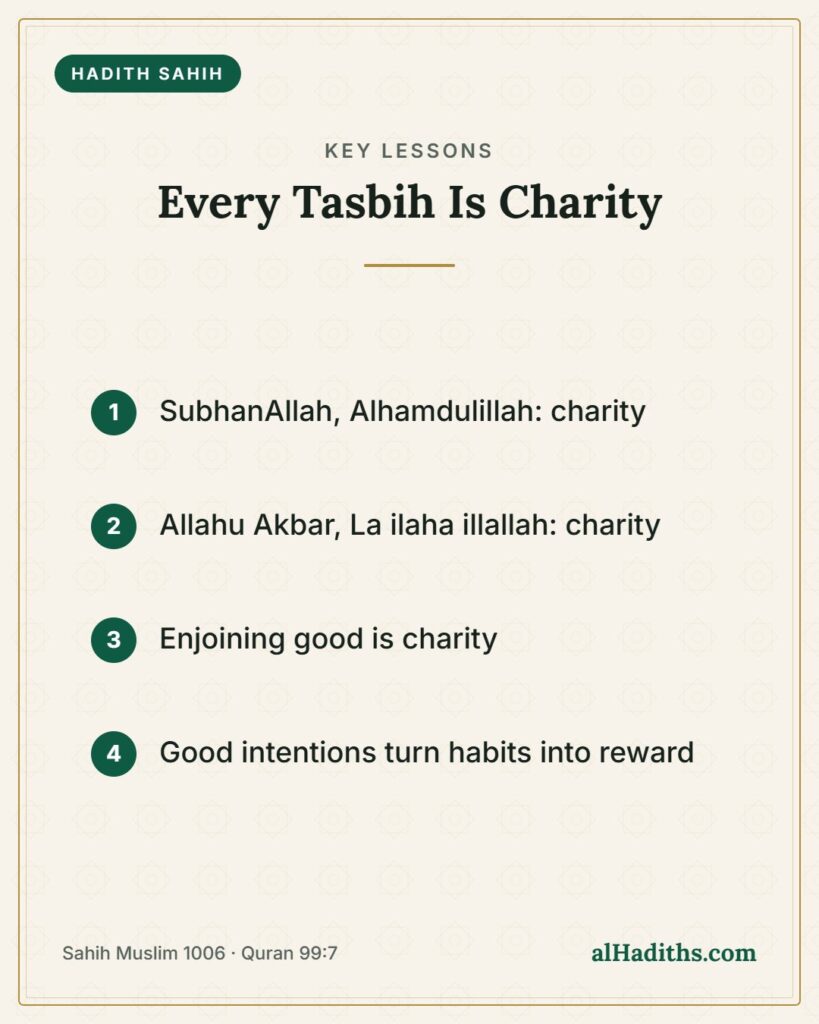
- Every tasbih, takbir, tahmid and tahlil is charity.
- Enjoining good and forbidding evil are charity too.
- Lawful acts can earn reward when done with a good intention.
- No one is shut out of good deeds; the doors of charity are open to all.
Questions people ask
Is every tasbih really charity?
Yes. In Sahih Muslim 1006 the Prophet ﷺ said that every tasbih (SubhanAllah) is charity, and so is every takbir, every tahmid and every tahlil.
How can I give charity without money in Islam?
This hadith names several ways: remembering Allah with words of praise, enjoining good, forbidding evil, and doing lawful things with a good intention. The Encyclopedia of Translated Prophetic Hadiths (HadeethEnc) explains that the doors of good are many and every Muslim can find something to do.
Why is intimacy with one’s spouse called charity in this hadith?
The Prophet ﷺ explained that if it would be a sin when done in a forbidden way, then done lawfully it brings a reward. HadeethEnc quotes Imam an-Nawawi that permissible acts become acts of obedience through sincere intentions, such as fulfilling the rights of one’s spouse and keeping both chaste.
A question to reflect on: which ordinary part of your day could become charity tomorrow, simply by the intention you bring to it?
Save this to Pinterest so you can come back to this hadith later.
Share the reward. Send this article to someone who needs it today — teaching a hadith or dua can become a lasting good deed for you, in shaa Allah.