Praying in Congregation: 6 Authentic Hadith on Jama’ah
Contents
Praying alone at home is still salah, and it still counts. So why did the Prophet ﷺ urge his companions so strongly to pray together? These six authentic hadith about praying in congregation answer that: the reward is multiplied many times over, every step to the masjid is counted, and two prayers in particular separate the sincere from the hypocrites.
At a glance
- Hadith: 6 hadith cards
- Collections: Sahih al-Bukhari, Sahih Muslim and Sunan Abi Dawud
- Grade: Sahih, plus one Hasan (al-Albani)
- Topic: Salah: praying in congregation (jama’ah)
- Put it into practice: Pick one prayer this week, Fajr or Isha if you can, and pray it at the masjid
1. Twenty-seven times better
‘Abdullah ibn ‘Umar (may Allah be pleased with him) reported that the Messenger of Allah ﷺ said:
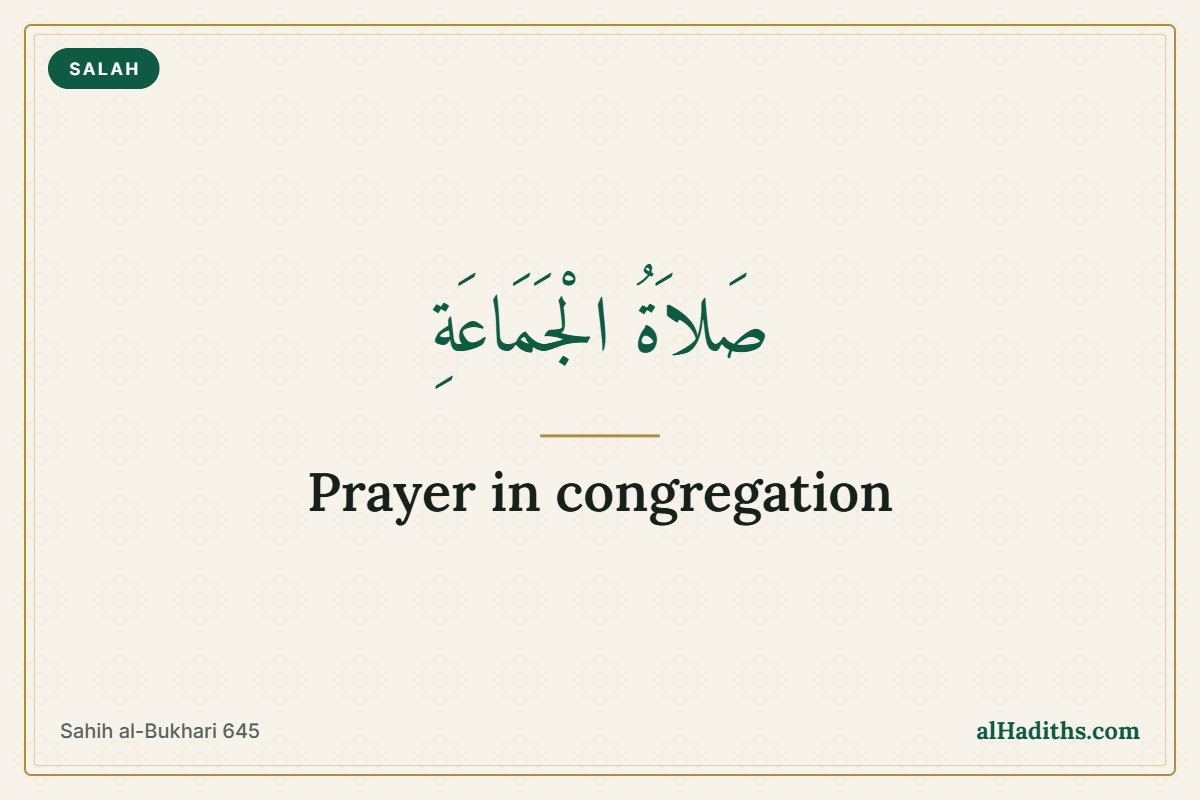
صَلاَةُ الْجَمَاعَةِ تَفْضُلُ صَلاَةَ الْفَذِّ بِسَبْعٍ وَعِشْرِينَ دَرَجَةً
“The prayer in congregation is twenty-seven times superior to the prayer offered by a person alone.”
Sahih al-Bukhari 645 · Narrated by ‘Abdullah ibn ‘Umar · Translation adapted from Sunnah.com
The same prayer, the same words, the same number of rak‘ahs, and yet the reward is multiplied twenty-seven times simply because it was prayed together. Few deeds offer so much extra for so little extra effort.
Try this: when you can choose between praying alone and joining others, at the masjid, at work or at home with your family, choose the jama’ah.
2. Every step is counted
Abu Hurairah (may Allah be pleased with him) reported that the Messenger of Allah ﷺ explained why the reward is so great:
صَلاَةُ الرَّجُلِ فِي الْجَمَاعَةِ تُضَعَّفُ عَلَى صَلاَتِهِ فِي بَيْتِهِ وَفِي سُوقِهِ خَمْسًا وَعِشْرِينَ ضِعْفًا، وَذَلِكَ أَنَّهُ إِذَا تَوَضَّأَ فَأَحْسَنَ الْوُضُوءَ، ثُمَّ خَرَجَ إِلَى الْمَسْجِدِ لاَ يُخْرِجُهُ إِلاَّ الصَّلاَةُ، لَمْ يَخْطُ خَطْوَةً إِلاَّ رُفِعَتْ لَهُ بِهَا دَرَجَةٌ، وَحُطَّ عَنْهُ بِهَا خَطِيئَةٌ، فَإِذَا صَلَّى لَمْ تَزَلِ الْمَلاَئِكَةُ تُصَلِّي عَلَيْهِ مَا دَامَ فِي مُصَلاَّهُ اللَّهُمَّ صَلِّ عَلَيْهِ، اللَّهُمَّ ارْحَمْهُ. وَلاَ يَزَالُ أَحَدُكُمْ فِي صَلاَةٍ مَا انْتَظَرَ الصَّلاَةَ
“The reward of the prayer offered by a person in congregation is twenty-five times greater than that of the prayer offered in one’s house or in the market (alone). And this is because if he performs ablution and does it perfectly and then proceeds to the mosque with the sole intention of praying, then for every step he takes towards the mosque, he is upgraded one degree in reward and one sin is taken off from his account. When he offers his prayer, the angels keep on asking Allah’s blessings and forgiveness for him as long as he is staying at his place of prayer. They say: ‘O Allah, bestow Your blessings upon him, be merciful to him.’ And one is regarded as being in prayer as long as one is waiting for the prayer.”
Sahih al-Bukhari 647 · Narrated by Abu Hurairah · Translation adapted from Sunnah.com
Here the reward is given as twenty-five, and in the first hadith as twenty-seven; both are authentic. HadeethEnc explains that the reward grows with each step taken toward the masjid after a good wudu, with no aim but the prayer: each step raises a rank and erases a sin, and the angels keep praying for the worshipper while he stays in his place without breaking his wudu or harming anyone.
Try this: make wudu at home before you leave, walk if you can, and sit in your place a little after the prayer while the angels make dua for you.
3. Isha and Fajr: like a whole night of prayer
‘Abd ar-Rahman ibn Abi ‘Amrah said that ‘Uthman ibn ‘Affan (may Allah be pleased with him) came into the masjid after Maghrib and sat alone, so he sat with him, and ‘Uthman said: “O son of my brother, I heard the Messenger of Allah ﷺ say:”
مَنْ صَلَّى الْعِشَاءَ فِي جَمَاعَةٍ فَكَأَنَّمَا قَامَ نِصْفَ اللَّيْلِ وَمَنْ صَلَّى الصُّبْحَ فِي جَمَاعَةٍ فَكَأَنَّمَا صَلَّى اللَّيْلَ كُلَّهُ
“He who observed the ‘Isha’ prayer in congregation, it was as if he prayed up to midnight, and he who prayed the morning prayer in congregation, it was as if he prayed the whole night.”
Sahih Muslim 656a · Narrated by ‘Uthman ibn ‘Affan · Translation adapted from Sunnah.com
Two prayers that sit at the edges of sleep carry the reward of standing in prayer through the night. For someone who finds the night prayer hard, this is a door that stays open every day.
Try this: if you can reach the masjid for only one prayer a day, make it Isha or Fajr.
4. The prayers heaviest on the hypocrites
Abu Hurairah (may Allah be pleased with him) reported that the Prophet ﷺ said:
لَيْسَ صَلاَةٌ أَثْقَلَ عَلَى الْمُنَافِقِينَ مِنَ الْفَجْرِ وَالْعِشَاءِ، وَلَوْ يَعْلَمُونَ مَا فِيهِمَا لأَتَوْهُمَا وَلَوْ حَبْوًا، لَقَدْ هَمَمْتُ أَنْ آمُرَ الْمُؤَذِّنَ فَيُقِيمَ، ثُمَّ آمُرَ رَجُلاً يَؤُمُّ النَّاسَ، ثُمَّ آخُذَ شُعَلاً مِنْ نَارٍ فَأُحَرِّقَ عَلَى مَنْ لاَ يَخْرُجُ إِلَى الصَّلاَةِ بَعْدُ
“No prayer is heavier upon the hypocrites than the Fajr and the ‘Isha’ prayers, and if they knew what is in them (in reward), they would have attended them, even if (it was) crawling. Certainly, I felt the urge to order the mu’adhdhin so that he would pronounce the iqamah, then order a man to lead the people (in prayer), then take a flame of fire so that I burn (the houses) upon those who had not left for the prayer yet.”
Sahih al-Bukhari 657 · Narrated by Abu Hurairah · Translation adapted from Sunnah.com
This is one of the strongest warnings about missing the congregation. HadeethEnc explains that the Prophet ﷺ did not carry it out because those homes also held women, children and others with valid excuses who had done nothing wrong. It adds that the reward of Isha and Fajr in congregation is so great that they are worth reaching even by crawling, and that keeping to these two prayers protects a person from hypocrisy, while neglecting them is one of the traits of the hypocrites.
Try this: treat Fajr and Isha at the masjid as a check on your own heart. If they feel heavy, that is a reason to go, not to stay home.
5. “Do you hear the call? Then respond”
Abu Hurairah (may Allah be pleased with him) reported:
أَتَى النَّبِيَّ صلى الله عليه وسلم رَجُلٌ أَعْمَى فَقَالَ يَا رَسُولَ اللَّهِ إِنَّهُ لَيْسَ لِي قَائِدٌ يَقُودُنِي إِلَى الْمَسْجِدِ. فَسَأَلَ رَسُولَ اللَّهِ صلى الله عليه وسلم أَنْ يُرَخِّصَ لَهُ فَيُصَلِّيَ فِي بَيْتِهِ فَرَخَّصَ لَهُ فَلَمَّا وَلَّى دَعَاهُ فَقَالَ هَلْ تَسْمَعُ النِّدَاءَ بِالصَّلاَةِ. فَقَالَ نَعَمْ. قَالَ فَأَجِبْ
“A blind man came to the Prophet ﷺ and said: ‘Messenger of Allah, I have no one to guide me to the mosque.’ He asked the Messenger of Allah ﷺ for permission to pray in his house, and he granted him permission. Then, when the man turned away, he called him and said: ‘Do you hear the call to prayer?’ He said: ‘Yes.’ He said: ‘Then respond to it.’”
Sahih Muslim 653 · Narrated by Abu Hurairah · Translation adapted from Sunnah.com
The man was blind and had no one to lead him, and the Prophet ﷺ first gave him permission. Then he called him back with a single question: could he hear the adhan? Scholars discuss what this hadith means for the ruling on the congregation, and their views are summed up in the questions below.
Try this: the next time you hear the adhan and can reach the masjid, take the call personally: it is addressed to you.
6. The wolf eats the straying sheep
Abu ad-Darda’ (may Allah be pleased with him) said that he heard the Messenger of Allah ﷺ say:
مَا مِنْ ثَلاَثَةٍ فِي قَرْيَةٍ وَلاَ بَدْوٍ لاَ تُقَامُ فِيهِمُ الصَّلاَةُ إِلاَّ قَدِ اسْتَحْوَذَ عَلَيْهِمُ الشَّيْطَانُ فَعَلَيْكَ بِالْجَمَاعَةِ فَإِنَّمَا يَأْكُلُ الذِّئْبُ الْقَاصِيَةَ
“If there are three men in a village or in the desert among whom prayer is not offered (in congregation), the devil has got the mastery over them. So observe (prayer) in congregation, for the wolf eats only the straggling animal.”
Sunan Abi Dawud 547 · Hasan (al-Albani) · Narrated by Abu ad-Darda’ · Translation adapted from Sunnah.com
A sheep that wanders away from the flock is the easy target. The Prophet ﷺ used that picture for the believer who drifts away from praying with others: alone, he is easier for Shaytan to pick off.
Try this: if there is no masjid near you, pray with your family, your housemates or your colleagues. Even three people can be a jama’ah.
Bringing it together
Reflection: the six hadith hold both a reward and a warning. Praying together multiplies the reward many times over, every step to the masjid lifts a rank and wipes away a sin, and Isha and Fajr in jama’ah weigh as much as a night of prayer. On the other side, staying away is described as a mark of the hypocrites and as leaving the flock for the wolf. Joining the congregation is a small daily choice, and it carries a great deal.
Questions people ask
What does the hadith say about praying in congregation?
The Prophet ﷺ said prayer in congregation is twenty-seven times better than praying alone (Sahih al-Bukhari 645), that every step to the masjid raises a degree and erases a sin (Sahih al-Bukhari 647), and that Isha and Fajr in congregation are like praying half the night and the whole night (Sahih Muslim 656a).
Is praying in congregation obligatory?
Scholars differ on its ruling for men: some hold it is an individual obligation, others a communal one or a stressed sunnah, citing hadith such as Sahih al-Bukhari 657 and Sahih Muslim 653. For the ruling that applies to you, ask a qualified local scholar.
Is there a hadith about praying 40 days in congregation?
A narration in Jami` at-Tirmidhi (241) mentions forty days of catching the first takbir in congregation. Sunnah.com shows it as Da‘if (Darussalam), so we have not used it as one of the hadith in this article.
Key lessons
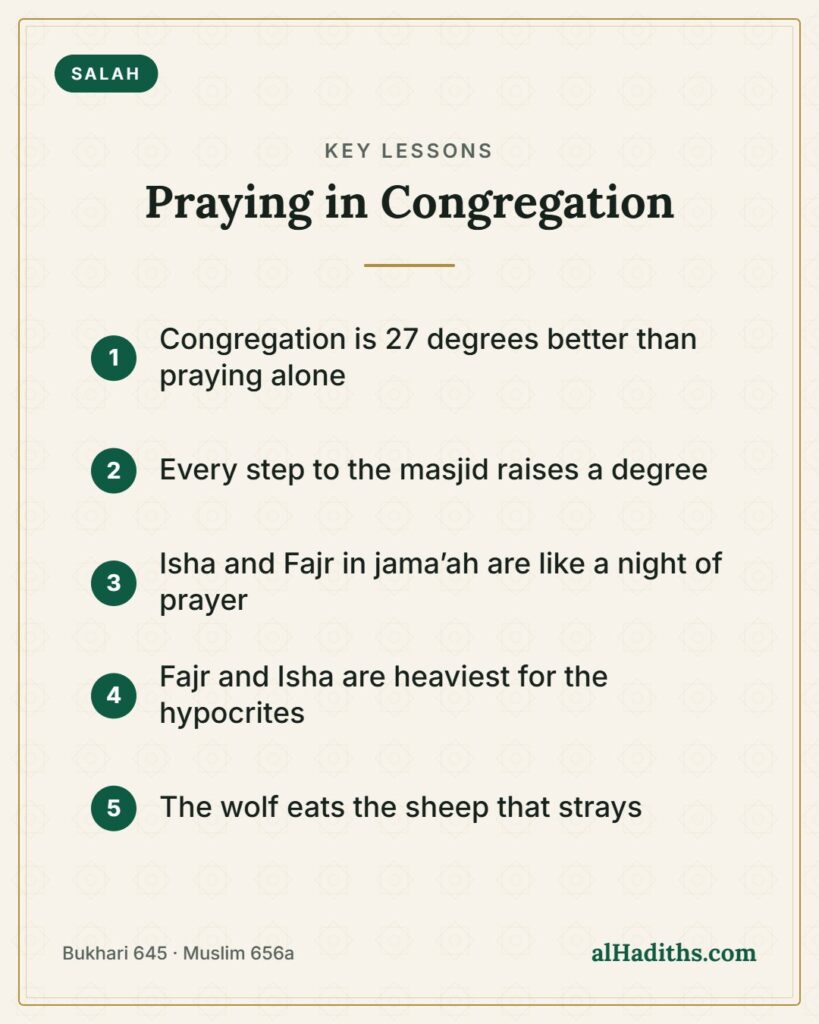
- Prayer in congregation is twenty-seven times better than praying alone.
- Every step to the masjid after a good wudu raises a degree and erases a sin.
- Isha and Fajr in congregation are like praying half the night and the whole night.
- Fajr and Isha are the heaviest prayers for the hypocrites.
- Stay with the jama’ah: the wolf eats the sheep that strays.
When you hear the next adhan, ask the blind man’s question of yourself: can I hear the call? Then answer it the way the Prophet ﷺ asked him to.
Save this to Pinterest so you can remember the reward waiting at the masjid
Share the reward. Send this article to someone who needs it today — teaching a hadith or dua can become a lasting good deed for you, in shaa Allah.