Renounce the World and Allah Will Love You: Hadith 31
Who does not want to be loved, by Allah and by people? A man once asked the Prophet ﷺ for a deed that would earn both, and the answer was two short sentences about the heart’s attachment to the world. This is Hadith 31 of Imam an-Nawawi’s collection, the zuhd hadith. Scholars differ on its grading, so we set that out clearly below.
At a glance
- Source: Sunan Ibn Majah 4102 (Hadith 31 of an-Nawawi’s 40)
- Narrated by: Sahl ibn Sa’d as-Sa’idi (may Allah be pleased with him)
- Grade: Sahih (al-Albani); hasan (an-Nawawi); graded weak by others. See the note on its grading
- Topic: Zuhd: not letting the world, or what others own, take hold of the heart
- Put it into practice: Today, notice one thing you envy in someone else’s hands, and let it go.
The hadith
Sahl ibn Sa’d as-Sa’idi (may Allah be pleased with him) said that a man came to the Prophet ﷺ and said: دُلَّنِي عَلَى عَمَلٍ إِذَا أَنَا عَمِلْتُهُ أَحَبَّنِيَ اللَّهُ وَأَحَبَّنِيَ النَّاسُ “O Messenger of Allah, show me a deed which, if I do it, Allah will love me and people will love me.” The Messenger of Allah ﷺ said:
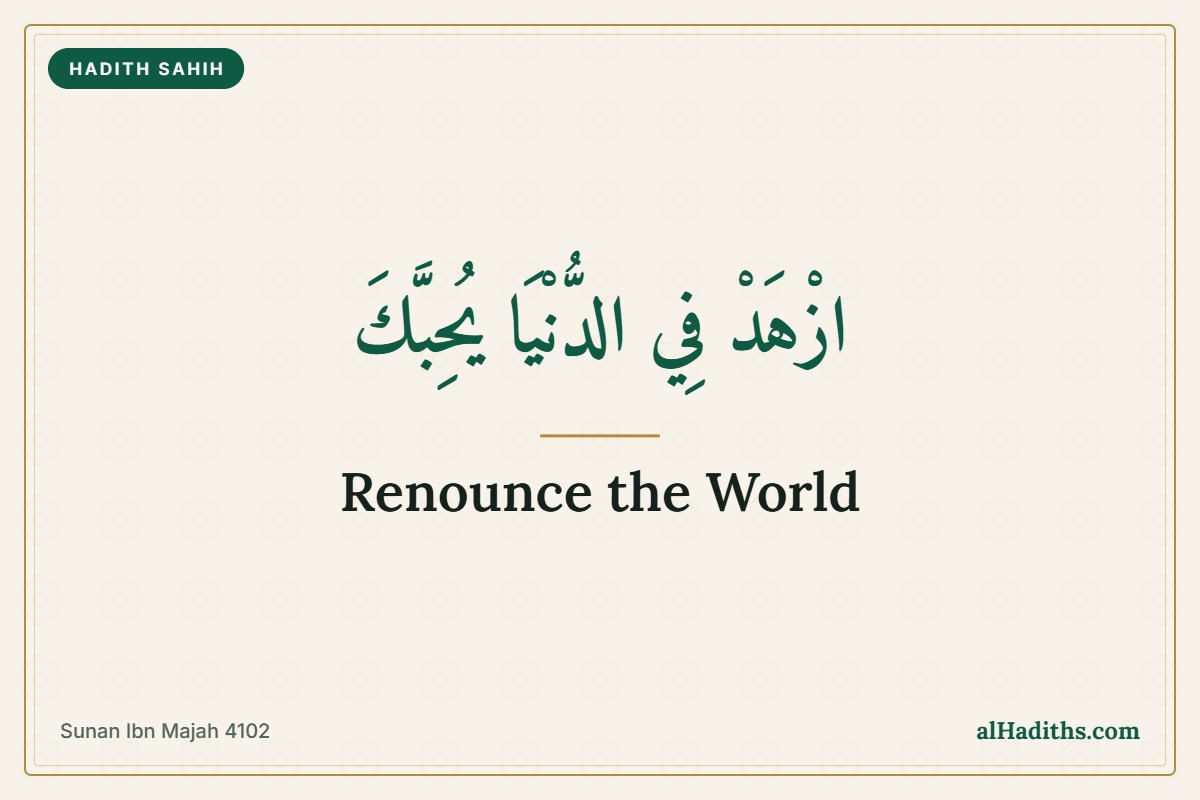
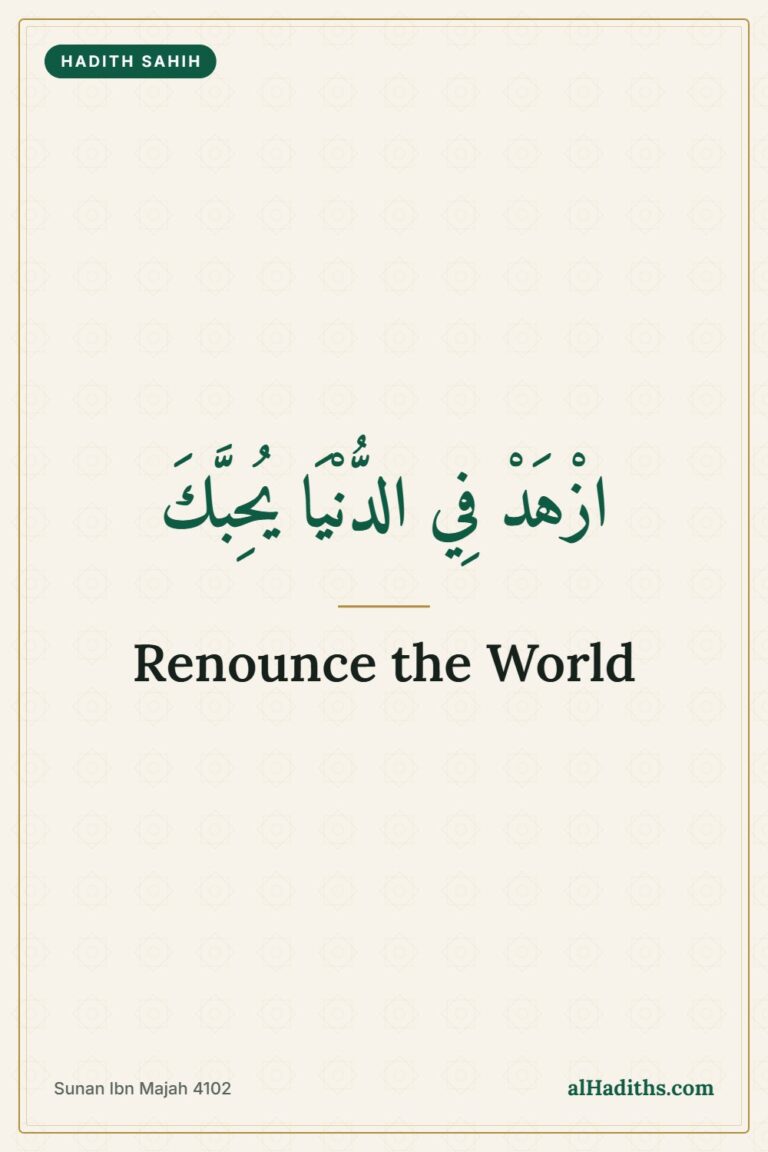
ازْهَدْ فِي الدُّنْيَا يُحِبَّكَ اللَّهُ وَازْهَدْ فِيمَا فِي أَيْدِي النَّاسِ يُحِبُّوكَ
“Be indifferent towards this world, and Allah will love you. Be indifferent to what is in people’s hands, and they will love you.”
Sunan Ibn Majah 4102 · Narrated by Sahl ibn Sa’d · Translation from Sunnah.com
Imam an-Nawawi gives it as Hadith 31 of his 40 Hadith, with slightly different wording. Here we quote the wording in Sunan Ibn Majah.
A note on its grading
Scholars of hadith differ on this narration:
- Sahih: Shaykh al-Albani graded it sahih, in his Silsilah as-Sahihah (no. 944), on the strength of its other routes (Tohed, Ibn Majah 4102).
- Hasan: Imam an-Nawawi said Ibn Majah and others reported it with hasan chains (Sunnah.com, 40 Hadith 31).
- Weak: Darussalam graded it da’if (Sunnah.com, Ibn Majah 4102), and Zubair Ali Zai graded it weak. Al-Busiri pointed out that one narrator in Ibn Majah’s chain, Khalid ibn ‘Amr, is weak (Hadith Unlocked, Ibn Majah 4102).
We present it as Imam an-Nawawi included it, with the gradings named so you can see the difference for yourself.
What the zuhd hadith teaches
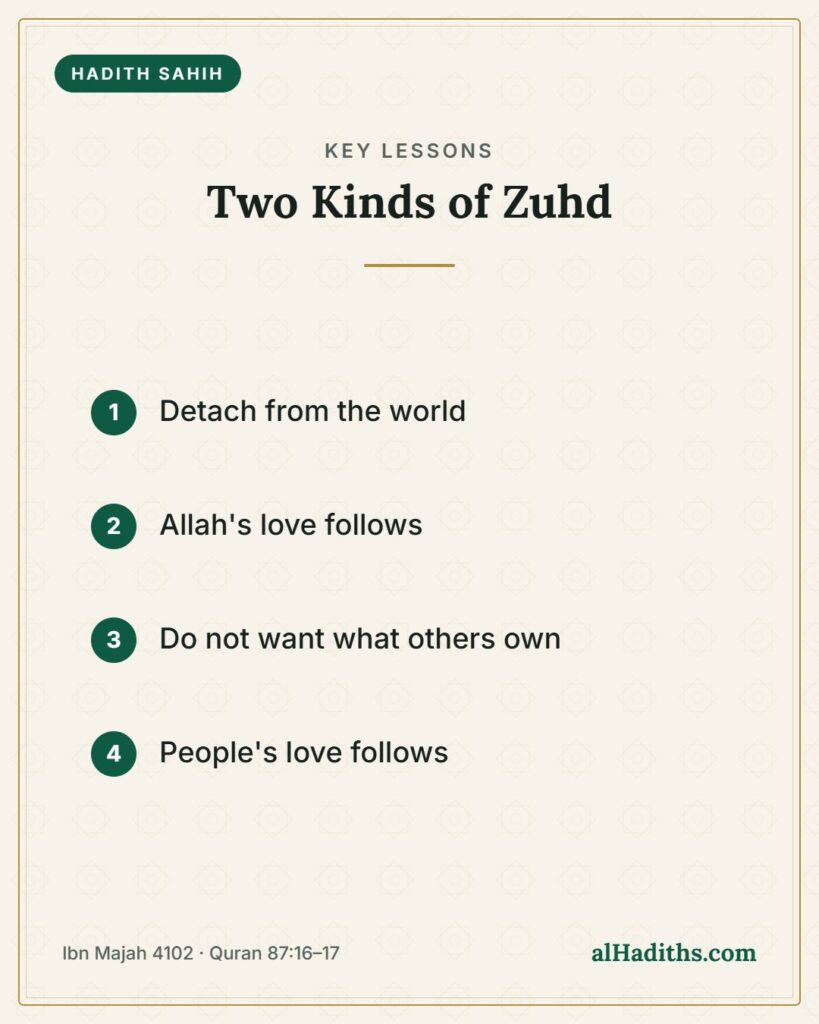
The hadith names two kinds of zuhd (detachment), each with its own reward:
- Detachment from the world, so that it does not own the heart, and the reward is Allah’s love.
- Detachment from what is in people’s hands: not longing for their wealth or envying what they have, and the reward is their love.
The Quran reminds us why the heart should not settle on this world:
بَلْ تُؤْثِرُونَ ٱلْحَيَوٰةَ ٱلدُّنْيَا
“But you prefer the worldly life,”
Surah Al-A’la 87:16 · Translation: Saheeh International, from Quran.com
وَٱلْـَٔاخِرَةُ خَيْرٌ وَأَبْقَىٰٓ
“While the Hereafter is better and more enduring.”
Surah Al-A’la 87:17 · Translation: Saheeh International, from Quran.com
Reflection: what I notice is that the man asked for two loves, and was given two detachments. Zuhd here is not about owning nothing; it is about where the heart rests. We can work, earn and provide for our families, and still keep the world in our hands rather than in our hearts. And the quickest way to lose people’s affection is to want what they have.
How to put it into practice
These are suggestions, not rulings:
- Practice contentment with what Allah has given you; see qana’ah.
- Do not ask people for what they have unless you truly need to, and do not envy them.
- Give in charity, which loosens the heart’s grip on wealth; see charity does not decrease wealth.
- Remember what follows you to the grave; see 3 things that follow a person to the grave.
Key lessons
- Detachment from the world is a path to Allah’s love.
- Not wanting what others own is a path to people’s love.
- The Hereafter is better and more lasting (Quran 87:17).
- Scholars differ on this hadith’s grading; it is shown openly.
Questions people ask
What does “renounce the world and Allah will love you” mean?
In Sunan Ibn Majah 4102 the Prophet ﷺ told a man that detachment from the world brings Allah’s love, and detachment from what is in people’s hands brings their love. It is about the heart not being attached, rather than owning nothing.
Is the zuhd hadith authentic?
Scholars differ. Shaykh al-Albani graded it sahih (Silsilah as-Sahihah 944) and Imam an-Nawawi said it has hasan chains, while Darussalam and Zubair Ali Zai graded it weak. See Sunnah.com, Ibn Majah 4102.
Does zuhd mean giving up work and wealth?
The hadith speaks about detachment, not about leaving work. Wealth can be earned and used well while the heart stays set on the Hereafter. For your own situation, ask a qualified local scholar.
A question to reflect on: what is one thing in someone else’s hands that your heart keeps returning to, and what would it feel like to let it go?
Save this to Pinterest so you can come back to this hadith later.
Share the reward. Send this article to someone who needs it today — teaching a hadith or dua can become a lasting good deed for you, in shaa Allah.