The Best Charity in Islam, According to the Hadith
Many of us picture the best charity as the biggest donation, or giving away everything we have. The Prophet ﷺ described it differently. In one short hadith he told us what the best charity in Islam looks like: it comes from what is spare, it starts at home, and it keeps the giver’s hand the upper hand. Let’s go through it, along with a hadith on when charity is worth the most.
At a glance
- Source: Sahih al-Bukhari 1427 and Sahih Muslim 1034
- Narrated by: Hakim ibn Hizam (may Allah be pleased with him)
- Grade: Sahih (Bukhari and Muslim)
- Topic: What makes charity the best
- Practise it: Cover your family’s needs first, then give from what is left, and give it now
The hadith on the best charity
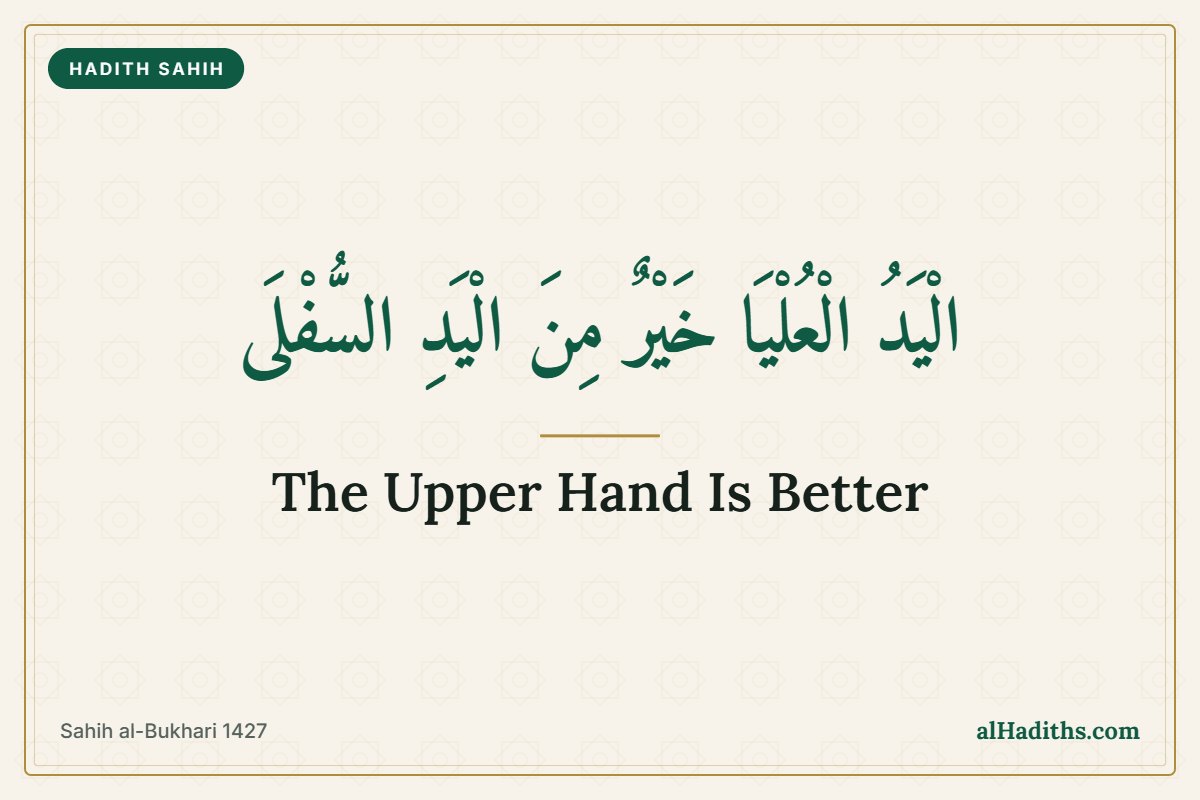
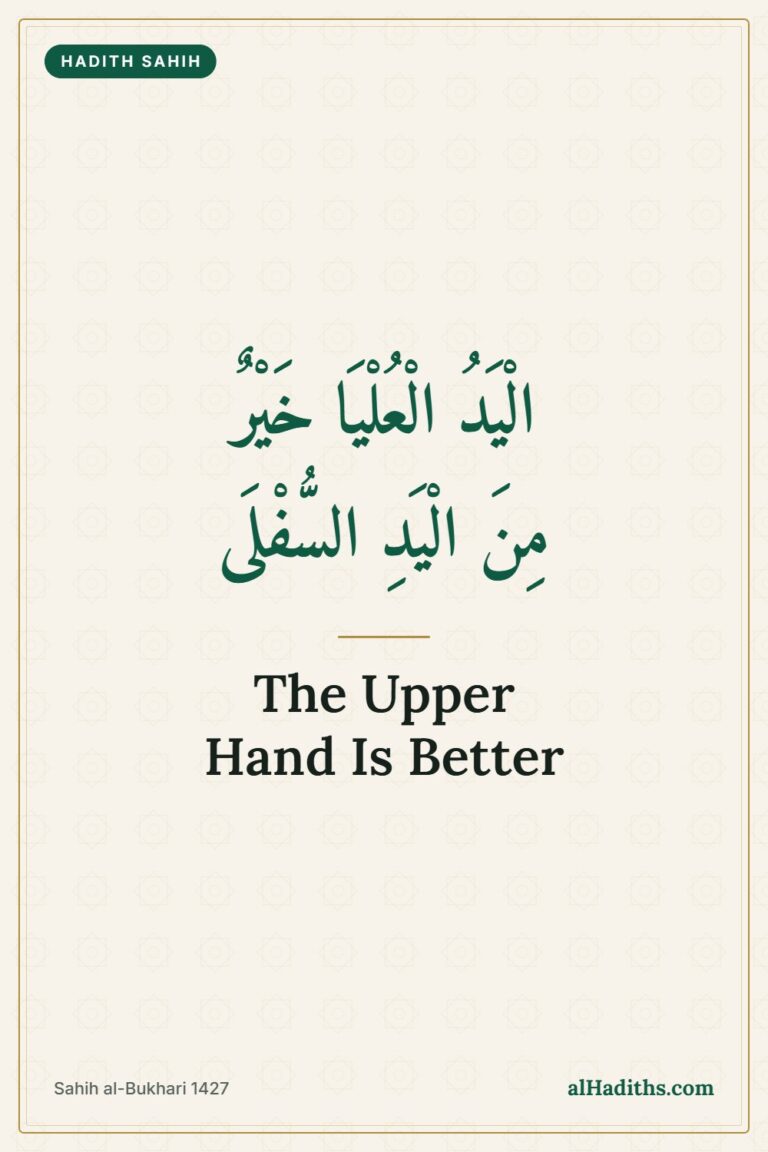
الْيَدُ الْعُلْيَا خَيْرٌ مِنَ الْيَدِ السُّفْلَى، وَابْدَأْ بِمَنْ تَعُولُ، وَخَيْرُ الصَّدَقَةِ عَنْ ظَهْرِ غِنًى، وَمَنْ يَسْتَعْفِفْ يُعِفَّهُ اللَّهُ، وَمَنْ يَسْتَغْنِ يُغْنِهِ اللَّهُ
The Prophet ﷺ said, “The upper hand is better than the lower hand (i.e. he who gives in charity is better than him who takes it). One should start giving first to his dependents. And the best object of charity is that which is given by a wealthy person (from the money which is left after his expenses). And whoever abstains from asking others for some financial help, Allah will give him and save him from asking others, Allah will make him self-sufficient.”
Sahih al-Bukhari 1427 · Narrated by Hakim ibn Hizam · Translation from Sunnah.com
Imam Muslim records the same teaching from Hakim ibn Hizam (Sahih Muslim 1034), and Abu Hurairah (may Allah be pleased with him) narrated a shorter version: the best charity is given from what is spare, and start with your dependants (Sahih al-Bukhari 1426).
What makes it the best charity
1. It comes from what is spare. The Sunnah.com translation explains this part as giving from the money left over after one’s expenses. In other words, the best charity is not the one that leaves us, or the people we provide for, in need. We give from what remains after the necessities are covered.
2. The giving hand is better than the asking hand. The Prophet ﷺ explained the two hands himself, while speaking from the pulpit:
الْيَدُ الْعُلْيَا خَيْرٌ مِنَ الْيَدِ السُّفْلَى، فَالْيَدُ الْعُلْيَا هِيَ الْمُنْفِقَةُ، وَالسُّفْلَى هِيَ السَّائِلَةُ
“The upper hand is better than the lower hand. The upper hand is that of the giver and the lower (hand) is that of the beggar.”
Sahih al-Bukhari 1429 · Narrated by Ibn ‘Umar · Translation from Sunnah.com
Muslim narrates it with the same meaning (Sahih Muslim 1033). This is not about looking down on people who are in need. It is an encouragement to be the one who gives whenever we can, and to keep our dignity by not asking people when we don’t have to.
3. It starts with the people we provide for. Our spouse, children and parents in our care come first. Spending on them with the right intention is itself sadaqah, as we explained in Providing for Your Family in Islam, and giving to relatives in need brings its own extra reward, covered in Charity Towards Family.
4. It goes with self-restraint. The end of the hadith turns to the receiver’s side: whoever holds back from asking people, Allah will make him self-sufficient. The best charity and the best way of receiving both protect a person’s dignity.
Reflection: this hadith takes the pressure off. We do not have to give away everything to give well. We look after our family, keep what we need, and then give regularly from what is left, even if it is small.
Don’t wait until the end
A man once asked the Prophet ﷺ which charity has the greatest reward. His answer was about timing:
أَنْ تَصَدَّقَ وَأَنْتَ صَحِيحٌ شَحِيحٌ، تَخْشَى الْفَقْرَ وَتَأْمُلُ الْغِنَى، وَلاَ تُمْهِلُ حَتَّى إِذَا بَلَغَتِ الْحُلْقُومَ قُلْتَ لِفُلاَنٍ كَذَا، وَلِفُلاَنٍ كَذَا، وَقَدْ كَانَ لِفُلاَنٍ
“The charity which you practice while you are healthy, niggardly and afraid of poverty and wish to become wealthy. Do not delay it to the time of approaching death and then say, ‘Give so much to such and such, and so much to such and such.’ And it has already belonged to such and such (as it is too late).”
Sahih al-Bukhari 1419 · Narrated by Abu Hurairah · Translation from Sunnah.com
It is also in Sahih Muslim 1032a. Giving is hardest when we are healthy and worried about money, and that is exactly when it is worth the most. At the end of life, the wealth is about to pass to others anyway. The Quran describes the dying person wishing for a little more time to give charity, which we looked at in The Three Things That Follow a Person to the Grave.
How to practise it
The hadith does not set an amount or a schedule, so these are suggestions:
- Cover the needs at home first. Make sure the people you provide for are looked after, and count that spending as sadaqah by making the intention.
- Set a small amount to give regularly. Something you can keep up from what is spare each month is better than one big gift that leaves you struggling.
- Give now, while you are healthy. If you have been planning to give, do it this week rather than waiting for a better time.
- Avoid asking people when you can manage. Ask Allah for self-sufficiency, and keep your hand the giving hand where you can.
Key lessons
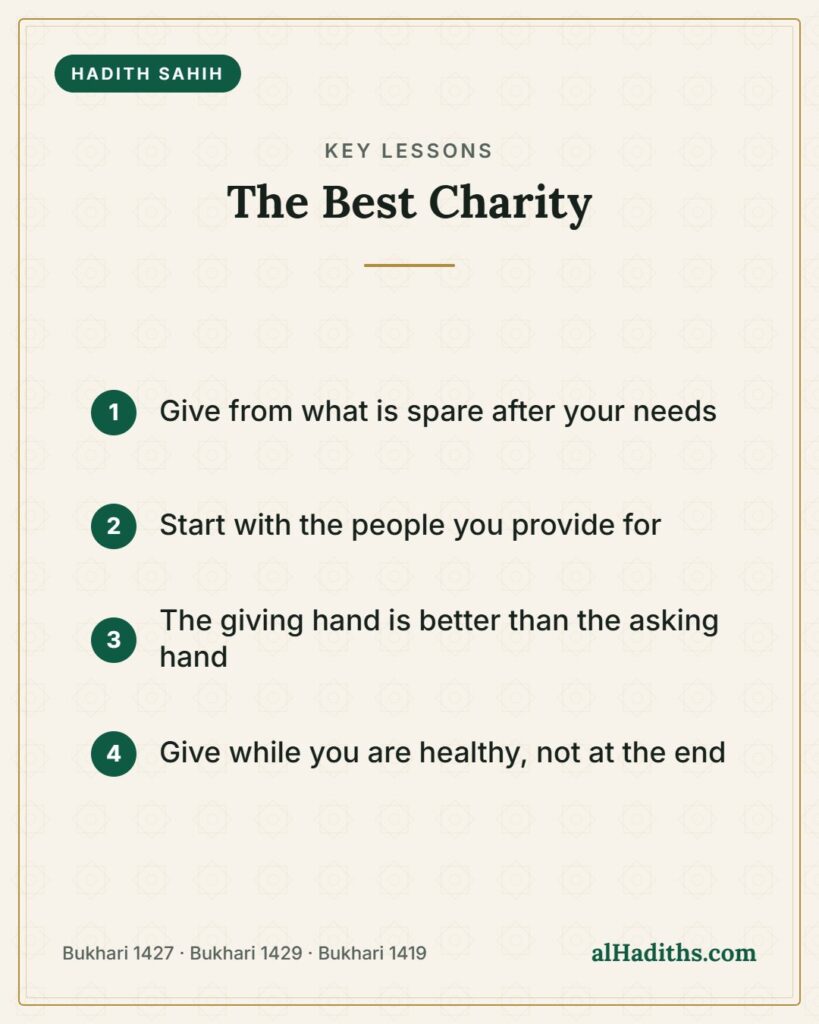
- The best charity is given from what is spare, not in a way that leaves us or our dependants in need.
- Charity starts with the people we are responsible for.
- The giving hand is better than the asking hand.
- Charity given while healthy and worried about money has the greatest reward.
Questions people ask
What is the best charity in Islam?
The Prophet ﷺ said the best charity is given from what is spare, starting with those you provide for (Sahih al-Bukhari 1427, Sahih Muslim 1034). He also said the charity with the greatest reward is given while you are healthy and afraid of poverty, not delayed until death (Sahih al-Bukhari 1419).
What does “the upper hand is better than the lower hand” mean?
The Prophet ﷺ explained it himself: the upper hand is the one that gives and the lower hand is the one that asks (Sahih al-Bukhari 1429). It encourages us to give when we can and to avoid asking people when we don’t need to.
Should I give charity to my family first?
Yes, the hadith says to start with those you provide for (Sahih al-Bukhari 1427). For how this applies to your own situation, such as zakat or obligatory spending, ask a qualified scholar near you.
One thing for today: look at what is left after this month’s needs, choose a small amount, and give it while you are healthy and able.
Save this to Pinterest so you can remember what makes charity the best
Share the reward. Send this article to someone who needs it today — teaching a hadith or dua can become a lasting good deed for you, in shaa Allah.