Istikhara Prayer: The Dua and How the Prophet ﷺ Taught It
Contents
Torn between two choices: a job offer, a move, a marriage proposal? The istikhara prayer is how the Prophet ﷺ taught his Companions to hand such decisions to Allah: two rak‘ahs, then a dua asking Allah to choose. Here is the authentic hadith from Sahih al-Bukhari, the full dua, and how to pray it.
At a glance
- Source: Sahih al-Bukhari 1166
- Narrated by: Jabir ibn ‘Abdullah
- Grade: Sahih (al-Bukhari)
- Topic: Asking Allah to choose before a decision
- Practise it: Before your next decision, pray two rak‘ahs and say this dua
The istikhara prayer in the hadith
Jabir ibn ‘Abdullah (may Allah be pleased with him) said the Prophet ﷺ taught them istikhara for all their affairs, just as he taught them a surah of the Quran. He would say:
إِذَا هَمَّ أَحَدُكُمْ بِالأَمْرِ فَلْيَرْكَعْ رَكْعَتَيْنِ مِنْ غَيْرِ الْفَرِيضَةِ
“If one of you is concerned about a matter, let him pray two rak‘ahs other than the obligatory prayer, then say…”
Sahih al-Bukhari 1166 · Narrated by Jabir ibn ‘Abdullah · Translation adapted from Sunnah.com
Al-Bukhari records the same hadith in two more places (Sahih al-Bukhari 6382 and 7390), and at-Tirmidhi has it too (Jami‘ at-Tirmidhi 480, Sahih (Darussalam)).
The istikhara dua
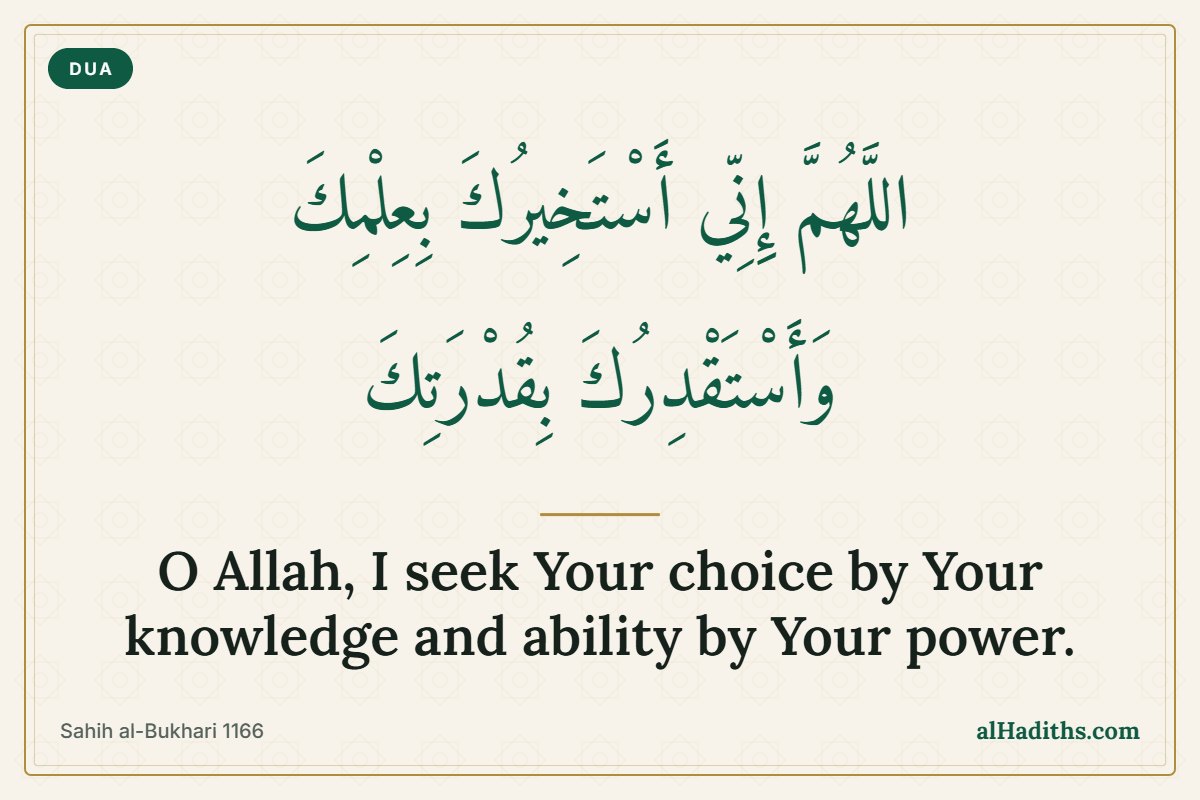
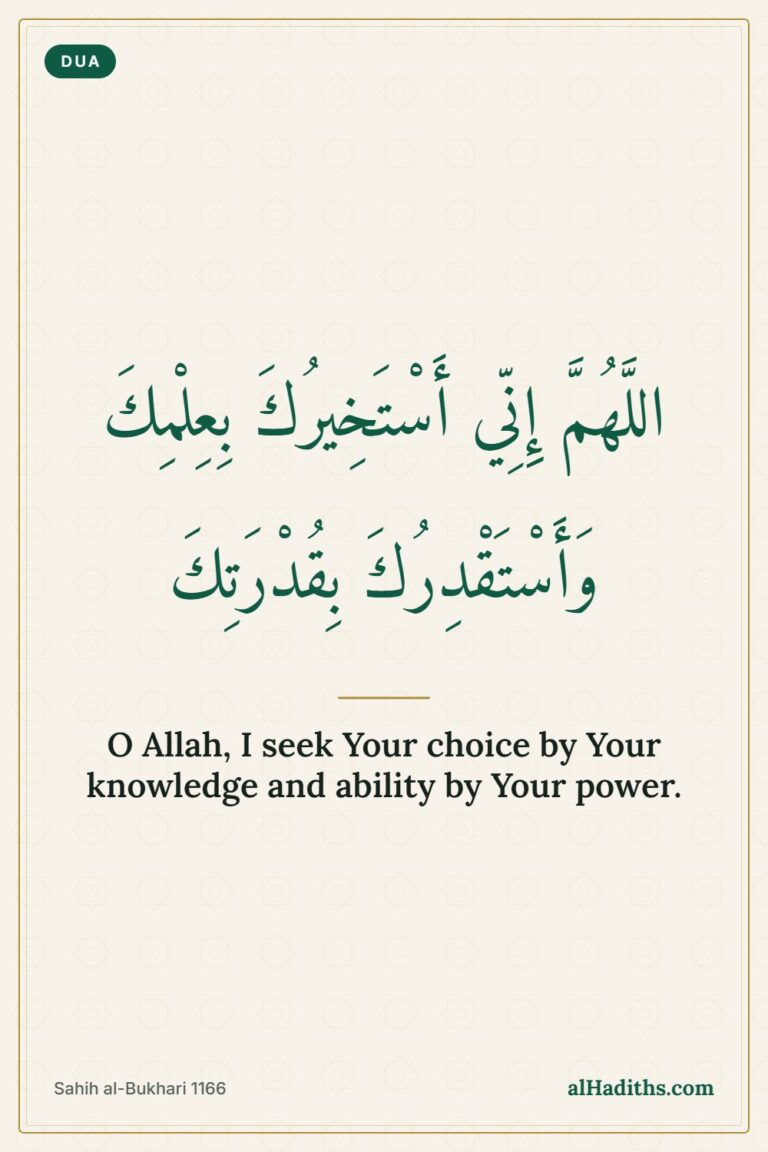
اللَّهُمَّ إِنِّي أَسْتَخِيرُكَ بِعِلْمِكَ وَأَسْتَقْدِرُكَ بِقُدْرَتِكَ، وَأَسْأَلُكَ مِنْ فَضْلِكَ الْعَظِيمِ، فَإِنَّكَ تَقْدِرُ وَلاَ أَقْدِرُ وَتَعْلَمُ وَلاَ أَعْلَمُ وَأَنْتَ عَلاَّمُ الْغُيُوبِ، اللَّهُمَّ إِنْ كُنْتَ تَعْلَمُ أَنَّ هَذَا الأَمْرَ خَيْرٌ لِي فِي دِينِي وَمَعَاشِي وَعَاقِبَةِ أَمْرِي ـ أَوْ قَالَ عَاجِلِ أَمْرِي وَآجِلِهِ ـ فَاقْدُرْهُ لِي وَيَسِّرْهُ لِي ثُمَّ بَارِكْ لِي فِيهِ، وَإِنْ كُنْتَ تَعْلَمُ أَنَّ هَذَا الأَمْرَ شَرٌّ لِي فِي دِينِي وَمَعَاشِي وَعَاقِبَةِ أَمْرِي ـ أَوْ قَالَ فِي عَاجِلِ أَمْرِي وَآجِلِهِ ـ فَاصْرِفْهُ عَنِّي وَاصْرِفْنِي عَنْهُ، وَاقْدُرْ لِي الْخَيْرَ حَيْثُ كَانَ ثُمَّ أَرْضِنِي بِهِ
Allahumma inni astakhiruka bi‘ilmika, wa astaqdiruka bi qudratika, wa as’aluka min fadlika-l-‘azim, fa innaka taqdiru wa la aqdir, wa ta‘lamu wa la a‘lam, wa anta ‘allamu-l-ghuyub. Allahumma in kunta ta‘lamu anna hadha-l-amra khayrun li fi dini wa ma‘ashi wa ‘aqibati amri (aw qala: ‘ajili amri wa ajilih), faqdurhu li wa yassirhu li, thumma barik li fih. Wa in kunta ta‘lamu anna hadha-l-amra sharrun li fi dini wa ma‘ashi wa ‘aqibati amri (aw qala: fi ‘ajili amri wa ajilih), fasrifhu ‘anni wasrifni ‘anhu, waqdur liya-l-khayra haythu kan, thumma ardini bih.
“O Allah, I ask You to choose for me by Your knowledge, I ask You for ability by Your power, and I ask You of Your great bounty. For You are able and I am not; You know and I do not, and You are the Knower of the unseen. O Allah, if You know that this matter is good for me in my religion, my livelihood and the outcome of my affairs (or he said: my affairs now and later), then decree it for me, make it easy for me, and bless me in it. And if You know that this matter is bad for me in my religion, my livelihood and the outcome of my affairs (or he said: my affairs now and later), then turn it away from me and turn me away from it, decree for me what is good wherever it may be, and make me pleased with it.” He said: and he names his need.
Sahih al-Bukhari 1166 · Narrated by Jabir ibn ‘Abdullah · Translation adapted from Sunnah.com
The words in brackets are a narrator’s note: he was unsure whether the Prophet ﷺ said “the outcome of my affairs” or “my affairs now and later”. Both are part of the hadith as recorded.
What the hadith teaches
Explaining this hadith, HadeethEnc’s explanation notes these points:
- Istikhara is for when the right choice is unclear, and the Prophet ﷺ taught it with the same care as a surah of the Quran.
- It is for permissible matters where you hesitate, not for whether to do an obligation or leave something forbidden.
- You name your need in the dua, such as buying a house or marrying a particular person.
- The dua comes after the two rak‘ahs; saying it before the closing salam is not counted wrong.
- You then accept what Allah decrees, whether it pleases you or not.
Reflection: The dua opens by admitting what we lack: Allah knows and we do not, Allah is able and we are not. A decision made after that confession is lighter to carry, because the outcome is already handed to the One who knows it.
How to pray istikhara
- Be clear on the matter: a permissible choice you are unsure about.
- Pray two rak‘ahs other than the obligatory prayer, as the hadith says.
- After the prayer, say the istikhara dua above.
- At “this matter”, name your need, as the hadith instructs.
- Then go ahead with the step in front of you, trusting Allah to ease it or turn it away. This last step is our suggestion; the hadith itself asks Allah to do the easing and turning.
Questions people ask
Will I see a dream or a sign after istikhara?
The hadith mentions no dream or sign. In the dua you ask Allah to make the matter easy if it is good for you and to turn it away if it is not, and to make you pleased with what He decrees (Bukhari 1166).
Can I pray istikhara for marriage?
Yes, marriage is a permissible matter, and HadeethEnc gives marrying a particular person as an example of a need to name. When Zainab bint Jahsh (may Allah be pleased with her) was proposed to, she said she would not do anything until she had consulted her Lord, and went to her place of prayer (Muslim 1428b).
When should I pray istikhara?
The hadith sets no time: it is for “when one of you is concerned about a matter” (Bukhari 1166). The Prophet ﷺ forbade prayer at three times of the day (Muslim 831), so many people avoid those times; ask a qualified scholar about the details.
Do I say the dua before or after salam?
The hadith puts the dua after the two rak‘ahs. HadeethEnc’s explanation adds that saying it before the closing salam is not counted wrong.
What is istikhara not for?
HadeethEnc notes it is not for deciding whether to do an obligation or a recommended act, or whether to leave something forbidden or disliked. It is for permissible choices where you hesitate.
Key lessons
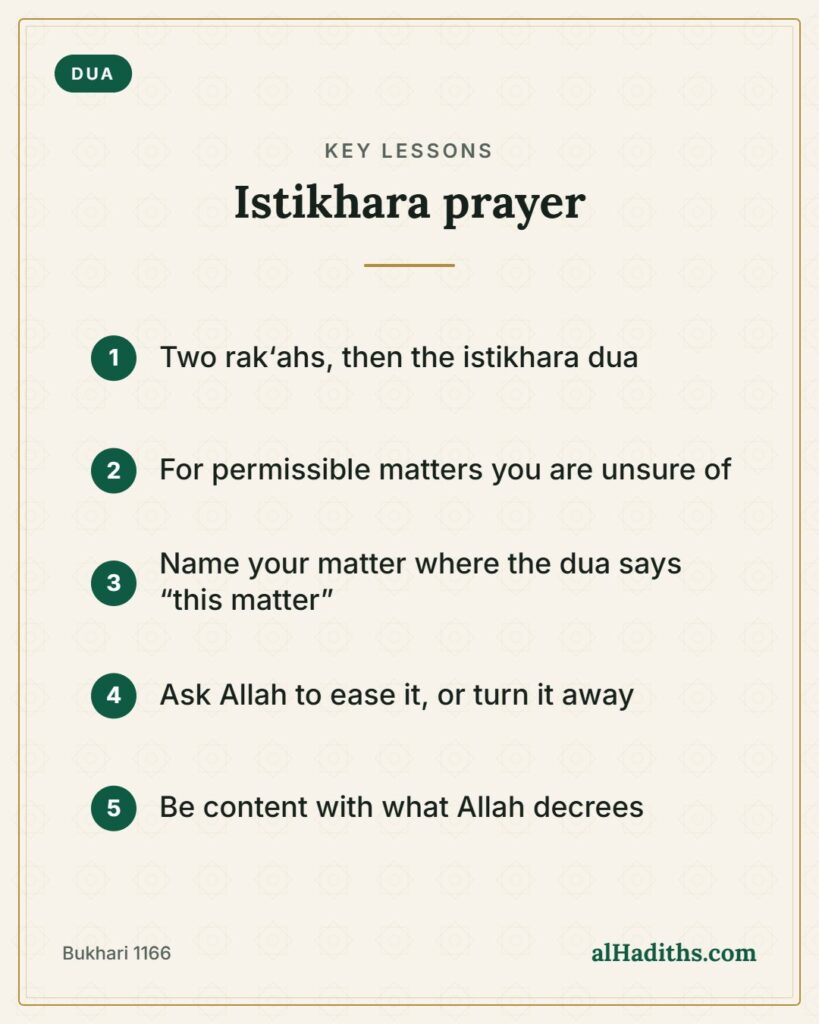
- The Prophet ﷺ taught istikhara like a surah of the Quran (Bukhari 1166).
- It is two rak‘ahs other than the obligatory prayer, then the dua.
- You name your matter where the dua says “this matter”.
- The hadith mentions no dream or sign to wait for.
- The dua ends by asking Allah to make you pleased with His choice.
Part of our Salah series: see all our salah articles in one place.
Before your next big decision, try two rak‘ahs and this dua, and leave the choosing to Allah.
Save this to Pinterest so you have the istikhara dua ready for your next big decision
Share the reward. Send this article to someone who needs it today — teaching a hadith or dua can become a lasting good deed for you, in shaa Allah.