Qana’ah Meaning: 6 Authentic Hadith on Contentment
Contents
Imagine scrolling through social media: luxurious vacations, designer outfits, picture-perfect lives. A familiar pang of envy tugs at your heart. “Why can’t I have that?” Islam offers a quiet answer to this old struggle: qana’ah. Here is the qana’ah meaning in simple words, 6 authentic hadith behind it, and how to grow it in your own heart.
At a glance
- Hadith: 6 authentic hadith
- Collections: Sahih al-Bukhari, Sahih Muslim, Jami at-Tirmidhi
- Grade: Sahih, and Hasan for Tirmidhi 2346 (Darussalam)
- Topic: Qana’ah: contentment with what Allah gives
- One thing to do today: When you catch yourself comparing upwards, think of someone who has less, and say Alhamdulillah
Qana’ah meaning in simple words
Qana’ah is an Arabic word usually translated as contentment, or being satisfied with what you have. It is more than putting up with our situation. It is a heart at peace with what Allah has given, while still working hard and making dua for good.
Qana’ah does not mean giving up ambition or refusing to earn more. It means our happiness does not depend on having more than other people. The hadith below show what it looks like.
1. The successful one is made content
‘Abdullah ibn ‘Amr ibn al-‘As (may Allah be pleased with him) narrated that the Messenger of Allah ﷺ said:
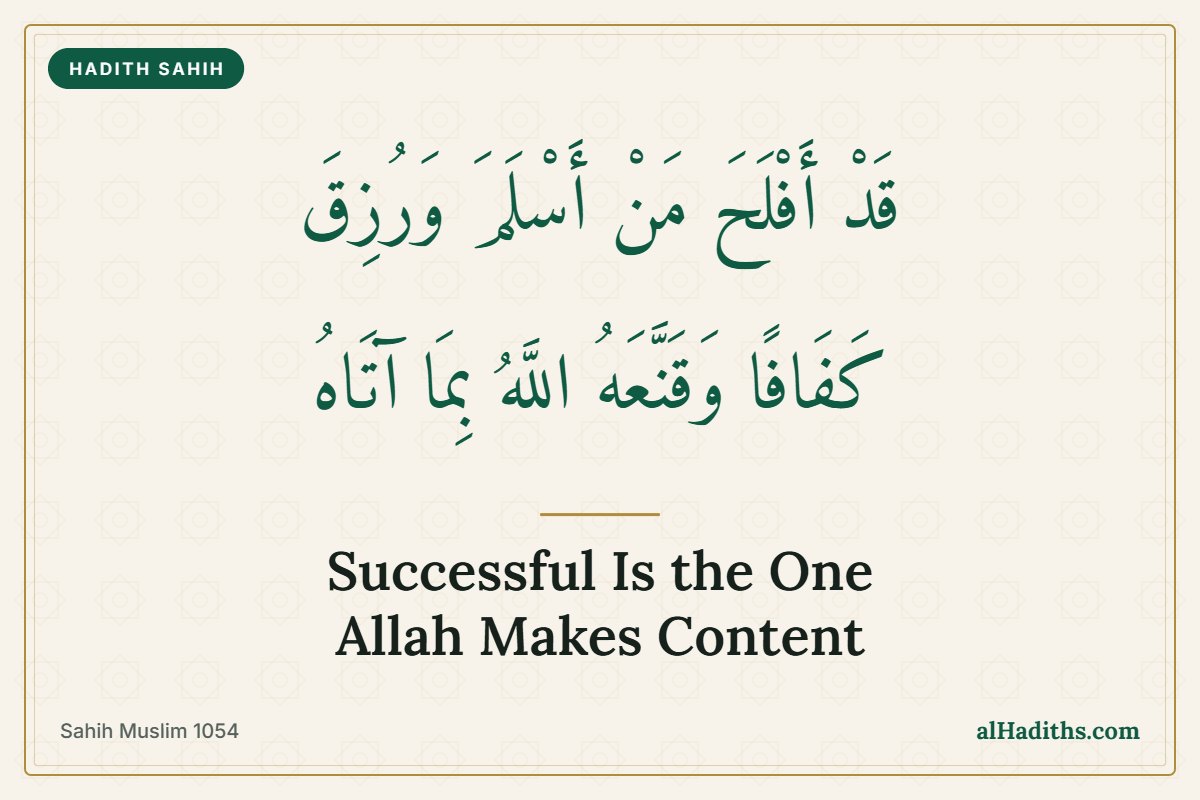
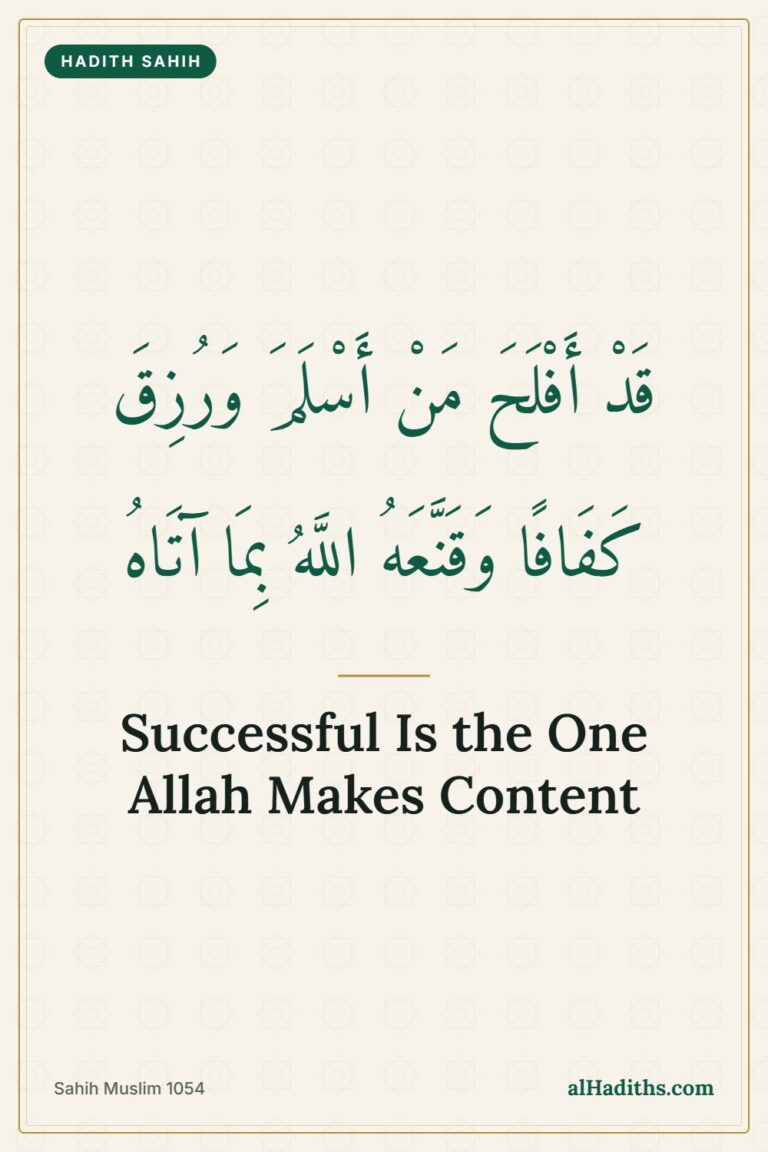
قَدْ أَفْلَحَ مَنْ أَسْلَمَ وَرُزِقَ كَفَافًا وَقَنَّعَهُ اللَّهُ بِمَا آتَاهُ
“He is successful who has accepted Islam, who has been provided with what is sufficient for his needs, and been made content by Allah with what He has given him.”
Sahih Muslim 1054 · Narrated by ‘Abdullah ibn ‘Amr ibn al-‘As · Translation adapted from Sunnah.com
The word for “made content” comes from the same root as qana’ah. According to HadeethEnc’s explanation, true success here combines three things: Islam, provision that meets our needs without excess, and a heart that Allah has made satisfied with it. The same hadith is in Jami at-Tirmidhi 2348 (Sahih, Darussalam).
Try this: in your dua, ask Allah not only for more provision, but also to make you content with what He gives.
2. Look at those who have less
Abu Hurairah (may Allah be pleased with him) narrated that the Messenger of Allah ﷺ said:
إِذَا نَظَرَ أَحَدُكُمْ إِلَى مَنْ فُضِّلَ عَلَيْهِ فِي الْمَالِ وَالْخَلْقِ، فَلْيَنْظُرْ إِلَى مَنْ هُوَ أَسْفَلَ مِنْهُ
“If anyone of you looks at a person who was made superior to him in wealth and appearance, then he should also look at the one who is below him.”
Sahih al-Bukhari 6490 · Narrated by Abu Hurairah · Translation adapted from Sunnah.com
Another narration gives the reason: look at those below you and not those above you, because that makes it less likely you will look down on Allah’s favors upon you (Sahih Muslim 2963c).
This is about worldly things like money and looks. Working hard to earn is not wrong, but envying what others have only steals our peace. Social media feeds show highlight reels; everyone carries struggles we never see.
Try this: next time a post makes you feel you have less, pause and think of someone who has less than you. Then say Alhamdulillah.
3. True wealth is in the heart
Abu Hurairah (may Allah be pleased with him) also narrated that the Prophet ﷺ said:
لَيْسَ الْغِنَى عَنْ كَثْرَةِ الْعَرَضِ، وَلَكِنَّ الْغِنَى غِنَى النَّفْسِ
“Wealth is not in having many possessions, but rather (true) wealth is feeling sufficiency in the soul.”
Sahih al-Bukhari 6446 · Narrated by Abu Hurairah · Translation adapted from Sunnah.com
A person with a lot can still feel poor if their heart always wants more, and a person with little can feel rich if their heart is content. Qana’ah is that inner richness. The same hadith is also in Sahih Muslim 1051.
Try this: before buying something you don’t need, ask yourself whether it will make your heart richer, or just your shelf fuller.
4. As if the whole world is yours
‘Ubaidullah ibn Mihsan al-Khatmi (may Allah be pleased with him), a Companion, narrated that the Messenger of Allah ﷺ said:
مَنْ أَصْبَحَ مِنْكُمْ آمِنًا فِي سِرْبِهِ مُعَافًى فِي جَسَدِهِ عِنْدَهُ قُوتُ يَوْمِهِ فَكَأَنَّمَا حِيزَتْ لَهُ الدُّنْيَا
“Whoever among you wakes up in the morning secure in his dwelling, healthy in his body, having his food for the day, then it is as if the world has been gathered for him.”
Jami at-Tirmidhi 2346 · Hasan (Darussalam) · Narrated by ‘Ubaidullah ibn Mihsan al-Khatmi · Translation adapted from Sunnah.com
Three simple blessings: safety, health, and today’s food. HadeethEnc explains that whoever has these, it is as though the whole world has been brought together for him. Many of us wake up with all three and still feel we have nothing.
Try this: tomorrow morning, before you pick up your phone, count these three blessings and thank Allah for each one.
5. Seek contentment, and Allah gives it
Abu Sa’id al-Khudri (may Allah be pleased with him) narrated that some of the Ansar asked the Prophet ﷺ for help, and he gave them until nothing was left with him. Then he said:
وَمَنْ يَسْتَعْفِفْ يُعِفَّهُ اللَّهُ، وَمَنْ يَسْتَغْنِ يُغْنِهِ اللَّهُ، وَمَنْ يَتَصَبَّرْ يُصَبِّرْهُ اللَّهُ، وَمَا أُعْطِيَ أَحَدٌ عَطَاءً خَيْرًا وَأَوْسَعَ مِنَ الصَّبْرِ
“Whoever abstains from asking others, Allah will make him contented, and whoever tries to make himself self-sufficient, Allah will make him self-sufficient. And whoever remains patient, Allah will make him patient. Nobody can be given a blessing better and greater than patience.”
Sahih al-Bukhari 1469 · Narrated by Abu Sa’id al-Khudri · Translation adapted from Sunnah.com
This hadith shows that contentment is not only a gift we wait for. We take the first step, and Allah completes it. It also ties qana’ah to patience: the content heart is a patient heart.
Try this: pick one “want” you keep thinking about, and choose to be patient with it for a week. Ask Allah to replace the craving with contentment.
6. The Prophet’s ﷺ dua for just enough
Abu Hurairah (may Allah be pleased with him) narrated that the Messenger of Allah ﷺ said:
اللَّهُمَّ اجْعَلْ رِزْقَ آلِ مُحَمَّدٍ قُوتًا
“O Allah, make the provision of the family of Muhammad just enough to sustain life.”
Sahih Muslim 1055 · Narrated by Abu Hurairah · Translation adapted from Sunnah.com
The Prophet ﷺ asked Allah for his family’s provision to be just enough, not more. He lived what he taught: a life without excess, rich in heart.
Try this: when you make dua for provision, also ask Allah to bless what you already have.
Bringing it together: qana’ah and gratitude
Together these hadith show that qana’ah is a choice of the eyes (looking at those with less), a state of the heart (richness of the soul), and a gift from Allah that we ask for and work toward. Qana’ah and gratitude go hand in hand, because we cannot thank Allah for what we keep looking past. Allah reminds us that His blessings are beyond counting:
وَءَاتَىٰكُم مِّن كُلِّ مَا سَأَلْتُمُوهُ ۚ وَإِن تَعُدُّوا۟ نِعْمَتَ ٱللَّهِ لَا تُحْصُوهَآ ۗ إِنَّ ٱلْإِنسَـٰنَ لَظَلُومٌ كَفَّارٌ
“And He gave you from all you asked of Him. And if you should count the favor [i.e., blessings] of Allāh, you could not enumerate them. Indeed, mankind is [generally] most unjust and ungrateful.”
Surah Ibrahim 14:34 · Translation: Saheeh International, from Quran.com
Reflection: qana’ah doesn’t mean we stop wanting good things. It means the good things we already have stop feeling small. A content person can still strive, but they strive in peace, not in envy.
Questions people ask
What is the meaning of qana’ah?
Qana’ah means contentment: being satisfied with what Allah has given you, without envying others. The Prophet ﷺ said the successful one is “made content by Allah with what He has given him” (Sahih Muslim 1054).
What is the difference between qana’ah and zuhd?
Qana’ah is being content with what you have. Zuhd is usually described as going a step further: not letting the world take hold of your heart at all, even when you have it. Read more in Renounce the World and Allah Will Love You.
Is “Be content and you will be the most grateful of people” an authentic hadith?
It is part of a longer narration in Sunan Ibn Majah 4217, graded Da’if (Darussalam), so we don’t use it as evidence here. The authentic hadith above carry the same lesson.
Does qana’ah mean I shouldn’t try to earn more?
No. Qana’ah is about the heart, not about giving up work. Earning halal provision is good; qana’ah keeps us from envy and greed while we earn. Halal Is Clear and Haram Is Clear covers earning in a halal way.
Key lessons
- Qana’ah means contentment with what Allah has given you.
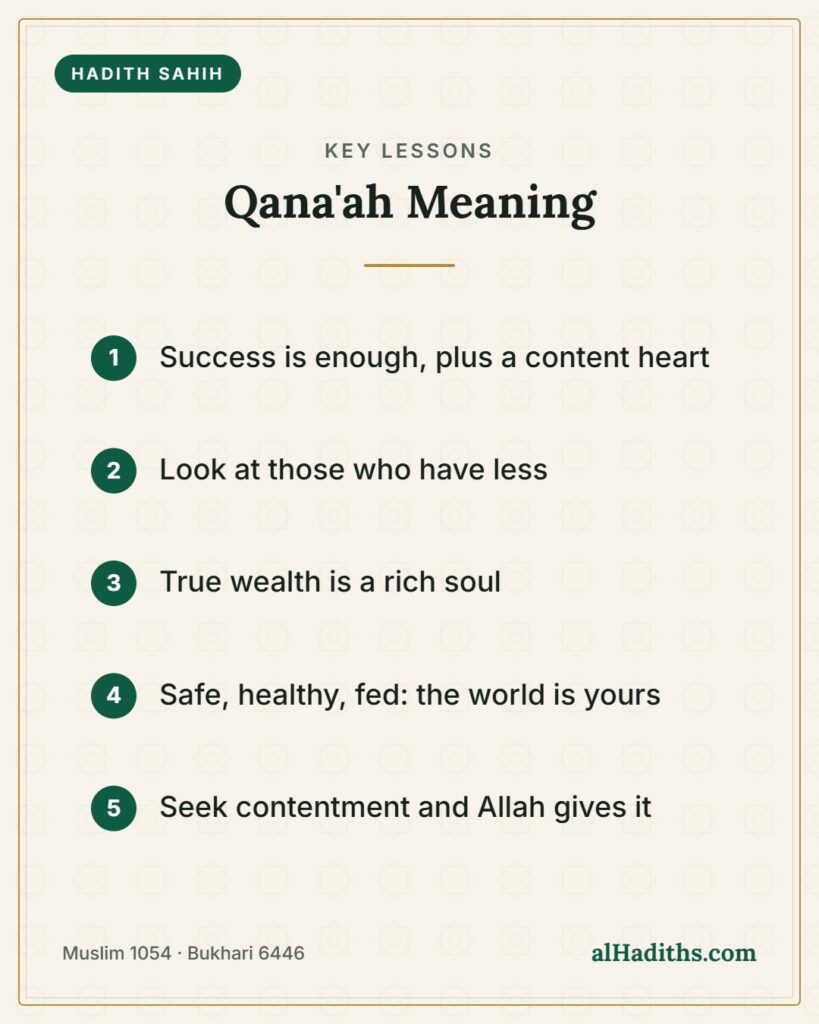
- The successful one has Islam, enough provision, and a heart Allah has made content (Muslim 1054).
- In worldly things, look at those below you so you do not look down on Allah’s favors (Bukhari 6490).
- True wealth is a content heart, not many possessions (Bukhari 6446).
- Whoever seeks contentment, Allah makes him content (Bukhari 1469).
Let go of the comparison game, and count what you already have. May Allah make us content with what He has given us, and grateful for it.
Save this to Pinterest so you can remember what qana’ah means
Share the reward. Send this article to someone who needs it today — teaching a hadith or dua can become a lasting good deed for you, in shaa Allah.