Gratitude in Islam: 2 Hadith on Thanking Allah and People
This is the 100th article on alHadiths.com, and there is no better topic for it than gratitude. Below are two authentic hadith about gratitude: one on thanking people, and one on the believer who thanks Allah in good times and stays patient in hard ones.
A note from me: our 100th article
Alhamdulillah. With this article, alHadiths.com has reached 100 articles. Every one of them was only possible by the help of Allah, and I am grateful to Him first.
Thank you to everyone who has read, saved or shared a hadith from this site. Whether you found us once or you come back often, you are part of this.
May Allah bless you and your family with good health, peace and ease in this world. May He forgive us all, keep us firm on His path, and gather us together in Jannah in the Hereafter. Ameen.
If an article here has benefited you, please share it with someone you love. A single link sent to a friend or a family group could be the reason someone learns a hadith today.
Fauzul Bahari
At a glance
- Sources: Sunan Abi Dawud 4811 and Sahih Muslim 2999
- Narrated by: Abu Hurairah and Suhaib (may Allah be pleased with them)
- Grade: Sahih (al-Albani) for Abu Dawud 4811; Sahih Muslim
- Topic: Gratitude (shukr) to Allah and to people
- Put it into practice: Thank one person today, by name, for something they did for you
1. Thanking people is part of thanking Allah
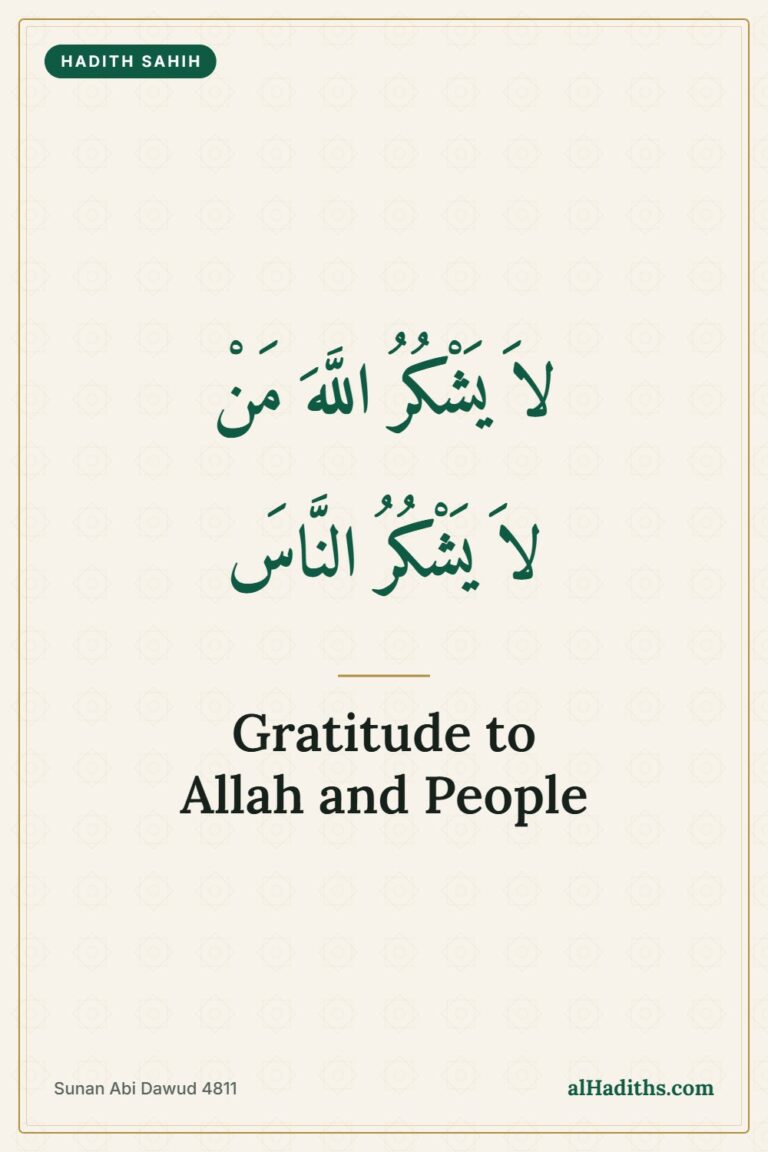
Abu Hurairah (may Allah be pleased with him) reported that the Prophet ﷺ said:
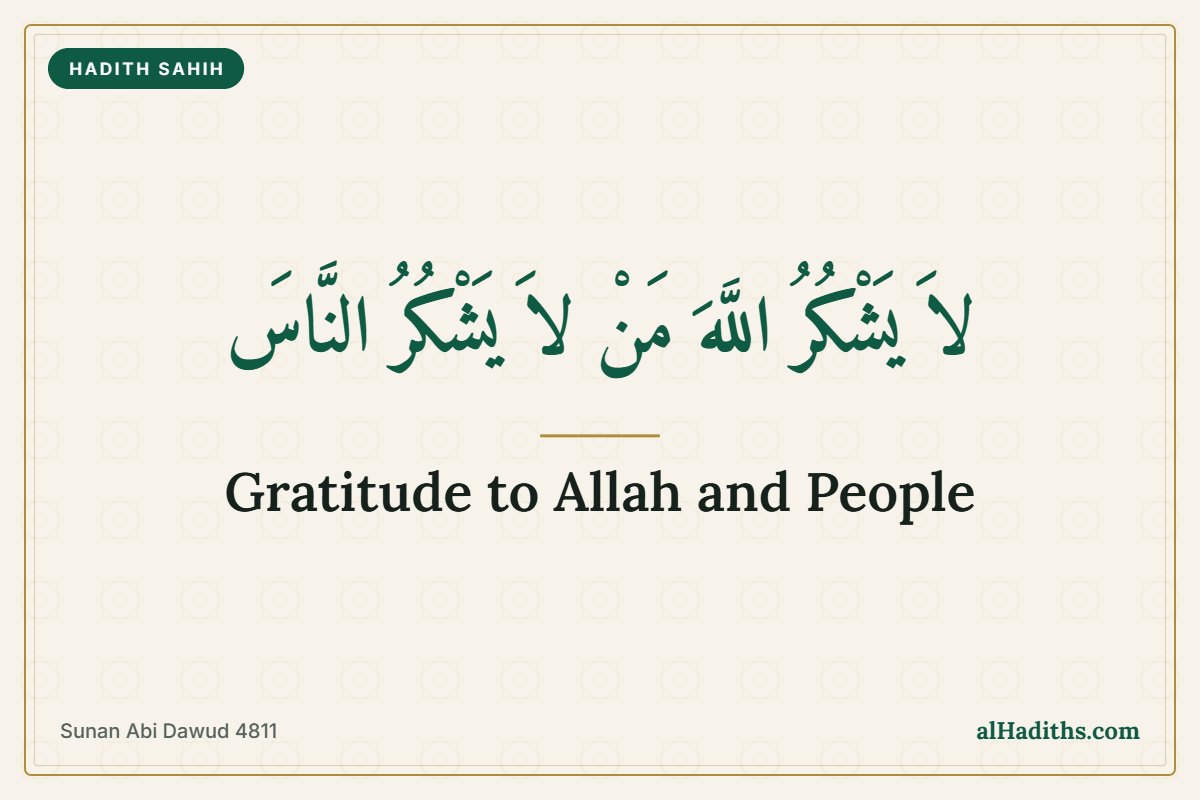
لاَ يَشْكُرُ اللَّهَ مَنْ لاَ يَشْكُرُ النَّاسَ
“He who does not thank the people is not thankful to Allah.”
Sunan Abi Dawud 4811 · Sahih (al-Albani) · Translation from Sunnah.com
The same hadith is in Jami` at-Tirmidhi 1954 and 1955, both graded Sahih (Darussalam). HadeethEnc explains that a person who does not thank people for their kindness is unlikely to thank Allah for His blessings, because the two habits go together. Allah is the true source of every blessing, and people are often the means He uses to send it, so thanking them is part of thanking Him.
2. The believer is grateful in ease and patient in hardship
Suhaib (may Allah be pleased with him) reported that the Messenger of Allah ﷺ said:
عَجَبًا لأَمْرِ الْمُؤْمِنِ إِنَّ أَمْرَهُ كُلَّهُ خَيْرٌ وَلَيْسَ ذَاكَ لأَحَدٍ إِلاَّ لِلْمُؤْمِنِ إِنْ أَصَابَتْهُ سَرَّاءُ شَكَرَ فَكَانَ خَيْرًا لَهُ وَإِنْ أَصَابَتْهُ ضَرَّاءُ صَبَرَ فَكَانَ خَيْرًا لَهُ
“Strange are the ways of a believer for there is good in every affair of his and this is not the case with anyone else except in the case of a believer for if he has an occasion to feel delight, he thanks (God), thus there is a good for him in it, and if he gets into trouble and shows resignation (and endures it patiently), there is a good for him in it.”
Sahih Muslim 2999 · Narrated by Suhaib · Translation from Sunnah.com
According to HadeethEnc, the believer wins either way. When something good happens, he thanks Allah and is rewarded for his gratitude. When something painful happens, he is patient, hoping for Allah’s reward, and is rewarded for his patience. HadeethEnc adds that faith in Allah’s decree is what gives the believer this contentment in every situation.
Allah’s promise to the grateful
The Quran makes a clear promise about gratitude:
وَإِذْ تَأَذَّنَ رَبُّكُمْ لَئِن شَكَرْتُمْ لَأَزِيدَنَّكُمْ ۖ وَلَئِن كَفَرْتُمْ إِنَّ عَذَابِى لَشَدِيدٌ
“And [remember] when your Lord proclaimed, ‘If you are grateful, I will surely increase you [in favor]; but if you deny, indeed, My punishment is severe.'”
Surah Ibrahim 14:7 · Translation: Saheeh International, from Quran.com
Reflection: gratitude is easy to say and easy to forget. We notice what is missing far more quickly than what is already there: health, family, a roof, the ability to pray. Every good thing comes from Allah, and very often it reaches us through people. Both deserve our thanks.
How to practice gratitude
The hadith do not set a fixed routine, so these are suggestions:
- Say “Alhamdulillah” on purpose when something good happens, however small.
- Thank people properly: a parent, a teacher, a colleague. Name what they did.
- Use a blessing in obedience, like using your health to pray or your wealth to give.
- Give charity for your body; see charity for every joint.
- Be content with what you have; see qana’ah in Islam.
- Stay patient in hard times, remembering that patience is rewarded too.
Key lessons
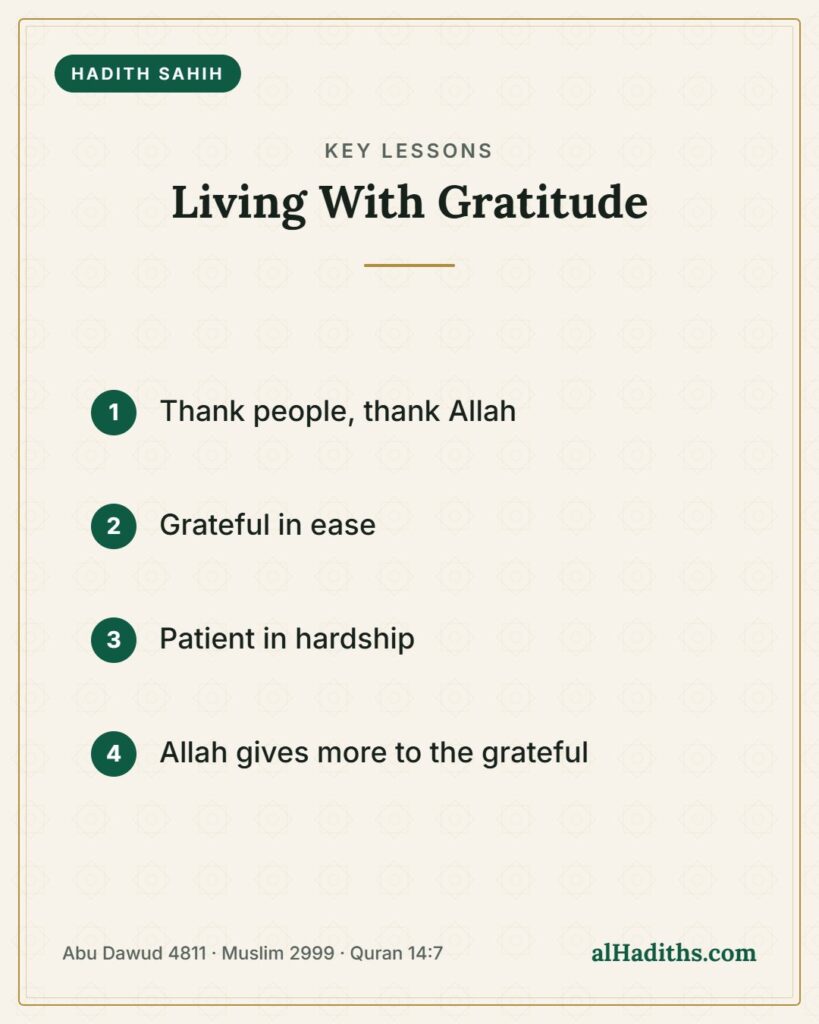
- Whoever does not thank people does not truly thank Allah.
- People are often the means through which Allah sends His blessings.
- The believer is grateful in ease and patient in hardship, and wins either way.
- Allah promises more to those who are grateful (14:7).
- Gratitude is shown in words and in how we use our blessings.
Questions people ask
What does Islam say about gratitude?
Allah promises to increase those who are grateful (Surah Ibrahim 14:7), and the Prophet ﷺ said the believer thanks Allah in good times and is patient in hard ones (Sahih Muslim 2999).
Is “whoever does not thank people does not thank Allah” an authentic hadith?
Yes. It is in Sunan Abi Dawud 4811, graded Sahih by al-Albani, and in Jami` at-Tirmidhi 1954 and 1955, graded Sahih by Darussalam.
Why should we thank people if all blessings come from Allah?
According to HadeethEnc, Allah is the source of every blessing and people are often the means He uses, so thanking them is part of being grateful to Him.
One thing for today: before you sleep, name three blessings you had today and say Alhamdulillah for each. And if you are new here, a good place to start is Imam an-Nawawi’s 40 Hadith.
Save this to Pinterest so you can come back to these hadith later.
Share the reward. Send this article to someone who needs it today — teaching a hadith or dua can become a lasting good deed for you, in shaa Allah.