Contents
Which hadith books do Muslims rely on most, and who wrote them? Six collections, known as the Six Books or Kutub al-Sittah, sit at the heart of hadith study. Almost every hadith on this site comes from one of them. This page introduces each book and the scholar who compiled it, and explains why some cards show a grade and others don’t. To understand those grades, read our companion page: Sahih Hadith Meaning: How Hadith Grading Works.
At a glance
- What they are: Six collections of the Prophet’s ﷺ sayings and actions, compiled in the 3rd century AH
- The two Sahihs: Sahih al-Bukhari and Sahih Muslim
- The four Sunan: Abu Dawud, at-Tirmidhi, an-Nasa’i, Ibn Majah
- Also called: Kutub al-Sittah, al-Sihah al-Sittah
- Practise it: Note the book and number of any hadith you share
The six hadith books at a glance
- Sahih al-Bukhari, by Imam al-Bukhari (194–256 AH)
- Sahih Muslim, by Imam Muslim (204–261 AH)
- Sunan Abi Dawud, by Imam Abu Dawud (202–275 AH)
- Jami’ at-Tirmidhi, by Imam at-Tirmidhi (209–279 AH)
- Sunan an-Nasa’i, by Imam an-Nasa’i (born 215 AH, died around 300–303 AH)
- Sunan Ibn Majah, by Imam Ibn Majah (209–273 AH)
Dates and biographies on this page follow IslamQA 21523, The authors of the Six Books, unless another source is linked. Sunnah.com, where we copy every hadith, has all six books online.
Why the hadith books were written
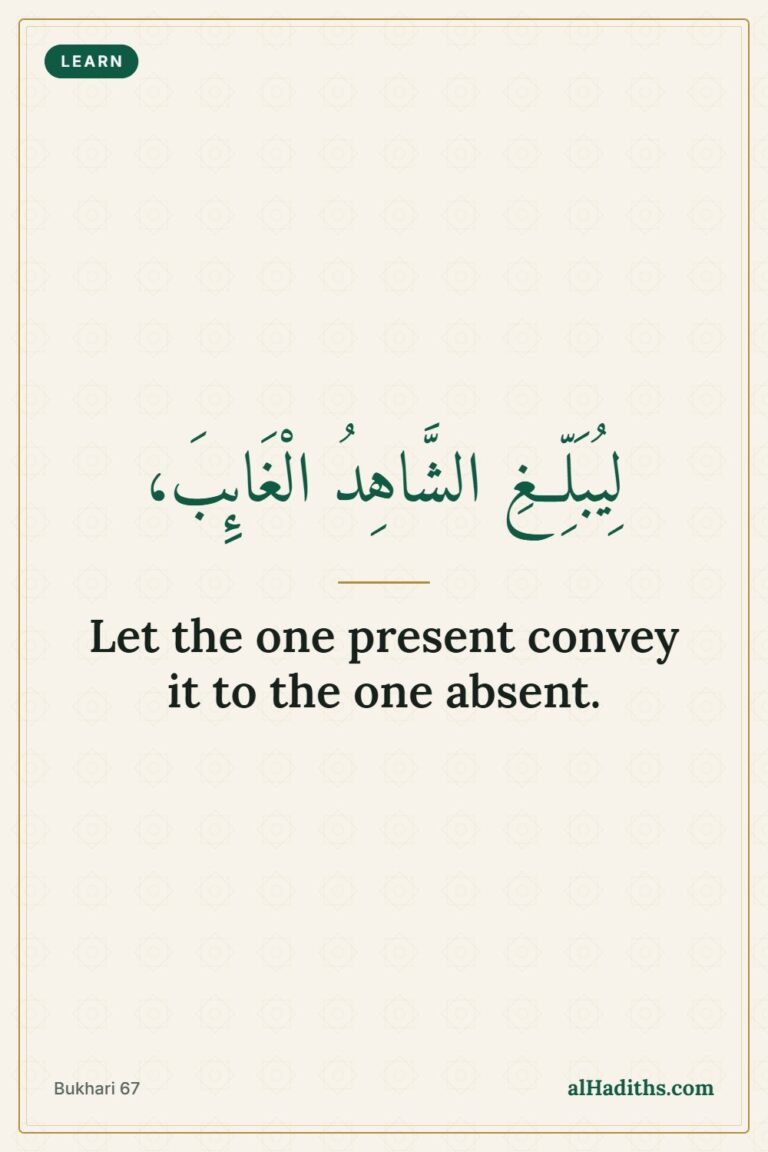
In his farewell sermon at Mina, the Prophet ﷺ told those listening to pass his words on:
لِيُبَلِّغِ الشَّاهِدُ الْغَائِبَ، فَإِنَّ الشَّاهِدَ عَسَى أَنْ يُبَلِّغَ مَنْ هُوَ أَوْعَى لَهُ مِنْهُ
“Let the one who is present convey it to the one who is absent, for the one who is present may convey it to someone who understands it better than he does.”
Bukhari 67 · Narrated by Abu Bakrah · Translation adapted from Sunnah.com
He ﷺ also made a dua for everyone who carries a hadith carefully:
نَضَّرَ اللَّهُ امْرَأً سَمِعَ مِنَّا حَدِيثًا فَحَفِظَهُ حَتَّى يُبَلِّغَهُ فَرُبَّ حَامِلِ فِقْهٍ إِلَى مَنْ هُوَ أَفْقَهُ مِنْهُ وَرُبَّ حَامِلِ فِقْهٍ لَيْسَ بِفَقِيهٍ
“May Allah brighten a man who hears a hadith from us, memorises it and passes it on. Many a bearer of knowledge conveys it to one who understands it better than he does, and many a bearer of knowledge does not understand it himself.”
Abu Dawud 3660 · Sahih (al-Albani) · Narrated by Zayd ibn Thabit · Translation adapted from Sunnah.com · Also Tirmidhi 2656, Sahih (Darussalam)
HadeethEnc explains a parallel narration from Ibn Mas’ud: the first carrier excels in memorising and passing on, while the one who receives it may excel in understanding and drawing out its lessons (HadeethEnc 6820). The compilers of the Six Books did exactly that work of memorising, checking and passing on, and the Quran makes the Prophet’s ﷺ teaching binding on us:
مَّآ أَفَآءَ ٱللَّهُ عَلَىٰ رَسُولِهِۦ مِنْ أَهْلِ ٱلْقُرَىٰ فَلِلَّهِ وَلِلرَّسُولِ وَلِذِى ٱلْقُرْبَىٰ وَٱلْيَتَـٰمَىٰ وَٱلْمَسَـٰكِينِ وَٱبْنِ ٱلسَّبِيلِ كَىْ لَا يَكُونَ دُولَةًۢ بَيْنَ ٱلْأَغْنِيَآءِ مِنكُمْ ۚ وَمَآ ءَاتَىٰكُمُ ٱلرَّسُولُ فَخُذُوهُ وَمَا نَهَىٰكُمْ عَنْهُ فَٱنتَهُوا۟ ۚ وَٱتَّقُوا۟ ٱللَّهَ ۖ إِنَّ ٱللَّهَ شَدِيدُ ٱلْعِقَابِ
And what Allāh restored to His Messenger from the people of the towns – it is for Allāh and for the Messenger and for [his] near relatives and orphans and the needy and the [stranded] traveler – so that it will not be a perpetual distribution among the rich from among you. And whatever the Messenger has given you – take; and what he has forbidden you – refrain from. And fear Allāh; indeed, Allāh is severe in penalty.
Surah al-Hashr 59:7 · Translation: Saheeh International, from Quran.com
Imam Bukhari and Sahih al-Bukhari
Muhammad ibn Isma’il al-Bukhari was born in Bukhara in 194 AH and grew up an orphan. He began memorising hadith before the age of ten, travelled for sixteen years to meet the scholars of many lands, and died in Khartank, near Samarqand, in 256 AH (870 CE), aged 62.
- The book: al-Jami’ al-Sahih, known as Sahih al-Bukhari. He set out to record only the soundest hadith, though he did not try to collect every sahih hadith. It is counted the most authentic book after the Quran.
- Grades on this site: none named: the hadith of Sahih al-Bukhari are accepted as authentic.
- Read one: Importance of Salah: 7 Authentic Hadith opens with Bukhari 8.
Imam Muslim and Sahih Muslim
Muslim ibn al-Hajjaj al-Qushayri was born in Nishapur in 204 AH. He travelled to Iraq and the Hijaz to learn hadith, and died near Nishapur in 261 AH (875 CE), aged 57.
- The book: Sahih Muslim, which he spent nearly fifteen years compiling. It is second only to Sahih al-Bukhari in standing. Muslim gathers the different chains of a hadith in one place, and opens with an Introduction on the isnad and the narrators.
- Grades on this site: none named: its hadith are accepted as authentic. A hadith recorded by both Bukhari and Muslim is called muttafaq ‘alayh, “agreed upon”.
- Read one: Tahajjud Hadith opens with Muslim 1163a.
Imam Abu Dawud and Sunan Abi Dawud
Sulayman ibn al-Ash’ath as-Sijistani was born in 202 AH in Sijistan. He studied with Imam Ahmad ibn Hanbal in Baghdad, travelled widely, settled in Basrah and died there in 275 AH (about 889 CE).
- The book: al-Sunan, with more than 5,300 hadith, gathered mainly around rulings of fiqh. Abu Dawud often adds a short note on a chain after the hadith.
- Grades on this site: al-Albani’s grade, as shown on Sunnah.com.
- Read one: Witr Prayer Hadith uses Abu Dawud 1416, Sahih (al-Albani).
Imam at-Tirmidhi and Jami’ at-Tirmidhi
Muhammad ibn ‘Isa at-Tirmidhi was born in 209 AH and came from Tirmidh, beyond the Oxus river. He studied under al-Bukhari, became blind later in life, and died in 279 AH (892 CE), aged 70.
- The book: al-Jami’. After many hadith, at-Tirmidhi gives his own verdict on it (for example “hasan sahih”) and notes which scholars acted on it, which makes it very useful for students of fiqh.
- Grades on this site: the Darussalam grade shown on Sunnah.com, with at-Tirmidhi’s own note quoted where it helps.
- Read one: Tarawih Prayer uses Tirmidhi 806, Sahih (Darussalam).
Imam an-Nasa’i and Sunan an-Nasa’i
Ahmad ibn Shu’ayb an-Nasa’i was born in 215 AH in Nasa, in Khurasan. He was known for his strict judgement of narrators and for fasting on alternate days. He lived in Egypt, later moved to Damascus, and died there; IslamQA gives 300 AH, while other sources give 303 AH (915 CE).
- The book: al-Sunan (also called al-Mujtaba or al-Sunan al-Sughra), arranged by topics of fiqh.
- Grades on this site: the Darussalam grade shown on Sunnah.com.
- Read one: Importance of Jummah Prayer uses Nasa’i 1371, Sahih (Darussalam).
Imam Ibn Majah and Sunan Ibn Majah
Muhammad ibn Yazid al-Qazwini, known as Ibn Majah after his father’s nickname, was born in Qazwin in 209 AH. He travelled to Iraq, Makkah, Syria and Egypt to write down hadith, and died in Ramadan 273 AH (887 CE), aged 64.
- The book: al-Sunan. Besides it, he wrote a tafsir and a book of history.
- Grades on this site: the Darussalam grade shown on Sunnah.com.
- Read one: Dua for Jannah uses Ibn Majah 3846, Sahih (Darussalam).
Sahih and Sunan: why some books show a grade
Only Bukhari and Muslim set out to collect sahih hadith alone. The four Sunan are not free of weak hadith; the compilers recorded every chain, so later scholars could tell the sound from the weak, and some weak ones were flagged by the compilers themselves (IslamQA 21523). That is why a card from Abu Dawud, at-Tirmidhi, an-Nasa’i or Ibn Majah always names a grade and a grader, and why we never use a weak one as the main hadith of an article. Our page on how hadith grading works explains each grade.
Other famous hadith collections
- al-Muwatta’ of Imam Malik (d. 179 AH), one of the earliest collections, from Madinah.
- al-Musnad of Imam Ahmad ibn Hanbal (d. 241 AH), a very large collection arranged by Companion.
- The Forty Hadith of Imam an-Nawawi (d. 676 AH), a short selection of 42 core hadith, mostly from the Six Books. Read it in our 40 Hadith of Imam an-Nawawi series.
Reflection: These six scholars spent their youth on the road, often with little money, to hear one hadith from one more teacher. More than a thousand years later, any of us can open their books on a phone in seconds. That ease is a trust: read a little of the Sunnah every day, and pass it on with its source.
Questions people ask
Why are these six called the Six Books?
Over time scholars came to treat these six collections as the core of hadith study. Wikipedia notes that Ibn Tahir al-Maqdisi (d. 507 AH) was among the first to treat them as one set (Kutub al-Sittah).
Is Ibn Majah or the Muwatta the sixth book?
Most scholars count Sunan Ibn Majah as the sixth, while some, notably the Malikis and Ibn al-Athir, listed Imam Malik’s Muwatta instead (Kutub al-Sittah). Both are respected collections.
Which hadith book is the most authentic?
Sahih al-Bukhari is counted the most authentic book after the Quran, followed by Sahih Muslim (IslamQA 21523). A minority of scholars placed Sahih Muslim first.
Are all hadith in the four Sunan authentic?
No. Most are sound, but each Sunan contains some weak hadith. That is why every hadith from these books on alHadiths shows its grade and who graded it.
Key lessons on the hadith books
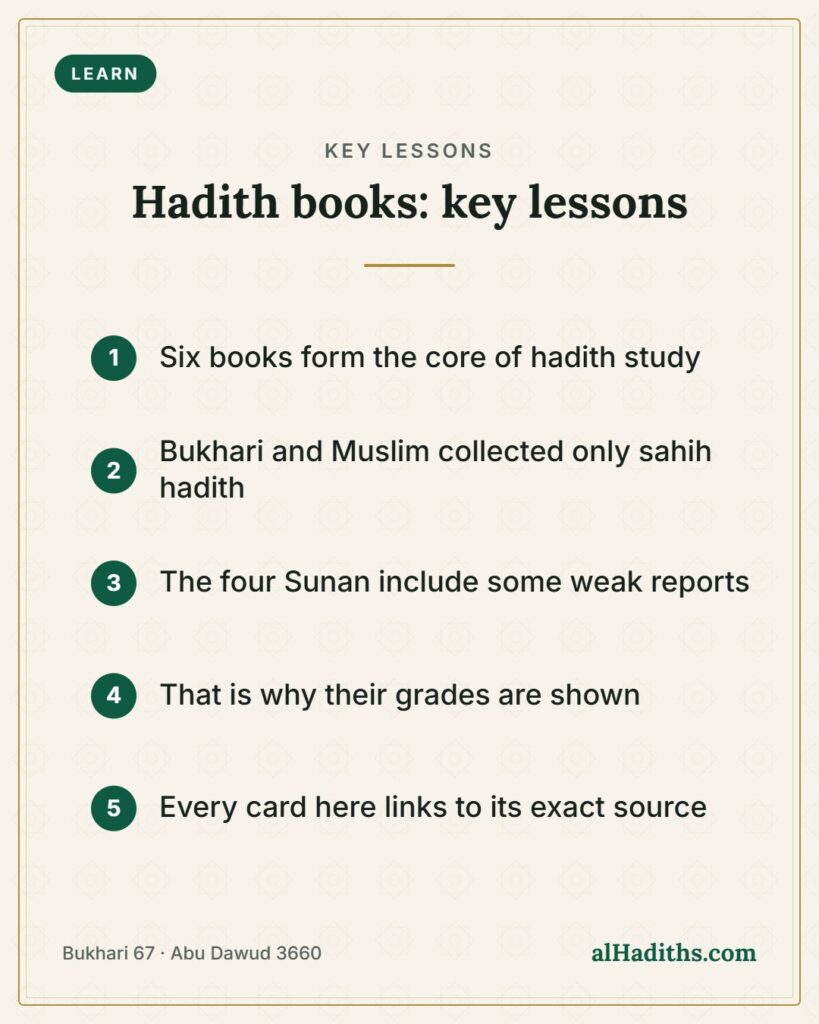
- The Six Books are the core hadith books: two Sahihs and four Sunan.
- Bukhari and Muslim collected only sahih hadith; the four Sunan include some weak ones.
- That is why grades are shown for Abu Dawud, at-Tirmidhi, an-Nasa’i and Ibn Majah.
- The compilers travelled for years to check and pass on the Sunnah.
- When you share a hadith, give its book and number.
Pick one of the six books and read a single hadith from it today, and notice the chain of names that carried it to you.
Save this to Pinterest so you know where the hadith you read come from
Share the reward. Send this article to someone who needs it today — teaching a hadith or dua can become a lasting good deed for you, in shaa Allah.