Contents
Every hadith on this site leads back to one man. Prophet Muhammad ﷺ is the final messenger of Allah, and the hadith are his words, his actions and the descriptions of the people who lived with him. This page gathers authentic hadith about who he was: his life, how he looked, his character, his names, his family and what we owe him.
At a glance
- Who: The final prophet and messenger of Allah
- Born: On a Monday (Sahih Muslim 1162)
- Prophethood: Began at age forty
- Makkah, then Madinah: 13 years, then 10 years after the Hijrah
- Died: At age sixty-three
- Sources: Sahih al-Bukhari and Sahih Muslim, checked on Sunnah.com
The life of Prophet Muhammad ﷺ at a glance
Abu Qatadah (may Allah be pleased with him) reported that the Prophet ﷺ was asked about fasting on Mondays. His answer tells us the day he was born:
وَسُئِلَ عَنْ صَوْمِ يَوْمِ الاِثْنَيْنِ قَالَ ذَاكَ يَوْمٌ وُلِدْتُ فِيهِ وَيَوْمٌ بُعِثْتُ أَوْ أُنْزِلَ عَلَىَّ فِيهِ
He was asked about fasting on Monday, and he said: “That is the day on which I was born, and the day on which I was sent (as a prophet), or on which revelation came down to me.”
Sahih Muslim 1162 · Narrated by Abu Qatadah · Translation adapted from Sunnah.com
The hadith gives the day, not the date. The year and month come from the books of seerah (the Prophet’s biography), and historians differ on them. Ibn ‘Abbas (may Allah be pleased with him) then gives us the shape of his whole mission in one short report:
بُعِثَ رَسُولُ اللَّهِ صلى الله عليه وسلم لأَرْبَعِينَ سَنَةً، فَمَكُثَ بِمَكَّةَ ثَلاَثَ عَشْرَةَ سَنَةً يُوحَى إِلَيْهِ، ثُمَّ أُمِرَ بِالْهِجْرَةِ فَهَاجَرَ عَشْرَ سِنِينَ، وَمَاتَ وَهُوَ ابْنُ ثَلاَثٍ وَسِتِّينَ
The Messenger of Allah ﷺ was sent (as a prophet) at the age of forty. He stayed in Makkah for thirteen years, receiving revelation. Then he was commanded to migrate, so he migrated and lived (in Madinah) for ten years, and he died at the age of sixty-three.
Sahih al-Bukhari 3902 · Narrated by Ibn ‘Abbas · Translation adapted from Sunnah.com
So his life falls into three parts: forty years before prophethood, thirteen years calling people to Allah in Makkah, and ten years in Madinah after the Hijrah (migration). ‘Aishah (may Allah be pleased with her) also reported that he died at sixty-three (Sahih al-Bukhari 3536).
His family line
Wathilah ibn al-Asqa‘ (may Allah be pleased with him) heard the Prophet ﷺ describe his lineage, which goes back to Prophet Isma‘il (peace be upon him):
إِنَّ اللَّهَ اصْطَفَى كِنَانَةَ مِنْ وَلَدِ إِسْمَاعِيلَ وَاصْطَفَى قُرَيْشًا مِنْ كِنَانَةَ وَاصْطَفَى مِنْ قُرَيْشٍ بَنِي هَاشِمٍ وَاصْطَفَانِي مِنْ بَنِي هَاشِمٍ
Indeed, Allah chose Kinanah from the descendants of Isma‘il, chose Quraysh from Kinanah, chose Banu Hashim from Quraysh, and chose me from Banu Hashim.
Sahih Muslim 2276 · Narrated by Wathilah ibn al-Asqa‘ · Translation adapted from Sunnah.com
He was from Quraysh, the leading tribe of Makkah, and from its clan of Banu Hashim. Allah chose the family as well as the man.
How the Prophet ﷺ looked
We do not draw or picture the Prophet ﷺ. Instead, the companions left careful descriptions of him. Anas ibn Malik (may Allah be pleased with him), who served him for ten years, said:
كَانَ رَبْعَةً مِنَ الْقَوْمِ، لَيْسَ بِالطَّوِيلِ وَلاَ بِالْقَصِيرِ، أَزْهَرَ اللَّوْنِ لَيْسَ بِأَبْيَضَ أَمْهَقَ وَلاَ آدَمَ، لَيْسَ بِجَعْدٍ قَطَطٍ وَلاَ سَبْطٍ رَجِلٍ،
He was of medium height among the people, neither tall nor short. He had a bright, rosy complexion, neither very white nor dark brown. His hair was neither very curly nor completely straight.
Sahih al-Bukhari 3547 · Narrated by Anas ibn Malik · Translation adapted from Sunnah.com
Al-Bara’ ibn ‘Azib (may Allah be pleased with him) added more detail:
كَانَ النَّبِيُّ صلى الله عليه وسلم مَرْبُوعًا، بَعِيدَ مَا بَيْنَ الْمَنْكِبَيْنِ، لَهُ شَعَرٌ يَبْلُغُ شَحْمَةَ أُذُنِهِ، رَأَيْتُهُ فِي حُلَّةٍ حَمْرَاءَ، لَمْ أَرَ شَيْئًا قَطُّ أَحْسَنَ مِنْهُ
The Prophet ﷺ was of medium height and broad-shouldered. His hair reached his earlobes. I saw him in a red garment, and I have never seen anything more beautiful than him.
Sahih al-Bukhari 3551 · Narrated by al-Bara’ ibn ‘Azib · Translation adapted from Sunnah.com
These details were kept because people loved him and wanted those who came later to know him.
His character: “his character was the Quran”
Allah Himself praised the Prophet’s ﷺ character in the Quran:
وَإِنَّكَ لَعَلَىٰ خُلُقٍ عَظِيمٍ
And indeed, you are of a great moral character.
Surah Al-Qalam 68:4 · Translation: Saheeh International, from Quran.com
When Sa‘d ibn Hisham asked ‘Aishah, the Mother of the Believers, about that character, she answered in one sentence:
يَا أُمَّ الْمُؤْمِنِينَ أَنْبِئِينِي عَنْ خُلُقِ رَسُولِ اللَّهِ صلى الله عليه وسلم. قَالَتْ أَلَسْتَ تَقْرَأُ الْقُرْآنَ قُلْتُ بَلَى. قَالَتْ فَإِنَّ خُلُقَ نَبِيِّ اللَّهِ صلى الله عليه وسلم كَانَ الْقُرْآنَ
“O Mother of the Believers, tell me about the character of the Messenger of Allah ﷺ.” She said: “Do you not recite the Quran?” I said: “Yes.” She said: “The character of the Prophet of Allah ﷺ was the Quran.”
Sahih Muslim 746 · Narrated by ‘Aishah (asked by Sa‘d ibn Hisham) · Translation adapted from Sunnah.com
HadeethEnc explains that whatever the Quran commanded, he did, and whatever it forbade, he avoided, so his manners were the Quran put into practice (HadeethEnc 8265). The hadith below show what that looked like day to day.
With those who served him
خَدَمْتُ النَّبِيَّ صلى الله عليه وسلم عَشْرَ سِنِينَ، فَمَا قَالَ لِي أُفٍّ. وَلاَ لِمَ صَنَعْتَ وَلاَ أَلاَّ صَنَعْتَ
I served the Prophet ﷺ for ten years, and he never once said “uff” to me, nor did he ever say, “Why did you do that?” or “Why did you not do this?”
Sahih al-Bukhari 6038 · Narrated by Anas ibn Malik · Translation adapted from Sunnah.com
Ten years is a long time to live with someone without a single word of irritation. HadeethEnc notes that “uff” is a small word of annoyance, and even that never came from him (HadeethEnc 6221).
At home with his family
سَأَلْتُ عَائِشَةَ مَا كَانَ النَّبِيُّ صلى الله عليه وسلم يَصْنَعُ فِي بَيْتِهِ قَالَتْ كَانَ يَكُونُ فِي مِهْنَةِ أَهْلِهِ ـ تَعْنِي خِدْمَةَ أَهْلِهِ ـ فَإِذَا حَضَرَتِ الصَّلاَةُ خَرَجَ إِلَى الصَّلاَةِ
I asked ‘Aishah what the Prophet ﷺ used to do at home. She said: “He used to be busy serving his family, and when it was time for prayer, he would go out to pray.”
Sahih al-Bukhari 676 · Narrated by al-Aswad, from ‘Aishah · Translation adapted from Sunnah.com
With children
مَنْ لاَ يَرْحَمُ لاَ يُرْحَمُ
The Messenger of Allah ﷺ kissed al-Hasan ibn ‘Ali while al-Aqra‘ ibn Habis was sitting with him. Al-Aqra‘ said, “I have ten children and I have never kissed any of them.” The Messenger of Allah ﷺ looked at him and said: “Whoever does not show mercy will not be shown mercy.”
Sahih al-Bukhari 5997 · Narrated by Abu Hurairah · Translation adapted from Sunnah.com
Gentle, never cruel
مَا ضَرَبَ رَسُولُ اللَّهِ صلى الله عليه وسلم شَيْئًا قَطُّ بِيَدِهِ وَلاَ امْرَأَةً وَلاَ خَادِمًا إِلاَّ أَنْ يُجَاهِدَ فِي سَبِيلِ اللَّهِ وَمَا نِيلَ مِنْهُ شَىْءٌ قَطُّ فَيَنْتَقِمَ مِنْ صَاحِبِهِ إِلاَّ أَنْ يُنْتَهَكَ شَىْءٌ مِنْ مَحَارِمِ اللَّهِ فَيَنْتَقِمَ لِلَّهِ عَزَّ وَجَلَّ
The Messenger of Allah ﷺ never struck anything with his hand, not a woman and not a servant, except when fighting in the cause of Allah. And whenever he was harmed by someone, he never took revenge, unless something Allah made sacred was violated; then he would act for the sake of Allah, the Mighty and Majestic.
Sahih Muslim 2328 · Narrated by ‘Aishah · Translation adapted from Sunnah.com
‘Aishah also said that whenever he had to choose between two matters, he took the easier one as long as it was not a sin (Sahih al-Bukhari 3560). And he taught that the best of people are those with the best character (Sahih al-Bukhari 6035). Allah describes why he was sent:
وَمَآ أَرْسَلْنَـٰكَ إِلَّا رَحْمَةً لِّلْعَـٰلَمِينَ
And We have not sent you, [O Muḥammad], except as a mercy to the worlds.
Surah Al-Anbiya 21:107 · Translation: Saheeh International, from Quran.com
His names
Jubayr ibn Mut‘im (may Allah be pleased with him) reported that the Prophet ﷺ named himself:
لِي خَمْسَةُ أَسْمَاءٍ أَنَا مُحَمَّدٌ، وَأَحْمَدُ، وَأَنَا الْمَاحِي الَّذِي يَمْحُو اللَّهُ بِي الْكُفْرَ، وَأَنَا الْحَاشِرُ الَّذِي يُحْشَرُ النَّاسُ عَلَى قَدَمِي، وَأَنَا الْعَاقِبُ
I have five names: I am Muhammad and Ahmad. I am al-Mahi, through whom Allah wipes out disbelief. I am al-Hashir, at whose feet the people will be gathered. And I am al-‘Aqib (the last, after whom there is no prophet).
Sahih al-Bukhari 3532 · Narrated by Jubayr ibn Mut‘im · Translation adapted from Sunnah.com
HadeethEnc points out that this does not mean he has only five names (HadeethEnc 10860). In another report, Abu Musa al-Ash‘ari (may Allah be pleased with him) heard him list more:
أَنَا مُحَمَّدٌ وَأَحْمَدُ وَالْمُقَفِّي وَالْحَاشِرُ وَنَبِيُّ التَّوْبَةِ وَنَبِيُّ الرَّحْمَةِ
I am Muhammad, Ahmad, al-Muqaffi (the last in succession), al-Hashir, the Prophet of repentance and the Prophet of mercy.
Sahih Muslim 2355 · Narrated by Abu Musa al-Ash‘ari · Translation adapted from Sunnah.com
The Seal of the Prophets
The Quran calls him the last of the prophets:
مَّا كَانَ مُحَمَّدٌ أَبَآ أَحَدٍ مِّن رِّجَالِكُمْ وَلَـٰكِن رَّسُولَ ٱللَّهِ وَخَاتَمَ ٱلنَّبِيِّـۧنَ ۗ وَكَانَ ٱللَّهُ بِكُلِّ شَىْءٍ عَلِيمًا
Muḥammad is not the father of [any] one of your men, but [he is] the Messenger of Allāh and seal [i.e., last] of the prophets. And ever is Allāh, of all things, Knowing.
Surah Al-Ahzab 33:40 · Translation: Saheeh International, from Quran.com
The Prophet ﷺ explained the same truth with a picture anyone can understand:
إِنَّ مَثَلِي وَمَثَلَ الأَنْبِيَاءِ مِنْ قَبْلِي كَمَثَلِ رَجُلٍ بَنَى بَيْتًا فَأَحْسَنَهُ وَأَجْمَلَهُ، إِلاَّ مَوْضِعَ لَبِنَةٍ مِنْ زَاوِيَةٍ، فَجَعَلَ النَّاسُ يَطُوفُونَ بِهِ وَيَعْجَبُونَ لَهُ، وَيَقُولُونَ هَلاَّ وُضِعَتْ هَذِهِ اللَّبِنَةُ قَالَ فَأَنَا اللَّبِنَةُ، وَأَنَا خَاتِمُ النَّبِيِّينَ
My example and the example of the prophets before me is like a man who built a house, and built it well and beautifully, except for the place of one brick in a corner. People walk around it, admire it and say: ‘If only this brick were put in its place!’ I am that brick, and I am the seal of the prophets.
Sahih al-Bukhari 3535 · Narrated by Abu Hurairah · Translation adapted from Sunnah.com
No prophet comes after him, and his message is for all people until the Last Day. On that Day, he said, he will be the first to intercede (Sahih Muslim 2278).
His family
Allah says in the Quran that the Prophet’s ﷺ wives are the mothers of the believers (Surah Al-Ahzab 33:6), which is why each of them is called “Mother of the Believers”. The Prophet ﷺ married eleven women, may Allah be pleased with them all (list from IslamQA 47072, which draws on the classical seerah works):
- Khadijah bint Khuwaylid
- Sawdah bint Zam‘ah
- ‘Aishah bint Abi Bakr as-Siddiq
- Hafsah bint ‘Umar
- Zaynab bint Khuzaymah
- Umm Salamah bint Abi Umayyah
- Juwayriyah bint al-Harith
- Zaynab bint Jahsh
- Umm Habibah bint Abi Sufyan
- Maymunah bint al-Harith
- Safiyyah bint Huyayy
He had seven children, three sons and four daughters. All of them were born to Khadijah except Ibrahim, whose mother was Mariyah al-Qibtiyyah. All of his children died in his lifetime except Fatimah, who died after him (IslamQA 23294, citing Ibn al-Qayyim’s Zad al-Ma‘ad):
- Sons: al-Qasim, ‘Abdullah and Ibrahim
- Daughters: Zaynab, Ruqayyah, Umm Kulthum and Fatimah
‘Aishah spoke of his love for Khadijah (may Allah be pleased with her), his wife in Makkah:
مَا غِرْتُ عَلَى أَحَدٍ مِنْ نِسَاءِ النَّبِيِّ صلى الله عليه وسلم مَا غِرْتُ عَلَى خَدِيجَةَ، وَمَا رَأَيْتُهَا، وَلَكِنْ كَانَ النَّبِيُّ صلى الله عليه وسلم يُكْثِرُ ذِكْرَهَا، وَرُبَّمَا ذَبَحَ الشَّاةَ، ثُمَّ يُقَطِّعُهَا أَعْضَاءً، ثُمَّ يَبْعَثُهَا فِي صَدَائِقِ خَدِيجَةَ، فَرُبَّمَا قُلْتُ لَهُ كَأَنَّهُ لَمْ يَكُنْ فِي الدُّنْيَا امْرَأَةٌ إِلاَّ خَدِيجَةُ. فَيَقُولُ إِنَّهَا كَانَتْ وَكَانَتْ، وَكَانَ لِي مِنْهَا وَلَدٌ
I never felt as jealous of any of the wives of the Prophet ﷺ as I did of Khadijah, though I never saw her. But the Prophet ﷺ used to mention her often. Sometimes he would slaughter a sheep, cut it into pieces and send them to Khadijah’s friends. I would sometimes say to him, “It is as if there were no woman in the world except Khadijah!” He would say, “She was this and she was that, and I had children from her.”
Sahih al-Bukhari 3818 · Narrated by ‘Aishah · Translation adapted from Sunnah.com
Of his daughter Fatimah (may Allah be pleased with her), al-Miswar ibn Makhramah (may Allah be pleased with him) reported:
فَاطِمَةُ بَضْعَةٌ مِنِّي، فَمَنْ أَغْضَبَهَا أَغْضَبَنِي
Fatimah is a part of me, so whoever angers her angers me.
Sahih al-Bukhari 3714 · Narrated by al-Miswar ibn Makhramah · Translation adapted from Sunnah.com
When his infant son Ibrahim was dying, the Prophet’s ﷺ eyes filled with tears, and he said that the eye sheds tears and the heart grieves, but we say only what pleases our Lord (Sahih al-Bukhari 1303). He also wept at the grave of his mother (Sahih Muslim 976).
What we owe him
Believing in him is part of faith, and loving him is part of that belief. Anas ibn Malik reported:
لاَ يُؤْمِنُ أَحَدُكُمْ حَتَّى أَكُونَ أَحَبَّ إِلَيْهِ مِنْ وَالِدِهِ وَوَلَدِهِ وَالنَّاسِ أَجْمَعِينَ
None of you truly believes until I am more beloved to him than his father, his children and all the people.
Sahih al-Bukhari 15 · Narrated by Anas ibn Malik · Translation adapted from Sunnah.com
Allah also commands us to send blessings (salawat) upon him:
إِنَّ ٱللَّهَ وَمَلَـٰٓئِكَتَهُۥ يُصَلُّونَ عَلَى ٱلنَّبِىِّ ۚ يَـٰٓأَيُّهَا ٱلَّذِينَ ءَامَنُوا۟ صَلُّوا۟ عَلَيْهِ وَسَلِّمُوا۟ تَسْلِيمًا
Indeed, Allāh confers blessing upon the Prophet, and His angels [ask Him to do so]. O you who have believed, ask [Allāh to confer] blessing upon him and ask [Allāh to grant him] peace.
Surah Al-Ahzab 33:56 · Translation: Saheeh International, from Quran.com
Whoever sends one blessing on him, Allah sends ten upon that person (Sahih Muslim 408). Our guide to salawat on the Prophet ﷺ shows how.
Reflection: Love that stays in the heart is only half the picture. When ‘Aishah said his character was the Quran, she pointed to something we can practise: a softer word at home, patience with those who work for us, mercy with children. Each of these is a small step towards him.
Questions people ask
When was Prophet Muhammad ﷺ born?
The Prophet ﷺ said he was born on a Monday (Sahih Muslim 1162). The hadith does not give the date. The year and month come from the seerah books, and historians differ on them.
How old was the Prophet ﷺ when he died?
He died at the age of sixty-three, as reported by Ibn ‘Abbas and ‘Aishah in Sahih al-Bukhari (3902 and 3536).
What are the names of the Prophet ﷺ?
In Sahih al-Bukhari 3532 he names five: Muhammad, Ahmad, al-Mahi, al-Hashir and al-‘Aqib. Sahih Muslim 2355 adds al-Muqaffi, the Prophet of repentance and the Prophet of mercy.
Why do Muslims say ﷺ after his name?
The sign ﷺ stands for “sallallahu ‘alayhi wa sallam”, meaning “may Allah send blessings and peace upon him”. Allah commands believers to send blessings on him (Quran 33:56), and Allah sends ten blessings on whoever sends one (Sahih Muslim 408).
Key lessons
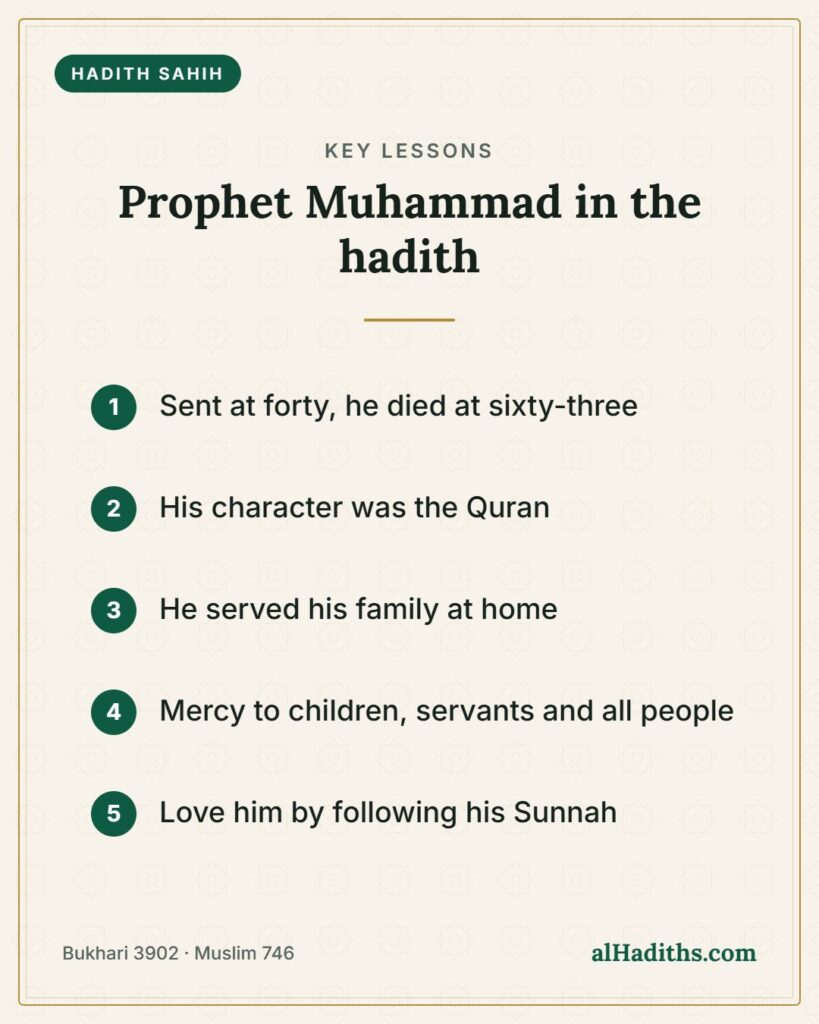
- The Prophet ﷺ was sent at forty and died at sixty-three, after 13 years in Makkah and 10 in Madinah.
- His character was the Quran put into practice.
- He served his family, was gentle with servants and showed mercy to children.
- He is the Seal of the Prophets, sent as a mercy to the worlds.
- We show our love by following his Sunnah and sending salawat on him.
Start reading his words
The best way to know the Prophet ﷺ is through his own words. Begin with Imam an-Nawawi’s 40 Hadith, learn how he prayed in the Salah series, or read what he taught about Jannah and Jahannam.
May Allah fill our hearts with love for His Messenger ﷺ and help us follow him in our homes, our work and our worship.
Save this to Pinterest so you can come back to it and share it
Share the reward. Send this article to someone who needs it today — teaching a hadith or dua can become a lasting good deed for you, in shaa Allah.