Tawbah Prayer (Salat al-Tawbah): How the Prophet ﷺ Taught It
Contents
Everyone slips. A harsh word, a missed prayer, a glance we regret. Salat al-Tawbah, the prayer of repentance, is what the Prophet ﷺ taught for that moment: make wudu, pray two rak‘ahs, and ask Allah to forgive you. This article goes through the authentic hadith behind it, what scholars explain from it, and how to pray it.
At a glance
- Source: Sunan Abi Dawud 1521, also in Tirmidhi and Ibn Majah
- Narrated by: Abu Bakr as-Siddiq (may Allah be pleased with him)
- Grade: Sahih (al-Albani)
- Topic: The two rak‘ahs of repentance after a sin
- Practise it: After a sin, make wudu, pray two rak‘ahs and ask Allah’s forgiveness
The hadith of Salat al-Tawbah
‘Ali ibn Abi Talib (may Allah be pleased with him) said that when someone told him a hadith, he would ask them to swear to it. But Abu Bakr as-Siddiq (may Allah be pleased with him) told him this one, “and Abu Bakr spoke the truth”:
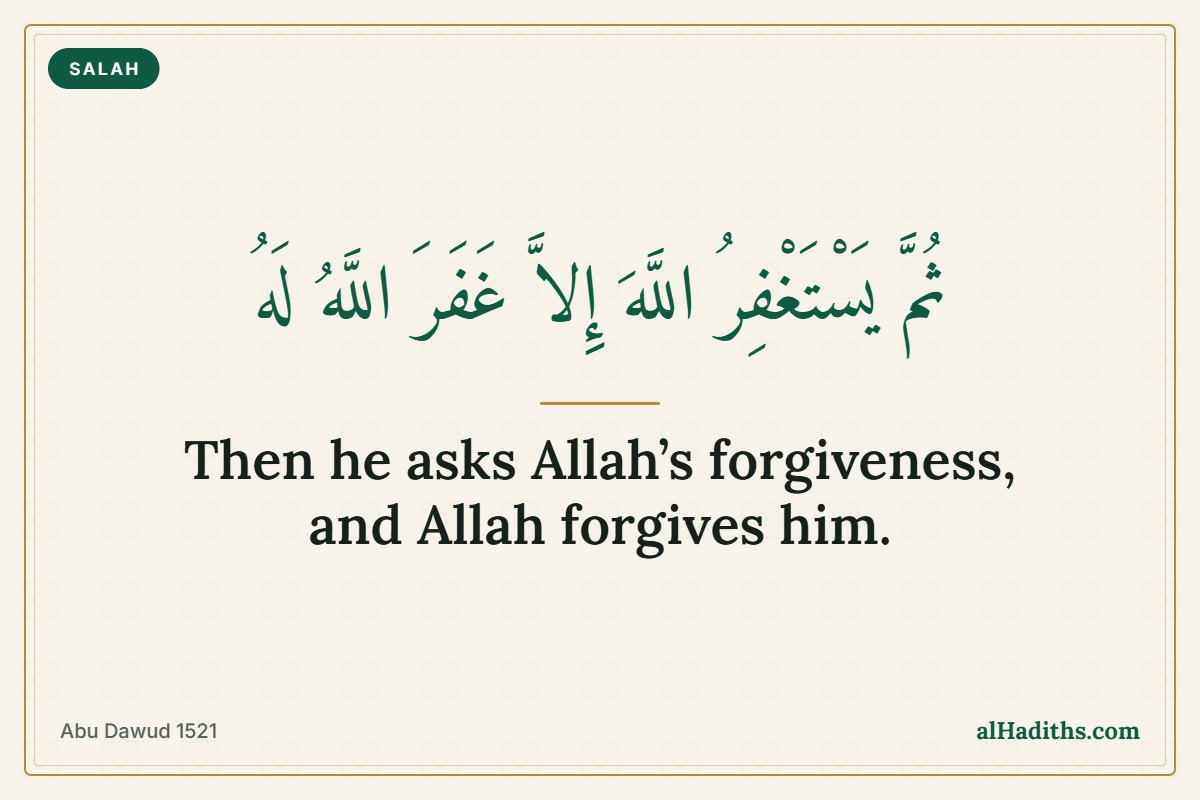
مَا مِنْ عَبْدٍ يُذْنِبُ ذَنْبًا فَيُحْسِنُ الطُّهُورَ ثُمَّ يَقُومُ فَيُصَلِّي رَكْعَتَيْنِ ثُمَّ يَسْتَغْفِرُ اللَّهَ إِلاَّ غَفَرَ اللَّهُ لَهُ
“There is no servant who commits a sin, then purifies himself well, then stands and prays two rak‘ahs, then asks Allah’s forgiveness, except that Allah forgives him.”
Sunan Abi Dawud 1521 · Sahih (al-Albani) · Narrated by Abu Bakr as-Siddiq · Also Tirmidhi 406 and Ibn Majah 1395, Hasan (Darussalam) · Translation adapted from Sunnah.com
Then the Prophet ﷺ recited a verse from Surah Al ‘Imran about the people who remember Allah straight after they do wrong:
وَٱلَّذِينَ إِذَا فَعَلُوا۟ فَـٰحِشَةً أَوْ ظَلَمُوٓا۟ أَنفُسَهُمْ ذَكَرُوا۟ ٱللَّهَ فَٱسْتَغْفَرُوا۟ لِذُنُوبِهِمْ وَمَن يَغْفِرُ ٱلذُّنُوبَ إِلَّا ٱللَّهُ وَلَمْ يُصِرُّوا۟ عَلَىٰ مَا فَعَلُوا۟ وَهُمْ يَعْلَمُونَ
“And those who, when they commit an immorality or wrong themselves [by transgression], remember Allāh and seek forgiveness for their sins – and who can forgive sins except Allāh? – and [who] do not persist in what they have done while they know.”
Surah Al ‘Imran 3:135 · Translation: Saheeh International, from Quran.com
What the hadith means
The Encyclopedia of Translated Prophetic Hadiths (HadeethEnc) explains that the person makes a perfect ablution, then offers two rak‘ahs “with the intention of repenting of this sin,” then asks Allah to forgive him, and Allah forgives him. It draws two benefits from the hadith: Muslims are urged to pray and seek Allah’s forgiveness after a sin, and it shows how wide Allah’s forgiveness is.
The verse the Prophet ﷺ recited adds the last piece. The people praised in it remember Allah, ask forgiveness, and do not persist in what they did. So the prayer is not a ritual that cancels a sin we plan to repeat. It is a way of turning back: regret, a clean start with wudu, two rak‘ahs, and a sincere plea.
Reflection: notice that the hadith says “there is no servant.” It does not limit this to the pious or the scholars. Anyone who slips can take this path back, the same day, with nothing more than water and two rak‘ahs.
Two rak‘ahs with a present heart
A hadith in Sahih al-Bukhari shows what makes these two rak‘ahs so powerful. Humran, the freed slave of ‘Uthman ibn ‘Affan (may Allah be pleased with him), watched ‘Uthman make wudu, then heard him say that the Prophet ﷺ said:
مَنْ تَوَضَّأَ نَحْوَ وُضُوئِي هَذَا ثُمَّ صَلَّى رَكْعَتَيْنِ، لاَ يُحَدِّثُ فِيهِمَا نَفْسَهُ، غَفَرَ اللَّهُ لَهُ مَا تَقَدَّمَ مِنْ ذَنْبِهِ
“Whoever performs ablution like this ablution of mine, then prays two rak‘ahs in which he does not let his mind wander, Allah forgives his past sins.”
Sahih al-Bukhari 164 · Narrated by ‘Uthman ibn ‘Affan · Translation adapted from Sunnah.com
This hadith is not only about repentance, but it points to the same gift: wudu done well, then two rak‘ahs prayed with focus. If you are praying Salat al-Tawbah, slow down and keep your mind on your prayer and on what you are asking for. Our guide on how to make wudu shows the Prophet’s ﷺ ablution step by step.
The door of repentance stays open
Some people feel they have sinned too often to come back. Abu Musa al-Ash‘ari (may Allah be pleased with him) reported that the Prophet ﷺ said:
إِنَّ اللَّهَ عَزَّ وَجَلَّ يَبْسُطُ يَدَهُ بِاللَّيْلِ لِيَتُوبَ مُسِيءُ النَّهَارِ وَيَبْسُطُ يَدَهُ بِالنَّهَارِ لِيَتُوبَ مُسِيءُ اللَّيْلِ حَتَّى تَطْلُعَ الشَّمْسُ مِنْ مَغْرِبِهَا
“Allah, the Exalted and Glorious, stretches out His Hand at night so that the one who did wrong in the day may repent, and stretches out His Hand in the day so that the one who did wrong at night may repent, until the sun rises from the west.”
Sahih Muslim 2759 · Narrated by Abu Musa al-Ash‘ari · Translation adapted from Sunnah.com
Night and day, the invitation is renewed. Whenever a sin happens, the time to turn back is now, until the sun rises from the west, when repentance is no longer accepted.
How to pray Salat al-Tawbah
The hadith gives the steps but no fixed time, no special surahs and no special dua. Here is what it describes, with some suggestions marked as suggestions:
- Regret the sin and stop it. The verse praises those who “do not persist” in what they did.
- Make wudu, and make it well. The hadith says “purifies himself well.”
- Pray two rak‘ahs. Pray them like any two-rak‘ah nafl prayer. The hadith does not name surahs, so recite what you know.
- Ask Allah’s forgiveness. The hadith does not fix the words. One suggestion is Sayyidul Istighfar, the best form of asking forgiveness the Prophet ﷺ taught, or simply “Astaghfirullah” from the heart.
- Make it right with people. If the sin wronged someone, put it right with them too. Ask a local scholar if you are unsure how.
Scholars differ on details such as praying it at times when nafl prayer is disliked, so ask a qualified local scholar if that applies to you.
Questions people ask
How many rak‘ahs is Salat al-Tawbah?
Two. The hadith in Sunan Abi Dawud 1521 says the person “stands and prays two rak‘ahs,” then asks Allah’s forgiveness.
When should I pray Salat al-Tawbah?
The hadith links it to the time after a sin, but it gives no fixed hour. Many pray it soon after the sin while the regret is fresh. Scholars differ on praying it at times when nafl prayer is disliked, so ask a local scholar.
Are there special surahs or a special dua for it?
No. The authentic hadith names no surahs and no set words. Methods that fix certain surahs, days or counts are not found in the authentic hadith, so recite what you know and ask forgiveness sincerely, in any language.
Is Salat al-Tawbah obligatory?
It is a voluntary (nafl) prayer that the Prophet ﷺ encouraged. Repentance itself is what Allah asks of every believer; this prayer is one way the Sunnah teaches us to do it.
Key lessons
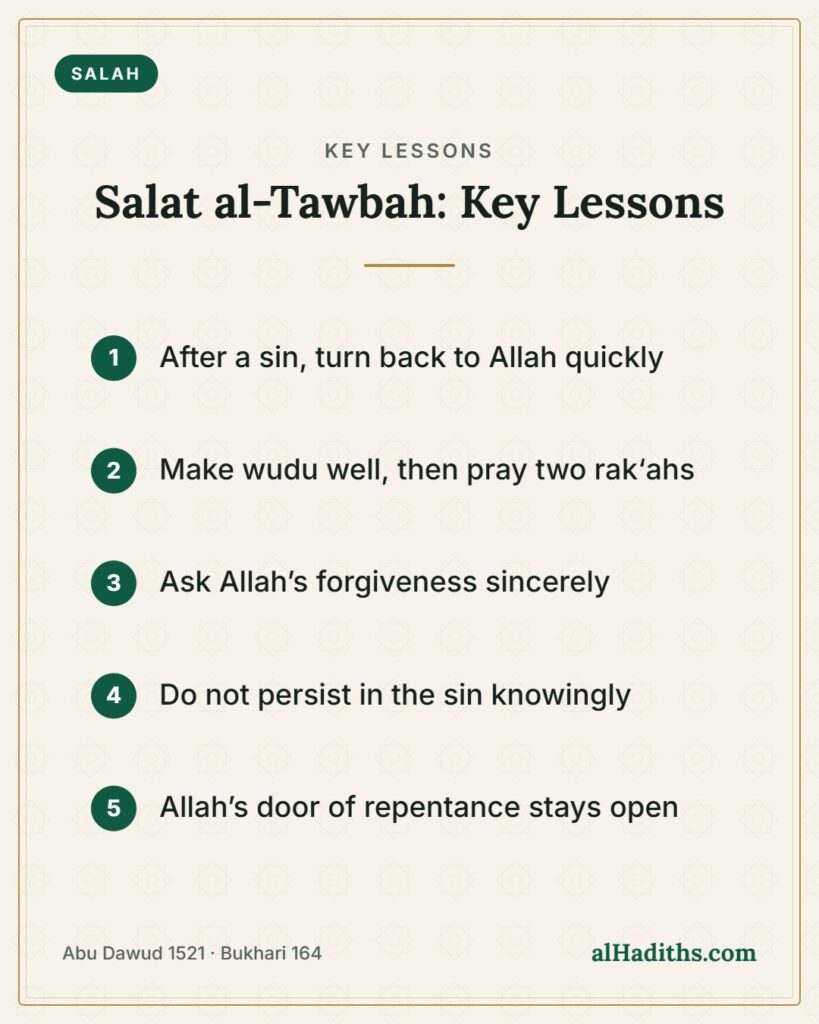
- A sin is not the end: the Prophet ﷺ taught a clear way back.
- Wudu, two rak‘ahs and asking forgiveness are the steps in the hadith.
- Real repentance means not persisting in the sin.
- Pray with a present heart, as in Bukhari 164.
- Allah stretches out His Hand night and day for those who repent.
Part of our Salah series: see all our salah articles in one place.
The next time you slip, don’t let shame keep you away. Get up, make wudu, pray two rak‘ahs, and ask Allah. He is waiting for you to come back.
Save this to Pinterest so you know what to do after a slip
Share the reward. Send this article to someone who needs it today — teaching a hadith or dua can become a lasting good deed for you, in shaa Allah.