Hold Fast to My Sunnah: Hadith 28 of an-Nawawi
One morning, after leading the prayer, the Prophet ﷺ turned to his Companions and spoke so movingly that eyes filled with tears and hearts trembled. They sensed it was a farewell, and asked him for advice to hold on to. His answer is Hadith 28 of Imam an-Nawawi’s collection, the hold fast to my Sunnah hadith: fear Allah, hear and obey, and cling to his Sunnah when people disagree.
At a glance
- Source: Sunan Abi Dawud 4607, also Jami` at-Tirmidhi 2676 (Hadith 28 of an-Nawawi’s 40)
- Narrated by: al-‘Irbad ibn Sariyah (may Allah be pleased with him)
- Grade: Sahih (al-Albani); at-Tirmidhi called it hasan sahih
- Topic: The Prophet’s farewell advice: taqwa, hearing and obeying, and holding fast to the Sunnah
- Put it into practice: When people disagree about a practice, ask for its source in the Quran and Sunnah.
The hadith
Al-‘Irbad ibn Sariyah (may Allah be pleased with him) said that one day the Messenger of Allah ﷺ led them in prayer, then faced them and gave a moving exhortation. A man said: Messenger of Allah, it seems like a farewell exhortation, so what do you advise us? He ﷺ said:
أُوصِيكُمْ بِتَقْوَى اللَّهِ وَالسَّمْعِ وَالطَّاعَةِ وَإِنْ عَبْدًا حَبَشِيًّا فَإِنَّهُ مَنْ يَعِشْ مِنْكُمْ بَعْدِي فَسَيَرَى اخْتِلاَفًا كَثِيرًا فَعَلَيْكُمْ بِسُنَّتِي وَسُنَّةِ الْخُلَفَاءِ الْمَهْدِيِّينَ الرَّاشِدِينَ تَمَسَّكُوا بِهَا وَعَضُّوا عَلَيْهَا بِالنَّوَاجِذِ وَإِيَّاكُمْ وَمُحْدَثَاتِ الأُمُورِ فَإِنَّ كُلَّ مُحْدَثَةٍ بِدْعَةٌ وَكُلَّ بِدْعَةٍ ضَلاَلَةٌ
“I enjoin you to fear Allah, and to hear and obey even if it be an Abyssinian slave, for those of you who live after me will see great disagreement. You must then follow my sunnah and that of the rightly-guided caliphs. Hold to it and stick fast to it. Avoid novelties, for every novelty is an innovation, and every innovation is an error.”
Sunan Abi Dawud 4607 · Narrated by al-‘Irbad ibn Sariyah · Sahih (al-Albani) · Translation from Sunnah.com
At-Tirmidhi’s narration adds that the sermon came after the morning prayer:
وَعَظَنَا رَسُولُ اللَّهِ صلى الله عليه وسلم يَوْمًا بَعْدَ صَلاَةِ الْغَدَاةِ مَوْعِظَةً بَلِيغَةً ذَرَفَتْ مِنْهَا الْعُيُونُ وَوَجِلَتْ مِنْهَا الْقُلُوبُ
“One day after the morning Salat, the Messenger of Allah (ﷺ) exhorted us to the extent that the eyes wept and the hearts shuddered with fear.”
Jami` at-Tirmidhi 2676 · Sahih (Darussalam); at-Tirmidhi said hasan sahih · Translation from Sunnah.com
Imam an-Nawawi gives it as Hadith 28 of his 40 Hadith.
What “hold fast to my Sunnah” means
The Encyclopedia of Translated Prophetic Hadiths (HadeethEnc) explains the main parts of the advice:
- Taqwa of Allah: doing what He has made obligatory and staying away from what He has forbidden, at all times and in every situation.
- Hearing and obeying, even if a slave is put in charge: HadeethEnc explains that even if the one in authority were of the lowest standing, believers should not look down on obeying him, so that turmoil and strife are avoided, as long as it does not involve disobeying Allah.
- “Those of you who live after me will see great disagreement”: discord would come to this Ummah, and the way out is to return to the Sunnah.
- The rightly guided caliphs are Abu Bakr as-Siddiq, ‘Umar ibn al-Khattab, ‘Uthman ibn ‘Affan and ‘Ali ibn Abi Talib (may Allah be pleased with them).
- “Stick fast to it”: the Arabic وَعَضُّوا عَلَيْهَا بِالنَّوَاجِذِ pictures biting on something with the molar teeth, meaning to hold on to the Sunnah firmly.
- “Avoid novelties”: a warning against bringing new matters into the religion, since every innovation in the religion is misguidance.
For more on that last warning, see the hadith on bid’ah. The Quran gives the same way back when people disagree:
يَـٰٓأَيُّهَا ٱلَّذِينَ ءَامَنُوٓا۟ أَطِيعُوا۟ ٱللَّهَ وَأَطِيعُوا۟ ٱلرَّسُولَ وَأُو۟لِى ٱلْأَمْرِ مِنكُمْ ۖ فَإِن تَنَـٰزَعْتُمْ فِى شَىْءٍ فَرُدُّوهُ إِلَى ٱللَّهِ وَٱلرَّسُولِ إِن كُنتُمْ تُؤْمِنُونَ بِٱللَّهِ وَٱلْيَوْمِ ٱلْـَٔاخِرِ ۚ ذَٰلِكَ خَيْرٌ وَأَحْسَنُ تَأْوِيلًا
“O you who have believed, obey Allāh and obey the Messenger and those in authority among you. And if you disagree over anything, refer it to Allāh and the Messenger, if you should believe in Allāh and the Last Day. That is the best [way] and best in result.”
Surah An-Nisa 4:59 · Translation: Saheeh International, from Quran.com
Reflection: what moves me here is the timing. Knowing he would not always be with them, the Prophet ﷺ did not leave his Companions a long list. He left them taqwa, unity, and his Sunnah to hold on to, and told them plainly that disagreement would come. It is advice for every generation, including ours.
How to put it into practice
These are suggestions drawn from the hadith and its explanation:
- Keep taqwa at the center, in private as well as in public; see fear Allah wherever you are.
- Learn the Sunnah from authentic sources, and check a hadith’s source and grading before you share it.
- When people disagree, go back to the Quran and Sunnah, as Quran 4:59 teaches, and ask for the source of a practice before taking it up.
- Be careful with new practices in worship. For questions about a particular practice, ask a qualified local scholar.
- Give sincere advice and help keep the community united; see the religion is sincerity.
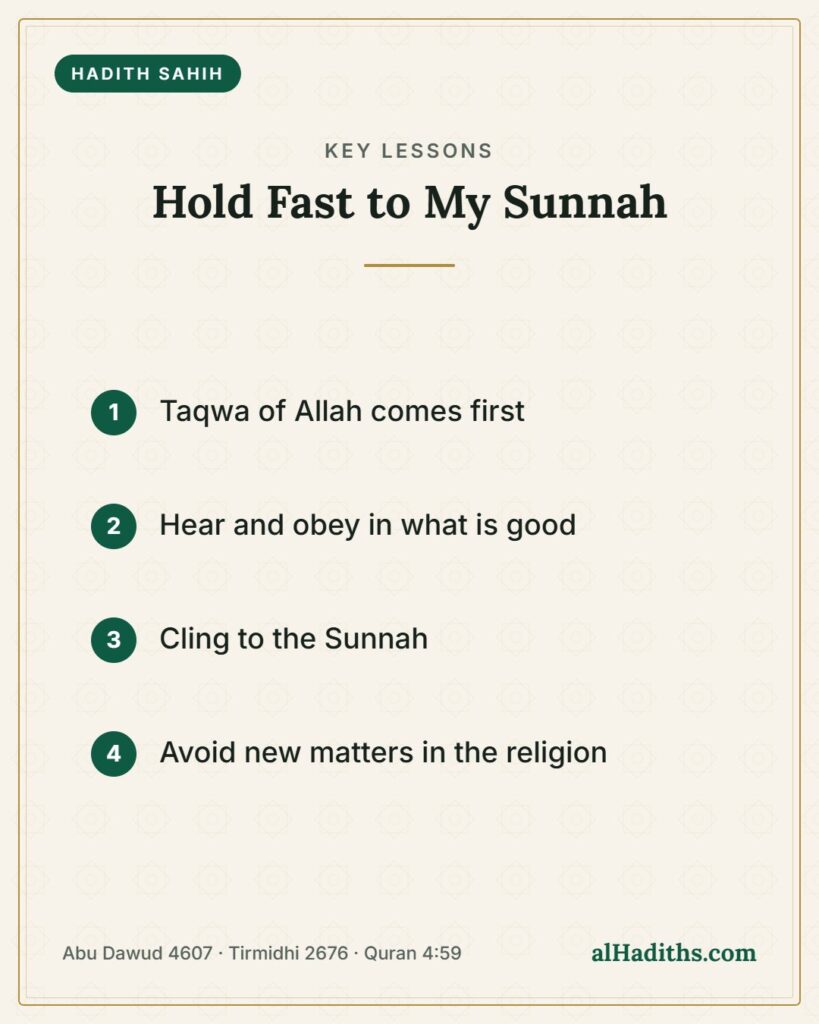
Key lessons
- Taqwa of Allah comes first, at all times.
- Hear and obey those in authority, as long as it is not disobedience to Allah.
- Hold fast to the Sunnah and the way of the rightly guided caliphs.
- Avoid new matters in the religion; every innovation in it is misguidance.
Questions people ask
Who are the rightly guided caliphs in the hadith?
The Encyclopedia of Translated Prophetic Hadiths (HadeethEnc) names them as Abu Bakr as-Siddiq, ‘Umar ibn al-Khattab, ‘Uthman ibn ‘Affan and ‘Ali ibn Abi Talib (may Allah be pleased with them).
What does “bite onto it with your molar teeth” mean?
It means holding on to the Sunnah firmly, the way you would grip something with your back teeth so it cannot slip away.
Is this the Prophet’s farewell sermon?
The Companions described it as sounding like a farewell exhortation, and asked him for lasting advice. It is reported in Sunan Abi Dawud 4607 and Jami` at-Tirmidhi 2676, after a prayer.
One thing for today: learn one Sunnah of the Prophet ﷺ you are not yet doing, from an authentic source, and begin it.
Save this to Pinterest so you can come back to this hadith later.
Share the reward. Send this article to someone who needs it today — teaching a hadith or dua can become a lasting good deed for you, in shaa Allah.