Khushu in Salah: 6 Hadith on Focus and Humility in Prayer
Contents
You say the takbir, and a moment later you are thinking about a message, a bill or what to cook tonight. Then you are in the final tashahhud and cannot remember what you recited. Khushu in salah, praying with a humble, present and still heart, is what the Quran ties to the success of the believers, and the Prophet ﷺ showed exactly what takes it away and what brings it back. Here are six authentic texts on it.
At a glance
- Texts: 5 hadith cards, plus Surah al-Mu’minun 23:1–2
- Collections: Sahih al-Bukhari, Sahih Muslim and Sunan Abi Dawud
- Grade: Sahih, plus one Hasan (al-Albani)
- Topic: Salah: khushu, focus and stillness in prayer
- Put it into practice: In your next prayer, stay still in every position until you feel settled
1. Khushu in salah: the mark of successful believers
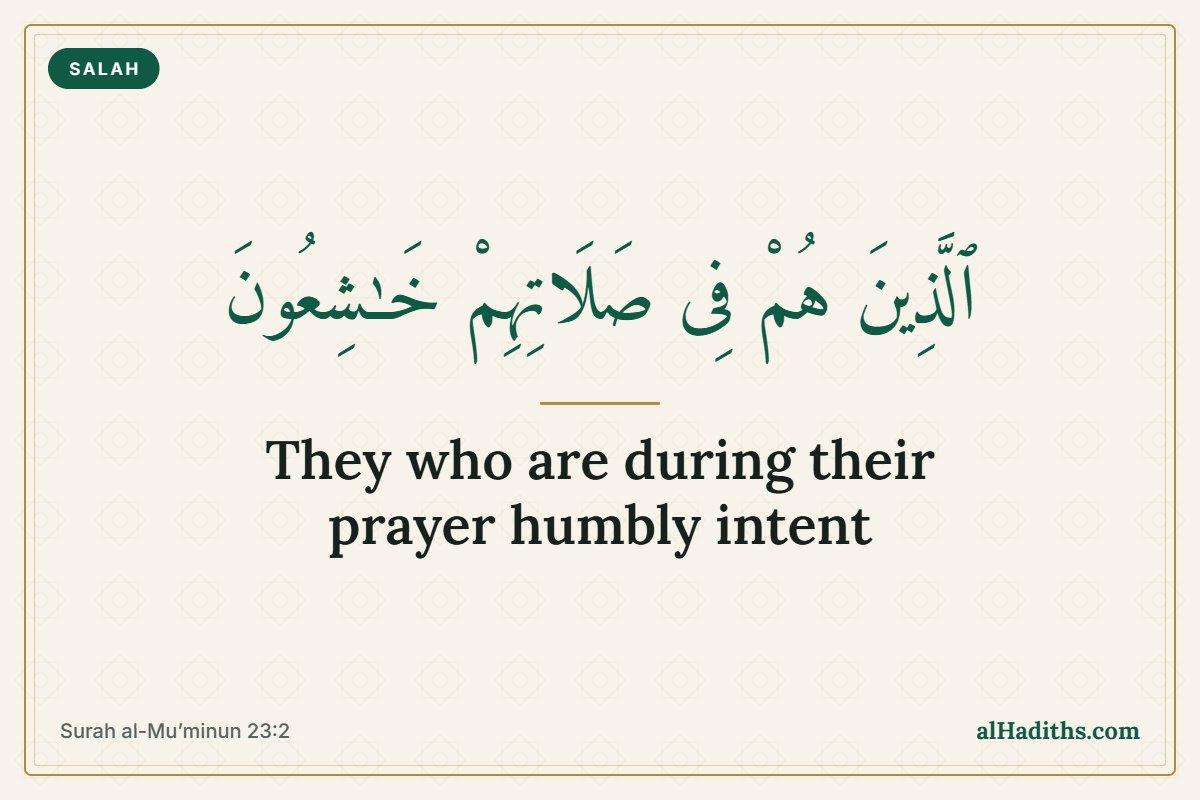
Surah al-Mu’minun opens by naming the believers who succeed, and the first quality it gives them is khushu in their prayer:
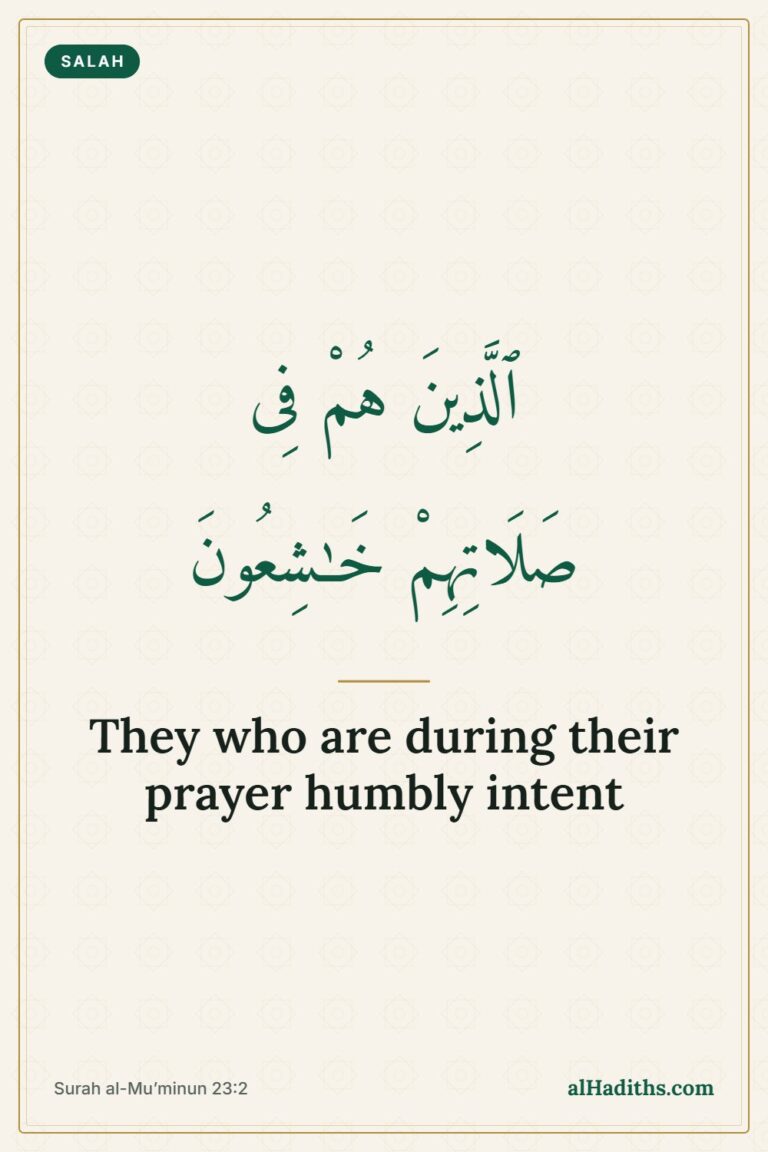
قَدْ أَفْلَحَ ٱلْمُؤْمِنُونَ ٱلَّذِينَ هُمْ فِى صَلَاتِهِمْ خَـٰشِعُونَ
“Certainly will the believers have succeeded: They who are during their prayer humbly intent.”
Surah al-Mu’minun 23:1–2 · Translation: Saheeh International, from Quran.com
Of all the qualities of the believers listed in these verses, Allah begins with how they pray. Khushu is not only about how the body looks; it is a heart that is humble before Allah and present in what it is doing. The hadith below show what that looks like in practice.
Try this: before you raise your hands for the takbir, pause for a breath and remind yourself who you are about to stand before.
2. Two rak’ahs without wandering thoughts
Humran, the freed slave of ‘Uthman ibn ‘Affan (may Allah be pleased with him), watched ‘Uthman make wudu and then heard him say that the Messenger of Allah ﷺ said:
مَنْ تَوَضَّأَ نَحْوَ وُضُوئِي هَذَا، ثُمَّ صَلَّى رَكْعَتَيْنِ، لاَ يُحَدِّثُ فِيهِمَا نَفْسَهُ، غُفِرَ لَهُ مَا تَقَدَّمَ مِنْ ذَنْبِهِ
“If anyone performs ablution like that of mine and offers a two-rak‘ah prayer during which he does not think of anything else (not related to the present prayer), then his past sins will be forgiven.”
Sahih al-Bukhari 159 · Narrated by Humran, from ‘Uthman ibn ‘Affan · Translation adapted from Sunnah.com
The reward here is tied to two things: a careful wudu and a prayer in which the person does not let his own thoughts take over. We looked at the wudu itself in How to Make Wudu; this hadith shows that the focus that follows it is just as important.
Try this: when a stray thought comes, do not argue with it; bring your attention back to the words you are saying.
3. Looking around: what Shaytan steals
‘A’ishah (may Allah be pleased with her) said:
سَأَلْتُ رَسُولَ اللَّهِ صلى الله عليه وسلم عَنْ الاِلْتِفَاتِ فِي الصَّلاَةِ فَقَالَ هُوَ اخْتِلاَسٌ يَخْتَلِسُهُ الشَّيْطَانُ مِنْ صَلاَةِ الْعَبْدِ
“I asked the Messenger of Allah ﷺ about looking here and there in prayer. He replied: ‘It is a way of stealing by which Satan takes away (a portion) from the prayer of a person.’”
Sahih al-Bukhari 751 · Narrated by ‘A’ishah · Translation adapted from Sunnah.com
HadeethEnc explains that the Prophet ﷺ described glancing about as a way the devil quickly and quietly snatches away part of a person’s prayer, so that it loses some of its reward. The eyes often lead the heart: when they wander, the mind follows.
Try this: keep your gaze on the place of your sujud, and pray facing a wall or a plain space rather than a screen or a busy room.
4. Only part of the prayer may be recorded
‘Ammar ibn Yasir (may Allah be pleased with him) said that he heard the Messenger of Allah ﷺ say:
إِنَّ الرَّجُلَ لَيَنْصَرِفُ وَمَا كُتِبَ لَهُ إِلاَّ عُشْرُ صَلاَتِهِ تُسْعُهَا ثُمُنُهَا سُبُعُهَا سُدُسُهَا خُمُسُهَا رُبُعُهَا ثُلُثُهَا نِصْفُهَا
“A man finishes his prayer while only a tenth of his prayer is recorded for him, or a ninth of it, an eighth, a seventh, a sixth, a fifth, a quarter, a third, or half of it.”
Sunan Abi Dawud 796 · Hasan (al-Albani) · Narrated by ‘Ammar ibn Yasir · Translation adapted from Sunnah.com
Two people can stand side by side in the same prayer and leave with very different rewards. The hadith does not say what decides the share, but the other texts in this article point to it: presence of heart, stillness and attention.
Try this: after the salam, ask yourself honestly how much of that prayer you were really in, and aim for a little more next time.
5. “Go back and pray, for you have not prayed”
Abu Hurairah (may Allah be pleased with him) reported that a man came into the masjid, prayed, and greeted the Prophet ﷺ, who returned the greeting and said:
ارْجِعْ فَصَلِّ، فَإِنَّكَ لَمْ تُصَلِّ. فَرَجَعَ يُصَلِّي كَمَا صَلَّى ثُمَّ جَاءَ فَسَلَّمَ عَلَى النَّبِيِّ صلى الله عليه وسلم فَقَالَ ارْجِعْ فَصَلِّ فَإِنَّكَ لَمْ تُصَلِّ ثَلاَثًا. فَقَالَ وَالَّذِي بَعَثَكَ بِالْحَقِّ مَا أُحْسِنُ غَيْرَهُ فَعَلِّمْنِي. فَقَالَ إِذَا قُمْتَ إِلَى الصَّلاَةِ فَكَبِّرْ، ثُمَّ اقْرَأْ مَا تَيَسَّرَ مَعَكَ مِنَ الْقُرْآنِ، ثُمَّ ارْكَعْ حَتَّى تَطْمَئِنَّ رَاكِعًا، ثُمَّ ارْفَعْ حَتَّى تَعْتَدِلَ قَائِمًا، ثُمَّ اسْجُدْ حَتَّى تَطْمَئِنَّ سَاجِدًا، ثُمَّ ارْفَعْ حَتَّى تَطْمَئِنَّ جَالِسًا، وَافْعَلْ ذَلِكَ فِي صَلاَتِكَ كُلِّهَا
“Go back and pray, for you have not prayed.” The man went back and prayed in the same way as before, then came and greeted the Prophet ﷺ, who said: “Go back and pray, for you have not prayed.” This happened three times. The man said: “By Him Who sent you with the Truth, I cannot pray better than this, so teach me.” He said: “When you stand for prayer, say the takbir, then recite what is easy for you of the Quran, then bow until you are at ease in bowing, then rise until you stand straight, then prostrate until you are at ease in prostration, then rise until you are at ease sitting, and do that in all of your prayer.”
Sahih al-Bukhari 757 · Narrated by Abu Hurairah · Translation adapted from Sunnah.com
The man’s prayer had all its movements, but he rushed through them. HadeethEnc explains that he did not settle in his standing, bowing and prostration, and that this calm in each position is one of the pillars of the prayer. Stillness of the body is where khushu of the heart begins.
Try this: in ruku‘ and sujud, let your body come to rest before you begin the words, and do not rise until you have finished them.
6. Clear the distractions first
‘A’ishah (may Allah be pleased with her) said that she heard the Messenger of Allah ﷺ say:
لاَ صَلاَةَ بِحَضْرَةِ الطَّعَامِ وَلاَ وَهُوَ يُدَافِعُهُ الأَخْبَثَانِ
“No prayer can be (rightly said) when the food is there (before the worshipper), or when he is prompted by the call of nature.”
Sahih Muslim 560a · Narrated by ‘A’ishah · Translation adapted from Sunnah.com
HadeethEnc explains the reason: a person who is hungry with food in front of him, or who is holding back the need to relieve himself, will be distracted, so he should remove whatever may distract him before he begins the prayer.
Try this: before each prayer, use the bathroom if you need to, and eat first if the food is already served, as long as the prayer time allows.
How to have khushu in salah
Putting the texts together, these steps come straight from the hadith above:
- Make wudu carefully, the way the Prophet ﷺ made it (Sahih al-Bukhari 159).
- Deal with hunger and the call of nature before you start (Sahih Muslim 560a).
- Keep your eyes from wandering (Sahih al-Bukhari 751).
- Settle fully in every position: standing, ruku‘, sujud and sitting (Sahih al-Bukhari 757).
- When your mind drifts, bring it back to the prayer (Sahih al-Bukhari 159).
A suggestion that is not from these hadith, but helps many people: learn the meaning of what you say in every position, starting with what to say in ruku‘ and sujud. Words you understand are easier to mean.
Bringing it together
Reflection: khushu can sound like something only the very pious reach, but these texts make it practical. Allah praises it, the Prophet ﷺ promised forgiveness for two focused rak’ahs, and he named what eats away at it: wandering eyes, a rushed body and a distracted mind. None of us will be perfect in this, but every prayer is a new chance to be a little more present than the last.
Questions people ask
What is khushu in salah?
Khushu is humility and stillness in prayer, with the heart present before Allah. Allah describes the successful believers as “during their prayer humbly intent” (Surah al-Mu’minun 23:2), and the hadith show its parts: calm in every position (Sahih al-Bukhari 757), not looking around (Sahih al-Bukhari 751) and not letting the mind wander (Sahih al-Bukhari 159).
Is my prayer valid if I lose focus?
The hadith show that a person may have only part of a prayer’s reward recorded (Sunan Abi Dawud 796, Hasan), while rushing the positions was something the Prophet ﷺ told a man to repeat his prayer for (Sahih al-Bukhari 757). For the ruling on a particular prayer, ask a qualified local scholar.
How can I improve khushu in salah?
Start with the steps the Prophet ﷺ taught: a careful wudu, removing distractions such as hunger and the call of nature, keeping your eyes from wandering, and settling fully in each position. Learning the meaning of what you recite also helps.
Key lessons
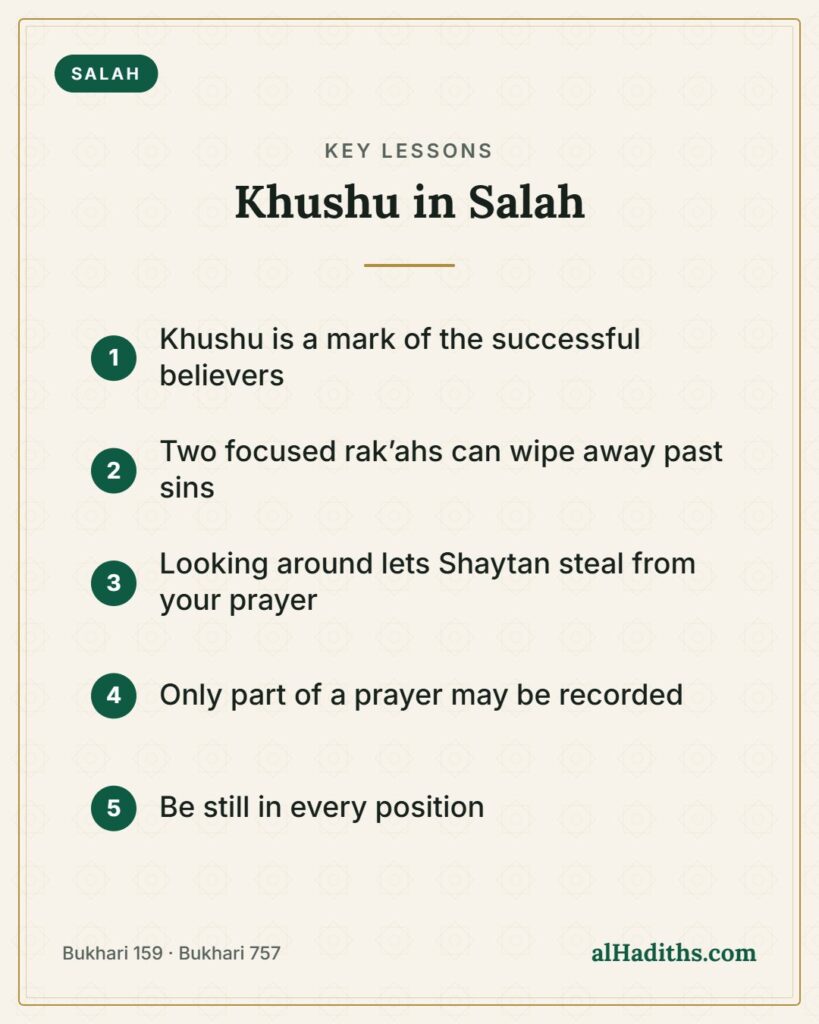
- Khushu in prayer is the first quality Allah names for the successful believers.
- Two rak’ahs prayed without wandering thoughts, after a good wudu, bring forgiveness of past sins.
- Looking around in prayer lets Shaytan steal part of it.
- A person may have only part of a prayer recorded for him.
- Settle in every position: the Prophet ﷺ told a man who rushed to go back and pray.
In your next prayer, choose just one thing from this page, perhaps keeping still in sujud until you feel at ease, and hold on to it. May Allah make us among those who are humbly intent in their prayer.
Save this to Pinterest so you can come back to these steps before your next prayer
Share the reward. Send this article to someone who needs it today — teaching a hadith or dua can become a lasting good deed for you, in shaa Allah.