Hadith of Jibril on Islam, Iman and Ihsan: Hadith 2
Contents
A stranger walks into the gathering of the Prophet ﷺ. His clothes are brilliant white, his hair jet black, and there is no dust of travel on him, yet nobody knows who he is. He sits knee to knee with the Prophet ﷺ and starts asking questions. This is the Hadith of Jibril, and by the end of it the Prophet ﷺ says the visitor came to teach us our religion.
At a glance
- Source: Sahih Muslim 8a (also Sahih al-Bukhari 50 and Sunan Abi Dawud 4695)
- Narrated by: ‘Umar ibn al-Khattab, through his son ‘Abdullah ibn ‘Umar (may Allah be pleased with them)
- Grade: Sahih (Muslim); Sahih (al-Albani) for Abu Dawud
- Topic: Islam, Iman, Ihsan and the Hour
- Put it into practice: Before your next salah, remind yourself that Allah sees you
The Hadith of Jibril
The hadith reached us through Yahya ibn Ya’mur. He and a friend met ‘Abdullah ibn ‘Umar (may Allah be pleased with him) and asked him about people who denied the Divine Decree. In reply, Ibn ‘Umar narrated what his father ‘Umar ibn al-Khattab (may Allah be pleased with him) had seen:
بَيْنَمَا نَحْنُ عِنْدَ رَسُولِ اللَّهِ صلى الله عليه وسلم ذَاتَ يَوْمٍ إِذْ طَلَعَ عَلَيْنَا رَجُلٌ شَدِيدُ بَيَاضِ الثِّيَابِ شَدِيدُ سَوَادِ الشَّعَرِ لاَ يُرَى عَلَيْهِ أَثَرُ السَّفَرِ وَلاَ يَعْرِفُهُ مِنَّا أَحَدٌ حَتَّى جَلَسَ إِلَى النَّبِيِّ صلى الله عليه وسلم فَأَسْنَدَ رُكْبَتَيْهِ إِلَى رُكْبَتَيْهِ وَوَضَعَ كَفَّيْهِ عَلَى فَخِذَيْهِ وَقَالَ يَا مُحَمَّدُ أَخْبِرْنِي عَنِ الإِسْلاَمِ . فَقَالَ رَسُولُ اللَّهِ صلى الله عليه وسلم ” الإِسْلاَمُ أَنْ تَشْهَدَ أَنْ لاَ إِلَهَ إِلاَّ اللَّهُ وَأَنَّ مُحَمَّدًا رَسُولُ اللَّهِ وَتُقِيمَ الصَّلاَةَ وَتُؤْتِيَ الزَّكَاةَ وَتَصُومَ رَمَضَانَ وَتَحُجَّ الْبَيْتَ إِنِ اسْتَطَعْتَ إِلَيْهِ سَبِيلاً . قَالَ صَدَقْتَ . قَالَ فَعَجِبْنَا لَهُ يَسْأَلُهُ وَيُصَدِّقُهُ . قَالَ فَأَخْبِرْنِي عَنِ الإِيمَانِ . قَالَ ” أَنْ تُؤْمِنَ بِاللَّهِ وَمَلاَئِكَتِهِ وَكُتُبِهِ وَرُسُلِهِ وَالْيَوْمِ الآخِرِ وَتُؤْمِنَ بِالْقَدَرِ خَيْرِهِ وَشَرِّهِ ” . قَالَ صَدَقْتَ . قَالَ فَأَخْبِرْنِي عَنِ الإِحْسَانِ . قَالَ ” أَنْ تَعْبُدَ اللَّهَ كَأَنَّكَ تَرَاهُ فَإِنْ لَمْ تَكُنْ تَرَاهُ فَإِنَّهُ يَرَاكَ ” . قَالَ فَأَخْبِرْنِي عَنِ السَّاعَةِ . قَالَ ” مَا الْمَسْئُولُ عَنْهَا بِأَعْلَمَ مِنَ السَّائِلِ ” . قَالَ فَأَخْبِرْنِي عَنْ أَمَارَتِهَا . قَالَ ” أَنْ تَلِدَ الأَمَةُ رَبَّتَهَا وَأَنْ تَرَى الْحُفَاةَ الْعُرَاةَ الْعَالَةَ رِعَاءَ الشَّاءِ يَتَطَاوَلُونَ فِي الْبُنْيَانِ ” . قَالَ ثُمَّ انْطَلَقَ فَلَبِثْتُ مَلِيًّا ثُمَّ قَالَ لِي ” يَا عُمَرُ أَتَدْرِي مَنِ السَّائِلُ ” . قُلْتُ اللَّهُ وَرَسُولُهُ أَعْلَمُ . قَالَ ” فَإِنَّهُ جِبْرِيلُ أَتَاكُمْ يُعَلِّمُكُمْ دِينَكُمْ
“One day we were sitting in the company of Allah’s Messenger ﷺ when there appeared before us a man dressed in pure white clothes, his hair extraordinarily black. There were no signs of travel on him. None amongst us recognized him. At last he sat with the Prophet ﷺ. He knelt before him, placed his palms on his thighs and said: Muhammad, inform me about al-Islam. The Messenger of Allah ﷺ said: Al-Islam is that you testify that there is no god but Allah and that Muhammad is the Messenger of Allah, and you establish prayer, pay Zakat, observe the fast of Ramadan, and perform pilgrimage to the House if you are able to make the journey. He said: You have told the truth. It amazed us that he would put the question and then he would himself verify the truth. He said: Inform me about Iman (faith). He ﷺ replied: That you affirm your faith in Allah, in His angels, in His Books, in His Messengers, in the Last Day, and you affirm your faith in the Divine Decree about good and evil. He said: You have told the truth. He said: Inform me about al-Ihsan. He ﷺ said: That you worship Allah as if you are seeing Him, for though you don’t see Him, He, verily, sees you. He said: Inform me about the Hour. He ﷺ remarked: One who is asked knows no more than the one who is inquiring. He said: Tell me some of its indications. He ﷺ said: That the slave-girl will give birth to her mistress, and that you will find barefooted, destitute goat-herds vying with one another in the construction of magnificent buildings. Then he went on his way, and I stayed for a long while. He ﷺ then said to me: ‘Umar, do you know who this inquirer was? I replied: Allah and His Messenger know best. He ﷺ said: He was Jibril (Gabriel). He came to you in order to instruct you in matters of religion.”
Sahih Muslim 8a · Narrated by ‘Umar ibn al-Khattab · Translation adapted from Sunnah.com
Abu Hurairah (may Allah be pleased with him) narrates the same meeting in Sahih al-Bukhari 50, and Abu Dawud records it in Sunan Abi Dawud 4695, graded Sahih by al-Albani.
Islam, Iman and Ihsan: three parts of our religion
At the end, the Prophet ﷺ said Jibril came “to instruct you in matters of religion”. So the three answers together describe the religion:
- Islam is what we do: the two testimonies, salah, zakah, fasting Ramadan and Hajj for those able. Read more in The Bedouin Who Asked About the Five Pillars of Islam.
- Iman is what we believe: in Allah, His angels, His Books, His Messengers, the Last Day, and the Divine Decree, its good and its bad. Iman also shows in our deeds, as the hadith on the branches of iman explains.
- Ihsan is how we worship: as if we see Allah, knowing that He sees us.
What is ihsan? Worship Allah as if you see Him
Of the three answers, ihsan is the shortest and perhaps the hardest:
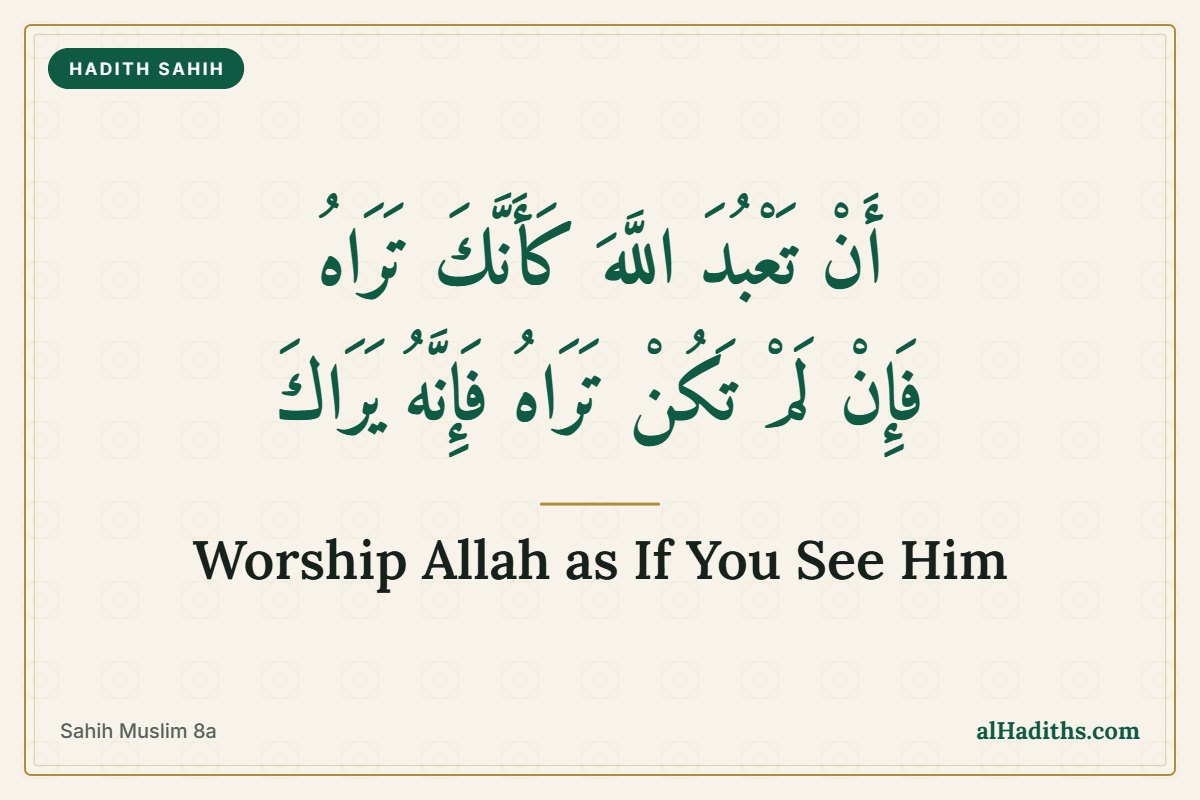
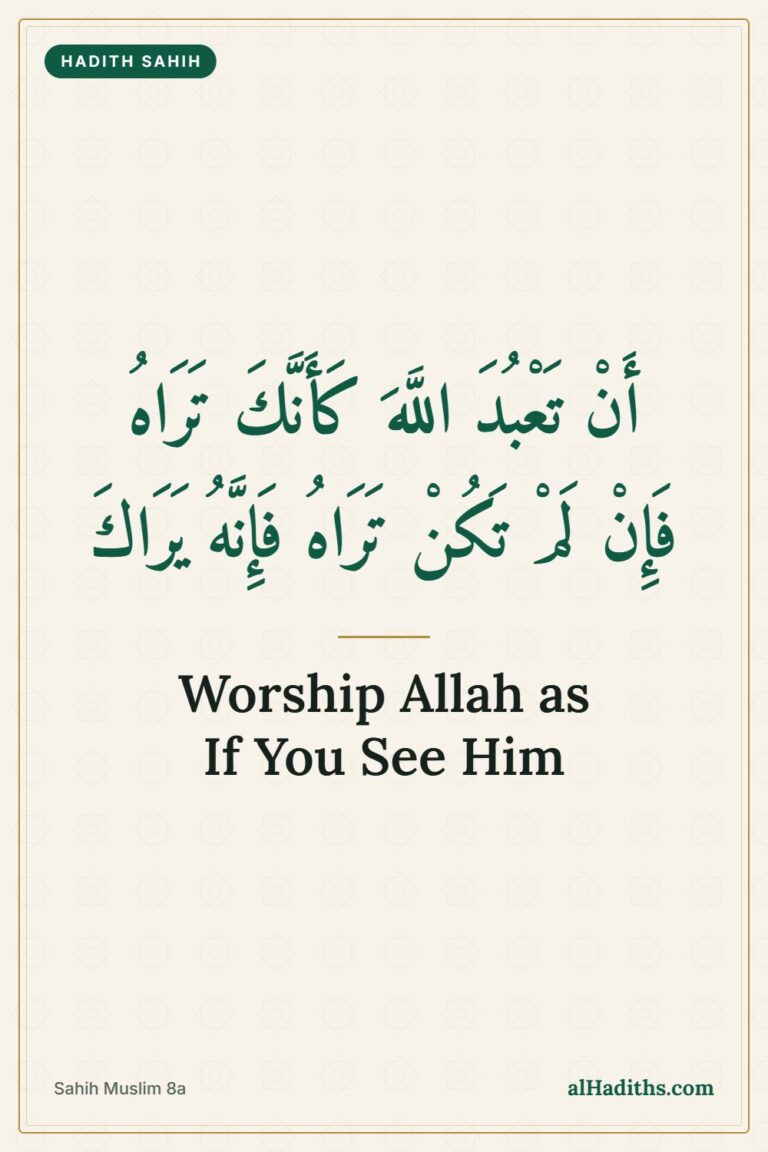
أَنْ تَعْبُدَ اللَّهَ كَأَنَّكَ تَرَاهُ فَإِنْ لَمْ تَكُنْ تَرَاهُ فَإِنَّهُ يَرَاكَ
“That you worship Allah as if you are seeing Him, for though you don’t see Him, He, verily, sees you.”
Sahih Muslim 8a · Translation from Sunnah.com
There are two steps in this answer. The first is to worship as if we can see Allah. If that is hard to reach, the second is still within reach: to remember that He sees us, in every rak’ah and every moment.
I try to remind myself before and during salah that I am standing before Allah and He is looking at me when my mind strays. Though I really need to improve in that aspect and make my salah better.
The Hour and its signs
When Jibril asked about the Hour, the Prophet ﷺ said the one asked knows no more about it than the one asking. Even the best of creation was not given its time; only Allah knows it.
He ﷺ then mentioned two of its signs. What do they mean?
1. “The slave-girl will give birth to her mistress”
Scholars have understood this sign in two main ways. The Mufti of the Federal Territory’s office in Malaysia summarises them in its Irsyad al-Hadith series 425:
- A literal meaning: Imam al-Nawawi, in al-Minhaj, his commentary on Sahih Muslim, says most scholars understood it as slavery becoming widespread. A slave woman bears her master’s child, and that child, as the master’s heir, becomes like a master over his own mother.
- A picture of disobedience to parents: Ibn Hajar al-‘Asqalani, in Fath al-Bari, explained it as children treating their parents the way a master treats his slaves, with disrespect and orders. Later scholars such as Dr Mustafa al-Bugha, in al-Wafi, also read it as a sign of widespread disobedience to parents in a time when conditions are turned upside down.
Both readings describe the normal order of things being reversed, starting inside the family.
2. Barefoot shepherds competing in tall buildings
Abu Hurairah’s narrations make this sign clearer: “When the shepherds of black camels start boasting and competing with others in the construction of higher buildings” (Sahih al-Bukhari 50). In Sahih Muslim 10 he adds: “when you see barefooted, naked, deaf and dumb (ignorant and foolish persons) as the rulers of the earth”.
Imam al-Nawawi explained that the poor people of the desert will suddenly become wealthy and begin boasting about their buildings (from al-Minhaj, as quoted by HadithAnswers). The concern is not wealth or buildings in themselves, but people competing to show off, and affairs passing to those without the knowledge or character to carry them.
The same answer also notes that the signs of the Hour are ambiguous and nuanced, so we should be careful about matching each one to the news. What the hadith teaches us clearly is to prepare for the Hour, not to guess its date: to honor our parents, and not to let wealth and buildings become a competition.
Reflection: look at how Jibril came to learn and teach: clean, well dressed, sitting close and asking clear questions. Even the way he asked is a lesson in how to seek knowledge, and in how a teacher can answer patiently so that everyone present benefits.
How to put it into practice
The hadith does not give a routine, so these are suggestions:
- Before your next salah, pause and remind yourself that Allah sees you.
- Check your Islam: which of the five pillars needs the most care in your life right now?
- Renew your Iman by learning a little more about one of the six things we believe in.
- Ask good questions when you learn about the religion, as Jibril did.
Key lessons
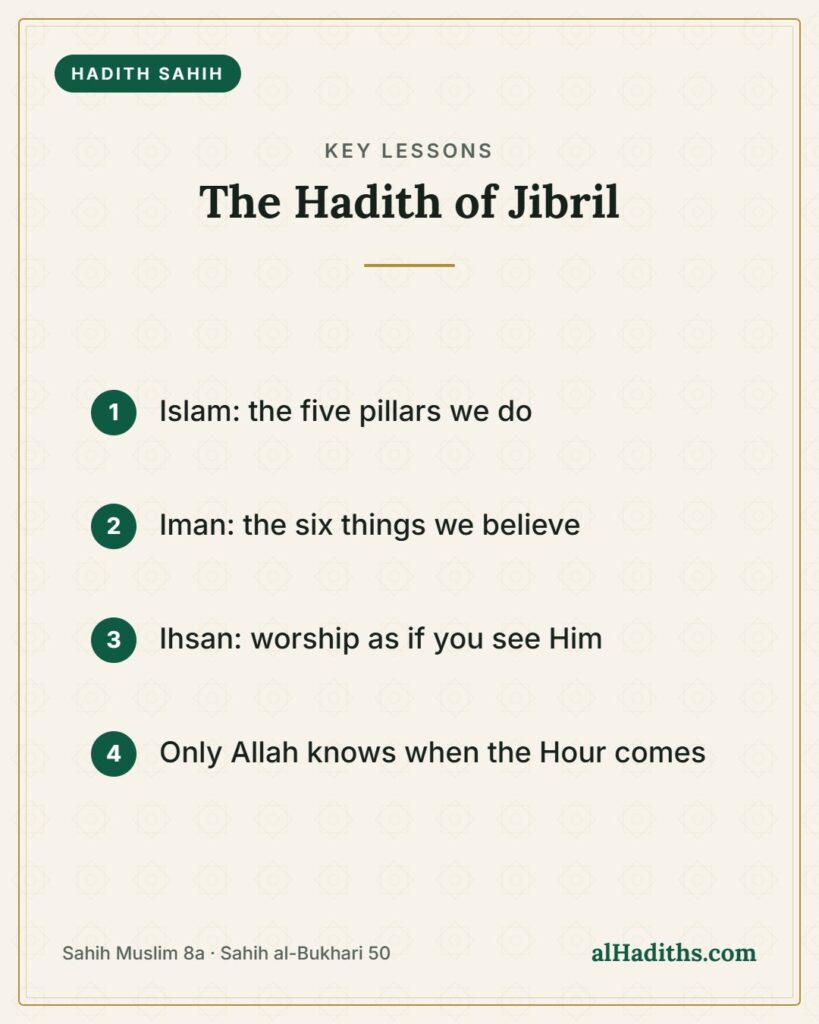
- Islam, Iman and Ihsan together make up our religion.
- Islam is the five pillars; Iman is belief in Allah, His angels, Books, Messengers, the Last Day and the Divine Decree.
- Ihsan is to worship Allah as if you see Him, knowing that He sees you.
- Only Allah knows when the Hour will come; our task is to prepare for it.
Questions people ask
What is the Hadith of Jibril?
It is the hadith in which the angel Jibril came in the form of a man and asked the Prophet ﷺ about Islam, Iman, Ihsan and the Hour. The Prophet ﷺ then said he came to teach people their religion (Sahih Muslim 8a).
What is ihsan in Islam?
The Prophet ﷺ defined ihsan as worshipping Allah as if you see Him, and if you do not see Him, knowing that He sees you (Sahih Muslim 8a).
What are the six pillars of iman in the Hadith of Jibril?
Belief in Allah, His angels, His Books, His Messengers, the Last Day, and the Divine Decree, its good and its bad (Sahih Muslim 8a).
A question to take into your next salah: if you truly felt that Allah is looking at you right now, what would you change?
Save this to Pinterest so you can remember the three parts of our religion
Share the reward. Send this article to someone who needs it today — teaching a hadith or dua can become a lasting good deed for you, in shaa Allah.