Dua After Adhan: What to Say When You Hear the Call to Prayer
Contents
Five times a day the adhan reaches us, from a masjid, a phone or a neighbour’s window. The Prophet ﷺ taught a short dua after adhan that turns that moment into worship, and he attached a promise to it: his intercession on the Day of Resurrection.
Below is the dua in Arabic with its English meaning, the authentic hadith behind it, and the simple order the Prophet ﷺ taught for answering the call to prayer.
At a glance
- Source: Sahih al-Bukhari 614 and Sahih Muslim 384
- Narrated by: Jabir ibn ‘Abdullah and ‘Abdullah ibn ‘Amr (may Allah be pleased with them)
- Grade: Sahih (Bukhari, Muslim)
- Topic: What to say during and after the adhan
- Practise it: At the next adhan: repeat it, send salawat, then say this dua
The dua after adhan in Arabic and English
Jabir ibn ‘Abdullah (may Allah be pleased with him) reported that the Messenger of Allah ﷺ said whoever says this when he hears the call to prayer will receive his intercession:
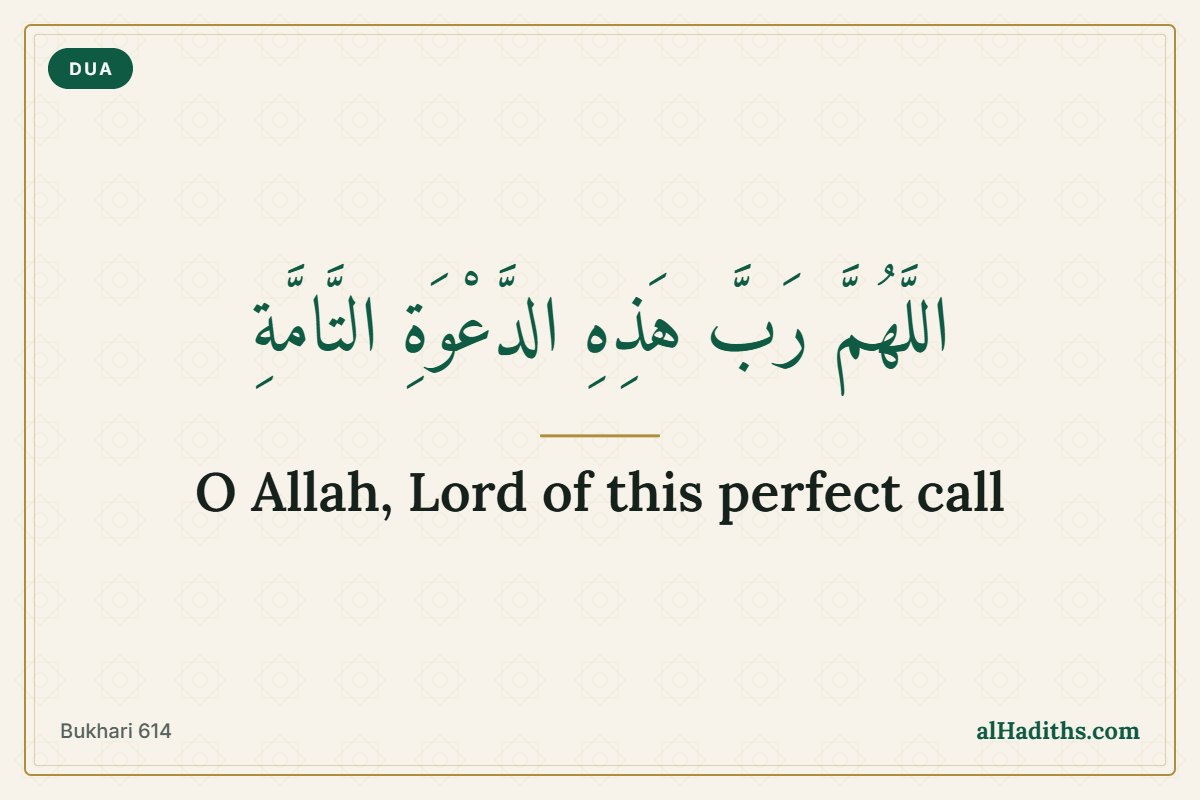
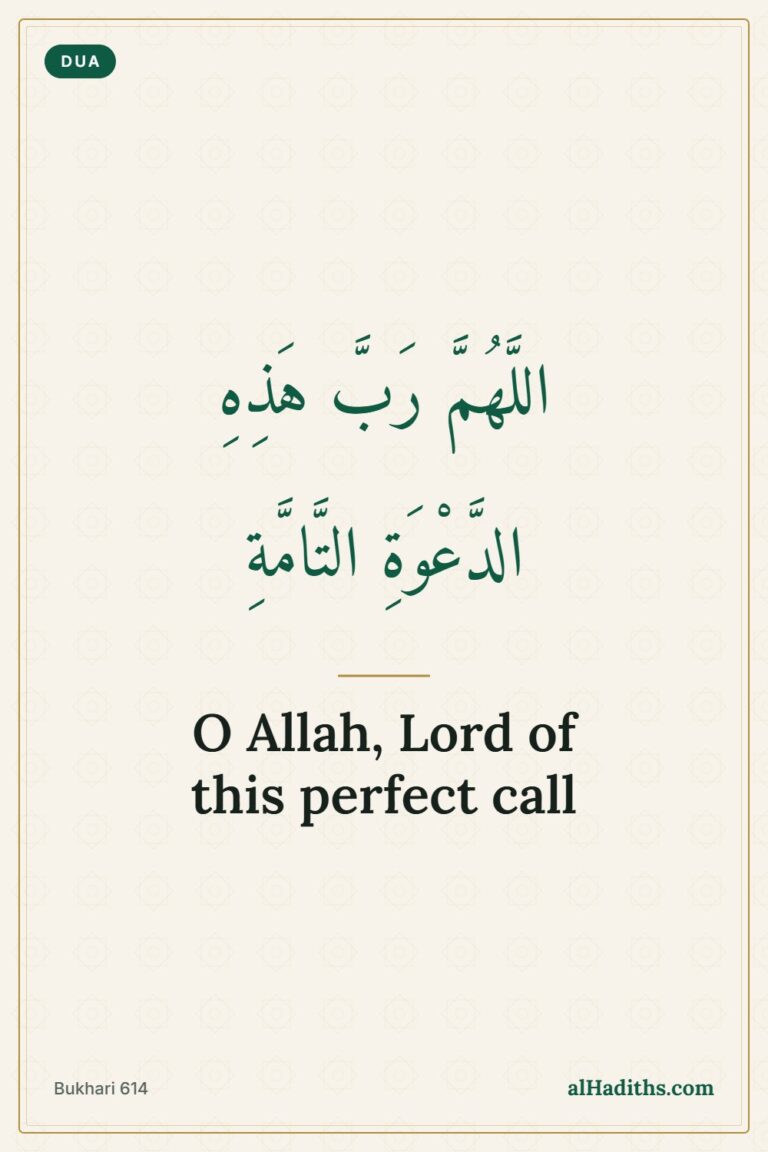
اللَّهُمَّ رَبَّ هَذِهِ الدَّعْوَةِ التَّامَّةِ وَالصَّلاَةِ الْقَائِمَةِ آتِ مُحَمَّدًا الْوَسِيلَةَ وَالْفَضِيلَةَ وَابْعَثْهُ مَقَامًا مَحْمُودًا الَّذِي وَعَدْتَهُ
Allahumma Rabba hadhihid-da‘watit-tammah, was-salatil-qa’imah, ati Muhammadanil-wasilata wal-fadilah, wab‘ath-hu maqaman mahmudanil-ladhi wa‘adtah.
“O Allah, Lord of this perfect call and of the prayer about to be established, grant Muhammad al-Wasilah and al-Fadilah, and raise him to the praised station that You have promised him.”
Sahih al-Bukhari 614 · Narrated by Jabir ibn ‘Abdullah · Translation adapted from Sunnah.com
Here is the full hadith, with the reward the Prophet ﷺ named for it:
مَنْ قَالَ حِينَ يَسْمَعُ النِّدَاءَ اللَّهُمَّ رَبَّ هَذِهِ الدَّعْوَةِ التَّامَّةِ وَالصَّلاَةِ الْقَائِمَةِ آتِ مُحَمَّدًا الْوَسِيلَةَ وَالْفَضِيلَةَ وَابْعَثْهُ مَقَامًا مَحْمُودًا الَّذِي وَعَدْتَهُ، حَلَّتْ لَهُ شَفَاعَتِي يَوْمَ الْقِيَامَةِ
“Whoever says, when he hears the call to prayer: ‘O Allah, Lord of this perfect call and of the prayer about to be established, grant Muhammad al-Wasilah and al-Fadilah, and raise him to the praised station that You have promised him,’ my intercession will be his on the Day of Resurrection.”
Sahih al-Bukhari 614 · Narrated by Jabir ibn ‘Abdullah · Translation adapted from Sunnah.com
Sunnah.com’s English adds explanations in brackets; we give the plain meaning of the Arabic. The transliteration above is ours, to help with pronunciation.
What the words of the dua mean
The Encyclopedia of Translated Prophetic Hadiths explains that “this perfect call” refers to the words of the adhan, which call people to the worship of Allah alone and to the prayer, and that the praised station is understood as the Prophet’s great intercession on the Day of Judgement (HadeethEnc 10635).
The “praised station” in the dua points to a promise in the Quran itself:
وَمِنَ ٱلَّيْلِ فَتَهَجَّدْ بِهِۦ نَافِلَةً لَّكَ عَسَىٰٓ أَن يَبْعَثَكَ رَبُّكَ مَقَامًا مَّحْمُودًا
“And from [part of] the night, pray with it [i.e., recitation of the Qur’ān] as additional [worship] for you; it is expected that your Lord will resurrect you to a praised station.”
Surah al-Isra 17:79 · Translation: Saheeh International, from Quran.com
The Prophet ﷺ himself explained what al-Wasilah is, in a hadith that also gives the order of what to say:
إِذَا سَمِعْتُمُ الْمُؤَذِّنَ فَقُولُوا مِثْلَ مَا يَقُولُ ثُمَّ صَلُّوا عَلَىَّ فَإِنَّهُ مَنْ صَلَّى عَلَىَّ صَلاَةً صَلَّى اللَّهُ عَلَيْهِ بِهَا عَشْرًا ثُمَّ سَلُوا اللَّهَ لِيَ الْوَسِيلَةَ فَإِنَّهَا مَنْزِلَةٌ فِي الْجَنَّةِ لاَ تَنْبَغِي إِلاَّ لِعَبْدٍ مِنْ عِبَادِ اللَّهِ وَأَرْجُو أَنْ أَكُونَ أَنَا هُوَ فَمَنْ سَأَلَ لِيَ الْوَسِيلَةَ حَلَّتْ لَهُ الشَّفَاعَةُ
“When you hear the mu’adhdhin, repeat what he says, then send salah upon me, for whoever sends salah upon me once, Allah sends salah upon him ten times. Then ask Allah to grant me al-Wasilah, which is a rank in Paradise fitting for only one of Allah’s servants, and I hope that I will be that one. Whoever asks for al-Wasilah for me, my intercession will be his due.”
Sahih Muslim 384 · Narrated by ‘Abdullah ibn ‘Amr ibn al-‘As · Translation adapted from Sunnah.com
HadeethEnc notes the Prophet’s modesty here: he asks his ummah to make dua for a rank meant for one person only, and Allah repays each salawat tenfold (HadeethEnc 65087).
Reflection: it is striking that the reward for asking something for the Prophet ﷺ comes back to the one who asks. We pray for his rank, and his intercession is promised to us in return.
What to say when you hear the adhan, step by step
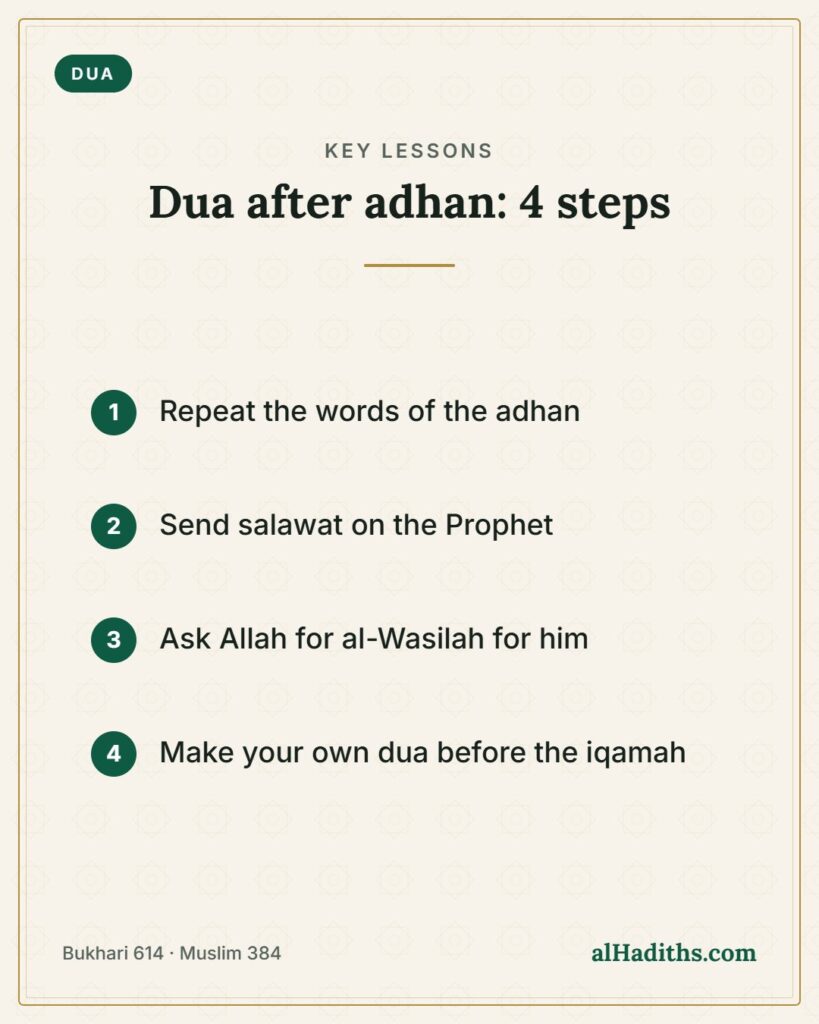
1. Repeat the words of the mu’adhdhin. Abu Sa‘id al-Khudri (may Allah be pleased with him) reported:
إِذَا سَمِعْتُمُ النِّدَاءَ فَقُولُوا مِثْلَ ما يَقُولُ الْمُؤَذِّنُ
“When you hear the call to prayer, say what the mu’adhdhin says.”
Sahih al-Bukhari 611 · Narrated by Abu Sa‘id al-Khudri · Translation adapted from Sunnah.com
At “hayya ‘alas-salah” and “hayya ‘alal-falah”, the Prophet ﷺ taught the reply “la hawla wa la quwwata illa billah” (Sahih Muslim 385). We explain that phrase in La Hawla Wa La Quwwata Illa Billah.
2. Send salawat on the Prophet ﷺ, as in Sahih Muslim 384 above. The salawat we say in the tashahhud is one authentic wording.
3. Say the dua after adhan from Sahih al-Bukhari 614.
4. Make your own dua before the iqamah. Anas ibn Malik (may Allah be pleased with him) reported:
لاَ يُرَدُّ الدُّعَاءُ بَيْنَ الأَذَانِ وَالإِقَامَةِ
“The supplication made between the adhan and the iqamah is not rejected.”
Sunan Abi Dawud 521 · Sahih (al-Albani) · Narrated by Anas ibn Malik · Also Jami‘ at-Tirmidhi 212, Sahih (Darussalam) · Translation from Sunnah.com
A man once told the Prophet ﷺ that the mu’adhdhins had an advantage over everyone else. His answer shows the door is open to all of us:
قُلْ كَمَا يَقُولُونَ فَإِذَا انْتَهَيْتَ فَسَلْ تُعْطَهْ
“Say what they say, and when you finish, ask, and you will be given.”
Sunan Abi Dawud 524 · Hasan Sahih (al-Albani) · Narrated by ‘Abdullah ibn ‘Amr · Translation adapted from Sunnah.com
Another authentic dhikr for the time of the adhan, with forgiveness of sins promised, is covered in Radhitu Billahi Rabba Wabil Islami Dina.
How to practise it
- Pause what you are doing when the adhan starts, and repeat each phrase quietly after the mu’adhdhin.
- Keep the dua on your phone’s lock screen or by your prayer mat until you know it by heart.
- When the adhan ends, send salawat, then say the dua once.
- Use the minutes before the iqamah for your own needs; the hadith gives no fixed wording, so ask in your own words.
- Teach it to your children at one adhan a day.
Questions people ask
Is “innaka la tukhliful mi‘ad” part of the dua after adhan?
It is not in Sahih al-Bukhari 614. Al-Bayhaqi records it in al-Sunan al-Kubra (1/410), and scholars differ on it: some hadith scholars, citing al-Albani’s Irwa’ al-Ghalil (1/261), consider it shadh and not established (commentary on Nasa’i 681), while HadithAnswers considers it acceptable to recite. We give the wording of al-Bukhari. The phrase “wad-darajatar-rafi‘ah”, heard in some versions, is not found in the hadith books (IslamWeb 35197).
When should I say the dua after adhan?
After the adhan ends. Sahih Muslim 384 gives the order: repeat the words of the mu’adhdhin, then send salawat, then ask Allah for al-Wasilah for the Prophet ﷺ.
What do I say at “hayya ‘alas-salah”?
Say “la hawla wa la quwwata illa billah” at both “hayya ‘alas-salah” and “hayya ‘alal-falah”, as taught in Sahih Muslim 385.
Can women say the dua after adhan?
The hadith use general wording (“whoever says…”, “when you hear…”) and do not limit it to men. For any specific ruling, ask a qualified local scholar.
Key lessons from the dua after adhan
- The adhan is a call to answer with the tongue, not just to hear.
- Repeating it, sending salawat and saying the dua is the order the Prophet ﷺ taught.
- Asking al-Wasilah for the Prophet ﷺ brings his intercession to the one who asks.
- The time between the adhan and the iqamah is a time when dua is not rejected.
Part of our Salah series: see all our salah articles in one place.
Today, at the very next adhan, try all four steps once. It takes less than a minute, and the promise attached to it lasts until the Day of Resurrection.
Save this to Pinterest so you can say the dua after adhan at every call to prayer
Share the reward. Send this article to someone who needs it today — teaching a hadith or dua can become a lasting good deed for you, in shaa Allah.