3 Deeds That Continue After Death: The Sadaqah Jariyah Hadith
Every living being will taste death, and when that time comes our deeds stop being counted. However, the Prophet ﷺ told us of three deeds that continue after death: sadaqah jariyah (ongoing charity), knowledge that benefits others, and a righteous child who makes dua for us. May we all be able to leave these three behind to accompany us in the afterlife.
At a glance
- Source: Sahih Muslim 1631
- Narrated by: Abu Hurairah (may Allah be pleased with him)
- Grade: Sahih (Muslim)
- Topic: Deeds whose reward continues after death
- Practise it: Set up one ongoing charity, teach one good thing, and make dua for your parents
The hadith
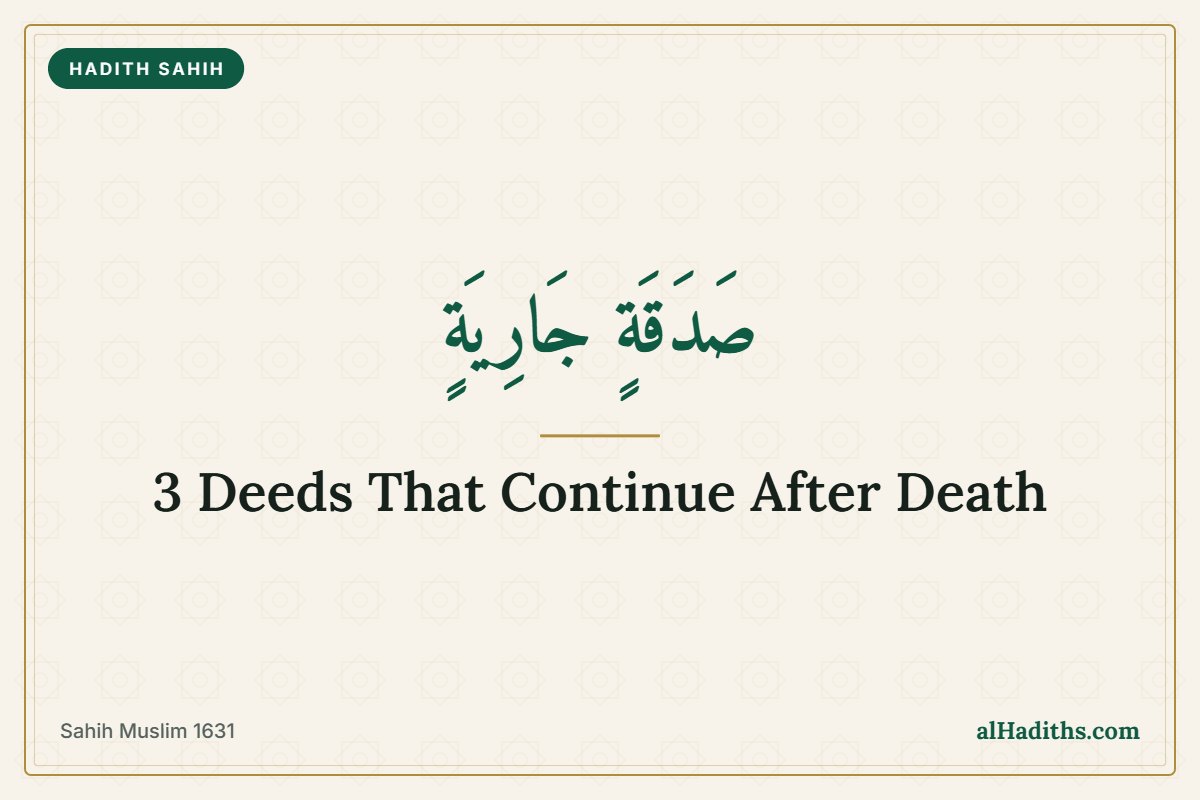
إِذَا مَاتَ الإِنْسَانُ انْقَطَعَ عَنْهُ عَمَلُهُ إِلاَّ مِنْ ثَلاَثَةٍ إِلاَّ مِنْ صَدَقَةٍ جَارِيَةٍ أَوْ عِلْمٍ يُنْتَفَعُ بِهِ أَوْ وَلَدٍ صَالِحٍ يَدْعُو لَهُ
Abu Hurairah reported that the Messenger of Allah ﷺ said: “When a person dies, his deeds come to an end except for three: sadaqah jariyah (ongoing charity), knowledge from which others benefit, or a righteous child who prays for him.”
Sahih Muslim 1631 · Narrated by Abu Hurairah · Translation adapted from Sunnah.com
Any person who has these three deeds to accompany them on the journey to the afterlife is a lucky person indeed. Not everyone will be able to achieve all of them, but then again it is not an impossible task.
1. Sadaqah jariyah: charity that keeps flowing
For sadaqah jariyah, charity whose benefit continues, you can give to causes that build things which last. There are lots of organisations building mosques, schools, roads and drinking wells, or planting trees. For as long as those things stand and people benefit from them, InsyaAllah the rewards will keep streaming into your account.
The clearest example from the Sunnah is ‘Umar (may Allah be pleased with him). When he received land at Khaybar, the most valuable property he had ever owned, he asked the Prophet ﷺ what to do with it:
عَنِ ابْنِ عُمَرَ، قَالَ أَصَابَ عُمَرُ أَرْضًا بِخَيْبَرَ فَأَتَى النَّبِيَّ صلى الله عليه وسلم يَسْتَأْمِرُهُ فِيهَا فَقَالَ يَا رَسُولَ اللَّهِ إِنِّي أَصَبْتُ أَرْضًا بِخَيْبَرَ لَمْ أُصِبْ مَالاً قَطُّ هُوَ أَنْفَسُ عِنْدِي مِنْهُ فَمَا تَأْمُرُنِي بِهِ قَالَ ” إِنْ شِئْتَ حَبَسْتَ أَصْلَهَا وَتَصَدَّقْتَ بِهَا ” . قَالَ فَتَصَدَّقَ بِهَا عُمَرُ أَنَّهُ لاَ يُبَاعُ أَصْلُهَا وَلاَ يُبْتَاعُ وَلاَ يُورَثُ وَلاَ يُوهَبُ
Ibn ‘Umar reported: ‘Umar acquired land at Khaybar. He came to the Prophet ﷺ to ask his advice about it and said: “Messenger of Allah, I have acquired land in Khaybar. I have never acquired property more valuable to me than this, so what do you command me to do with it?” He said: “If you like, you may keep the land itself and give its produce as sadaqah.” So ‘Umar gave it as sadaqah on the condition that the land itself must not be sold, bought, inherited or given away as a gift.
Sahih Muslim 1632a · Narrated by Ibn ‘Umar · Translation adapted from Sunnah.com
The land stayed, and only its produce was given away, year after year. That is the idea behind waqf (endowment) and the heart of sadaqah jariyah.
It does not have to be big. The Prophet ﷺ said that when a Muslim plants a tree or sows a seed and a bird, a person or an animal eats from it, it counts as charity for him (Sahih al-Bukhari 2320).
Allah describes how He multiplies what we spend in His way:
مَّثَلُ ٱلَّذِينَ يُنفِقُونَ أَمْوَٰلَهُمْ فِى سَبِيلِ ٱللَّهِ كَمَثَلِ حَبَّةٍ أَنۢبَتَتْ سَبْعَ سَنَابِلَ فِى كُلِّ سُنۢبُلَةٍ مِّا۟ئَةُ حَبَّةٍ ۗ وَٱللَّهُ يُضَـٰعِفُ لِمَن يَشَآءُ ۗ وَٱللَّهُ وَٰسِعٌ عَلِيمٌ
The example of those who spend their wealth in the way of Allāh is like a seed [of grain] which grows seven spikes; in each spike is a hundred grains. And Allāh multiplies [His reward] for whom He wills. And Allāh is all-Encompassing and Knowing.
Surah al-Baqarah 2:261 · Translation: Saheeh International (Quran.com)
So let’s take that as an inspiration to sincerely give what we can in Allah’s cause.
2. Knowledge that others benefit from
You do not have to be a professional educator to spread knowledge. Teach what you know, especially about the Deen, and when the person you taught practises it, InsyaAllah the reward is attached to you in this life and beyond. The Prophet ﷺ said that whoever guides someone to something good has a reward like the one who does it (Sahih Muslim 1893a).
Teach your family and teach your friends. Spread the Deen as far and wide as you can, and may Allah reward you greatly for it.
Allah also promises to raise in rank those who believe and those who have knowledge:
يَـٰٓأَيُّهَا ٱلَّذِينَ ءَامَنُوٓا۟ إِذَا قِيلَ لَكُمْ تَفَسَّحُوا۟ فِى ٱلْمَجَـٰلِسِ فَٱفْسَحُوا۟ يَفْسَحِ ٱللَّهُ لَكُمْ ۖ وَإِذَا قِيلَ ٱنشُزُوا۟ فَٱنشُزُوا۟ يَرْفَعِ ٱللَّهُ ٱلَّذِينَ ءَامَنُوا۟ مِنكُمْ وَٱلَّذِينَ أُوتُوا۟ ٱلْعِلْمَ دَرَجَـٰتٍ ۚ وَٱللَّهُ بِمَا تَعْمَلُونَ خَبِيرٌ
O you who have believed, when you are told, “Space yourselves” in assemblies, then make space; Allāh will make space for you. And when you are told, “Arise,” then arise; Allāh will raise those who have believed among you and those who were given knowledge, by degrees. And Allāh is Aware of what you do.
Surah al-Mujadilah 58:11 · Translation: Saheeh International (Quran.com)
So teach and learn, and may Allah raise your status through those you have taught.
3. A righteous child who makes dua for you
Last but not least, in my opinion the hardest of the lot is the third: having a righteous child who makes dua for us. This needs good upbringing, understanding and nurturing from the parents.
Prophet Ibrahim (peace be upon him) asked Allah for righteous offspring, and we can make the same dua:
رَبِّ هَبْ لِى مِنَ ٱلصَّـٰلِحِينَ
My Lord, grant me [a child] from among the righteous.
Surah as-Saffat 37:100 · Translation: Saheeh International (Quran.com)
As a father of three boys, I lack all sorts of things, and I feel many of us fathers have the same feelings too. I do hope that I somehow succeed in raising sons who will supplicate for me when I am gone. The trials of the grave are real, and I want no part of them, as I am sure you don’t either.
This also works the other way round. If your parents have passed away, you can be that righteous child for them today. Allah teaches us this dua for our parents:
وَٱخْفِضْ لَهُمَا جَنَاحَ ٱلذُّلِّ مِنَ ٱلرَّحْمَةِ وَقُل رَّبِّ ٱرْحَمْهُمَا كَمَا رَبَّيَانِى صَغِيرًا
And lower to them the wing of humility out of mercy and say, “My Lord, have mercy upon them as they brought me up [when I was] small.”
Surah al-Isra 17:24 · Translation: Saheeh International (Quran.com)
How to start on these deeds that continue after death
- Pick one ongoing charity this month, such as a well, a mosque, a school or a tree-planting project, and give what you can.
- Teach one thing you know well, even a short dua, to your child, spouse or a friend.
- Make dua for your parents by name after your prayers, whether they are alive or have passed away.
- Make the dua of Prophet Ibrahim for your children, and for children you hope to have.
- Remember that charity does not decrease wealth (Sahih Muslim 2588), so give without fear.
Key lessons
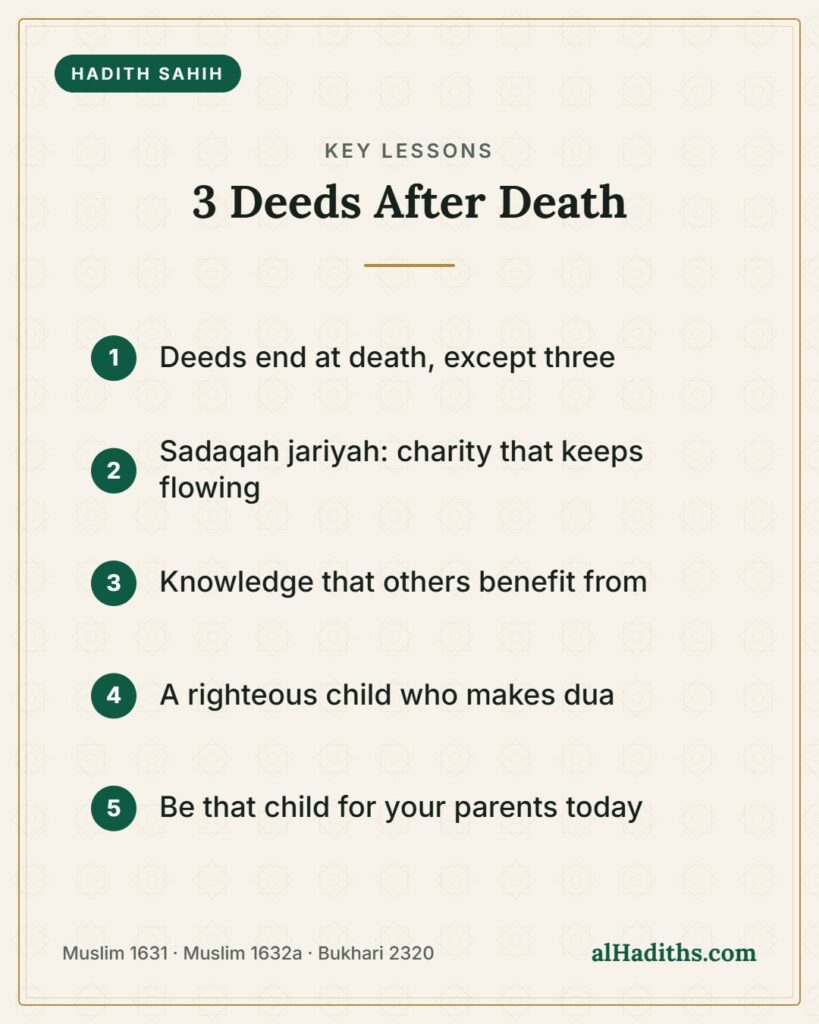
- Deeds end at death, except three.
- Sadaqah jariyah keeps rewarding as long as people benefit from it.
- Knowledge you teach keeps earning reward when others act on it.
- A righteous child’s dua reaches the parent after death.
- We can be that righteous child for our own parents today.
Questions people ask
What are the three things that continue after death?
Sadaqah jariyah (ongoing charity), knowledge that others benefit from, and a righteous child who makes dua for the person (Sahih Muslim 1631).
What counts as sadaqah jariyah?
Charity whose benefit continues, such as land or property kept so its produce is given away, as ‘Umar did (Sahih Muslim 1632a), or things like wells, mosques, schools and trees that people keep using (Sahih al-Bukhari 2320).
Can I do sadaqah jariyah for my parents who have passed away?
Yes. Sa’d ibn ‘Ubadah asked the Prophet ﷺ whether charity on behalf of his late mother would benefit her, he said yes, and Sa’d gave his garden in charity for her (Sahih al-Bukhari 2756). Your own dua as their child is also one of the three deeds in this hadith. For detailed rulings, ask a qualified scholar near you.
The road to heaven is paved with thorns, whilst the road to hell is paved with leisure. Choose wisely, and let’s keep building our good deeds with these three, in the hope that if not all three, at least one of them brings us success in the afterlife.
Save this to Pinterest so you can start one of these deeds this week

Share the reward. Send this article to someone who needs it today — teaching a hadith or dua can become a lasting good deed for you, in shaa Allah.