Contents
What does sahih hadith mean, and why does every card on this site name a grade? A sahih hadith is a report of the Prophet ﷺ that scholars have checked, link by link, and found sound. This page explains in plain words how hadith grading works: Sahih, Hasan, Da’if and Mawdu’, the isnad behind each grade, and how alHadiths picks the grades you see. For the books these hadith come from, see our companion page on the hadith books and their compilers.
At a glance
- What it is: How scholars judge whether a report truly goes back to the Prophet ﷺ
- The grades: Sahih (sound), Hasan (good), Da’if (weak), Mawdu’ (fabricated)
- What is checked: The isnad (chain of narrators) and the matn (the text)
- On this site: Main hadith are Sahih or Hasan, with the grader named
- Practise it: Check the grade before you share a hadith
Why hadith grading exists
The Prophet ﷺ warned very strongly against putting words in his mouth. This warning is the reason the early scholars took such care over every report:
مَنْ كَذَبَ عَلَىَّ مُتَعَمِّدًا فَلْيَتَبَوَّأْ مَقْعَدَهُ مِنَ النَّارِ
“Whoever lies about me intentionally, let him take his seat in the Fire.”
Muslim 3 (Introduction) · Narrated by Abu Hurairah · Translation adapted from Sunnah.com
The same words are in Bukhari 110. Among its lessons, HadeethEnc lists a warning against spreading hadith before making sure they truly come from the Prophet ﷺ (HadeethEnc 65043).
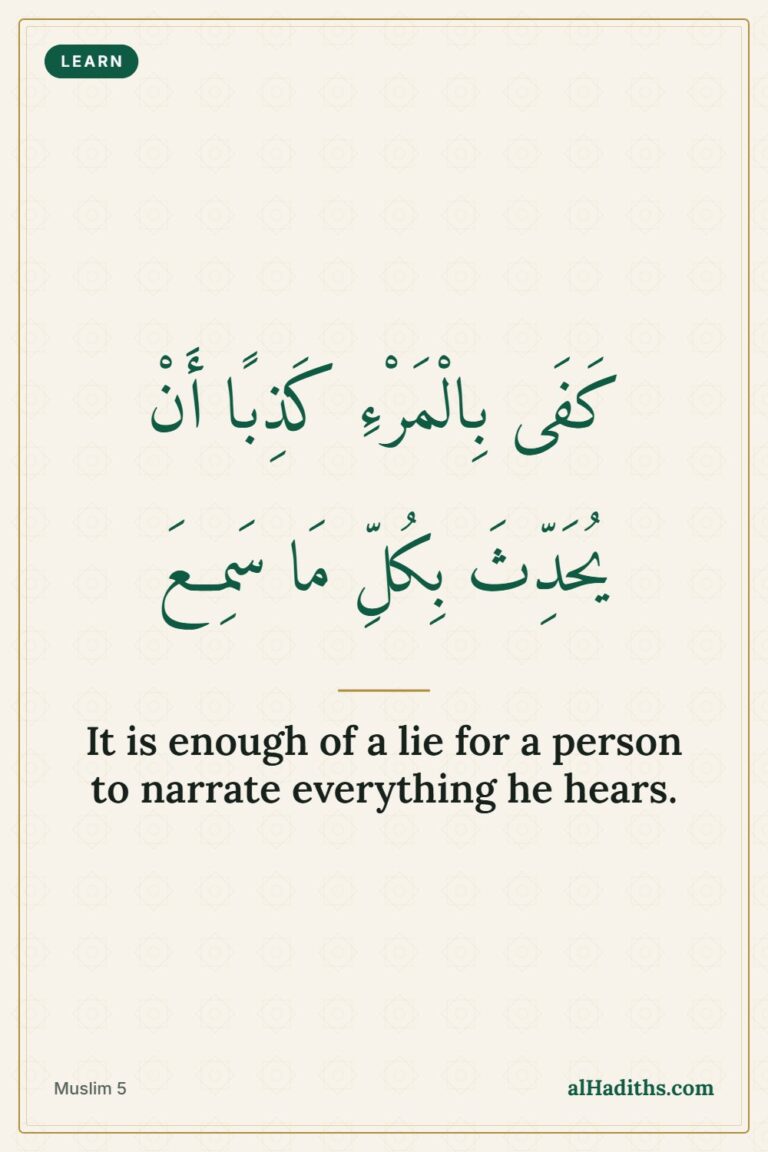
He ﷺ also taught that passing on everything you hear is itself a kind of lying:
كَفَى بِالْمَرْءِ كَذِبًا أَنْ يُحَدِّثَ بِكُلِّ مَا سَمِعَ
“It is enough of a lie for a person to narrate everything he hears.”
Muslim 5 (Introduction) · Narrated by Abu Hurairah · Translation adapted from Sunnah.com
The Quran sets the same rule for any news that reaches us: check it before acting on it.
يَـٰٓأَيُّهَا ٱلَّذِينَ ءَامَنُوٓا۟ إِن جَآءَكُمْ فَاسِقٌۢ بِنَبَإٍ فَتَبَيَّنُوٓا۟ أَن تُصِيبُوا۟ قَوْمًۢا بِجَهَـٰلَةٍ فَتُصْبِحُوا۟ عَلَىٰ مَا فَعَلْتُمْ نَـٰدِمِينَ
O you who have believed, if there comes to you a disobedient one with information, investigate, lest you harm a people out of ignorance and become, over what you have done, regretful.
Surah al-Hujurat 49:6 · Translation: Saheeh International, from Quran.com
What is an isnad? The chain behind every hadith
Every hadith has two parts. The isnad is the chain of people who passed the report on, one to the next, back to the Prophet ﷺ. The matn is the text itself, the words that were reported. Grading a hadith means examining both.
Imam Muslim recorded this famous statement of the early scholar Abdullah ibn al-Mubarak in the Introduction to his Sahih. It is his own saying, not a hadith of the Prophet ﷺ:
الإِسْنَادُ مِنَ الدِّينِ وَلَوْلاَ الإِسْنَادُ لَقَالَ مَنْ شَاءَ مَا شَاءَ
“The isnad is part of the religion. Were it not for the isnad, anyone could say whatever he wished.”
Muslim, Introduction 32 · Saying of Abdullah ibn al-Mubarak · Translation adapted from Sunnah.com
A small example shows why the chain matters. Abu Dawud recorded the “enough of a lie” hadith through two teachers, then noted that one of them did not mention Abu Hurairah in the chain (Abu Dawud 4992, Sahih (al-Albani)). A missing link, a different wording, a narrator with a weak memory: these are exactly the details graders look for.
Sahih hadith meaning: the five conditions
Sahih means sound. Scholars of hadith call a report sahih when it meets five conditions (summarised here from Shaykh Jamir Meah at SeekersGuidance):
- A connected chain: every narrator heard it from the one before him, with no gap.
- Upright narrators: each one was known for honesty and sound practice of the religion.
- Precise narrators: each one had an accurate memory or a careful written record.
- No shudhudh: it does not go against a more reliable narration.
- No hidden defect (‘illah): no concealed flaw that experts find on close study.
A sahih hadith is accepted as evidence. A hadith can be sahih in itself (sahih li-dhatihi), or rise to that level because other chains support it (sahih li-ghayrihi).
Hasan: good, and still accepted
A hasan (good) hadith meets the same conditions, except that the memory of one or more narrators is a little less precise. Like a sahih hadith, it is accepted (maqbul). Imam at-Tirmidhi made the term widely known in his Jami’, which is why his own comment, such as “hasan sahih”, is often quoted under his hadith on Sunnah.com. A weaker chain can also be lifted to hasan by other supporting chains (hasan li-ghayrihi).
Da’if: the weak hadith
A da’if (weak) hadith fails one or more of the conditions: a broken chain, an unknown or unreliable narrator, or a narrator with a poor memory. Weak does not always mean the words are false; it means the report cannot be relied on as the Prophet’s ﷺ words. Scholars differ on whether a weak hadith may be acted on for virtuous deeds, and under what conditions (SeekersGuidance), so we give no ruling here. Ask a qualified scholar you trust.
Mawdu’: the fabricated report
A mawdu’ (fabricated) report was made up and falsely attributed to the Prophet ﷺ. It is not really a hadith at all, only a forgery, and the warning in Muslim 3 above applies to anyone who knowingly spreads it as his words. Our article on the Rajab month shows this in practice: some popular Rajab sayings are weak, and the Salat al-Ragha’ib is fabricated.
Who graded the hadith on this site
Every grade on an alHadiths card names the scholar or edition it comes from, as shown on Sunnah.com:
- Bukhari and Muslim: no grader is named, because the ummah accepts the hadith in these two books as authentic, apart from a very few phrases the commentators discussed (IslamQA 21523).
- al-Albani: Shaykh Muhammad Nasir ad-Din al-Albani (d. 1999) graded the hadith of the Sunan collections; Sunnah.com shows his grades, for example under Sunan Abi Dawud.
- Darussalam: the grades printed in the Darussalam English editions, which Sunnah.com shows for at-Tirmidhi, an-Nasa’i and Ibn Majah.
- The compilers’ own notes: at-Tirmidhi and Abu Dawud often comment on a chain right after the hadith. We quote those notes when they matter.
- an-Nawawi: in his Forty Hadith, Imam an-Nawawi gives his own grade for each narration (see our 40 Hadith series).
- HadeethEnc: the Encyclopedia of Translated Prophetic Hadiths gives a grade and a scholarly explanation; we link it for the meaning.
Why scholars sometimes grade a hadith differently
Grading is expert judgement. One scholar may know a supporting chain that another did not, or weigh a narrator differently. So the same hadith can be Da’if in one edition and Sahih with another grader. For example, the palm-tree hadith in Trees in Jannah is graded Sahih by al-Albani and Da’if by Darussalam. When that happens, we name both and add an open note on its grading, with links, so you can see the evidence.
How alHadiths picks the grades you see
- Every hadith is copied from Sunnah.com, and every card links to its exact page.
- The main hadith of an article is always Sahih or Hasan, with the grader named.
- If graders differ, we use the Sahih or Hasan grade and add an open note on its grading.
- Weak narrations that people often share are labelled weak, with the grader, and never get an Arabic card.
- Grades on Sunnah.com are sometimes updated, so we re-check them every time we write or refresh an article.
We are not scholars. We follow the grades of recognised scholars and say where each one comes from. More on our method is on the About page.
Before you share a hadith: 3 quick checks
- Ask for the source: the collection and number (for example, Bukhari 614).
- Look it up on Sunnah.com and read the grade under it.
- If it is weak or has no source, don’t pass it on as the Prophet’s ﷺ words.
Reflection: Behind one short hadith there can be five or six names, each checked for honesty and memory by people who never met us. That care is a gift to every Muslim after them. The least we can do with it is pause before forwarding a “hadith” and ask: where is it from, and who graded it?
Questions people ask
Are all hadith in Bukhari and Muslim sahih?
Scholars accept the hadith in Sahih al-Bukhari and Sahih Muslim as authentic, apart from a very few phrases that the commentators discussed (IslamQA 21523). That is why we show no grader for them.
Can I act on a weak hadith?
Scholars differ on whether a weak hadith may be acted on for virtuous deeds, and under what conditions (SeekersGuidance). Ask a qualified scholar you trust. On this site, weak narrations are labelled and never used as the main hadith.
What does “hasan sahih” mean in at-Tirmidhi?
It is Imam at-Tirmidhi’s own wording after many hadith in his Jami’. Scholars have offered several explanations of the phrase. We quote his note as he wrote it, next to the modern grade.
What is a hadith qudsi?
A hadith qudsi is a saying in which the Prophet ﷺ reports words from Allah. It is graded in the same way as any other hadith: by its chain and its text.
Key lessons on sahih hadith
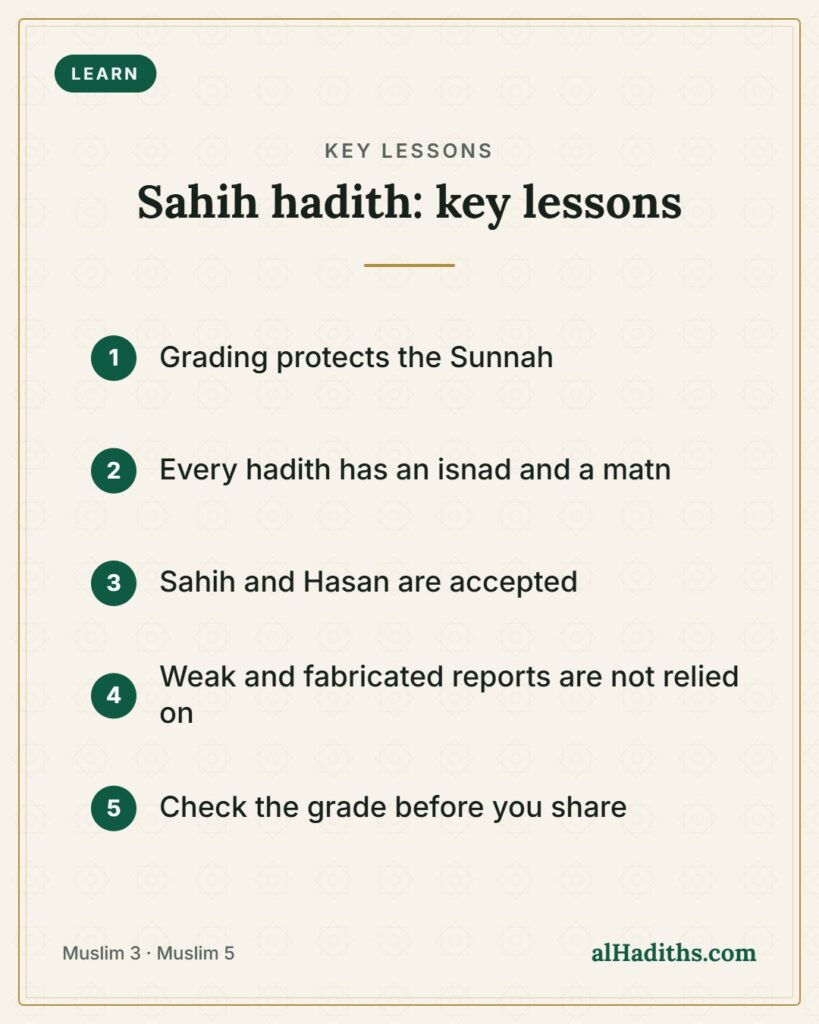
- Hadith grading exists to protect the words of the Prophet ﷺ from error and lies.
- Every hadith has an isnad (chain) and a matn (text), and both are checked.
- Sahih and Hasan hadith are accepted; Da’if is not relied on, and Mawdu’ is a forgery.
- Graders can differ, so alHadiths names the grader every time.
- Before you share a hadith, check its source and grade.
Next time a hadith reaches your phone, give it ten seconds: find the reference, check the grade, then share it with a clear conscience.
Save this to Pinterest so you can check a hadith before you share it
Share the reward. Send this article to someone who needs it today — teaching a hadith or dua can become a lasting good deed for you, in shaa Allah.