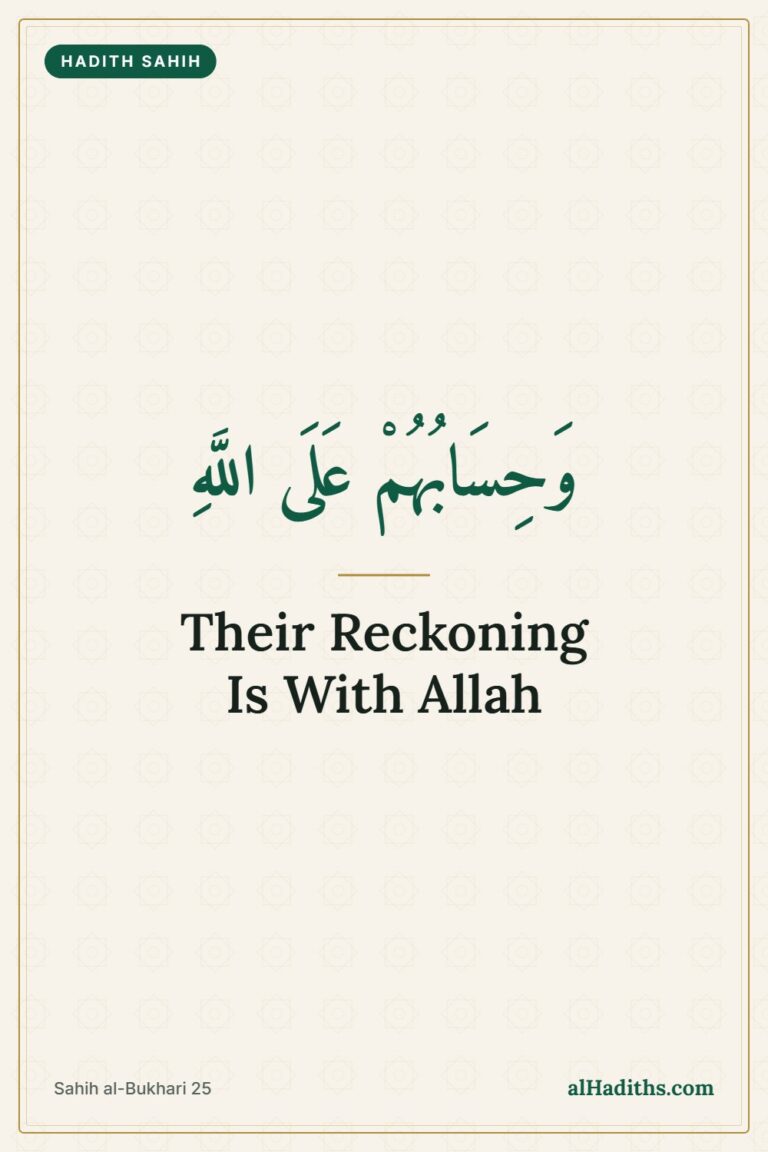
Their Reckoning Is With Allah: Hadith 8 of an-Nawawi
This hadith is often quoted out of context. Its opening words, “I have been ordered to fight against the people”, get shared on their own, sometimes to attack Islam and sometimes to justify violence. Read with its context and the explanations of scholars, it says something quite different, and it ends with a lesson every Muslim needs: their reckoning is with Allah.
At a glance
- Source: Sahih al-Bukhari 25 (also Sahih Muslim 22)
- Narrated by: ‘Abdullah ibn ‘Umar (may Allah be pleased with him and his father)
- Grade: Sahih (Bukhari and Muslim)
- Topic: Context of the hadith; judging by what is outward
- Put it into practice: Leave people’s hearts to Allah
The hadith
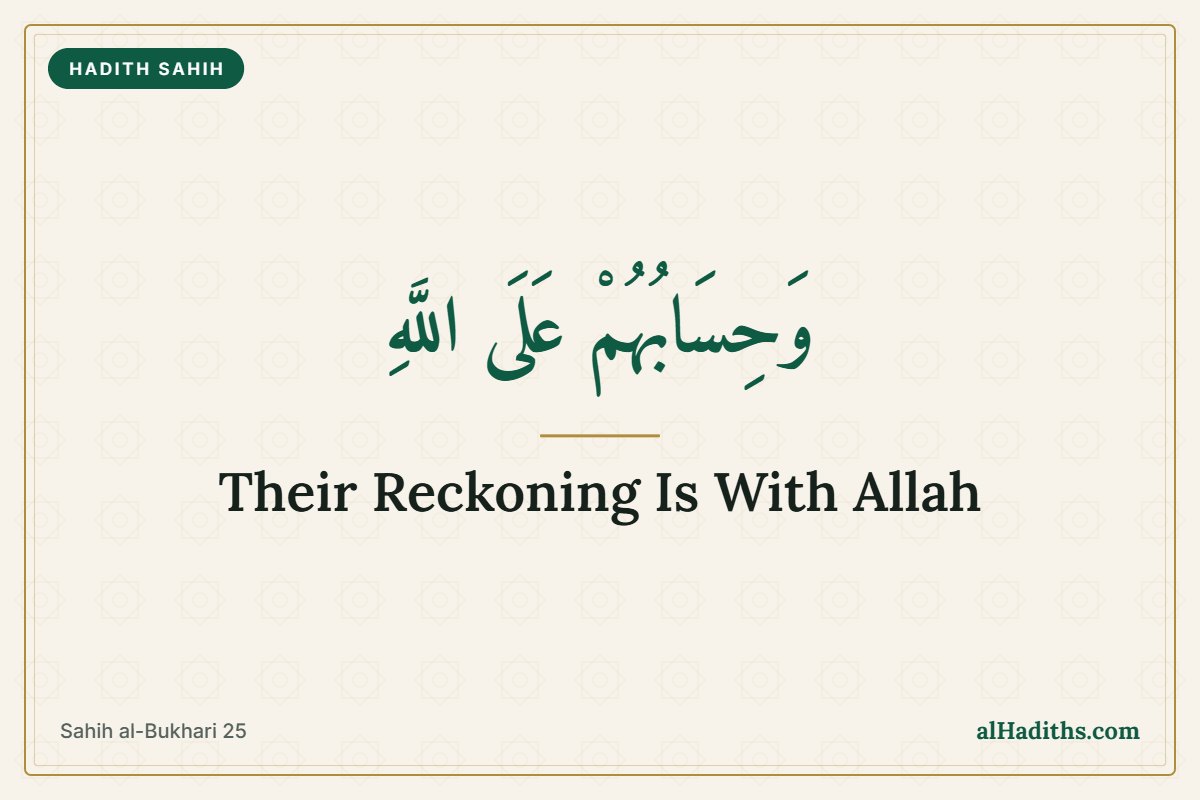
أُمِرْتُ أَنْ أُقَاتِلَ النَّاسَ حَتَّى يَشْهَدُوا أَنْ لاَ إِلَهَ إِلاَّ اللَّهُ وَأَنَّ مُحَمَّدًا رَسُولُ اللَّهِ، وَيُقِيمُوا الصَّلاَةَ، وَيُؤْتُوا الزَّكَاةَ، فَإِذَا فَعَلُوا ذَلِكَ عَصَمُوا مِنِّي دِمَاءَهُمْ وَأَمْوَالَهُمْ إِلاَّ بِحَقِّ الإِسْلاَمِ، وَحِسَابُهُمْ عَلَى اللَّهِ
“I have been ordered (by Allah) to fight against the people until they testify that none has the right to be worshipped but Allah and that Muhammad is Allah’s Messenger, and offer the prayers perfectly and give the obligatory charity, so if they perform that, then they save their lives and property from me except for Islamic laws and then their reckoning (accounts) will be done by Allah.”
Sahih al-Bukhari 25 · Narrated by Ibn ‘Umar · Translation from Sunnah.com
Imam an-Nawawi placed it as Hadith 8 of an-Nawawi’s 40 Hadith. Because it is so easy to misread, the rest of this article stays close to what scholars have said about it, with a link to each source.
“Fight”, not “kill”
In an answer published by SeekersGuidance, Shaykh Faraz A. Khan (reviewed by Shaykh Faraz Rabbani) points out that the Arabic verb is uqatil, from qital (fighting), not qatl (killing): “Killing (qatl) is one-directional, whereas fighting (qital) implies mutuality”. Fighting means two sides already in conflict.
Who are “the people” in this hadith?
The same answer explains that the word “people” (an-nas) here is restricted by other texts of the Qur’an and Sunnah, and refers to the Arab polytheists of that time, not to all non-Muslims.
An article on NU Online by Muhammad Kudhori makes the same point and adds:
- In the Qur’an, an-nas does not always mean all of humanity; it can mean a particular group, or even one person.
- The hadith addressed the Arab polytheists who had persecuted the Muslims in Makkah for thirteen years, fought them in Madinah, and broke their treaties.
- Scholars it cites, including Ibn Taymiyyah, held that the ones to be fought are those who take up arms against the Muslims, pointing to Surah al-Baqarah 2:190.
- The Prophet’s ﷺ own practice fits this: he spared the captive Thumamah, accepted ransom for the prisoners of Badr, and trade with non-Muslims continued.
The verse it refers to says:
وَقَـٰتِلُوا۟ فِى سَبِيلِ ٱللَّهِ ٱلَّذِينَ يُقَـٰتِلُونَكُمْ وَلَا تَعْتَدُوٓا۟ ۚ إِنَّ ٱللَّهَ لَا يُحِبُّ ٱلْمُعْتَدِينَ
“Fight in the way of Allāh those who fight against you but do not transgress. Indeed, Allāh does not like transgressors.”
Surah al-Baqarah 2:190 · Translation: Saheeh International, from Quran.com
No compulsion in religion
The Encyclopedia of Translated Prophetic Hadiths (HadeethEnc) states plainly: “This Hadīth does not imply forcing the polytheists to embrace Islam.” The Qur’an says:
لَآ إِكْرَاهَ فِى ٱلدِّينِ ۖ قَد تَّبَيَّنَ ٱلرُّشْدُ مِنَ ٱلْغَىِّ ۚ فَمَن يَكْفُرْ بِٱلطَّـٰغُوتِ وَيُؤْمِنۢ بِٱللَّهِ فَقَدِ ٱسْتَمْسَكَ بِٱلْعُرْوَةِ ٱلْوُثْقَىٰ لَا ٱنفِصَامَ لَهَا ۗ وَٱللَّهُ سَمِيعٌ عَلِيمٌ
“There shall be no compulsion in [acceptance of] the religion. The right course has become distinct from the wrong.”
Surah al-Baqarah 2:256 · Saheeh International translation
Among the benefits of the hadith, HadeethEnc also lists “The importance of calling to Tawhīd (monotheism)”: the message is an invitation to believe in one God.
A matter for the state, not individuals
This hadith was discussed by the leaders of the Muslim state. After the Prophet ﷺ passed away, some tribes refused to pay zakah. ‘Umar asked Abu Bakr, then the caliph, how he could fight them, and quoted this hadith; Abu Bakr answered that he would fight those who separated salah from zakah (Sahih al-Bukhari 1399).
In the SeekersGuidance answer, Shaykh Faraz A. Khan is clear that individuals have no such authority. Speaking of people who used this hadith to force others to hand over zakah, he says: “Only the government would have such authority, not individual Muslims.”
“Their reckoning is with Allah”
The last words of the hadith carry its most practical lesson. Among the benefits HadeethEnc lists: “External aspects are what count in rulings, whereas the intentions are judged by Allah.” We deal with people by what they show; what is in their hearts is for Allah.
Usamah ibn Zayd (may Allah be pleased with him) learned this the hard way. During an expedition, a man said “There is no god but Allah” and Usamah struck him anyway, thinking he only said it out of fear. The Prophet ﷺ asked him:
أَفَلاَ شَقَقْتَ عَنْ قَلْبِهِ حَتَّى تَعْلَمَ أَقَالَهَا أَمْ لاَ
“Did you tear his heart in order to find out whether it had professed or not?”
Sahih Muslim 96a · Narrated by Usamah ibn Zayd · Translation from Sunnah.com
Usamah said the Prophet ﷺ kept repeating it until he wished he had embraced Islam only that day.
Reflection: a hadith that is often used to frighten people actually ends by limiting us. It tells us we cannot judge what is in someone’s heart, and that a person’s life and property are protected.
What this means for us today
- Read hadith in context, together with the Qur’an and other hadith, before drawing conclusions.
- Be careful what you share: a single line taken out of a hadith can mislead.
- Do not judge people’s hearts; deal with them by what they show and leave the rest to Allah.
- Respect the life and property of others, as the hadith itself stresses.
- Learn sensitive texts from qualified scholars, not from social media clips.
Key lessons
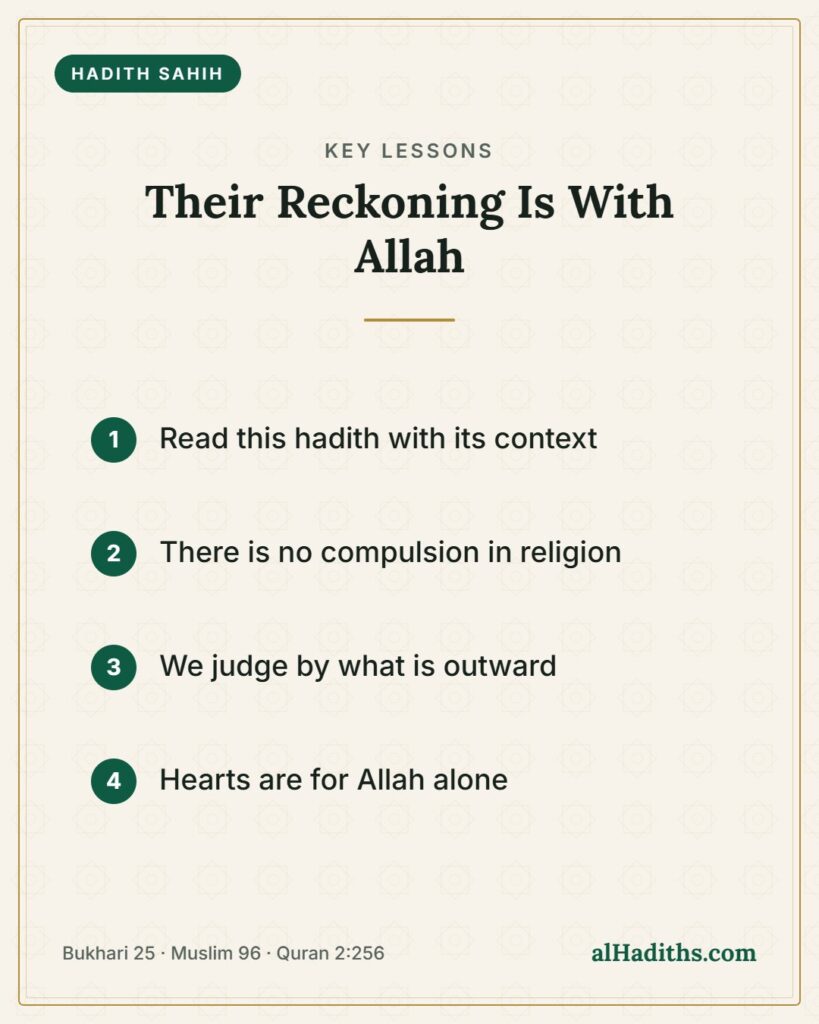
- Scholars explain that “the people” in this hadith were the Arab polytheists at war with the Muslims, not all non-Muslims.
- The Qur’an says there is no compulsion in religion (2:256).
- Decisions about fighting belong to the state, never to individuals.
- We judge by what is outward; the reckoning of hearts is with Allah.
Questions people ask
Does this hadith mean Muslims must fight all non-Muslims?
No. Scholars explain that “the people” here were the Arab polytheists at war with the Muslims at that time, and that the hadith does not mean forcing anyone into Islam (Encyclopedia of Translated Prophetic Hadiths (HadeethEnc)). The Qur’an says there is no compulsion in religion (Surah al-Baqarah 2:256).
What does “their reckoning is with Allah” mean?
It means people are treated according to what they show outwardly, while what is in their hearts is for Allah to judge. The Prophet ﷺ asked Usamah, “Did you tear his heart in order to find out whether it had professed or not?” (Sahih Muslim 96a).
Is this hadith authentic?
Yes. It is narrated by Ibn ‘Umar and recorded by al-Bukhari and Muslim (Sahih al-Bukhari 25). Because it is easily misunderstood, it should be studied with qualified scholars.
One thing to do today: the next time you see a single line of hadith shared without context, look up the full narration and an explanation from a trusted scholar before you react or pass it on.
Save this to Pinterest so you can read this hadith in its proper context
Share the reward. Send this article to someone who needs it today — teaching a hadith or dua can become a lasting good deed for you, in shaa Allah.