Providing for Your Family in Islam: Why It Counts as Sadaqah
Groceries, school fees, the electricity bill. Most of what we earn goes to our family, and it can start to feel like a list of payments. The Prophet ﷺ taught that spending on family in Islam is much more than that: when we do it seeking Allah’s reward, it is written for us as sadaqah. Here is the hadith, and three more that show how much it is worth.
At a glance
- Source: Sahih al-Bukhari 5351 (also Sahih Muslim 1002a)
- Narrated by: Abu Mas’ud al-Ansari (may Allah be pleased with him)
- Grade: Sahih (al-Bukhari and Muslim)
- Topic: Providing for your family with the right intention
- Practise it: Before you spend on your family, renew your niyyah (intention) for Allah
The hadith
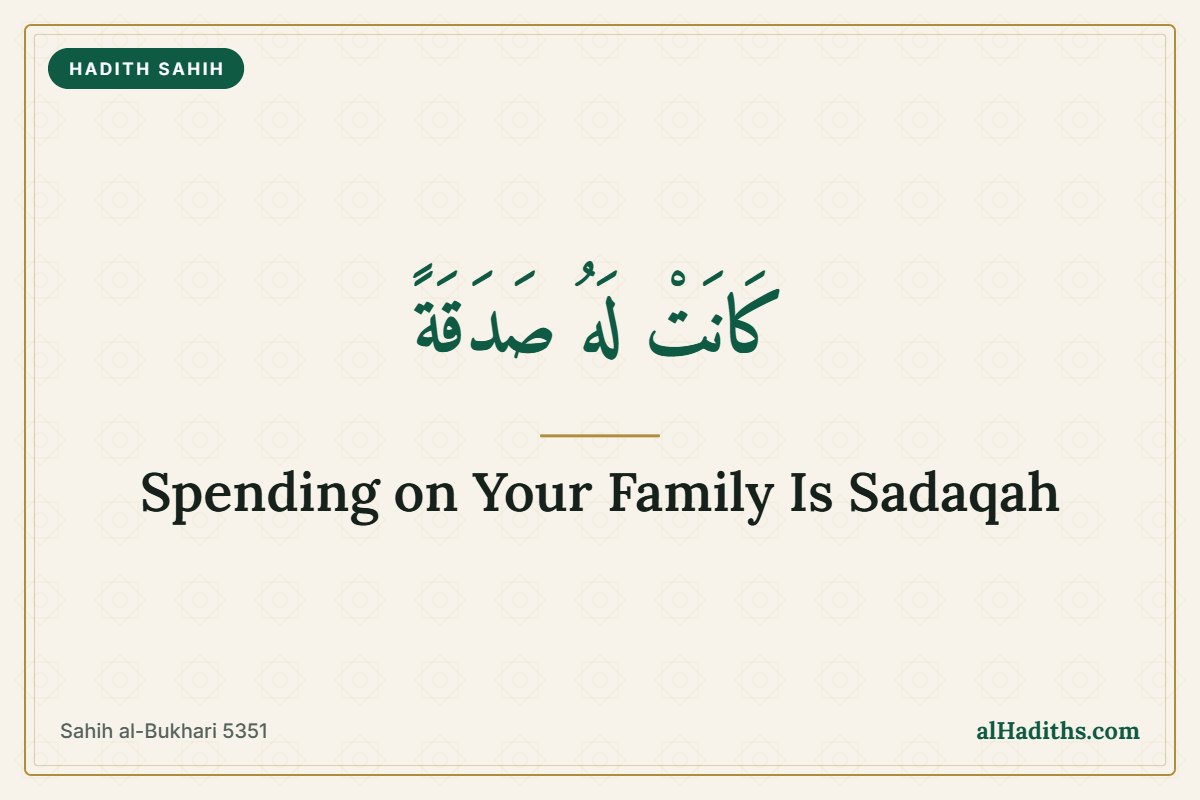
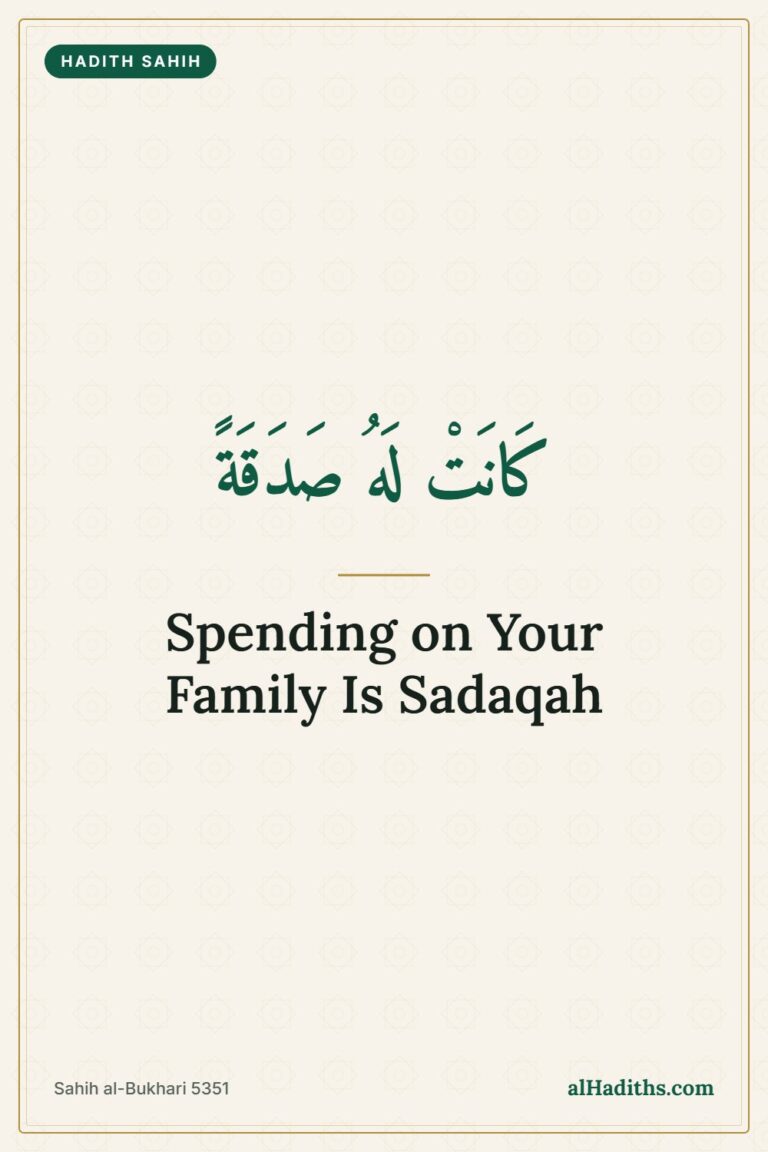
إِذَا أَنْفَقَ الْمُسْلِمُ نَفَقَةً عَلَى أَهْلِهِ وَهْوَ يَحْتَسِبُهَا، كَانَتْ لَهُ صَدَقَةً
The Prophet ﷺ said, “When a Muslim spends something on his family intending to receive Allah’s reward, it is regarded as sadaqah for him.”
Sahih al-Bukhari 5351 · Narrated by Abu Mas’ud al-Ansari · Also Sahih al-Bukhari 55 and Sahih Muslim 1002a · Translation adapted from Sunnah.com
What it means to spend “seeking reward”
The key word in the Arabic is yahtasibuha: he spends it while hoping for its reward from Allah. Providing for our family is already a duty. This hadith shows that the same money, spent with that hope, is also counted as sadaqah.
Imam al-Bukhari placed this hadith in his Book of Belief, under a chapter titled (in Sunnah.com’s translation) “The reward of deeds depends upon the intention and hoping to get rewards from Allah” (Sahih al-Bukhari 55). So the lesson is about intention more than money. Two people can pay the same bill. For the one who pays it for Allah, it is also sadaqah.
Spending on family brings the greatest reward
دِينَارٌ أَنْفَقْتَهُ فِي سَبِيلِ اللَّهِ وَدِينَارٌ أَنْفَقْتَهُ فِي رَقَبَةٍ وَدِينَارٌ تَصَدَّقْتَ بِهِ عَلَى مِسْكِينٍ وَدِينَارٌ أَنْفَقْتَهُ عَلَى أَهْلِكَ أَعْظَمُهَا أَجْرًا الَّذِي أَنْفَقْتَهُ عَلَى أَهْلِكَ
Allah’s Messenger ﷺ said: “Of the dinar you spend in Allah’s path, or to set free a slave, or as sadaqah given to a needy person, or to support your family, the one yielding the greatest reward is that which you spent on your family.”
Sahih Muslim 995 · Narrated by Abu Hurairah (may Allah be pleased with him) · Translation adapted from Sunnah.com
All four are good deeds. Yet the Prophet ﷺ named the dinar spent on our own family as the one with the greatest reward. In Sahih Muslim 994, narrated by Thawban, he also listed the dinar spent on one’s family first among the best ways to spend.
This does not mean we stop giving to others. It means the money we spend at home every day is not “lost” to charity. It is one of the best forms of it.
Even a morsel of food counts
إِنَّكَ لَنْ تُنْفِقَ نَفَقَةً تَبْتَغِي بِهَا وَجْهَ اللَّهِ إِلَّا أُجِرْتَ عَلَيْهَا حَتَّى مَا تَجْعَلُ فِي فَمِ امْرَأَتِكَ
Allah’s Messenger ﷺ said, “You will be rewarded for whatever you spend for Allah’s sake, even if it were a morsel which you put in your wife’s mouth.”
Sahih al-Bukhari 56 · Narrated by Sa’d ibn Abi Waqqas (may Allah be pleased with him) · Translation adapted from Sunnah.com
The example is small on purpose. Feeding our spouse is something we do anyway, every day. Spent for Allah’s sake, even that one bite is rewarded.
The Prophet ﷺ said this to Sa’d when Sa’d was very ill and wanted to give away most of his wealth (Sahih al-Bukhari 1295). We look at that story in the Prophet’s ﷺ counsel on wealth distribution.
Neglecting them is a sin
كَفَى بِالْمَرْءِ إِثْمًا أَنْ يُضَيِّعَ مَنْ يَقُوتُ
The Messenger of Allah ﷺ said: “It is sin enough for a man that he neglects those whom he is responsible for feeding.”
Sunan Abi Dawud 1692 · Hasan (al-Albani) · Narrated by ‘Abdullah ibn ‘Amr (may Allah be pleased with him) · Translation adapted from Sunnah.com
This is the other side of the same teaching. Providing for those who depend on us is not optional extra charity. It is a responsibility, and neglecting it is a sin. Sahih Muslim 996 carries a similar warning.
When providing feels like a burden
A personal note from me: when money is tight, I sometimes feel that providing for my family is a burden. When that happens, I try to remember this hadith and correct my niyyah (intention), so that I am spending for the sake of Allah.
Reflection: the bills do not get smaller when we change our intention. What changes is what they mean. The same payment that felt like pressure becomes something we can offer to Allah, and the Prophet ﷺ told us that it is rewarded.
How to practise it
- Renew your niyyah before you spend. The hadith does not give fixed words. A simple thought in your heart is enough, for example: “I am doing this for Allah.”
- Remember the small things. A meal, school shoes, a ride to school: each one can be sadaqah.
- Start at home. When money is limited, those you are responsible for come first (see the excellence of sadaqah).
- Don’t keep score against your family. What you spend on them with the right intention is written for you, not lost.
- Ask a scholar for the details. Who you must support (nafaqah) and how much depends on your situation, so ask a qualified local scholar.
Key lessons
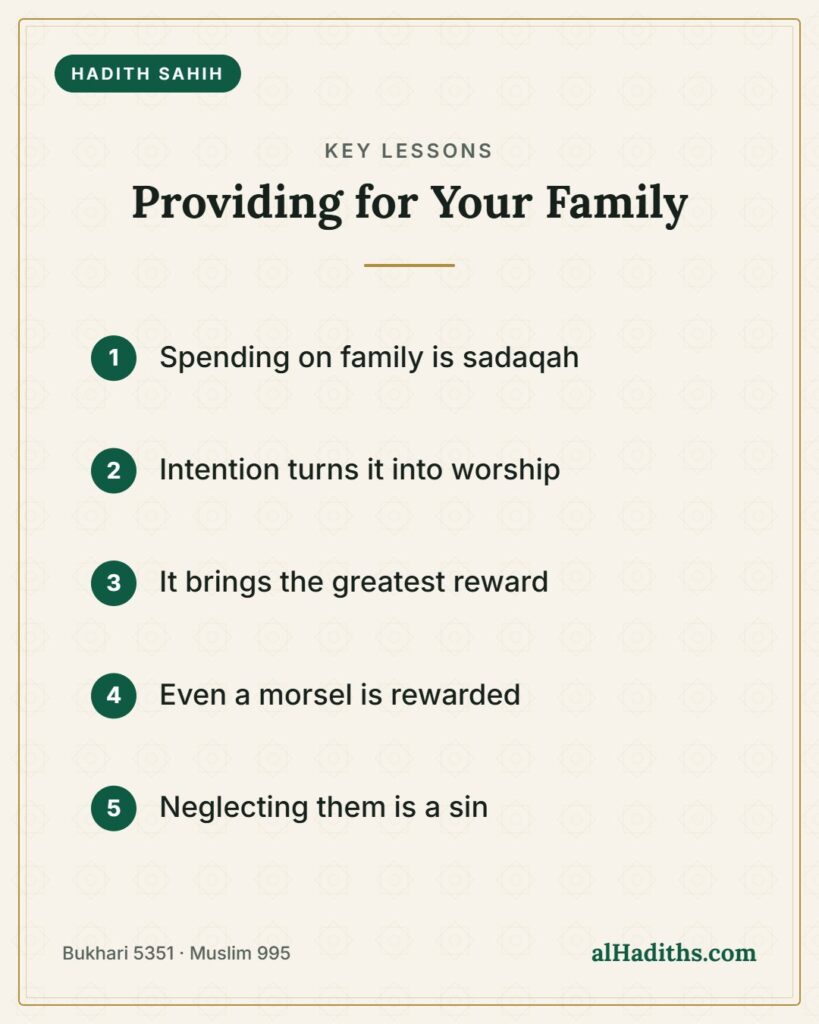
- Spending on your family, seeking Allah’s reward, is sadaqah.
- Of all the money we spend, what goes to our family brings the greatest reward.
- Even a morsel you put in your spouse’s mouth is rewarded.
- Neglecting those who depend on you is a sin.
- When providing feels heavy, renew your niyyah.
Questions people ask
Is spending on family considered sadaqah in Islam?
Yes. The Prophet ﷺ said that when a Muslim spends on his family seeking Allah’s reward, it is counted as sadaqah for him (Sahih al-Bukhari 5351, Sahih Muslim 1002a).
Is spending on family better than giving charity to others?
In Sahih Muslim 995, the Prophet ﷺ compared money spent in Allah’s path, on freeing a slave, on the poor and on one’s family, and said the greatest reward is in what is spent on one’s family. Giving to others is still a great deed.
Do I need to make an intention every time I spend on my family?
The hadith links the reward to spending while seeking Allah’s reward, but it does not set fixed words. Many people simply remind themselves in their heart before they spend. For a detailed ruling, ask a qualified scholar.
Tonight, when you put food on the table, say it quietly in your heart: this is for Allah. It costs nothing, and in shaa Allah it turns an ordinary meal into sadaqah.
Save this to Pinterest so you remember your niyyah when money feels tight.
Share the reward. Send this article to someone who needs it today — teaching a hadith or dua can become a lasting good deed for you, in shaa Allah.