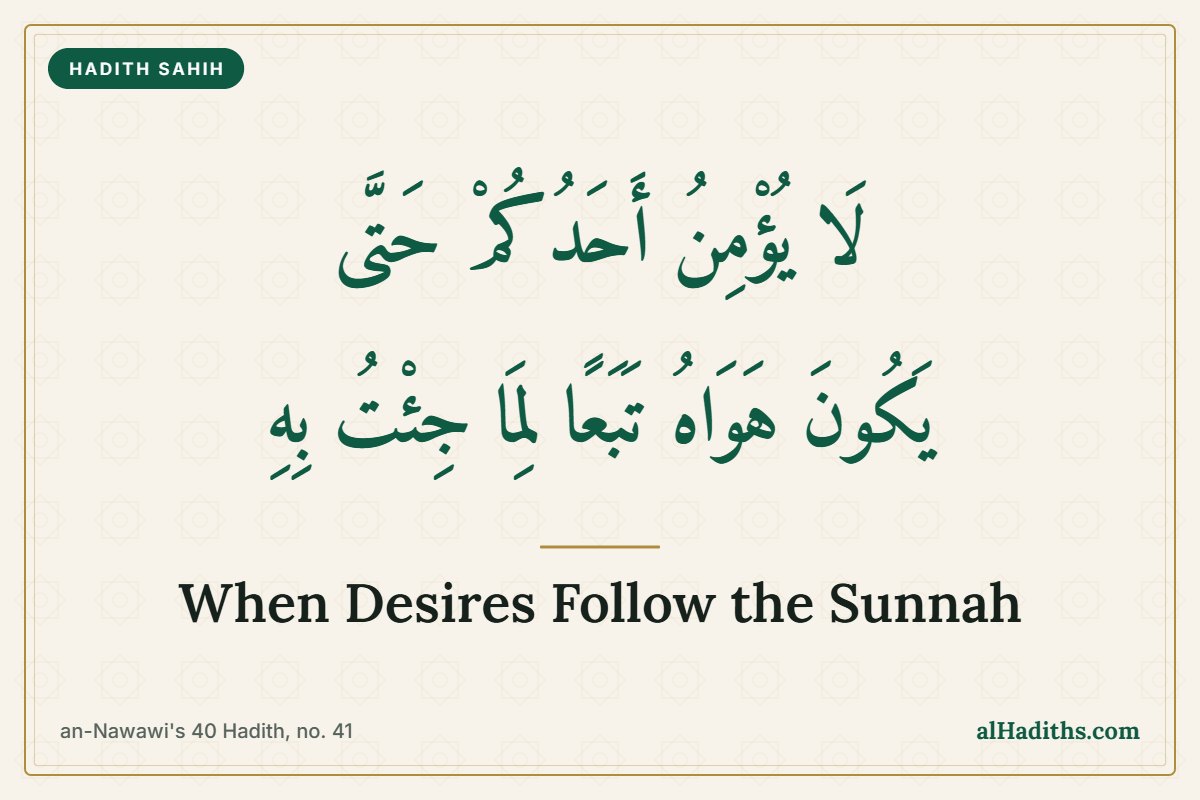
When Desires Follow the Sunnah: Hadith 41 of an-Nawawi
We all have things we want. The question this hadith asks is: what leads, our wants or the guidance of the Prophet ﷺ? Hadith 41 of Imam an-Nawawi’s collection, the none of you believes until his desires hadith, says complete faith means our desires follow what he brought. Scholars differ on its chain, and we explain that openly below.
At a glance
- Source: Hadith 41 of an-Nawawi’s 40, from Kitab al-Hujjah
- Narrated by: ‘Abdullah ibn ‘Amr ibn al-‘As (may Allah be pleased with him)
- Grade: Hasan sahih (an-Nawawi); graders differ, see the note on its grading
- Topic: Letting our desires follow the guidance of the Prophet ﷺ
- Put it into practice: Before a choice today, ask what the Sunnah says first
The hadith
‘Abdullah ibn ‘Amr ibn al-‘As (may Allah be pleased with him) reported that the Messenger of Allah ﷺ said:
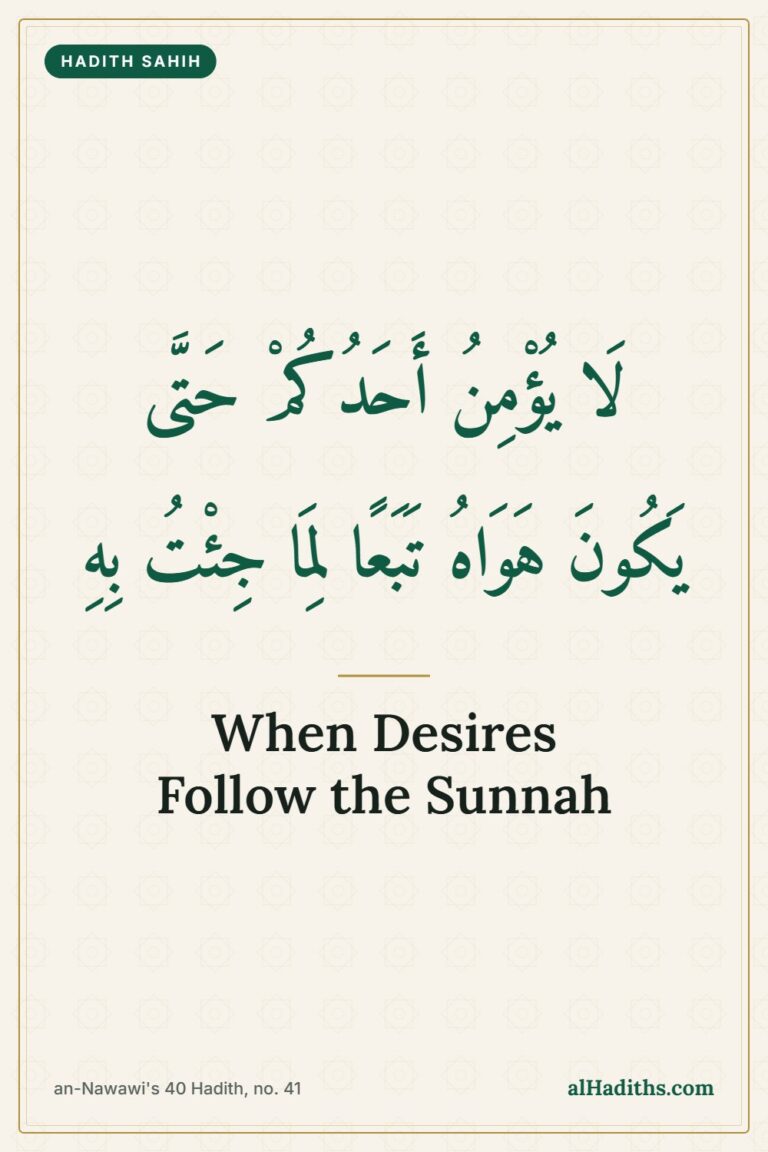
لَا يُؤْمِنُ أَحَدُكُمْ حَتَّى يَكُونَ هَوَاهُ تَبَعًا لِمَا جِئْتُ بِهِ
“None of you [truly] believes until his desires are subservient to that which I have brought.”
40 Hadith an-Nawawi 41 · Hasan sahih (an-Nawawi) · Translation from Sunnah.com
Imam an-Nawawi said he narrated it in the book Kitab al-Hujjah with a sahih chain, and graded it hasan sahih.
A note on its grading
Scholars of hadith did not all agree with that grade:
- Imam an-Nawawi graded it hasan sahih (Sunnah.com), and HadeethEnc quotes his grade.
- Ibn Rajab, in his commentary on the 40 Hadith, Jami’ al-‘Ulum wal-Hikam, said that declaring it authentic is very far-fetched, for several reasons. The first is that only Nu’aym ibn Hammad narrates it. Many imams respected Nu’aym, but the hadith critics came to judge him weak because of his mistakes (the Arabic text on Hadith Unlocked; our summary, translated from Arabic).
We follow our usual rule: we give an-Nawawi’s grade and show where scholars differ, so you can see both. Whatever one concludes about the chain, the meaning itself is taught clearly in the Quran:
فَلَا وَرَبِّكَ لَا يُؤْمِنُونَ حَتَّىٰ يُحَكِّمُوكَ فِيمَا شَجَرَ بَيْنَهُمْ ثُمَّ لَا يَجِدُوا۟ فِىٓ أَنفُسِهِمْ حَرَجًا مِّمَّا قَضَيْتَ وَيُسَلِّمُوا۟ تَسْلِيمًا
“But no, by your Lord, they will not [truly] believe until they make you, [O Muḥammad], judge concerning that over which they dispute among themselves and then find within themselves no discomfort from what you have judged and submit in [full, willing] submission.”
Surah An-Nisa 4:65 · Translation: Saheeh International, from Quran.com
What it means
Based on HadeethEnc‘s explanation:
- Complete faith is reached when what we love matches what the Prophet ﷺ brought: we love what he commanded and dislike what he forbade.
- Our minds and habits are not the judge. We don’t put them ahead of what he brought.
- The Shariah is the reference in all matters.
- Faith goes up and down: it increases with good deeds and decreases with sins.
Reflection: desires don’t have to disappear. Wanting rest, food, comfort or success is human. The hadith is about who leads. When our wants walk behind the Sunnah, they become part of our worship; when they walk in front, they quietly start making our decisions for us.
How to put it into practice
The hadith does not set out steps, so these are suggestions:
- Ask first, decide second. Before a choice, ask: what did the Prophet ﷺ teach about this?
- Notice the excuse. When we look for a way around a clear teaching, that is desire leading.
- Learn the Sunnah so you know what he brought; one authentic hadith a day is a start.
- Hold to the Sunnah, not new practices; see Hadith 28 and Hadith 5 on bid’ah.
- Ask a qualified scholar when you are unsure what a teaching requires of you.
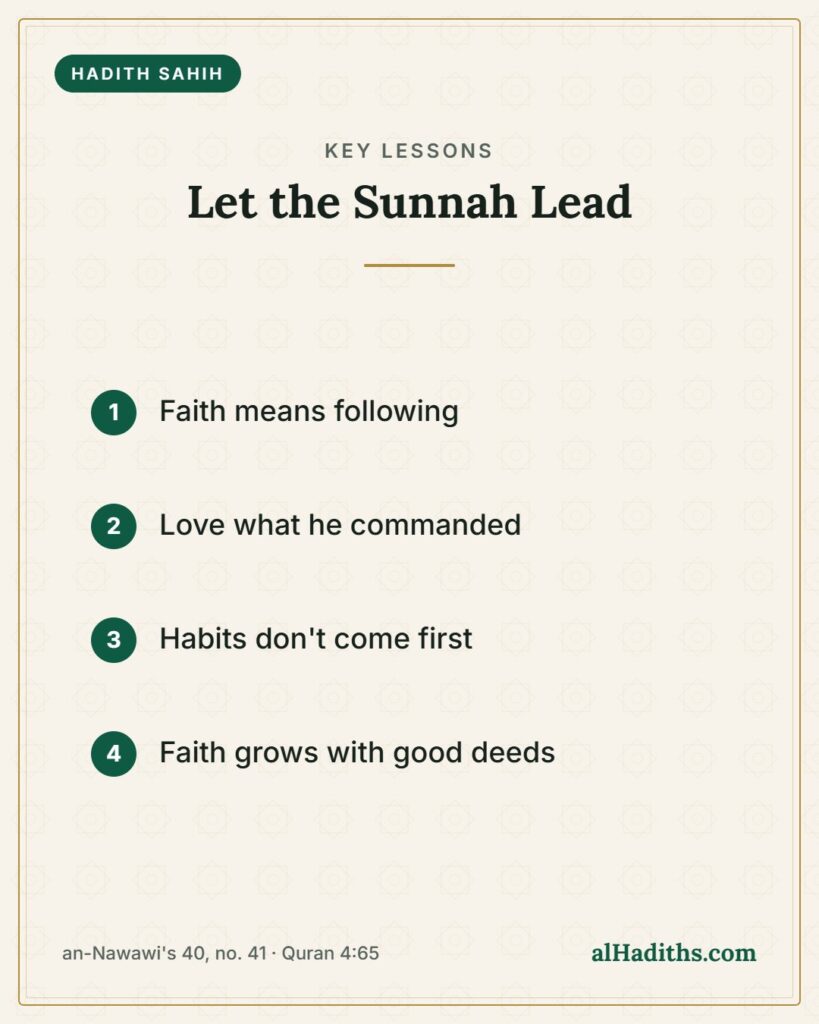
Key lessons
- Complete faith means our desires follow the guidance of the Prophet ﷺ.
- We love what he commanded and dislike what he forbade.
- Our habits and opinions don’t come before the Sunnah.
- Scholars differ on this hadith’s chain, but its meaning is in the Quran (4:65).
- Faith grows with good deeds and weakens with sins.
Questions people ask
Is the hadith “none of you believes until his desires” authentic?
Imam an-Nawawi graded it hasan sahih. Ibn Rajab said declaring it authentic is very far-fetched, mainly because only Nu’aym ibn Hammad narrates it. Its meaning is supported by the Quran (4:65).
What does it mean for desires to follow the Sunnah?
According to HadeethEnc, it means loving what the Prophet ﷺ commanded and disliking what he forbade, and not putting our own opinions or habits ahead of what he brought.
Does this mean a Muslim should have no desires?
No. The hadith speaks of desires following what the Prophet ﷺ brought, not of having none.
A question to sit with today: in the last decision I made, which came first, what I wanted or what the Prophet ﷺ taught?
Save this to Pinterest so you can come back to this hadith later.
Share the reward. Send this article to someone who needs it today — teaching a hadith or dua can become a lasting good deed for you, in shaa Allah.