No One Enters Jannah by Deeds Alone: Only by Allah’s Mercy
If Paradise were a reward we could earn, who would ever feel safe? The Prophet ﷺ answered that worry in one short hadith: no one will enter Paradise by his deeds alone. When the Companions asked if that included him, he ﷺ said it did, unless Allah covered him with His mercy. This is the last article in our Heaven series, and it holds the key to every door we have described so far.
At a glance
- Source: Sahih al-Bukhari 6463 (also Sahih Muslim 2816a)
- Narrated by: Abu Hurairah
- Grade: Sahih (al-Bukhari and Muslim)
- Topic: Entering Jannah by Allah’s mercy
- Practise it: Pick one small deed you can keep up every day, and ask Allah for His mercy
The hadith
Abu Hurairah (may Allah be pleased with him) reported that the Messenger of Allah ﷺ said:
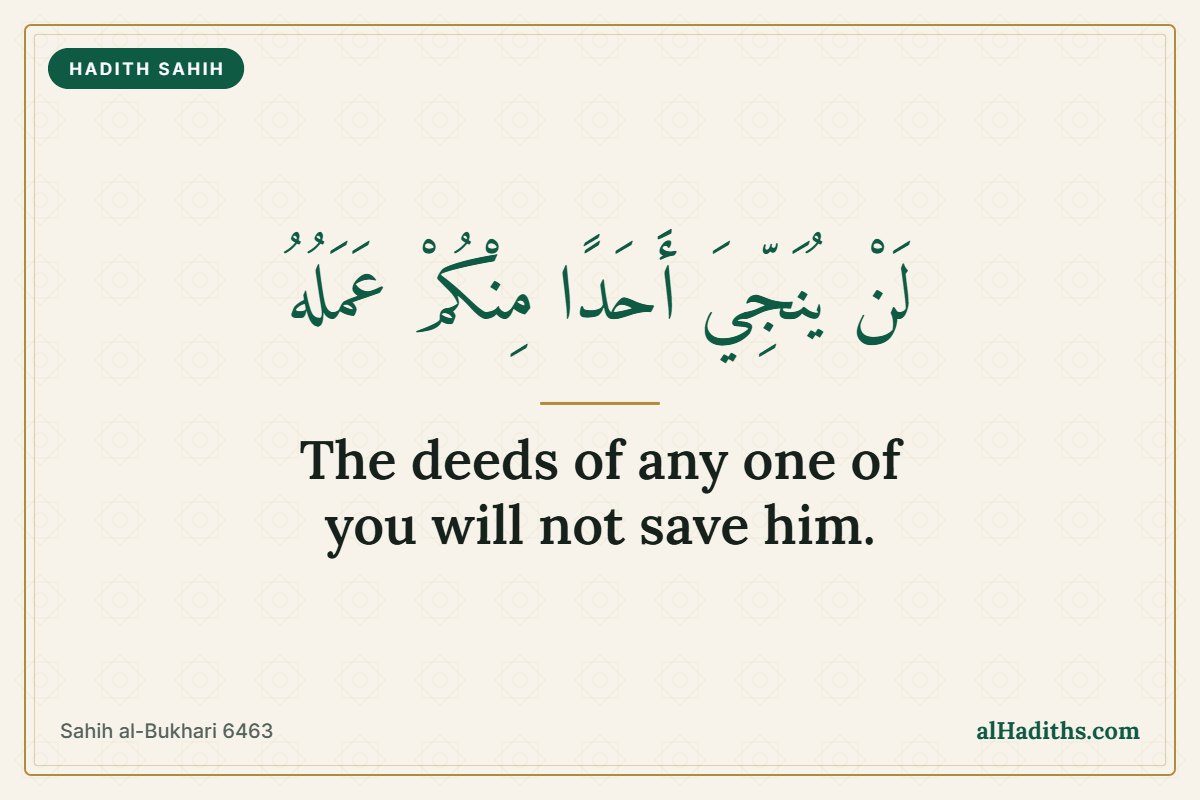
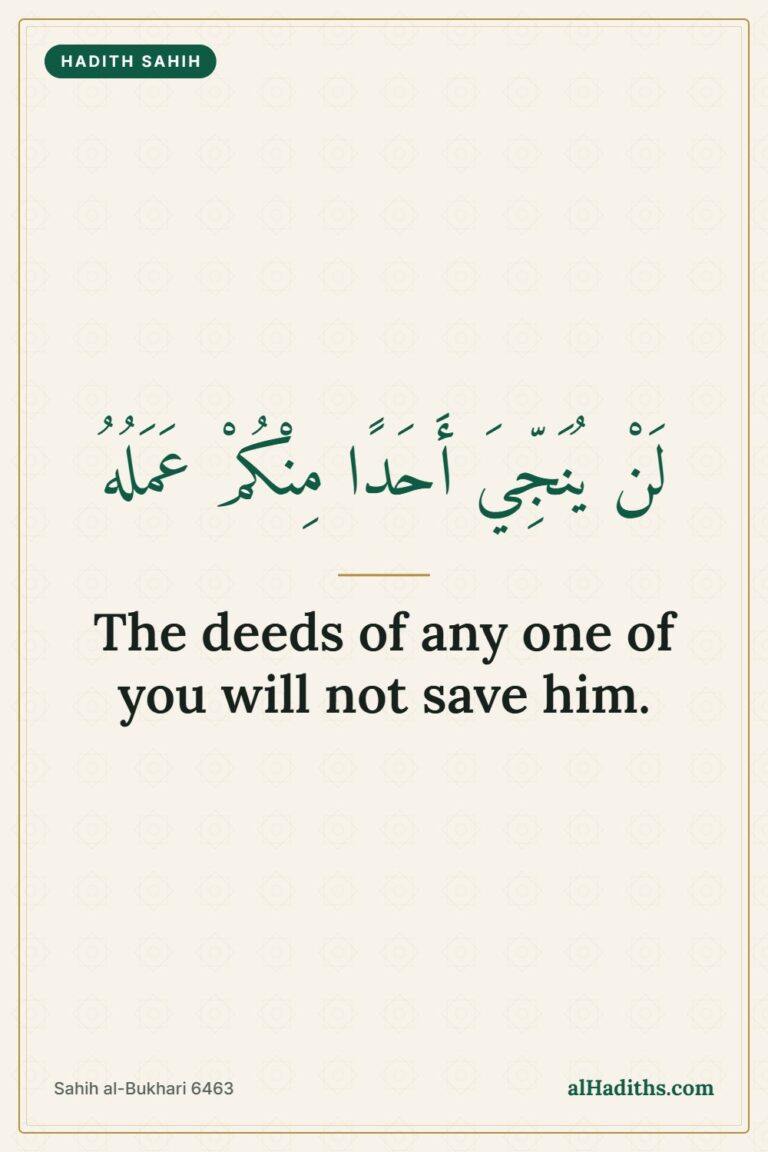
لَنْ يُنَجِّيَ أَحَدًا مِنْكُمْ عَمَلُهُ. قَالُوا وَلاَ أَنْتَ يَا رَسُولَ اللَّهِ قَالَ وَلاَ أَنَا، إِلاَّ أَنْ يَتَغَمَّدَنِي اللَّهُ بِرَحْمَةٍ، سَدِّدُوا وَقَارِبُوا، وَاغْدُوا وَرُوحُوا، وَشَىْءٌ مِنَ الدُّلْجَةِ. وَالْقَصْدَ الْقَصْدَ تَبْلُغُوا
“The deeds of any one of you will not save him.” They said, “Not even you, O Messenger of Allah?” He said, “Not even me, unless Allah covers me with His mercy. So do good deeds properly, sincerely and moderately, worship Allah in the forenoon and in the afternoon and during a part of the night, and always keep to the middle course, the middle course, and you will reach your goal (Paradise).”
Sahih al-Bukhari 6463 · Narrated by Abu Hurairah · Translation adapted from Sunnah.com
Sahih Muslim records the same words from Abu Hurairah through another chain, with “mercy from Him”:
لَنْ يُنْجِيَ أَحَدًا مِنْكُمْ عَمَلُهُ. قَالَ رَجُلٌ وَلاَ إِيَّاكَ يَا رَسُولَ اللَّهِ قَالَ وَلاَ إِيَّاىَ إِلاَّ أَنْ يَتَغَمَّدَنِيَ اللَّهُ مِنْهُ بِرَحْمَةٍ وَلَكِنْ سَدِّدُوا
“None of you will be saved by his deeds.” A man said, “Not even you, O Messenger of Allah?” He said, “Not even me, unless Allah wraps me in mercy from Him. But you should act with moderation.”
Sahih Muslim 2816a · Narrated by Abu Hurairah · Translation adapted from Sunnah.com
In both narrations the Companions asked the same question, because no one had better deeds than the Prophet ﷺ. His answer shows the rule has no exceptions.
“And receive good news”
‘A’ishah (may Allah be pleased with her) reported a version that starts with good news:
سَدِّدُوا وَقَارِبُوا، وَأَبْشِرُوا، فَإِنَّهُ لاَ يُدْخِلُ أَحَدًا الْجَنَّةَ عَمَلُهُ. قَالُوا وَلاَ، أَنْتَ يَا رَسُولَ اللَّهِ قَالَ وَلاَ أَنَا إِلاَّ أَنْ يَتَغَمَّدَنِي اللَّهُ بِمَغْفِرَةٍ وَرَحْمَةٍ
“Do good deeds properly, sincerely and moderately, and receive good news, because no one’s deeds will make him enter Paradise.” They asked, “Not even you, O Messenger of Allah?” He said, “Not even me, unless Allah covers me with His forgiveness and mercy.”
Sahih al-Bukhari 6467 · Narrated by ‘A’ishah · Translation adapted from Sunnah.com
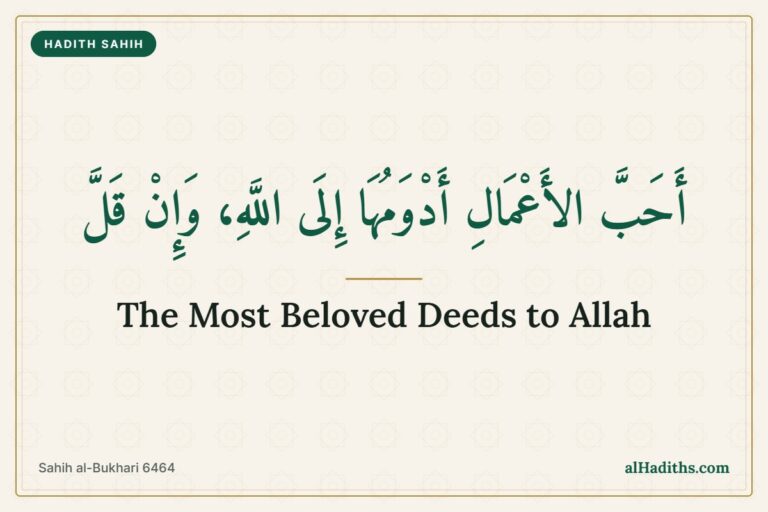
Before saying that deeds are not enough, he ﷺ told them to receive good news. The hadith is not meant to make anyone give up. In Sahih Muslim 2818a, ‘A’ishah’s narration ends with one more line: the deed most loved by Allah is the one done constantly, even if it is small. We looked at that line in Hadith About Consistency.
Why no one will enter Paradise by his deeds alone
The Encyclopedia of Translated Prophetic Hadiths (HadeethEnc) explains that good deeds are a cause of entering Paradise, but they do not guarantee it on their own. Entry comes with Allah’s pardon and mercy, a point it quotes from Shaykh Ibn Baz.
It also quotes Ibn al-Jawzi, who gave several reasons. Being guided to do good is itself a mercy from Allah. A servant, and all he does, belongs to his Lord. A few short years of deeds are rewarded with a life in Paradise that never ends, which is generosity, not a fair exchange. And entering Paradise is by Allah’s mercy, while the ranks people reach inside it follow their deeds.
But does the Quran not link Paradise to what people did? The people of Paradise will hear these words:
وَنَزَعْنَا مَا فِى صُدُورِهِم مِّنْ غِلٍّ تَجْرِى مِن تَحْتِهِمُ ٱلْأَنْهَـٰرُ ۖ وَقَالُوا۟ ٱلْحَمْدُ لِلَّهِ ٱلَّذِى هَدَىٰنَا لِهَـٰذَا وَمَا كُنَّا لِنَهْتَدِىَ لَوْلَآ أَنْ هَدَىٰنَا ٱللَّهُ ۖ لَقَدْ جَآءَتْ رُسُلُ رَبِّنَا بِٱلْحَقِّ ۖ وَنُودُوٓا۟ أَن تِلْكُمُ ٱلْجَنَّةُ أُورِثْتُمُوهَا بِمَا كُنتُمْ تَعْمَلُونَ
And We will have removed whatever is within their breasts of resentment, [while] flowing beneath them are rivers. And they will say, “Praise to Allāh, who has guided us to this; and we would never have been guided if Allāh had not guided us. Certainly the messengers of our Lord had come with the truth.” And they will be called, “This is Paradise, which you have been made to inherit for what you used to do.”
Surah Al-A’raf 7:43 · Translation: Saheeh International, from Quran.com
HadeethEnc answers this by quoting Imam an-Nawawi on verses such as An-Nahl 16:32 and Az-Zukhruf 43:72, which also link Paradise to deeds. There is no contradiction. Deeds are a means of entering Paradise, but being guided to them, doing them sincerely and having them accepted all come from Allah’s mercy. So deeds are a cause, not a price that Allah owes.
The middle course
The hadith does not stop at “deeds are not enough”. It ends with instructions. HadeethEnc explains saddidu as pursuing what is right, and qaribu as staying as close to it as you can when you cannot reach it fully, avoiding both excess and neglect, as Imam an-Nawawi explained.
The morning, the afternoon and part of the night also appear in Sahih al-Bukhari 39, which begins by saying the religion is easy. Its HadeethEnc entry explains that the Prophet ﷺ compared worship to a journey and named the times a traveler has the most energy: the early morning, the afternoon, and only part of the night, because the night is harder. Choosing those times helps a person keep going.
The same entry names the danger of excess: exhaustion, missing obligations such as Fajr in congregation, or giving up altogether. That is why the Prophet ﷺ repeated “the middle course” twice.
How to practise it
- Choose one small deed you can keep up daily, such as two rak‘ahs before Fajr or a few minutes of Quran. Steady and small is most loved by Allah.
- Use your fresh times: something after Fajr, something in the afternoon, a little at night. The hadith gives no amounts, so pick what you can sustain.
- Thank Allah after a good deed instead of counting it as your own achievement. Being guided to it was His mercy.
- Ask Allah for His mercy and for Jannah. Authentic duas for this are in Dua for Jannah.
- If you slip, come back. The hadith says aim for what is right and stay close to it, not be perfect.
Try this: write down the one deed you will keep up this week, and the time of day you will do it.
What it takes
Across this series we walked through the gates, the levels, the rivers and the trees of Jannah, and the greatest reward of all, seeing Allah. This hadith ties them together: none of it is bought. Our deeds are the path Allah asked us to walk, and His mercy is what carries us to the end of it. To go back through the series:
- Jannah in Islam: 6 Authentic Hadith About Paradise
- Levels of Jannah and al-Firdaus
- The 8 Gates of Jannah
- Dua for Jannah: 4 Authentic Duas
- The Last Person to Enter Jannah
- Seeing Allah in Jannah
- Rivers of Jannah
- Trees in Jannah
- 70,000 Who Enter Jannah Without Reckoning
- No One Enters Jannah by Deeds Alone (this article)
For the same truth from the other side, read Allah’s Mercy in 100 Parts, the hadith that closed our series on Hellfire.
Reflection: In Surah Al-A’raf 7:43, the people of Paradise are told they inherited it for what they used to do, yet their own words are: “we would never have been guided if Allah had not guided us.” The ones who did the deeds are the first to say the deeds were His gift.
Questions people ask
Will anyone enter Paradise because of their deeds?
According to Sahih al-Bukhari 6463, no one is saved by his deeds alone. Deeds are a means Allah has made for entering Paradise, but entry comes through His mercy, as the scholars quoted in HadeethEnc explain.
Does this mean good deeds don’t matter?
No. In the same hadith the Prophet ﷺ commanded good deeds right after this statement. Deeds are the cause Allah has tied to Paradise; His mercy is what makes them enough.
Did the Prophet ﷺ say he would enter Jannah by Allah’s mercy too?
Yes. When the Companions asked, “Not even you?”, he ﷺ answered, “Not even me, unless Allah covers me with His mercy” (Sahih al-Bukhari 6463, Sahih Muslim 2816a).
How do the Quran verses about deeds fit with this hadith?
Imam an-Nawawi, quoted in HadeethEnc, explained that verses linking Paradise to deeds mean deeds are a means, and being guided to them and having them accepted is itself Allah’s mercy.
Key lessons
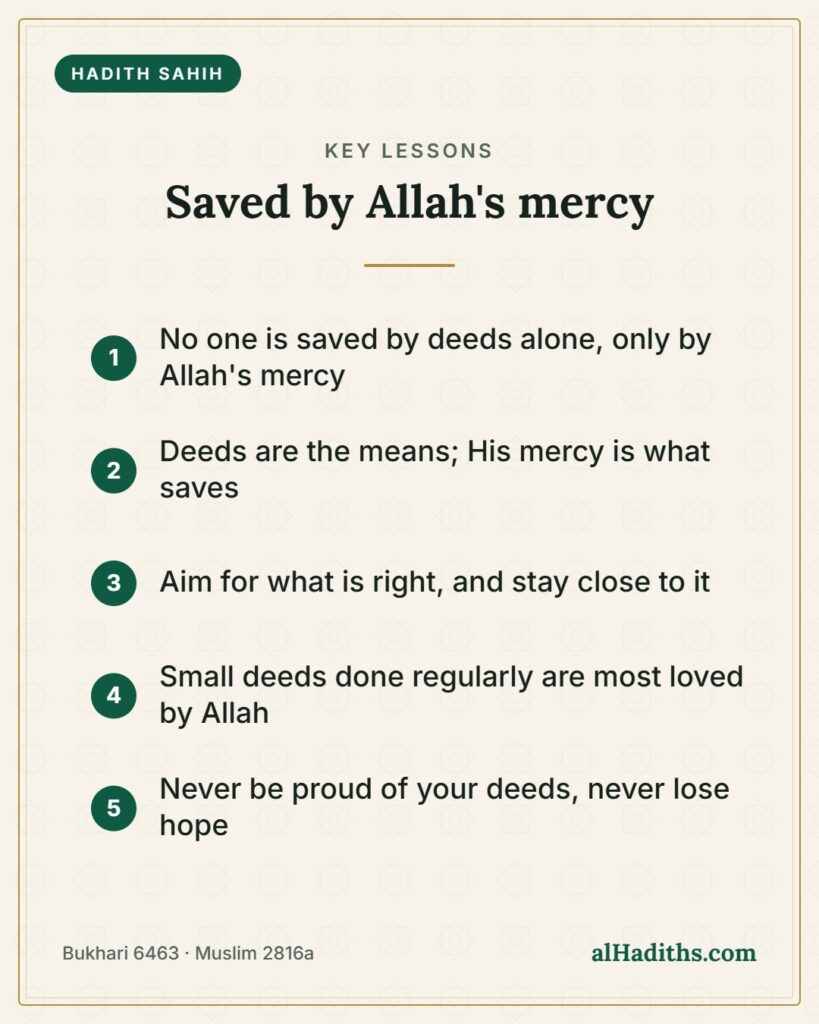
- No one enters Paradise by deeds alone, not even the Prophet ﷺ; it is Allah’s mercy that saves.
- Deeds still matter: they are the means Allah has tied to Paradise.
- Aim for what is right, and when you fall short, stay as close to it as you can.
- A small deed done constantly is most loved by Allah.
- Never be proud of your deeds, and never lose hope in His mercy.
May Allah cover us with His mercy, guide us to the deeds He loves, and gather us in Jannah al-Firdaus with those we love.
Save this to Pinterest so you can remember that Paradise is reached by Allah’s mercy, and share it
Share the reward. Send this article to someone who needs it today — teaching a hadith or dua can become a lasting good deed for you, in shaa Allah.