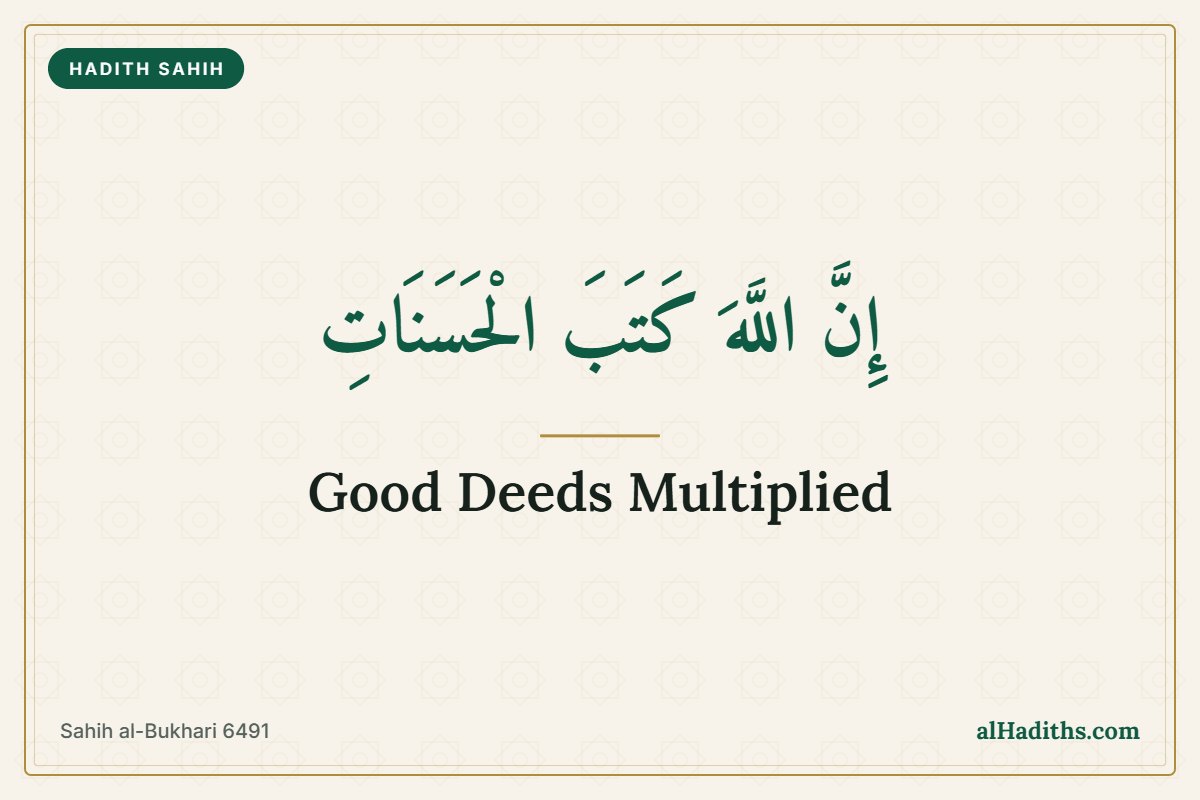
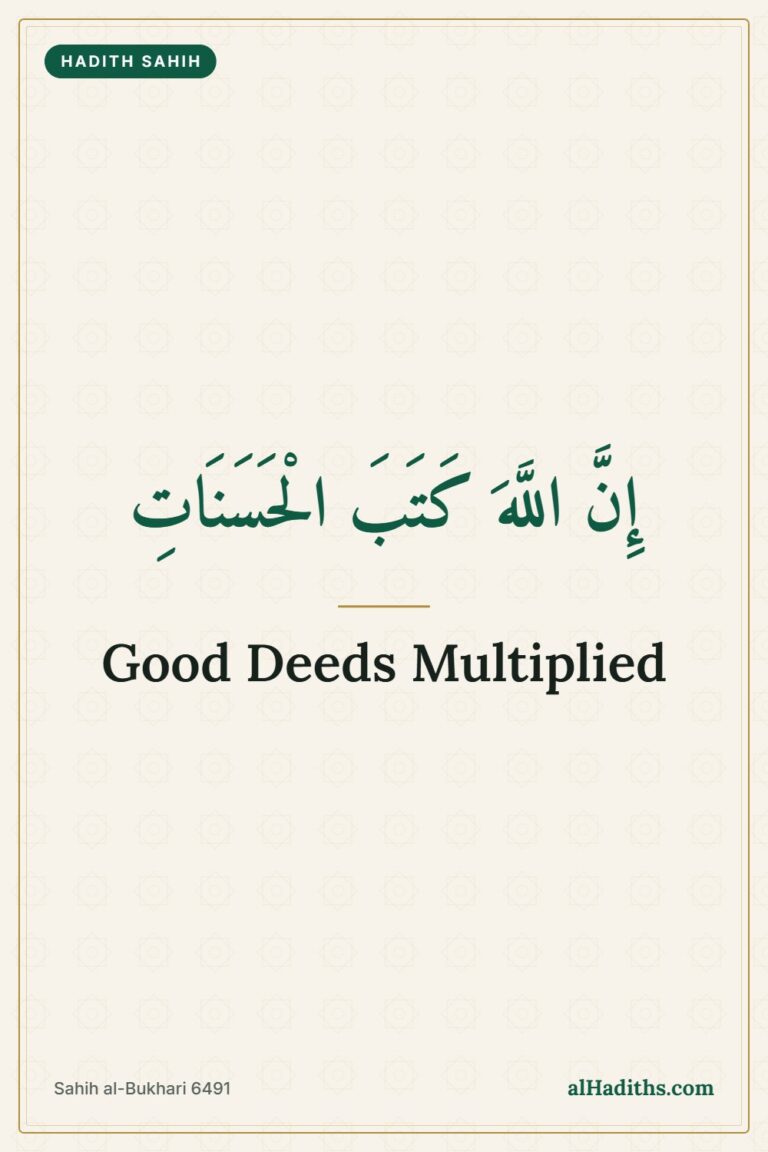
Good Deeds Multiplied, Bad Deeds Counted Once: Hadith 37
Did you know that a good deed you only planned, and never managed to do, can still be written for you? This is Hadith 37 of Imam an-Nawawi’s collection, a hadith qudsi in which the Prophet ﷺ tells us how Allah writes good deeds and bad deeds, and how generous that writing is.
At a glance
- Source: Sahih al-Bukhari 6491; also Sahih Muslim 131a and Hadith 37 of an-Nawawi’s 40
- Narrated by: Ibn ‘Abbas (may Allah be pleased with him)
- Grade: Sahih (al-Bukhari and Muslim); a hadith qudsi
- Topic: Intentions, and how good and bad deeds are recorded
- Put it into practice: Today, sincerely intend one good deed, then try to do it
The hadith
Ibn ‘Abbas (may Allah be pleased with him) reported that the Prophet ﷺ said, narrating from his Lord:
إِنَّ اللَّهَ كَتَبَ الْحَسَنَاتِ وَالسَّيِّئَاتِ، ثُمَّ بَيَّنَ ذَلِكَ فَمَنْ هَمَّ بِحَسَنَةٍ فَلَمْ يَعْمَلْهَا كَتَبَهَا اللَّهُ لَهُ عِنْدَهُ حَسَنَةً كَامِلَةً، فَإِنْ هُوَ هَمَّ بِهَا فَعَمِلَهَا كَتَبَهَا اللَّهُ لَهُ عِنْدَهُ عَشْرَ حَسَنَاتٍ إِلَى سَبْعِمِائَةِ ضِعْفٍ إِلَى أَضْعَافٍ كَثِيرَةٍ، وَمَنْ هَمَّ بِسَيِّئَةٍ فَلَمْ يَعْمَلْهَا كَتَبَهَا اللَّهُ لَهُ عِنْدَهُ حَسَنَةً كَامِلَةً، فَإِنْ هُوَ هَمَّ بِهَا فَعَمِلَهَا كَتَبَهَا اللَّهُ لَهُ سَيِّئَةً وَاحِدَةً
“Allah ordered (the appointed angels over you) that the good and the bad deeds be written, and He then showed (the way) how (to write). If somebody intends to do a good deed and he does not do it, then Allah will write for him a full good deed (in his account with Him); and if he intends to do a good deed and actually did it, then Allah will write for him (in his account) with Him (its reward equal) from ten to seven hundred times to many more times: and if somebody intended to do a bad deed and he does not do it, then Allah will write a full good deed (in his account) with Him, and if he intended to do it (a bad deed) and actually did it, then Allah will write one bad deed (in his account).”
Sahih al-Bukhari 6491 · Narrated by Ibn ‘Abbas · Translation from Sunnah.com
How Allah writes good deeds and bad deeds
Based on the explanation in HadeethEnc, Allah decreed the good and bad deeds and then made clear to the two recording angels how to write them:
- A good deed intended but not done is written as one complete good deed.
- A good deed intended and done is written as ten good deeds, up to seven hundred times and many times more. HadeethEnc says the increase depends on things like the sincerity in the person’s heart and how much the deed benefits others.
- A bad deed done is written as only one bad deed.
A bad deed intended but not done
The hadith says it is written as a complete good deed. HadeethEnc explains the detail behind this:
- If the person leaves it for Allah’s sake, it is written as a good deed.
- If he leaves it because something else distracted him, without having taken steps towards it, nothing is written.
- If he leaves it only because he was not able to do it, his intention is written against him.
The Quran states the same balance of ten for one:
مَن جَآءَ بِٱلْحَسَنَةِ فَلَهُۥ عَشْرُ أَمْثَالِهَا ۖ وَمَن جَآءَ بِٱلسَّيِّئَةِ فَلَا يُجْزَىٰٓ إِلَّا مِثْلَهَا وَهُمْ لَا يُظْلَمُونَ
“Whoever comes [on the Day of Judgement] with a good deed will have ten times the like thereof [to his credit], and whoever comes with an evil deed will not be recompensed except the like thereof; and they will not be wronged.”
Surah Al-An’am 6:160 · Translation: Saheeh International, from Quran.com
This hadith sits well beside Hadith 1, actions are judged by intentions. HadeethEnc lists among its benefits Allah’s great favor on this ummah, the importance of intention, and His kindness in rewarding a good deed that was only intended.
Reflection: many of us carry a quiet list of good things we meant to do and never did. This hadith turns that list into something hopeful: a sincere intention is already written. It also asks us to be honest with ourselves about the other list, the wrongs we only stopped because we could not reach them. The difference between those two is what we really wanted.
How to put it into practice
The hadith does not set a routine, so these are suggestions:
- Intend good often. Before you sleep, make a sincere intention for tomorrow: a prayer, a visit, a charity.
- Then act on it. The reward for doing it is ten times or more; see Allah loves deeds done regularly.
- Purify the intention, since sincerity is part of what multiplies the reward.
- Leave a sin for Allah, not only because the chance passed. Turning away for His sake is itself written as a good deed.
- Choose deeds that help others, like relieving a believer’s hardship.
Key lessons
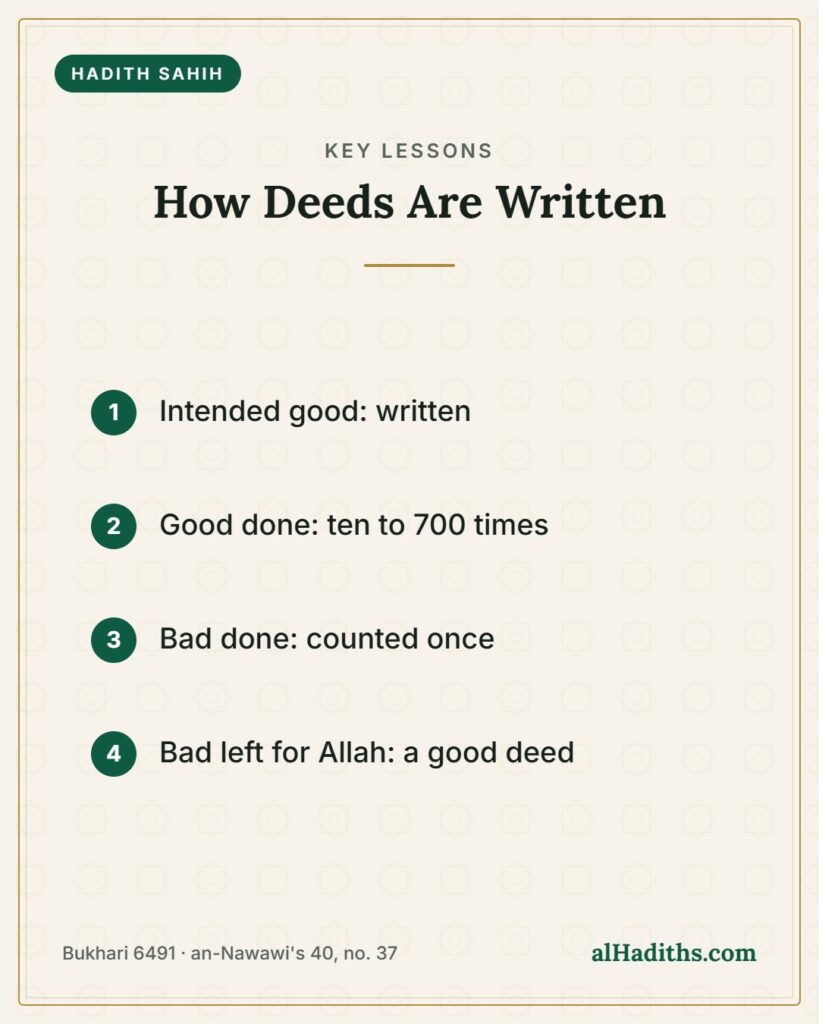
- A good deed you intend is written, even if you could not do it.
- A good deed done is multiplied ten to seven hundred times or more.
- A bad deed done is written only once.
- A bad deed left for Allah’s sake is written as a good deed.
- Sincerity and intention shape the reward.
Questions people ask
Do I get rewarded for a good deed I only intended?
Yes. The hadith says Allah writes it as a complete good deed even if you did not do it (Sahih al-Bukhari 6491).
Am I sinful for thinking about a bad deed?
According to HadeethEnc, a bad deed you intended and then left for Allah’s sake is written as a good deed; if you were only distracted, nothing is written; but if you left it only because you could not do it, the intention is written against you. For your own case, ask a qualified scholar.
Is this a hadith qudsi?
Yes. The Prophet ﷺ narrated it from his Lord. It is in Sahih al-Bukhari and Sahih Muslim, and Imam an-Nawawi included it as Hadith 37 of his 40.
One question to take with you today: what good have you been meaning to do for a long time? Intend it sincerely tonight, and try to do it tomorrow.
Save this to Pinterest so you can come back to this hadith later.
Share the reward. Send this article to someone who needs it today — teaching a hadith or dua can become a lasting good deed for you, in shaa Allah.