If You Feel No Shame, Do As You Wish: Hadith 20 of an-Nawawi
At first glance, “do as you wish” sounds like permission to do anything at all. In fact, Hadith 20 of Imam an-Nawawi’s collection says the opposite. The Prophet ﷺ said that among the words people inherited from the earlier prophets is this: if you feel no shame, then do as you wish. It is a short line about haya, the sense of shame and modesty that holds a person back from what is wrong. Here is the hadith, what the scholars say it means, and how it applies today.
At a glance
- Source: Sahih al-Bukhari 3484 and 6120 (Hadith 20 of an-Nawawi’s 40)
- Narrated by: Abu Mas’ud ‘Uqbah ibn ‘Amr al-Ansari (may Allah be pleased with him)
- Grade: Sahih (Sahih al-Bukhari)
- Topic: Haya: modesty and a sense of shame before Allah and people
- Put it into practice: Before doing something, ask: would I be ashamed if Allah and people saw this?
The hadith
Abu Mas’ud (may Allah be pleased with him) reported that the Prophet ﷺ said:
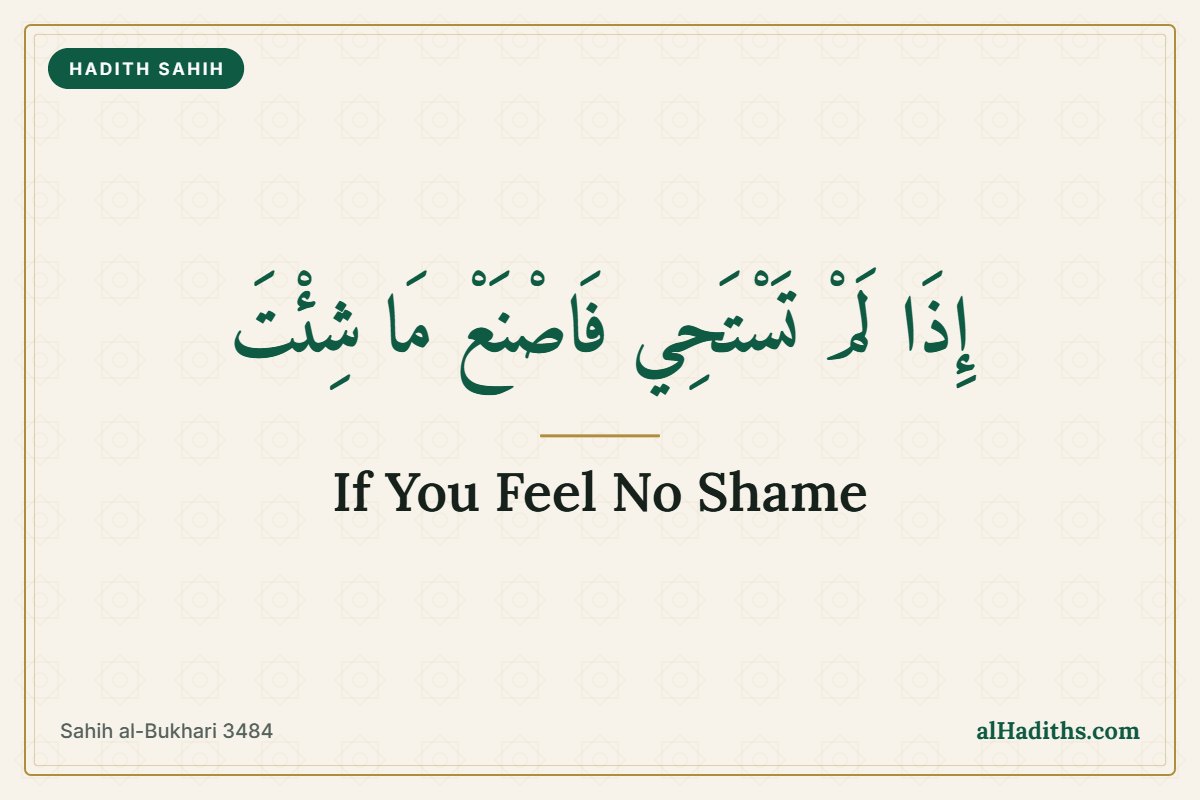
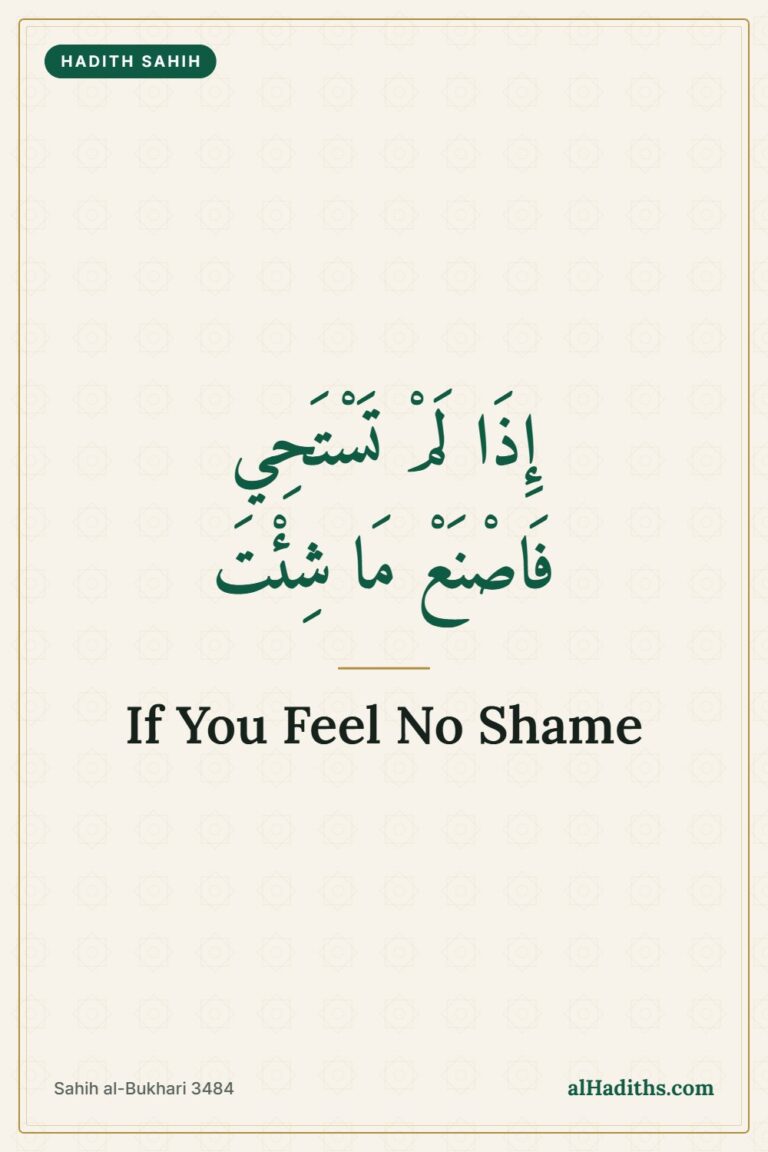
إِنَّ مِمَّا أَدْرَكَ النَّاسُ مِنْ كَلاَمِ النُّبُوَّةِ إِذَا لَمْ تَسْتَحِي فَاصْنَعْ مَا شِئْتَ
“One of the sayings of the prophets which the people have got is: ‘If you do not feel ashamed, then do whatever you like.'”
Sahih al-Bukhari 3484 · Narrated by Abu Mas’ud · Translation from Sunnah.com
In another narration in al-Bukhari (Sahih al-Bukhari 6120) the words are كَلاَمِ النُّبُوَّةِ الأُولَى, “the speech of the earliest prophecy”. That is the wording Imam an-Nawawi gives as Hadith 20 of his 40 Hadith.
A teaching of the earlier prophets
The Encyclopedia of Translated Prophetic Hadiths (HadeethEnc) explains that this was among the teachings of the earlier prophets that spread among people and passed from one generation to the next until it reached this Ummah. Its message is simple: think about what you want to do. If it is not something to be ashamed of, do it; if it is, leave it. HadeethEnc adds that modesty holds a person back from shameful deeds, while someone with no share of it will fall into every kind of wrong.
What “if you feel no shame, do as you wish” means
HadeethEnc quotes Imam an-Nawawi and other explanations of the command “do as you wish”:
- A permission: if you want to do something and it would not make you ashamed before Allah and people, go ahead; otherwise, leave it. An-Nawawi called this a keystone of Islam.
- A warning: if modesty has been taken from you, then do what you like, and Allah will recompense you for it.
- A statement of fact: whoever has no shame will simply do whatever he wants.
Under the first reading, an-Nawawi explains, a person should feel ashamed to leave what Allah has commanded and ashamed to do what He has forbidden, so the hadith touches every kind of deed. For how a specific action is ruled, ask a qualified scholar.
Haya is part of faith
The Prophet ﷺ praised haya in other authentic hadith. He heard a man scolding his brother about his modesty, and said:
الْحَيَاءُ مِنَ الإِيمَانِ
“Modesty is part of Iman (faith).”
Sahih Muslim 36a · Narrated by Ibn ‘Umar · Translation from Sunnah.com
He ﷺ also said:
الْحَيَاءُ لاَ يَأْتِي إِلاَّ بِخَيْرٍ
“Haya’ (modesty) does not bring anything except good.”
Sahih al-Bukhari 6117 · Narrated by ‘Imran ibn Husain · Translation adapted from Sunnah.com
Haya is also named among the branches of faith; see the branches of iman. Among the benefits HadeethEnc lists: modesty is the core of noble character, it is a trait of the prophets, and it moves a Muslim toward what is beautiful and away from what is disgraceful.
Reflection: this hadith was spoken long before screens, yet it fits them well. Much of what we do today happens in private, on a phone, where no one else is watching. The test the hadith gives still works: if I would be ashamed for Allah or for the people I respect to see this, it is better left. Haya before Allah is close to the ihsan described in the Hadith of Jibril, worshipping Allah as though you see Him.
How to put it into practice
The hadith does not give a routine, so these are suggestions:
- Pause before you act and ask whether you would be ashamed if Allah and people saw it.
- Keep haya in private, online and offline, remembering that Allah sees you. See fear Allah wherever you are.
- Guard your words: avoid crude speech and mocking others.
- Do not mock modesty in others. When a man scolded his brother about it, the Prophet ﷺ said, “Leave him” (Sahih al-Bukhari 24).
- Let haya push you to do good, not only to avoid wrong: feel shy before Allah about leaving what He has commanded.
Key lessons
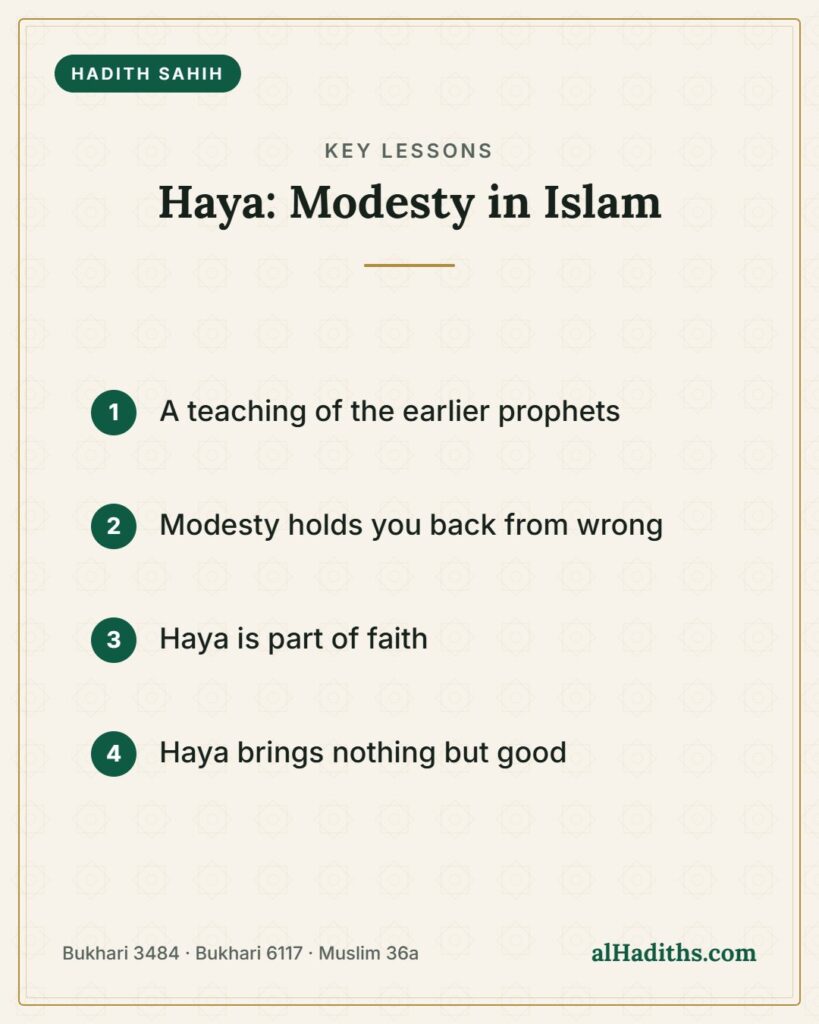
- Haya is a teaching shared by the earlier prophets.
- Modesty holds a person back from shameful deeds.
- Haya is part of faith and brings nothing but good.
- Feel ashamed before Allah to leave His commands or do what He forbids.
Questions people ask
What does “if you feel no shame, then do as you wish” mean?
Scholars give three readings: a permission (do it if it would not make you ashamed before Allah and people, otherwise leave it), a warning (do what you like, and Allah will recompense you), or a statement (whoever has no shame does whatever he wants). HadeethEnc gives all three, quoting Imam an-Nawawi (Encyclopedia of Translated Prophetic Hadiths (HadeethEnc)).
What is haya in Islam?
Haya is modesty and a sense of shame that holds a person back from what is wrong and moves him toward what is good. The Prophet ﷺ said modesty is part of faith (Sahih Muslim 36a) and that it brings nothing but good (Sahih al-Bukhari 6117).
Is the hadith “if you feel no shame” authentic?
Yes. It is in Sahih al-Bukhari 3484 and 6120, narrated by Abu Mas’ud, and it is Hadith 20 of an-Nawawi’s 40.
One step for today: before you open an app, send a message or say something you are unsure about, ask yourself the question this hadith teaches.
Save this to Pinterest so you can come back to this hadith.
Share the reward. Send this article to someone who needs it today — teaching a hadith or dua can become a lasting good deed for you, in shaa Allah.