Deeds That Lead to Jannah: The Bedouin Called a Man of Paradise
“Whoever likes to see a man of Paradise, then he may look at this man.” The Prophet ﷺ said this about a Bedouin who had just walked away from him. The man had asked a simple question: which deeds lead to Jannah? The answer he received, and a second Bedouin’s version of the same question, give us a short, clear list we can check ourselves against today.
At a glance
- Source: Sahih al-Bukhari 1397; also Sahih Muslim 13a
- Narrated by: Abu Hurairah and Abu Ayyub al-Ansari (may Allah be pleased with them)
- Grade: Sahih (Sahih al-Bukhari, Sahih Muslim); Riyad as-Salihin 1212 notes it is agreed upon
- Topic: Deeds that lead to Jannah, the obligations, ties of kinship
- Practise it: Check yourself against the five deeds, then contact one relative this week
The hadith: “a man of Paradise”
Abu Hurairah (may Allah be pleased with him) narrated:
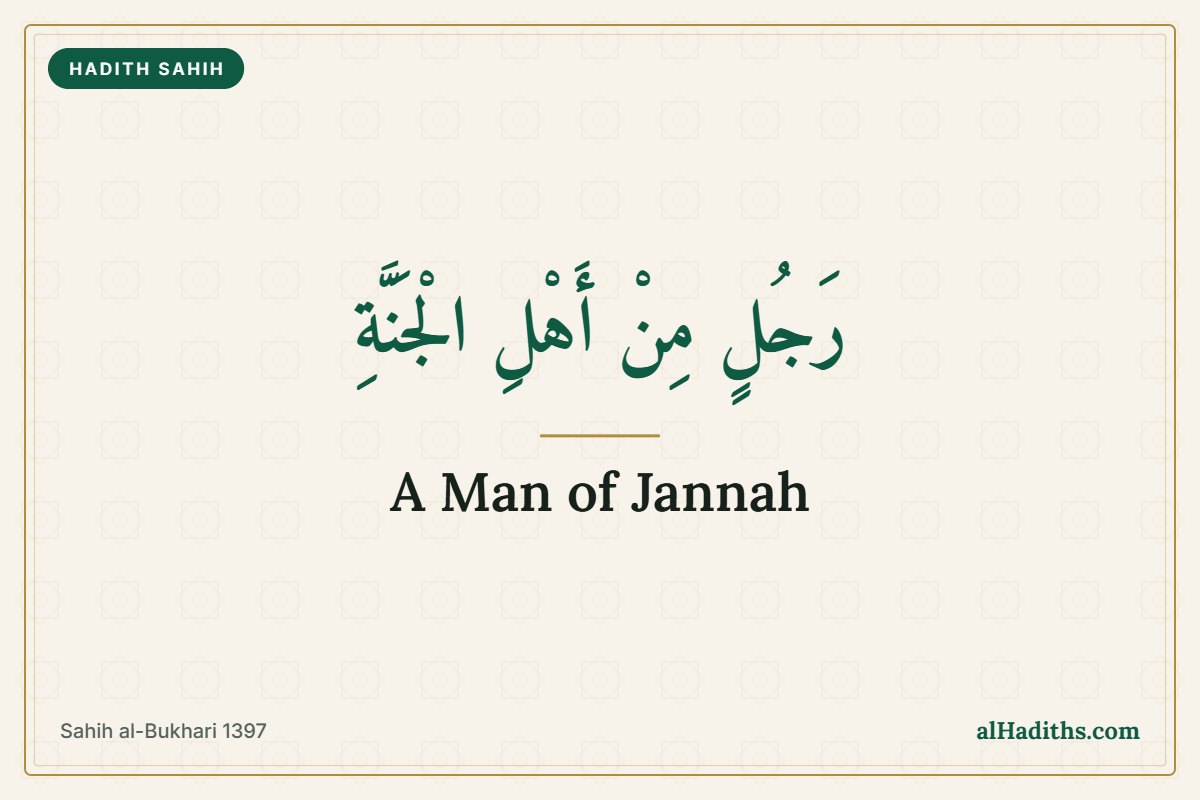
أَنَّ أَعْرَابِيًّا، أَتَى النَّبِيَّ صلى الله عليه وسلم فَقَالَ دُلَّنِي عَلَى عَمَلٍ إِذَا عَمِلْتُهُ دَخَلْتُ الْجَنَّةَ. قَالَ ” تَعْبُدُ اللَّهَ لاَ تُشْرِكُ بِهِ شَيْئًا، وَتُقِيمُ الصَّلاَةَ الْمَكْتُوبَةَ، وَتُؤَدِّي الزَّكَاةَ الْمَفْرُوضَةَ، وَتَصُومُ رَمَضَانَ ”. قَالَ وَالَّذِي نَفْسِي بِيَدِهِ لاَ أَزِيدُ عَلَى هَذَا. فَلَمَّا وَلَّى قَالَ النَّبِيُّ صلى الله عليه وسلم ” مَنْ سَرَّهُ أَنْ يَنْظُرَ إِلَى رَجُلٍ مِنْ أَهْلِ الْجَنَّةِ فَلْيَنْظُرْ إِلَى هَذَا ” .
“A Bedouin came to the Prophet (ﷺ) and said, “Tell me of such a deed as will make me enter Paradise, if I do it.” The Prophet (p.b.u.h) said, “Worship Allah, and worship none along with Him, offer the (five) prescribed compulsory prayers perfectly, pay the compulsory Zakat, and fast the month of Ramadan.” The Bedouin said, “By Him, in Whose Hands my life is, I will not do more than this.” When he (the Bedouin) left, the Prophet (ﷺ) said, “Whoever likes to see a man of Paradise, then he may look at this man.””
Sahih al-Bukhari 1397 · Narrated by Abu Hurairah
The man promised not to do more than this, and the Prophet ﷺ still pointed him out as a man of Paradise. A very similar story, with the full five pillars and the words “if he were true”, is in Sahih Muslim 12a; we covered it in the Bedouin who asked about the five pillars.
What I take from this hadith: The Bedouin did not promise anything beyond the obligations, yet the Prophet ﷺ called him a man of Paradise. To me, this means that if we sincerely uphold the five pillars, Jannah is our reward, in shaa Allah. That message speaks to our time too. Many of us juggle long working hours, family and bills, and it is easy to feel our worship is never enough. This hadith reassures us that the door to Jannah is open to anyone who holds firmly and truthfully to the basics. In the similar story in Sahih Muslim 12a, the Prophet ﷺ said “if he were true”, so sincerity is the key. Voluntary prayers, charity and good character are extra blessings on top of that foundation.
A second Bedouin: what brings you closer to Jannah
Abu Ayyub al-Ansari (may Allah be pleased with him) describes another Bedouin who stopped the Prophet ﷺ on a journey by taking hold of his camel’s reins:
أَنَّ أَعْرَابِيًّا، عَرَضَ لِرَسُولِ اللَّهِ صلى الله عليه وسلم وَهُوَ فِي سَفَرٍ . فَأَخَذَ بِخِطَامِ نَاقَتِهِ أَوْ بِزِمَامِهَا ثُمَّ قَالَ يَا رَسُولَ اللَّهِ – أَوْ يَا مُحَمَّدُ – أَخْبِرْنِي بِمَا يُقَرِّبُنِي مِنَ الْجَنَّةِ وَمَا يُبَاعِدُنِي مِنَ النَّارِ . قَالَ فَكَفَّ النَّبِيُّ صلى الله عليه وسلم ثُمَّ نَظَرَ فِي أَصْحَابِهِ ثُمَّ قَالَ ” لَقَدْ وُفِّقَ – أَوْ لَقَدْ هُدِيَ – قَالَ كَيْفَ قُلْتَ ” . قَالَ فَأَعَادَ . فَقَالَ النَّبِيُّ صلى الله عليه وسلم ” تَعْبُدُ اللَّهَ لاَ تُشْرِكُ بِهِ شَيْئًا وَتُقِيمُ الصَّلاَةَ وَتُؤْتِي الزَّكَاةَ وَتَصِلُ الرَّحِمَ دَعِ النَّاقَةَ ” .
“once during the journey of the Prophet (may peace of Allah be upon him) a bedouin appeared before him and caught hold of the nosestring of his she-camel and then said, Messenger of Allah (or Muhammad), inform me about that which takes me near to Paradise and draws me away from the Fire (of Hell). He (the narrator) said: The Prophet (ﷺ) stopped for a while and cast a glance upon his companions and then said: He was afforded a good opportunity (or he had been guided well). He (the Holy Prophet) addressing the bedouin said: (Repeat) whatever you have uttered. He (the bedouin) repeated that. Upon this the Apostle (ﷺ) remarked: The deed which can draw you near to Paradise and take you away from Hell is, that you worship Allah and associate none with Him, and you establish prayer and pay Zakat, and do good to your kin. After having uttered these words, the Prophet asked the bedouin to release the nosestring of his she-camel.”
Sahih Muslim 13a · Narrated by Abu Ayyub al-Ansari
Notice how the Prophet ﷺ paused, looked at his companions and praised the question: “he had been guided well.” Then he asked the man to repeat his question. And this time the answer adds a fifth deed: wa taṣilur-raḥim (وَتَصِلُ الرَّحِمَ), “and do good to your kin.”
The deeds that lead to Jannah in these hadith
- Worship Allah alone (تَعْبُدُ اللَّهَ لاَ تُشْرِكُ بِهِ شَيْئًا): worship Allah and associate nothing with Him. Everything else is built on this.
- Establish the obligatory prayers (وَتُقِيمُ الصَّلاَةَ الْمَكْتُوبَةَ): the five prescribed prayers, offered properly.
- Pay the obligatory zakat (وَتُؤَدِّي الزَّكَاةَ الْمَفْرُوضَةَ).
- Fast Ramadan (وَتَصُومُ رَمَضَانَ).
- Keep ties of kinship (وَتَصِلُ الرَّحِمَ): stay connected to your relatives and do good to them (Sahih Muslim 13a).
Reflection: What stands out in the second answer is its ordinariness. A man asks what brings him closer to Jannah, and alongside prayer and zakat the Prophet ﷺ names something as everyday as staying in touch with family. It is a reminder that the road to Jannah runs through our homes and our phone calls to relatives, not only through the masjid.
How to practise this hadith
- Check yourself against the list. Go through the five deeds above and be honest about which one needs attention.
- Protect your obligatory prayers first. The Bedouin promised to keep what was obligatory; make sure those come before anything extra.
- Contact one relative this week. A call, a visit or a message to someone you have not spoken to in a while is a simple way to act on Sahih Muslim 13a.
- Ask good questions. The Prophet ﷺ praised the Bedouin’s question. Take your own questions about the religion to people of knowledge you trust.
- Don’t belittle the basics. These hadith show that keeping the obligations sincerely is itself praised by the Prophet ﷺ.
Key lessons
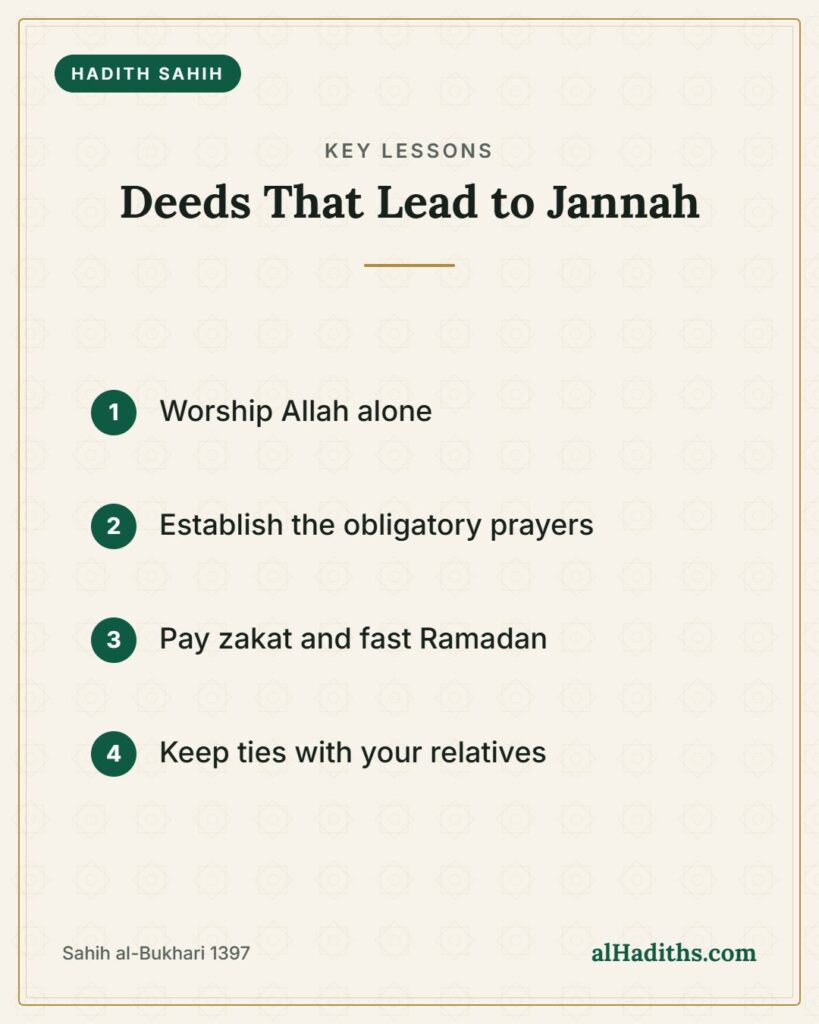
- A Bedouin asked for a deed that would take him to Jannah, and the Prophet ﷺ named worshipping Allah alone, prayer, zakat and fasting Ramadan (Sahih al-Bukhari 1397).
- The Prophet ﷺ called him “a man of Paradise” after he promised to keep these.
- Another Bedouin’s question was praised as well guided, and the answer added keeping ties of kinship (Sahih Muslim 13a).
- The obligations, done sincerely, together with good relations with family, are a clear path towards Jannah.
Questions people ask
What deeds lead to Jannah according to the hadith?
In Sahih al-Bukhari 1397 the Prophet ﷺ told a Bedouin: worship Allah and associate nothing with Him, offer the prescribed prayers, pay the obligatory zakat and fast Ramadan. In Sahih Muslim 13a he also mentioned keeping ties of kinship. Many other hadith mention further deeds, but these are a clear foundation.
Why did the Prophet ﷺ call the Bedouin a man of Paradise?
After hearing the obligations, the man said: “By Him, in Whose Hands my life is, I will not do more than this.” As he left, the Prophet ﷺ said: “Whoever likes to see a man of Paradise, then he may look at this man” (Sahih al-Bukhari 1397). In the similar story in Sahih Muslim 12a, the Prophet ﷺ added the condition “if he were true”.
Why is Hajj not mentioned in this hadith?
This narration does not mention Hajj, and the hadith itself does not explain why. Hajj is one of the five pillars of Islam in Sahih al-Bukhari 8, and it is mentioned in the similar story in Sahih Muslim 12a. For the scholars’ discussion of this, please ask a qualified local scholar.
What does keeping ties of kinship mean?
In Sahih Muslim 13a the Arabic is “taṣilur-raḥim”, translated on Sunnah.com as “do good to your kin”. In simple terms it means staying connected to your relatives and treating them well, and the Prophet ﷺ listed it among the deeds that bring a person closer to Jannah.
A question to take with you: of these five deeds, which one needs your attention this week? Start there, and ask Allah to make it easy for you.
Save this to Pinterest so you can come back to this list
Share the reward. Send this article to someone who needs it today — teaching a hadith or dua can become a lasting good deed for you, in shaa Allah.