Shab e Barat (15th Sha‘ban): What Is Authentic and What Is Weak
Contents
Every year, around the middle of Sha‘ban, messages spread about Shab e Barat, also called Laylat al-Bara’ah or Nisfu Sya‘ban: a hundred-rak‘ah prayer, Surah Yasin read three times, a special dua said to change your decree for the year. Some of what is said about this night has a basis, and much of it does not. This article sets out what the authentic hadith teach about Sha‘ban, labels the popular narrations that are weak or fabricated with the scholars who graded them, and explains where scholars differ.
At a glance
- What it is: The night before the 15th of Sha‘ban, the 8th Islamic month
- Authentic hadith here: 5, from Bukhari, Muslim, Abu Dawud and an-Nasa’i, plus Quran 44:3–4
- Weak or fabricated: “Pray its night and fast its day”, the Banu Kalb sheep narration, the 100-rak‘ah prayer, set Shab e Barat duas
- Shab e Barat 2027: Expected on the night of about 23 January 2027 (the moon sighting decides)
- One thing to do: Fast some days of Sha‘ban, and make peace with anyone you are at odds with before Ramadan
1. Sha‘ban: the month he most loved to fast
‘Aishah (may Allah be pleased with her) described which month the Prophet ﷺ preferred for voluntary fasting:
كَانَ أَحَبَّ الشُّهُورِ إِلَى رَسُولِ اللَّهِ صلى الله عليه وسلم أَنْ يَصُومَهُ شَعْبَانُ ثُمَّ يَصِلُهُ بِرَمَضَانَ
The month the Messenger of Allah ﷺ most loved to fast was Sha‘ban, and he would then join it to Ramadan.
Sunan Abi Dawud 2431 · Sahih (al-Albani) · Narrated by ‘Aishah · Translation adapted from Sunnah.com
She also said she never saw him fast more in any month outside Ramadan than in Sha‘ban (Sahih al-Bukhari 1969). HadeethEnc explains that he fasted most of the month, and that we should follow his example by fasting more in Sha‘ban than in other months (HadeethEnc 6213). So the virtue the authentic Sunnah gives is to the month as a whole, not to one night in the middle of it.
Try this: choose a few days across Sha‘ban to fast, such as Mondays and Thursdays, rather than putting all your effort into one date.
2. Why Sha‘ban: deeds are raised to Allah
Usamah ibn Zayd (may Allah be pleased with him) asked the Prophet ﷺ why he fasted so much in Sha‘ban:
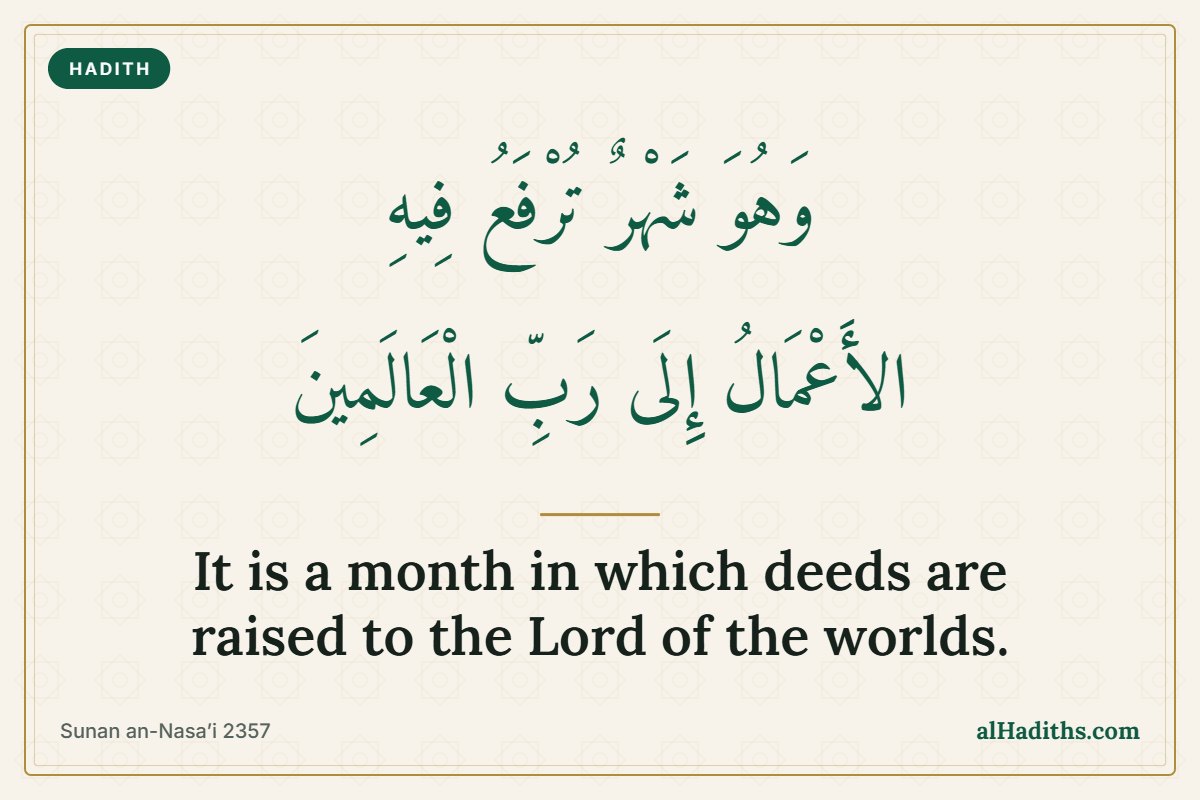
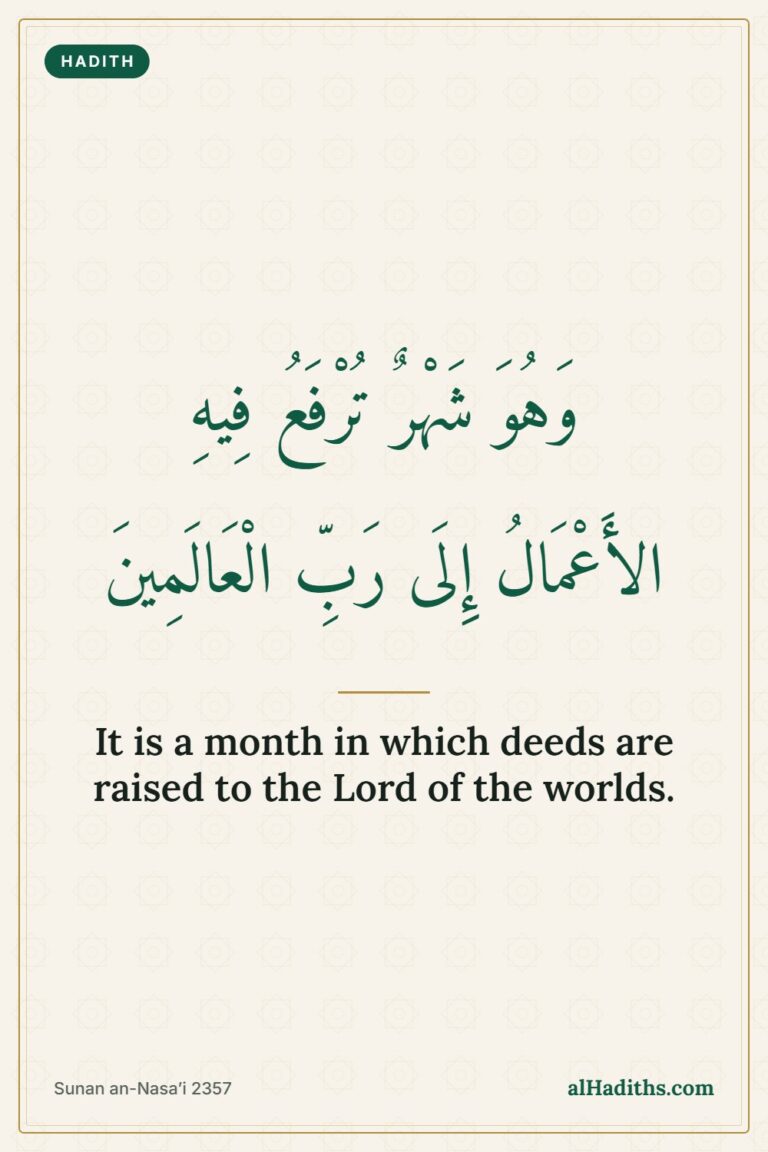
قُلْتُ يَا رَسُولَ اللَّهِ لَمْ أَرَكَ تَصُومُ شَهْرًا مِنَ الشُّهُورِ مَا تَصُومُ مِنْ شَعْبَانَ. قَالَ ذَلِكَ شَهْرٌ يَغْفُلُ النَّاسُ عَنْهُ بَيْنَ رَجَبٍ وَرَمَضَانَ وَهُوَ شَهْرٌ تُرْفَعُ فِيهِ الأَعْمَالُ إِلَى رَبِّ الْعَالَمِينَ فَأُحِبُّ أَنْ يُرْفَعَ عَمَلِي وَأَنَا صَائِمٌ
I said: “O Messenger of Allah, I do not see you fasting in any month as much as you fast in Sha‘ban.” He said: “That is a month people neglect, between Rajab and Ramadan. It is a month in which deeds are raised to the Lord of the worlds, and I love that my deeds are raised while I am fasting.”
Sunan an-Nasa’i 2357 · Hasan (Darussalam) · Narrated by Usamah ibn Zayd · Translation adapted from Sunnah.com
This is the authentic reason Sha‘ban is special: it is a month people overlook, and a month when deeds are raised. The hadith links it to fasting through the month, not to a night of celebration.
Try this: use Sha‘ban as a quiet month of catching up: fast, pay back any missed Ramadan fasts, and keep one good habit going so it is in place when Ramadan begins.
3. Forgiveness for everyone except those holding rancor
Many Shab e Barat messages say Allah forgives everyone on this night except the one who associates partners with Him and the one who holds enmity. That exact wording comes from a narration whose grading is disputed (see the grading note below). The same meaning comes in an authentic hadith, tied to every week rather than one night. Abu Hurairah (may Allah be pleased with him) reported that the Prophet ﷺ said:
تُفْتَحُ أَبْوَابُ الْجَنَّةِ يَوْمَ الاِثْنَيْنِ وَيَوْمَ الْخَمِيسِ فَيُغْفَرُ لِكُلِّ عَبْدٍ لاَ يُشْرِكُ بِاللَّهِ شَيْئًا إِلاَّ رَجُلاً كَانَتْ بَيْنَهُ وَبَيْنَ أَخِيهِ شَحْنَاءُ فَيُقَالُ أَنْظِرُوا هَذَيْنِ حَتَّى يَصْطَلِحَا أَنْظِرُوا هَذَيْنِ حَتَّى يَصْطَلِحَا أَنْظِرُوا هَذَيْنِ حَتَّى يَصْطَلِحَا
The gates of Paradise are opened on Monday and Thursday, and every servant who does not associate anything with Allah is forgiven, except a man who has rancor between himself and his brother. It is said: “Wait for these two until they reconcile; wait for these two until they reconcile; wait for these two until they reconcile.”
Sahih Muslim 2565a · Narrated by Abu Hurairah · Translation adapted from Sunnah.com
HadeethEnc explains that the two are held back until the enmity between them is removed, and that a Muslim should take the first step to clear a grudge with a brother, even when it is hard, seeking the reward from Allah (HadeethEnc 5908). See also the hadith “Do not envy one another”.
Try this: think of one person you are not speaking to, and send a greeting or an apology before Ramadan.
4. Allah’s descent is every night, not one night
Some narrations say Allah descends to the lowest heaven on the night of mid-Sha‘ban. Those narrations are weak (see below), but an authentic hadith says something greater:
يَنْزِلُ رَبُّنَا تَبَارَكَ وَتَعَالَى كُلَّ لَيْلَةٍ إِلَى السَّمَاءِ الدُّنْيَا حِينَ يَبْقَى ثُلُثُ اللَّيْلِ الآخِرُ يَقُولُ مَنْ يَدْعُونِي فَأَسْتَجِيبَ لَهُ مَنْ يَسْأَلُنِي فَأُعْطِيَهُ مَنْ يَسْتَغْفِرُنِي فَأَغْفِرَ لَهُ
Our Lord, the Blessed and Exalted, descends every night to the lowest heaven when the last third of the night remains, and says: “Who is calling upon Me, that I may answer him? Who is asking of Me, that I may give him? Who is seeking My forgiveness, that I may forgive him?”
Sahih al-Bukhari 1145 · Narrated by Abu Hurairah · Translation adapted from Sunnah.com
HadeethEnc notes that this hadith shows the merit of the last third of the night for prayer, dua and seeking forgiveness (HadeethEnc 10412). IslamQA makes the same point about mid-Sha‘ban: the reports of a special descent on that night are weak, while the descent every night is authentic, and that night is included in it (IslamQA 49678). For the night prayer itself, see the Tahajjud hadith.
Try this: wake for a few minutes before Fajr on any night of Sha‘ban, pray two rak‘ahs and ask Allah for what you need.
5. The 15th is one of the white days
The 15th of every Islamic month has an authentic virtue of its own, as one of the three “white days” when the moon is full. Jarir ibn ‘Abdullah (may Allah be pleased with him) reported that the Prophet ﷺ said:
صِيَامُ ثَلاَثَةِ أَيَّامٍ مِنْ كُلِّ شَهْرٍ صِيَامُ الدَّهْرِ وَأَيَّامُ الْبِيضِ صَبِيحَةَ ثَلاَثَ عَشْرَةَ وَأَرْبَعَ عَشْرَةَ وَخَمْسَ عَشْرَةَ
Fasting three days of every month is fasting for a lifetime, and the white days (al-Bid) are the mornings of the thirteenth, fourteenth and fifteenth.
Sunan an-Nasa’i 2420 · Sahih (Darussalam) · Narrated by Jarir ibn ‘Abdullah · Translation adapted from Sunnah.com
So someone who already fasts the white days each month fasts the 13th, 14th and 15th of Sha‘ban as usual. That is different from fasting the 15th alone because of a narration that says to “fast its day”, which is graded fabricated (see below). For more on these fasts, see three daily Sunnahs the Prophet ﷺ advised.
Try this: if you want to fast in mid-Sha‘ban, fast the 13th, 14th and 15th together as the white days.
Weak and fabricated Shab e Barat narrations
The narrations below are widely shared. They are listed here only to say that they are not authentic, so they have no Arabic cards.
“Pray its night and fast its day”
The narration “When it is the night of the middle of Sha‘ban, spend its night in prayer and fast its day” is graded Maudu‘ (fabricated) (Darussalam) (Sunan Ibn Majah 1388). IslamQA notes that one of its narrators, Ibn Abi Sabrah, was accused by Ahmad and Ibn Ma‘in of fabricating hadith (IslamQA 154850).
“More than the hairs of the sheep of Banu Kalb”
The report that ‘Aishah found the Prophet ﷺ at al-Baqi‘ and he said Allah descends on the night of mid-Sha‘ban and forgives more people than the hairs on the sheep of Banu Kalb is graded Da‘if (Darussalam) in both Jami‘ at-Tirmidhi 739 and Sunan Ibn Majah 1389.
The 100-rak‘ah prayer, six rak‘ahs with Yasin, and set duas
Salat al-Alfiyyah is a hundred rak‘ahs with Surah al-Ikhlas recited ten times in each. IslamQA quotes al-Fatni and Ibn Dihyah, who said its reports are weak or fabricated, and an-Nawawi, who called the prayers of Rajab and Sha‘ban two reprehensible innovations. The same answer says praying six rak‘ahs that night for protection from calamity and a long life, with Surah Yasin and dua between them, has no basis (IslamQA 154850). HadithAnswers, which does hold that the night has merit, also says no specific type of salah is prescribed for it (HadithAnswers). No authentic hadith sets a Shab e Barat dua, or reading Surah Yasin three times on this night.
A note on the grading of the mid-Sha‘ban forgiveness hadith
The narration “Allah looks down on the night of the middle of Sha‘ban and forgives all His creation, except the one who associates partners with Him and the one who holds enmity” is graded Da‘if (Darussalam) on Sunnah.com (Sunan Ibn Majah 1390). It comes through several chains, and IslamQA notes that scholars differ on whether these strengthen each other, and that Ibn Rajab mentioned some scholars who classed some of them as sahih (IslamQA 49678). For how grades like these are reached, see how hadith grading works.
This difference leads to two well-known positions. Some scholars hold that the night has merit, and that a person may worship on it on their own, with no special form of prayer (HadithAnswers). Others hold that no sahih hadith establishes its merit, and that singling it out for celebration is an innovation; IslamQA links Shaykh Ibn Baz’s detailed article on this view (IslamQA, Ibn Baz). Both positions agree that no fixed prayer, dua or recitation for this night comes from an authentic hadith. How to treat the night where you live is a question for a qualified local scholar; for the general principle, see the hadith on bid‘ah.
Is Shab e Barat the blessed night in the Quran?
Shab e Barat is often linked to these verses of Surah ad-Dukhan:
إِنَّآ أَنزَلْنَـٰهُ فِى لَيْلَةٍ مُّبَـٰرَكَةٍ ۚ إِنَّا كُنَّا مُنذِرِينَ فِيهَا يُفْرَقُ كُلُّ أَمْرٍ حَكِيمٍ
Indeed, We sent it down during a blessed night. Indeed, We were to warn [mankind]. Therein [i.e., on that night] is made distinct every precise matter –
Surah Ad-Dukhan 44:3–4 · Translation: Saheeh International, from Quran.com
Ibn Kathir explains that the blessed night is Laylatul Qadr, in Ramadan, because Allah says He sent the Quran down on Laylatul Qadr (97:1) and in the month of Ramadan (2:185). He adds that whoever says it is the night of mid-Sha‘ban, as is reported from ‘Ikrimah, has gone far from the mark, since the Quran states it is in Ramadan; and that the report “lifespans are cut off from Sha‘ban to Sha‘ban” is mursal and cannot be set against these texts (Tafsir Ibn Kathir on 44:3, translated from Arabic). The night when the year’s decrees are set out is the one to look for in the last ten nights of Ramadan.
Bringing it together
Sha‘ban is honored in the authentic Sunnah: it is the month the Prophet ﷺ fasted most outside Ramadan, and the month when deeds are raised to Allah. The weak and fabricated narrations sit around one night in its middle: the special prayer, the set fast, the dua to change your decree. Scholars differ on whether that night has merit, but they agree that no special form of worship for it comes from an authentic hadith.
Reflection: the line that appears again and again, in the authentic hadith and in the disputed one, is about the heart: Allah forgives, except the one who holds rancor against a brother. Whatever we do on that night, the surer preparation for Ramadan may be to fast in Sha‘ban, as the Prophet ﷺ did, and to make peace with the people we have fallen out with.
Questions people ask
When is Shab e Barat in 2027?
Shab e Barat is the night before the 15th of Sha‘ban. Sha‘ban 1448 is expected to begin around 10 January 2027, so the night falls around 23 January 2027. The moon sighting decides the exact date.
Is there an authentic Shab e Barat dua?
No authentic hadith gives a special dua for this night. Dua in your own words is good on any night, especially in the last third of the night (Sahih al-Bukhari 1145).
Is fasting on 15 Sha‘ban sunnah?
The narration telling people to fast that day is graded Maudu‘ (Sunan Ibn Majah 1388). Fasting in Sha‘ban in general is authentic (Sunan Abi Dawud 2431), and the 15th is one of the three white days for those who fast them each month (Sunan an-Nasa’i 2420).
Is Shab e Barat mentioned in the Quran?
No. Ibn Kathir explains that the blessed night in Surah ad-Dukhan 44:3 is Laylatul Qadr in Ramadan, not the night of mid-Sha‘ban.
Can I fast after the middle of Sha‘ban?
A hadith says not to fast once half of Sha‘ban has passed (Sunan Abi Dawud 2337, Sahih, al-Albani; Jami‘ at-Tirmidhi 738), and another says not to fast a day or two before Ramadan unless it is a fast you regularly keep (Sahih al-Bukhari 1914). Scholars differ on how to apply them, so ask a qualified local scholar.
Key lessons
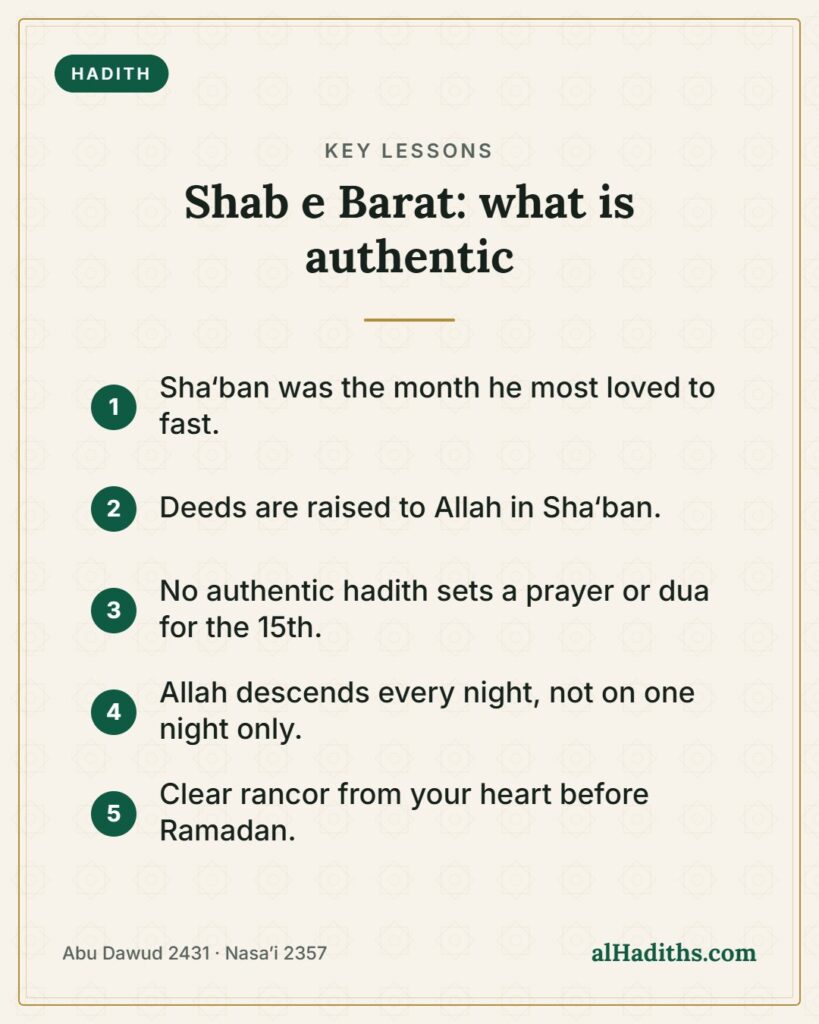
- Sha‘ban was the month the Prophet ﷺ most loved to fast, joining it to Ramadan.
- Deeds are raised to Allah in Sha‘ban, so it is a month to fast and do good.
- Allah forgives every Monday and Thursday, except those who hold rancor against each other.
- Allah descends every night in its last third, not only on the night of mid-Sha‘ban.
- The 100-rak‘ah prayer, “pray its night and fast its day” and set Shab e Barat duas are not authentic.
Before you forward the next Shab e Barat message, check its source. May Allah let us reach Ramadan with clean hearts, and accept our deeds when they are raised to Him.
Save this to Pinterest so you can check before you share a Shab e Barat message
Share the reward. Send this article to someone who needs it today — teaching a hadith or dua can become a lasting good deed for you, in shaa Allah.