Hadith About Women in Hellfire: The Reasons and the Remedy
Few hadith are quoted as often, or as angrily, as the hadith about women in Hellfire. Many people know only one line of it. Read in full, these narrations from Sahih al-Bukhari and Sahih Muslim are a stern warning with a clear cause and a clear way out. The Prophet ﷺ named the reasons himself, and in the very same moment he told the women how to save themselves. Here we present them as they are, with what trusted scholars say about them.
In this article:
- What the Prophet ﷺ was shown when he looked into Paradise and the Fire
- The two reasons he gave, in his own words
- The remedy he gave in the same Eid sermon, and the hope Allah gives every believing woman
At a glance
- Hadith: 3 authentic narrations, plus 1 Quran verse
- Collections: Sahih al-Bukhari 3241, 29 and 304; Sahih Muslim 2737a
- Grade: Sahih (al-Bukhari and Muslim)
- Topic: Hellfire, the tongue, gratitude and charity
- Do one thing today: Give a small charity, and hold back one harsh word
1. What the Prophet ﷺ was shown
اطَّلَعْتُ فِي الْجَنَّةِ فَرَأَيْتُ أَكْثَرَ أَهْلِهَا الْفُقَرَاءَ، وَاطَّلَعْتُ فِي النَّارِ فَرَأَيْتُ أَكْثَرَ أَهْلِهَا النِّسَاءَ
“I looked at Paradise and found poor people forming the majority of its inhabitants; and I looked at Hell and saw that the majority of its inhabitants were women.”
Sahih al-Bukhari 3241 · Narrated by ‘Imran ibn Husain · Translation from Sunnah.com
‘Imran ibn Husain (may Allah be pleased with him) narrates this, and Ibn ‘Abbas (may Allah be pleased with him) narrates the same words in Sahih Muslim:
اطَّلَعْتُ فِي الْجَنَّةِ فَرَأَيْتُ أَكْثَرَ أَهْلِهَا الْفُقَرَاءَ وَاطَّلَعْتُ فِي النَّارِ فَرَأَيْتُ أَكْثَرَ أَهْلِهَا النِّسَاءَ
“I had a chance to look into the Paradise and I found that majority of the people was poor and I looked into the Fire and there I found the majority constituted by women.”
Sahih Muslim 2737a · Narrated by Ibn ‘Abbas · Translation from Sunnah.com
This is something the Prophet ﷺ saw, not a guess. The Encyclopedia of Translated Prophetic Hadiths notes that the poor are many in Paradise because of their righteousness together with their poverty, not because poverty alone saves anyone. On the women, it points to habits the Prophet ﷺ named elsewhere, and says they must guard their religion to be saved from the Fire (HadeethEnc 3184).
Take heed: what he saw is real. A warning given by the one who looked into the Fire is not to be argued with, explained away or laughed at. It is to be acted on.
2. The reason he gave: ingratitude
أُرِيتُ النَّارَ فَإِذَا أَكْثَرُ أَهْلِهَا النِّسَاءُ يَكْفُرْنَ. قِيلَ أَيَكْفُرْنَ بِاللَّهِ قَالَ يَكْفُرْنَ الْعَشِيرَ، وَيَكْفُرْنَ الإِحْسَانَ، لَوْ أَحْسَنْتَ إِلَى إِحْدَاهُنَّ الدَّهْرَ ثُمَّ رَأَتْ مِنْكَ شَيْئًا قَالَتْ مَا رَأَيْتُ مِنْكَ خَيْرًا قَطُّ
“I was shown the Hell-fire and that the majority of its dwellers were women who were ungrateful.” It was asked, “Do they disbelieve in Allah?” (or are they ungrateful to Allah?) He replied, “They are ungrateful to their husbands and are ungrateful for the favors and the good (charitable deeds) done to them. If you have always been good (benevolent) to one of them and then she sees something in you (not of her liking), she will say, ‘I have never received any good from you.’”
Sahih al-Bukhari 29 · Narrated by Ibn ‘Abbas · Translation adapted from Sunnah.com
The Companions asked the obvious question: does he mean disbelief in Allah? The word in Arabic, yakfurna, can carry both meanings. The Prophet ﷺ answered it himself. He meant ingratitude to the husband and to kindness received: years of good forgotten over one thing she disliked.
Ingratitude to people is not a small matter. The Prophet ﷺ also taught that whoever does not thank people does not thank Allah, which we cover in Gratitude in Islam: 2 Hadith on Thanking Allah and People.
Take heed: one sentence, “I have never seen any good from you”, can wipe out years of thanks in a moment. The warning is given to women here, but denying kindness is a blameworthy trait in anyone.
3. The Eid sermon: “O women, give charity”
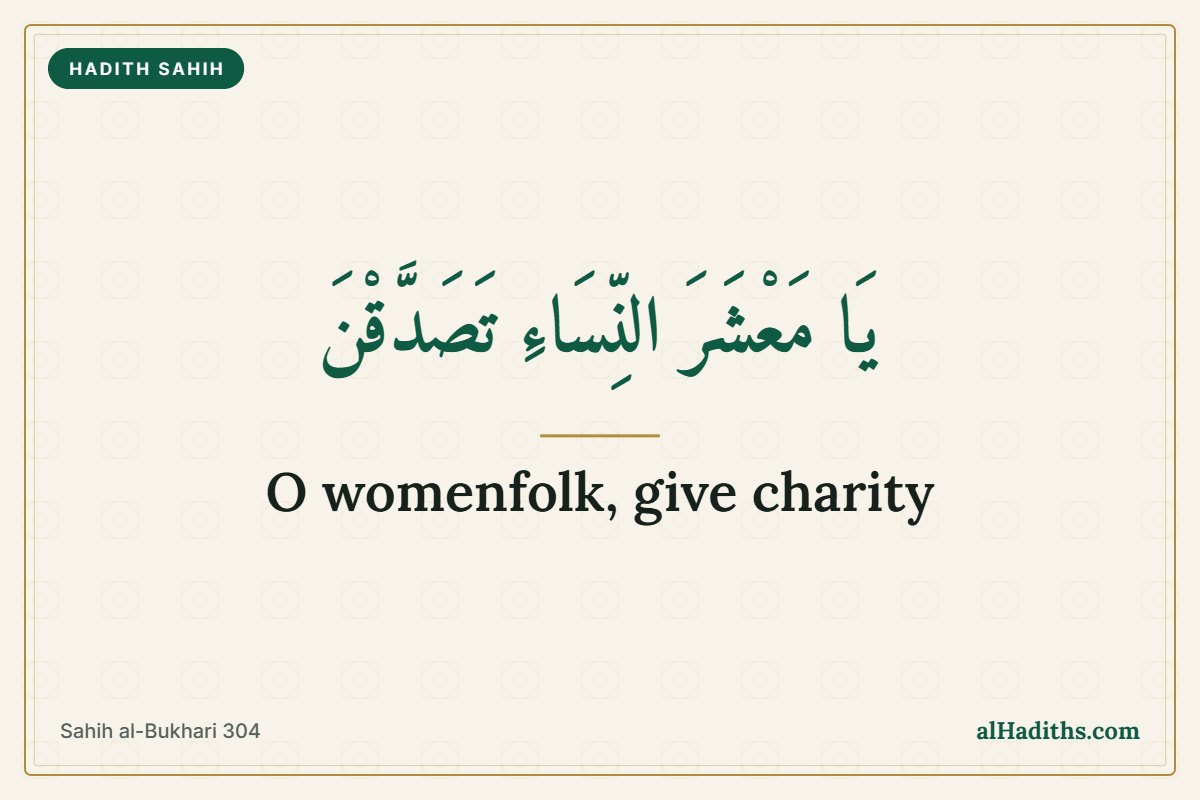
خَرَجَ رَسُولُ اللَّهِ صلى الله عليه وسلم فِي أَضْحًى ـ أَوْ فِطْرٍ ـ إِلَى الْمُصَلَّى، فَمَرَّ عَلَى النِّسَاءِ فَقَالَ يَا مَعْشَرَ النِّسَاءِ تَصَدَّقْنَ، فَإِنِّي أُرِيتُكُنَّ أَكْثَرَ أَهْلِ النَّارِ. فَقُلْنَ وَبِمَ يَا رَسُولَ اللَّهِ قَالَ تُكْثِرْنَ اللَّعْنَ، وَتَكْفُرْنَ الْعَشِيرَ، مَا رَأَيْتُ مِنْ نَاقِصَاتِ عَقْلٍ وَدِينٍ أَذْهَبَ لِلُبِّ الرَّجُلِ الْحَازِمِ مِنْ إِحْدَاكُنَّ. قُلْنَ وَمَا نُقْصَانُ دِينِنَا وَعَقْلِنَا يَا رَسُولَ اللَّهِ قَالَ أَلَيْسَ شَهَادَةُ الْمَرْأَةِ مِثْلَ نِصْفِ شَهَادَةِ الرَّجُلِ. قُلْنَ بَلَى. قَالَ فَذَلِكَ مِنْ نُقْصَانِ عَقْلِهَا، أَلَيْسَ إِذَا حَاضَتْ لَمْ تُصَلِّ وَلَمْ تَصُمْ. قُلْنَ بَلَى. قَالَ فَذَلِكَ مِنْ نُقْصَانِ دِينِهَا
Once Allah’s Messenger ﷺ went out to the Musalla (to offer the prayer) of ‘Id-al-Adha or Al-Fitr prayer. Then he passed by the women and said, “O women! Give alms, as I have seen that the majority of the dwellers of Hell-fire were you (women).” They asked, “Why is it so, O Allah’s Messenger?” He replied, “You curse frequently and are ungrateful to your husbands. I have not seen anyone more deficient in intelligence and religion than you. A cautious sensible man could be led astray by some of you.” The women asked, “O Allah’s Messenger! What is deficient in our intelligence and religion?” He said, “Is not the evidence of two women equal to the witness of one man?” They replied in the affirmative. He said, “This is the deficiency in her intelligence. Isn’t it true that a woman can neither pray nor fast during her menses?” The women replied in the affirmative. He said, “This is the deficiency in her religion.”
Sahih al-Bukhari 304 · Narrated by Abu Sa‘id al-Khudri · Translation adapted from Sunnah.com
Abu Sa‘id al-Khudri (may Allah be pleased with him) narrates this. A similar narration from Ibn ‘Umar is in Sahih Muslim 79a, where he tells them to give charity and to seek forgiveness often.
Notice the order. The first words of the sermon are the cure: give charity. Only then does he give the reason. Two reasons are named: cursing often, and denying the husband’s rights. The Encyclopedia of Translated Prophetic Hadiths says these are major sins, because a threat of the Fire is attached to them, and it quotes Ibn Hajar: charity repels punishment and may expiate sins committed between people (HadeethEnc 10011).
The line on “deficiency in intelligence and religion” is explained by the Prophet ﷺ himself in the same hadith: the testimony of two women in place of one man, and not praying or fasting during menstruation. The same source quotes Imam an-Nawawi: mentioning this deficiency is not meant to blame women for it, as it is part of their natural disposition, and the punishment is tied to the ingratitude and other sins, not to the deficiency. Not praying during menstruation is something a woman is commanded to do, so she is not sinful for it (HadeethEnc 10011).
On cursing and the tongue, see Doors of Good and Guarding the Tongue.
Take heed: the two causes named are habits of the tongue and the heart. Cursing comes easily in anger, and so does forgetting kindness. Neither is small when the Prophet ﷺ links it to the Fire.
What these hadith do not say
- They do not say every woman is in the Fire, or that a woman is in the Fire for being a woman. The causes named are deeds: cursing and ingratitude.
- They do not leave women without a way out. The same sermon begins with the remedy, and in Sahih Muslim 885a the women threw their rings into Bilal’s cloth as charity after the Eid sermon. Giving within the family counts too: see Charity to Relatives in Islam.
- They do not make menstruation a sin. Leaving salah and fasting then is what Allah commands, as an-Nawawi explains above.
Hope: forgiveness and a great reward
Alongside the warning, the Quran gives a promise that names believing women next to believing men, quality by quality:
إِنَّ ٱلْمُسْلِمِينَ وَٱلْمُسْلِمَـٰتِ وَٱلْمُؤْمِنِينَ وَٱلْمُؤْمِنَـٰتِ وَٱلْقَـٰنِتِينَ وَٱلْقَـٰنِتَـٰتِ وَٱلصَّـٰدِقِينَ وَٱلصَّـٰدِقَـٰتِ وَٱلصَّـٰبِرِينَ وَٱلصَّـٰبِرَٰتِ وَٱلْخَـٰشِعِينَ وَٱلْخَـٰشِعَـٰتِ وَٱلْمُتَصَدِّقِينَ وَٱلْمُتَصَدِّقَـٰتِ وَٱلصَّـٰٓئِمِينَ وَٱلصَّـٰٓئِمَـٰتِ وَٱلْحَـٰفِظِينَ فُرُوجَهُمْ وَٱلْحَـٰفِظَـٰتِ وَٱلذَّٰكِرِينَ ٱللَّهَ كَثِيرًا وَٱلذَّٰكِرَٰتِ أَعَدَّ ٱللَّهُ لَهُم مَّغْفِرَةً وَأَجْرًا عَظِيمًا
“Indeed, the Muslim men and Muslim women, the believing men and believing women, the obedient men and obedient women, the truthful men and truthful women, the patient men and patient women, the humble men and humble women, the charitable men and charitable women, the fasting men and fasting women, the men who guard their private parts and the women who do so, and the men who remember Allāh often and the women who do so – for them Allāh has prepared forgiveness and a great reward.”
Surah Al-Ahzab 33:35 · Translation: Saheeh International, from Quran.com
Reflection: the hadith about women in Hellfire is a warning given with a cure attached. The verse is the other side of it. Every quality in it, from truthfulness and patience to charity, fasting and remembering Allah often, is open to every woman, and for each one Allah promises forgiveness and a great reward. Even a small charity counts, as we saw in Save Yourself From the Fire, Even With Half a Date.
Questions people ask
Why are most of the people of Hellfire women?
In Sahih al-Bukhari 29 and 304 the Prophet ﷺ gave the reasons himself: cursing often, and being ungrateful to husbands and to the kindness they receive. Scholars explain these as major sins, and the Prophet ﷺ gave charity as the remedy in the same sermon.
Does “deficient in intelligence and religion” mean women are worth less?
The Prophet ﷺ explained it in the same hadith: the testimony of two women in place of one man, and not praying or fasting during menstruation. Imam an-Nawawi said it is not meant as blame, and that the punishment is tied to ingratitude and other sins, not to this deficiency (HadeethEnc 10011).
How can a woman protect herself from Hellfire?
The hadith themselves name charity, and a related narration in Sahih Muslim adds seeking forgiveness often, along with avoiding cursing and ingratitude. Surah Al-Ahzab 33:35 lists the qualities for which Allah promises forgiveness and a great reward. For personal rulings, ask a qualified local scholar.
Key lessons
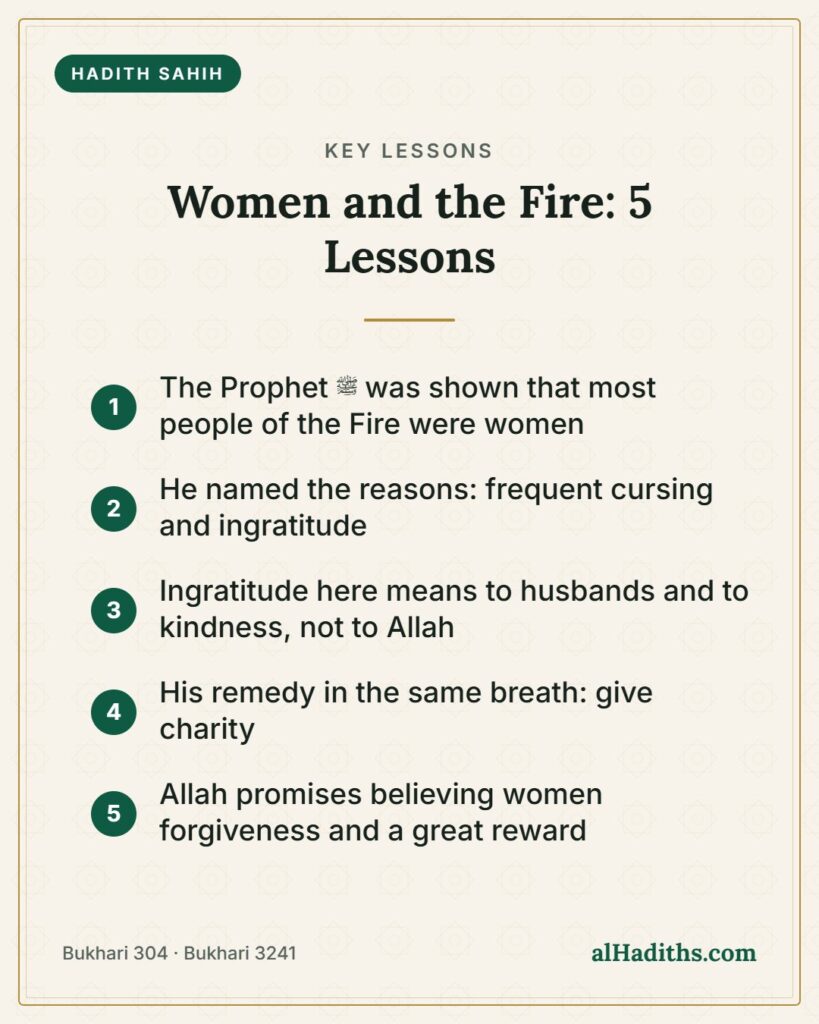
- The Prophet ﷺ was shown that most of the people of the Fire were women; the warning is real.
- He named the causes himself: frequent cursing and ingratitude to husbands and to kindness.
- “Ungrateful” here is not disbelief in Allah; he was asked and he explained it.
- The remedy came first: give charity, and seek forgiveness often.
- Allah promises believing women, like believing men, forgiveness and a great reward.
A warning this direct is a mercy. The Prophet ﷺ did not only tell the women where many would end up; he told them, in the same breath, how to stay out. Thank those who are kind to you, hold back the curse before it leaves your mouth, and give something today, however small.
Share the reward. Send this article to someone who needs it today — teaching a hadith or dua can become a lasting good deed for you, in shaa Allah.