3 Daily Sunnahs the Prophet ﷺ Advised: Fasting, Duha, Witr
There are three important practices that Prophet Muhammad ﷺ advised his companion Abu Hurairah to keep. As Muslims, following the Sunnah should be a priority in our lives. We may not have the capacity to do it all, but we should make an effort to follow the ones we can, as a sign of love and respect for our beloved Prophet ﷺ.
At a glance
- Source: Sahih al-Bukhari 1981 (also Sahih Muslim 721)
- Narrated by: Abu Hurairah (may Allah be pleased with him)
- Grade: Sahih (Bukhari and Muslim)
- Topic: Fasting, Duha and Witr
- Put it into practice: Start with Witr before sleep tonight
The hadith: three things my friend advised me
أَوْصَانِي خَلِيلِي صلى الله عليه وسلم بِثَلاَثٍ صِيَامِ ثَلاَثَةِ أَيَّامٍ مِنْ كُلِّ شَهْرٍ، وَرَكْعَتَىِ الضُّحَى، وَأَنْ أُوتِرَ قَبْلَ أَنْ أَنَامَ
Abu Hurairah said: “My friend (the Prophet ﷺ) advised me to observe three things: (1) to fast three days a month; (2) to pray two rak’at of Duha prayer (forenoon prayer); and (3) to pray witr before sleeping.”
Sahih al-Bukhari 1981 · Narrated by Abu Hurairah · Translation adapted from Sunnah.com
Imam Muslim narrates the same advice (Sahih Muslim 721). Abu Hurairah called the Prophet ﷺ “my friend”, and this is advice given with love: three small acts, easy enough to keep for life.
1. Fast three days every month
Outside Ramadan, a common way to do this is to fast the 13th, 14th and 15th of each lunar month, known as Ayyam al-Bid, the white days. Qatadah ibn Malhan said the Messenger of Allah ﷺ used to command them to fast these days, and said: “This is like keeping perpetual fast” (Sunan Abi Dawud 2449, Sahih, al-Albani).
Another option is to fast on Mondays and Thursdays in any week of the month:
كَانَ رَسُولُ اللَّهِ صلى الله عليه وسلم يَصُومُ شَعْبَانَ وَرَمَضَانَ وَيَتَحَرَّى الاِثْنَيْنِ وَالْخَمِيسَ
‘Aishah said: “The Messenger of Allah used to fast Sha`ban and Ramadan, and he made sure to fast on Mondays and Thursday.”
Sunan an-Nasa’i 2187 · Narrated by ‘Aishah · Grade: Sahih (Darussalam) · Translation from Sunnah.com
For more on voluntary fasting and moderation, read The Best Type of Fasting: The Fast of Prophet Dawud.
2. Two rak’ahs of Duha: charity for every joint
To express thankfulness to Allah, we are encouraged to pray Duha in the forenoon. The Prophet ﷺ explained what these two rak’ahs are worth:
يُصْبِحُ عَلَى كُلِّ سُلاَمَى مِنْ أَحَدِكُمْ صَدَقَةٌ فَكُلُّ تَسْبِيحَةٍ صَدَقَةٌ وَكُلُّ تَحْمِيدَةٍ صَدَقَةٌ وَكُلُّ تَهْلِيلَةٍ صَدَقَةٌ وَكُلُّ تَكْبِيرَةٍ صَدَقَةٌ وَأَمْرٌ بِالْمَعْرُوفِ صَدَقَةٌ وَنَهْىٌ عَنِ الْمُنْكَرِ صَدَقَةٌ وَيُجْزِئُ مِنْ ذَلِكَ رَكْعَتَانِ يَرْكَعُهُمَا مِنَ الضُّحَى
Allah’s Messenger ﷺ said: “In the morning charity is due from every bone in the body of every one of you. Every utterance of Allah’s glorification is an act of charity. Every utterance of praise of Him is an act of charity, every utterance of profession of His Oneness is an act of charity, every utterance of profession of His Greatness is an act of charity, enjoining good is an act of charity, forbidding what is disreputable is an act of charity, and two rak’ahs which one prays in the forenoon will suffice.”
Sahih Muslim 720 · Narrated by Abu Dharr · Translation adapted from Sunnah.com
Two rak’ahs is what Abu Hurairah was advised, and you may pray more. Duha is prayed after the sun has risen and before it reaches its zenith; for the exact times where you live, check a local timetable or ask a local scholar.
3. Witr before you sleep
The Prophet ﷺ said: “Witr is a duty (haqq), and whoever wants to pray witr with five, let him do so; whoever wants to pray witr with three, let him do so; and whoever wants to pray witr with one, let him do so” (Sunan an-Nasa’i 1711, Sahih, Darussalam; translation adapted from Sunnah.com). Scholars of the different madhhabs differ on its exact status and on how to pray it, so ask a qualified scholar what applies to you.
After finishing witr, the Prophet ﷺ used to say:
سُبْحَانَ الْمَلِكِ الْقُدُّوسِ
Subhanal-Malikil-Quddus
Glory be to the Sovereign, the Most Holy. He would say it three times, raising his voice the third time.
Sunan an-Nasa’i 1732 · Narrated by ‘Abdur-Rahman ibn Abza · Grade: Sahih (Darussalam) · Translation adapted from Sunnah.com
Reflection: introspectively, I have not yet been able to consistently practice these three acts of worship. Let’s strive together to add these sunnahs into our daily routines, and may Allah make it easy for us.
How to put it into practice
- Tonight: pray witr before you sleep, even if it is one rak’ah.
- Tomorrow: pray two rak’ahs of Duha before midday.
- This month: mark the white days on your calendar, or pick a Monday or Thursday.
- Keep it small and steady rather than doing a lot once.
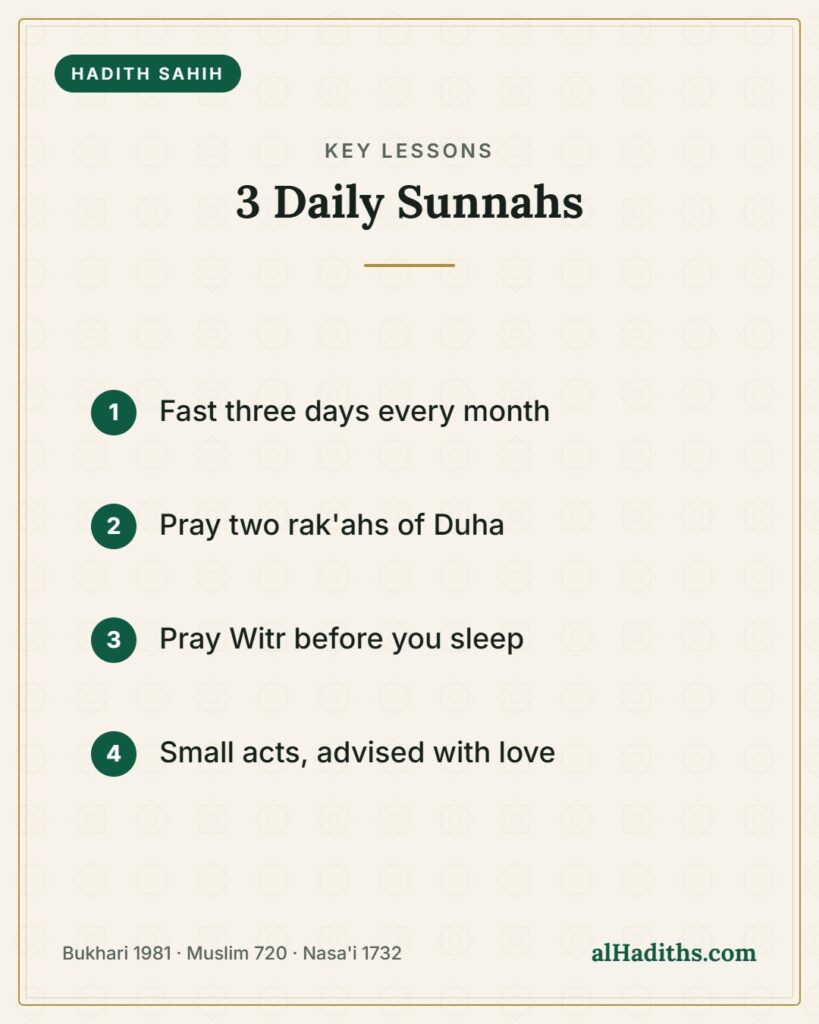
Key lessons
- The Prophet ﷺ advised Abu Hurairah to fast three days a month, pray Duha and pray Witr before sleeping.
- Fasting the white days or Mondays and Thursdays is an easy way to keep the first.
- Two rak’ahs of Duha are a charity for every joint of the body.
- Witr closes the day; say Subhanal-Malikil-Quddus after it.
Questions people ask
What three things did the Prophet ﷺ advise Abu Hurairah?
To fast three days every month, to pray two rak’ahs of Duha, and to pray Witr before sleeping (Sahih al-Bukhari 1981, Sahih Muslim 721).
What is the reward of the Duha prayer?
Every joint of the body owes a charity each morning, and two rak’ahs of Duha suffice for all of it (Sahih Muslim 720).
What do you say after witr?
Subhanal-Malikil-Quddus, three times, raising the voice the third time (Sunan an-Nasa’i 1732).
May Allah make these three sunnahs part of our days, and make us among those who follow His Messenger ﷺ with love.
Save this to Pinterest so you can add one of these sunnahs this week

Share the reward. Send this article to someone who needs it today — teaching a hadith or dua can become a lasting good deed for you, in shaa Allah.