Do Not Overstep Allah’s Limits: Hadith 30 of an-Nawawi
Is everything the religion does not mention forbidden? Hadith 30 of Imam an-Nawawi’s collection answers with a clear map: there are obligations to keep, limits not to cross, things that are forbidden, and things Allah left unmentioned out of mercy. This is the Allah has set limits hadith. Imam an-Nawawi graded it hasan, and other scholars graded it weak, so we explain both below.
At a glance
- Source: Hadith 30 of an-Nawawi’s 40, reported by ad-Daraqutni and others
- Narrated by: Abu Tha’labah al-Khushani (may Allah be pleased with him)
- Grade: Hasan (an-Nawawi); graded weak by al-Albani. See the note on its grading below
- Topic: Obligations, limits, prohibitions, and what Allah left unmentioned out of mercy
- Put it into practice: Keep the obligations first, and do not make the religion harder than Allah made it.
The hadith
Abu Tha’labah al-Khushani (may Allah be pleased with him) reported that the Messenger of Allah ﷺ said:
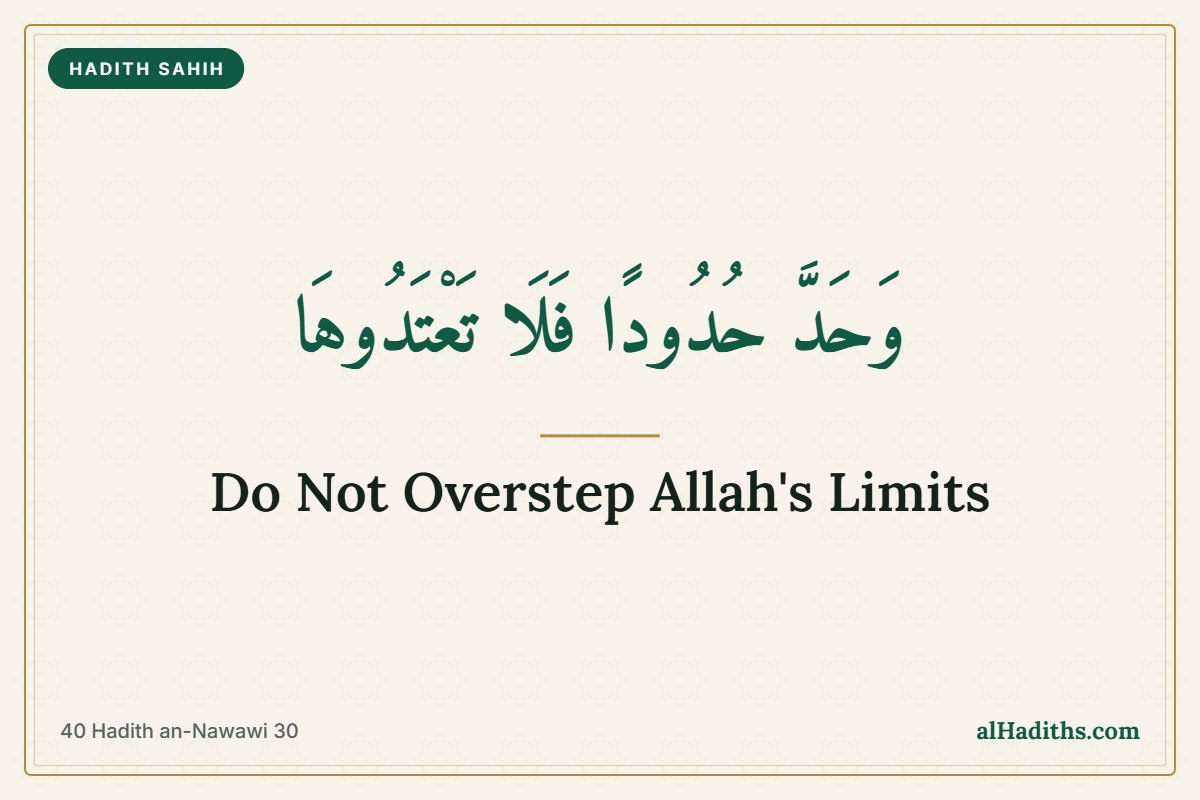
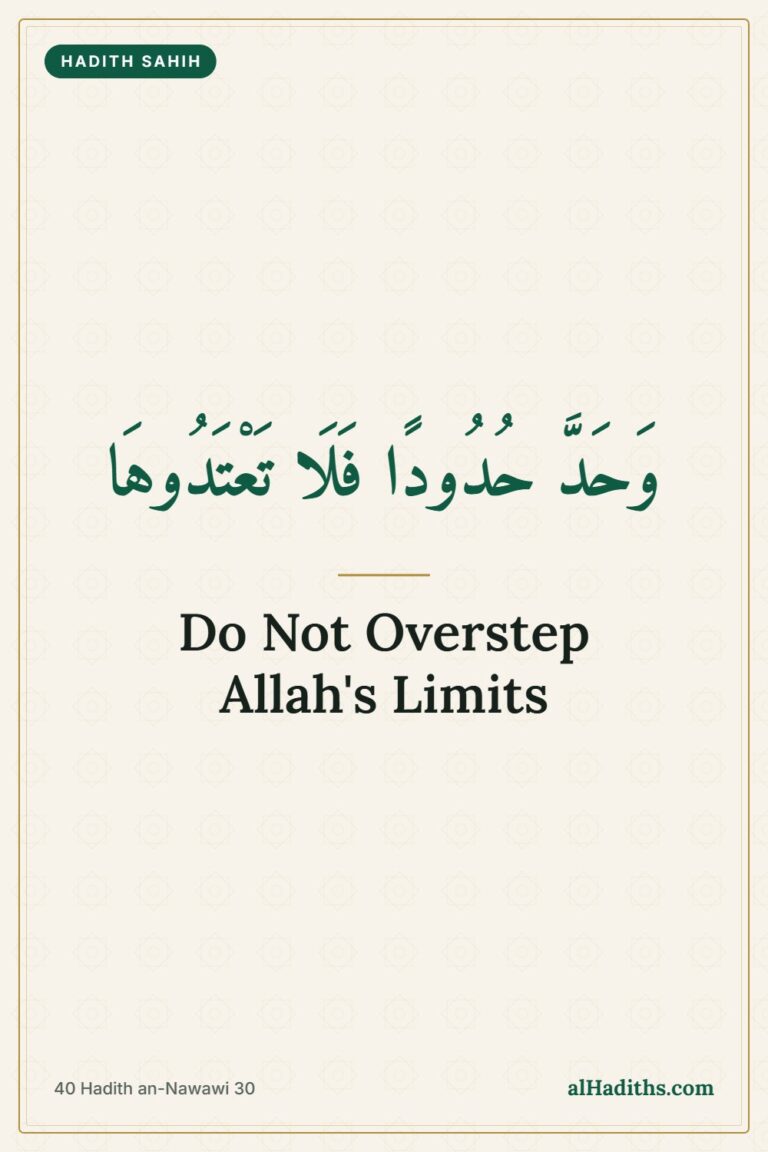
إنَّ اللَّهَ تَعَالَى فَرَضَ فَرَائِضَ فَلَا تُضَيِّعُوهَا، وَحَدَّ حُدُودًا فَلَا تَعْتَدُوهَا، وَحَرَّمَ أَشْيَاءَ فَلَا تَنْتَهِكُوهَا، وَسَكَتَ عَنْ أَشْيَاءَ رَحْمَةً لَكُمْ غَيْرَ نِسْيَانٍ فَلَا تَبْحَثُوا عَنْهَا
“Verily Allah ta’ala has laid down religious obligations (fara’id), so do not neglect them; and He has set limits, so do not overstep them; and He has forbidden some things, so do not violate them; and He has remained silent about some things, out of compassion for you, not forgetfulness — so do not seek after them.”
40 Hadith an-Nawawi 30 · Narrated by Abu Tha’labah al-Khushani · Reported by ad-Daraqutni · Translation from Sunnah.com
Imam an-Nawawi said it is a hasan hadith, reported by ad-Daraqutni in his Sunan and by others.
A note on its grading
Scholars of hadith differ on this narration:
- Imam an-Nawawi graded it hasan (good) (Sunnah.com, 40 Hadith 30), and the Encyclopedia of Translated Prophetic Hadiths (HadeethEnc) quotes his grading.
- Shaykh al-Albani graded it weak, and Zubair Ali Zai graded its chain weak (Mishkat al-Masabih 197 on Sunnah.com).
We present it as Imam an-Nawawi included and graded it, and we name the other gradings so you can see the difference for yourself.
What “do not overstep Allah’s limits” means
The Encyclopedia of Translated Prophetic Hadiths (HadeethEnc) explains the four parts of the hadith:
- Obligations: Allah has prescribed duties, so carry them out and do not neglect them.
- Limits: Allah set boundaries to keep people from what displeases Him. Do not cross them, including by adding practices the Shariah has not prescribed.
- Forbidden things: avoid them, and stay away from what leads to them.
- What Allah left unmentioned: وَسَكَتَ عَنْ أَشْيَاءَ رَحْمَةً لَكُمْ غَيْرَ نِسْيَانٍ فَلَا تَبْحَثُوا عَنْهَا He was silent about some things out of mercy, not forgetfulness. These stay permissible as they are, so there is no need to dig into them.
Among its benefits, HadeethEnc notes that Allah alone is the Lawgiver, and that what Allah did not command, limit or forbid is lawful. The Quran gives a similar warning against asking about things that would only make the religion harder:
يَـٰٓأَيُّهَا ٱلَّذِينَ ءَامَنُوا۟ لَا تَسْـَٔلُوا۟ عَنْ أَشْيَآءَ إِن تُبْدَ لَكُمْ تَسُؤْكُمْ وَإِن تَسْـَٔلُوا۟ عَنْهَا حِينَ يُنَزَّلُ ٱلْقُرْءَانُ تُبْدَ لَكُمْ عَفَا ٱللَّهُ عَنْهَا ۗ وَٱللَّهُ غَفُورٌ حَلِيمٌ
“O you who have believed, do not ask about things which, if they are shown to you, will distress you. But if you ask about them while the Qur’ān is being revealed, they will be shown to you. Allāh has pardoned it [i.e., that which is past]; and Allāh is Forgiving and Forbearing.”
Surah Al-Ma’idah 5:101 · Translation: Saheeh International, from Quran.com
Reflection: I find real comfort in the words “out of compassion for you, not forgetfulness”. Allah did not overlook anything. What He left open, He left open on purpose, so that our religion stays easy. It is a reminder not to burden ourselves, or others, with rules Allah did not make.
How to put it into practice
These are suggestions drawn from the explanation above:
- Put the obligations first: the five daily prayers, zakah, fasting Ramadan, and the rights of family and others.
- Know the clear haram and stay well away from it; see halal is clear and haram is clear.
- When something is genuinely doubtful, leave it; see leave what makes you doubt.
- Do not dig into what does not concern you; see leaving what does not concern you.
- Do not make things harder than Allah made them. For a ruling on your own situation, ask a qualified local scholar.
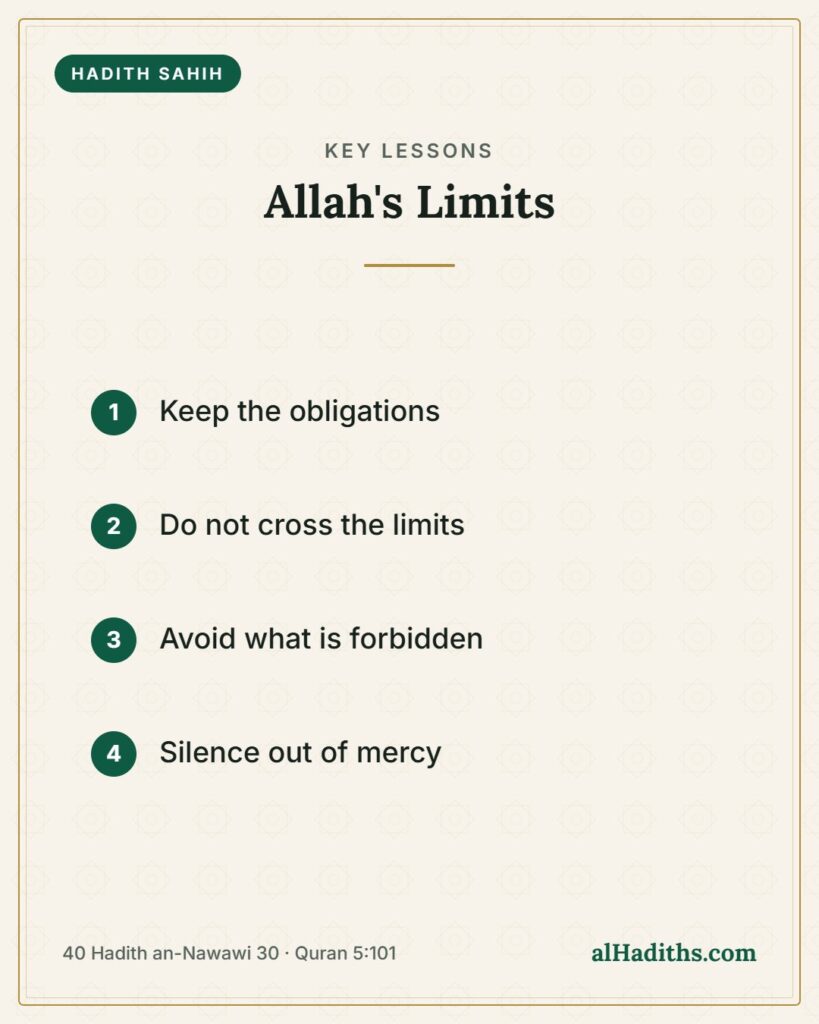
Key lessons
- Keep the obligations Allah has prescribed.
- Do not cross the limits Allah has set.
- Avoid what Allah has forbidden.
- What Allah left unmentioned was left out of mercy, not forgetfulness.
Questions people ask
Is the hadith “Allah has set limits, do not overstep them” authentic?
Imam an-Nawawi graded it hasan, and HadeethEnc quotes his grading. Shaykh al-Albani graded it weak, and Zubair Ali Zai graded its chain weak (Mishkat al-Masabih 197).
What does it mean that Allah was silent about things out of mercy?
The Encyclopedia of Translated Prophetic Hadiths (HadeethEnc) explains that what Allah did not command, limit or forbid stays permissible as it is, out of His mercy, so people should not burden themselves by searching into it.
What are the limits of Allah?
HadeethEnc explains them as the boundaries Allah set to keep people from what displeases Him, which should not be crossed, including by adding practices the Shariah has not prescribed.
May Allah help us keep what He made obligatory, stay within His limits, and be grateful for the ease He has given us.
Save this to Pinterest so you can come back to this hadith later.
Share the reward. Send this article to someone who needs it today — teaching a hadith or dua can become a lasting good deed for you, in shaa Allah.