Dhul Hijjah: The Best 10 Days of the Year and What to Do
Contents
If you could choose ten days in the year to work hardest for your akhirah, which would they be? The Prophet ﷺ answered that for us: the first 10 days of Dhul Hijjah. Hajj, the Day of Arafah and Eid al-Adha all fall inside them, and good deeds done in them are better than at any other time of the year. Here is what the authentic hadith say about Dhul Hijjah, and what we can do in it, even far from Makkah.
At a glance
- Hadith: 4 authentic hadith, plus one parallel
- Collections: Bukhari, Muslim, Abu Dawud, at-Tirmidhi
- Grade: Sahih
- Topic: The first 10 days of Dhul Hijjah
- Do today: Choose one good deed to do every day of the ten
When is Dhul Hijjah 2027?
Dhul Hijjah is the twelfth and last month of the Islamic year, and one of the four sacred months. In 2027, 1 Dhul Hijjah 1448 is expected on Friday 7 May, the Day of Arafah on Saturday 15 May and Eid al-Adha on Sunday 16 May. These are estimates: the sighting of the new moon decides, so dates in your country may differ by a day. All the key dates are on our Islamic calendar page.
1. The best 10 days of Dhul Hijjah for good deeds
Ibn ‘Abbas (may Allah be pleased with him) narrated that the Prophet ﷺ said:
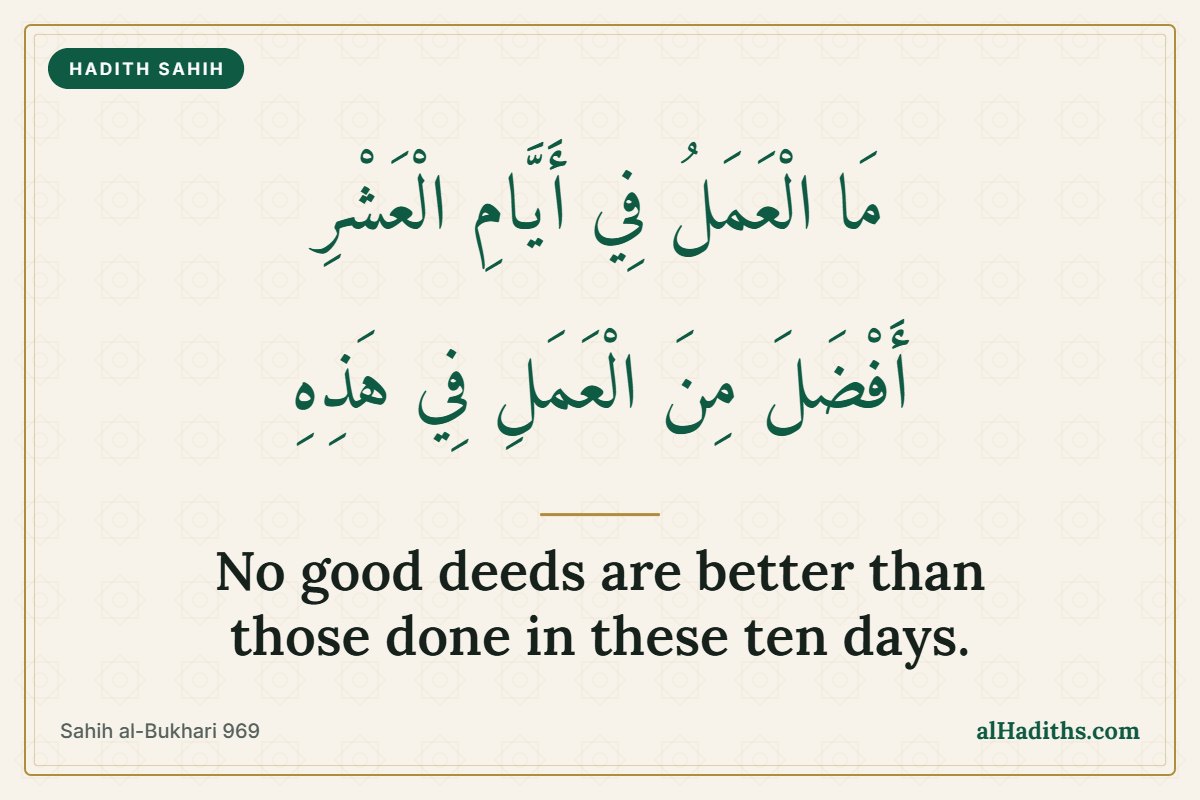
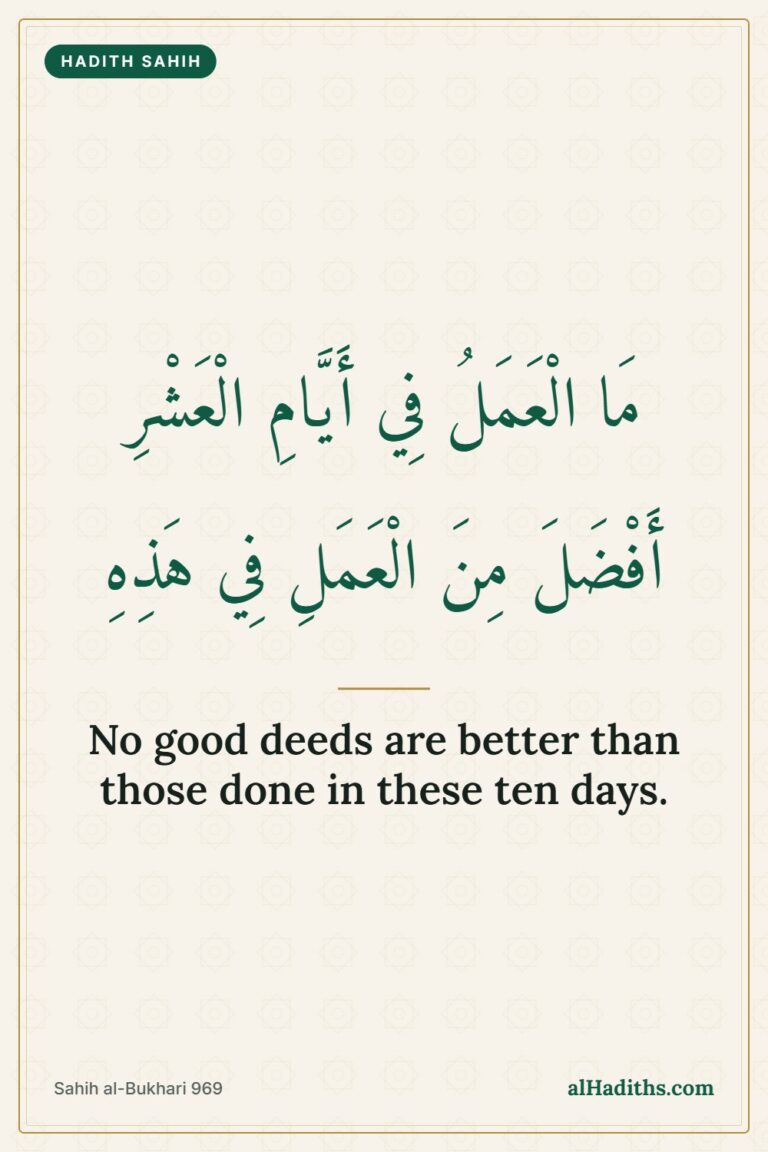
مَا الْعَمَلُ فِي أَيَّامِ الْعَشْرِ أَفْضَلَ مِنَ الْعَمَلِ فِي هَذِهِ. قَالُوا وَلاَ الْجِهَادُ قَالَ وَلاَ الْجِهَادُ، إِلاَّ رَجُلٌ خَرَجَ يُخَاطِرُ بِنَفْسِهِ وَمَالِهِ فَلَمْ يَرْجِعْ بِشَىْءٍ
“No good deeds done on other days are superior to those done on these (first ten days of Dhul Hijjah).” Then some companions of the Prophet ﷺ said, “Not even jihad?” He replied, “Not even jihad, except that of a man who does it by putting himself and his property in danger (for Allah’s sake) and does not return with any of those things.”
Sahih al-Bukhari 969 · Narrated by Ibn ‘Abbas · Translation adapted from Sunnah.com
The companions knew jihad as one of the greatest deeds, which is why they asked. As HadeethEnc explains, the answer means that good deeds in these ten days are better than jihad on other days, except for the one who goes out with his life and wealth and loses both. Ibn Hajar explained that these days are special because the main acts of worship, prayer, fasting, charity and Hajj, come together in them, which does not happen at any other time (Fath al-Bari, quoted by Jordan’s General Iftaa’ Department).
At-Tirmidhi narrates the same hadith with the words “more beloved to Allah”:
مَا مِنْ أَيَّامٍ الْعَمَلُ الصَّالِحُ فِيهِنَّ أَحَبُّ إِلَى اللَّهِ مِنْ هَذِهِ الأَيَّامِ الْعَشْرِ. فَقَالُوا يَا رَسُولَ اللَّهِ وَلاَ الْجِهَادُ فِي سَبِيلِ اللَّهِ فَقَالَ رَسُولُ اللَّهِ صلى الله عليه وسلم وَلاَ الْجِهَادُ فِي سَبِيلِ اللَّهِ إِلاَّ رَجُلٌ خَرَجَ بِنَفْسِهِ وَمَالِهِ فَلَمْ يَرْجِعْ مِنْ ذَلِكَ بِشَيْءٍ
“There are no days in which righteous deeds are more beloved to Allah than these ten days.” They said, “O Messenger of Allah! Not even jihad in Allah’s cause?” The Messenger of Allah ﷺ said, “Not even jihad in Allah’s cause, unless a man were to go out with his self and his wealth and not return with anything from that.”
Jami’ at-Tirmidhi 757 · Grade: Sahih (Darussalam) · Narrated by Ibn ‘Abbas · Translation adapted from Sunnah.com
Notice that the hadith says “good deeds” without listing them. Salah, Quran, dhikr, charity, fasting, kindness to parents: all of it counts, and all of it weighs more in these days.
Try this: pick one deed you already do, such as your morning dhikr, two rak’ahs of Duha or a small daily charity, and do it on every one of the ten days, a little more than usual.
2. Fasting the first nine days of Dhul Hijjah
Hunaydah ibn Khalid narrated from his wife, from one of the wives of the Prophet ﷺ, who said:
كَانَ رَسُولُ اللَّهِ صلى الله عليه وسلم يَصُومُ تِسْعَ ذِي الْحِجَّةِ وَيَوْمَ عَاشُورَاءَ وَثَلاَثَةَ أَيَّامٍ مِنْ كُلِّ شَهْرٍ أَوَّلَ اثْنَيْنِ مِنَ الشَّهْرِ وَالْخَمِيسَ
“The Messenger of Allah ﷺ used to fast the first nine days of Dhul-Hijjah, Ashura’ and three days of every month, that is, the first Monday (of the month) and Thursday.”
Sunan Abi Dawud 2437 · Grade: Sahih (al-Albani) · Narrated by one of the wives of the Prophet ﷺ · Translation adapted from Sunnah.com
Nine days, not ten, because the tenth is the day of Eid al-Adha. The ninth is the Day of Arafah, and its fast, for those not on Hajj, has its own hadith: the Prophet ﷺ said he hoped it expiates the sins of the year before and the year after (Sahih Muslim 1162a).
Try this: if nine days of fasting is too much for you this year, start smaller: a few of the days, or at least the Day of Arafah, with a sincere intention.
3. “I never saw him fasting the ten”: Aishah’s report
‘Aishah (may Allah be pleased with her) said:
مَا رَأَيْتُ رَسُولَ اللَّهِ صلى الله عليه وسلم صَائِمًا فِي الْعَشْرِ قَطُّ
“I never saw the Messenger of Allah ﷺ fasting in the ten days of Dhul-Hijjah.”
Sahih Muslim 1176a · Narrated by ‘Aishah · Translation adapted from Sunnah.com
So did he fast these days or not? Imam an-Nawawi, in his commentary on Sahih Muslim, explained that “the ten” here means the first nine days, and that ‘Aishah’s words could mean the Prophet ﷺ did not fast them in some years because of illness, travel or another reason, or that she simply did not see him fasting them. He cited the narration of Abu Dawud above in support. Ibn Hajar added that he may have left them at times so that people would not think they were obligatory (both quoted by Jordan’s General Iftaa’ Department).
We present both reports as they are. Scholars differ on the details, so for a ruling that fits your situation, please ask a qualified local scholar.
Try this: when two authentic reports seem to disagree, look up how the scholars brought them together before choosing a side. It is a habit that protects us from taking one hadith alone.
4. Offering a sacrifice? Leave your hair and nails
Umm Salamah (may Allah be pleased with her) narrated that the Prophet ﷺ said:
إِذَا دَخَلَتِ الْعَشْرُ وَأَرَادَ أَحَدُكُمْ أَنْ يُضَحِّيَ فَلاَ يَمَسَّ مِنْ شَعَرِهِ وَبَشَرِهِ شَيْئًا
“When the ten days begin and one of you intends to offer a sacrifice, let him not touch anything of his hair or his skin.”
Sahih Muslim 1977c · Narrated by Umm Salamah · Translation adapted from Sunnah.com
Another narration in the same chapter says he “should not get his hair cut or nails trimmed” (Sahih Muslim 1977d). As HadeethEnc explains, this covers hair from any part of the body and the fingernails and toenails, from the start of Dhul Hijjah until the sacrifice is slaughtered. It applies to the one who intends to offer the sacrifice (udhiyah, or qurbani). Scholars differ on whether it is forbidden or disliked (IslamQA quotes an-Nawawi on this), so ask a qualified local scholar if you need the ruling.
Try this: if you plan to give a sacrifice this year, trim your hair and nails before 1 Dhul Hijjah, and set a reminder for the evening the month is announced.
Bringing it together
Most of us will not be on Hajj this year. Yet the Prophet ﷺ did not keep the virtue of these days for the pilgrims only: every good deed, done anywhere, counts for more in them.
Reflection: Ramadan gives us its last ten nights, and Dhul Hijjah gives us its first ten days. If we plan for them the way we plan for Ramadan, with a simple list of deeds and a little extra effort each day, they can become one of the brightest seasons of our year.
Questions people ask
What are the 10 days of Dhul Hijjah?
They are the first ten days of Dhul Hijjah, from the 1st to the 10th, the day of Eid al-Adha. The Prophet ﷺ said no good deeds done on other days are better than those done in them (Sahih al-Bukhari 969). In 2027 they are expected from Friday 7 May to Sunday 16 May.
Is it sunnah to fast the first 9 days of Dhul Hijjah?
One of the wives of the Prophet ﷺ reported that he used to fast the first nine days of Dhul Hijjah (Sunan Abi Dawud 2437, Sahih per al-Albani), while ‘Aishah said she never saw him fasting the ten (Sahih Muslim 1176a). Imam an-Nawawi reconciled the two reports. For a ruling, please ask a qualified local scholar.
Can I cut my hair and nails in Dhul Hijjah?
The instruction is for the person who intends to offer a sacrifice: from the start of Dhul Hijjah, he should not cut his hair or nails until the sacrifice is made (Sahih Muslim 1977c, Sahih Muslim 1977d). Scholars differ on whether it is forbidden or disliked.
Key lessons
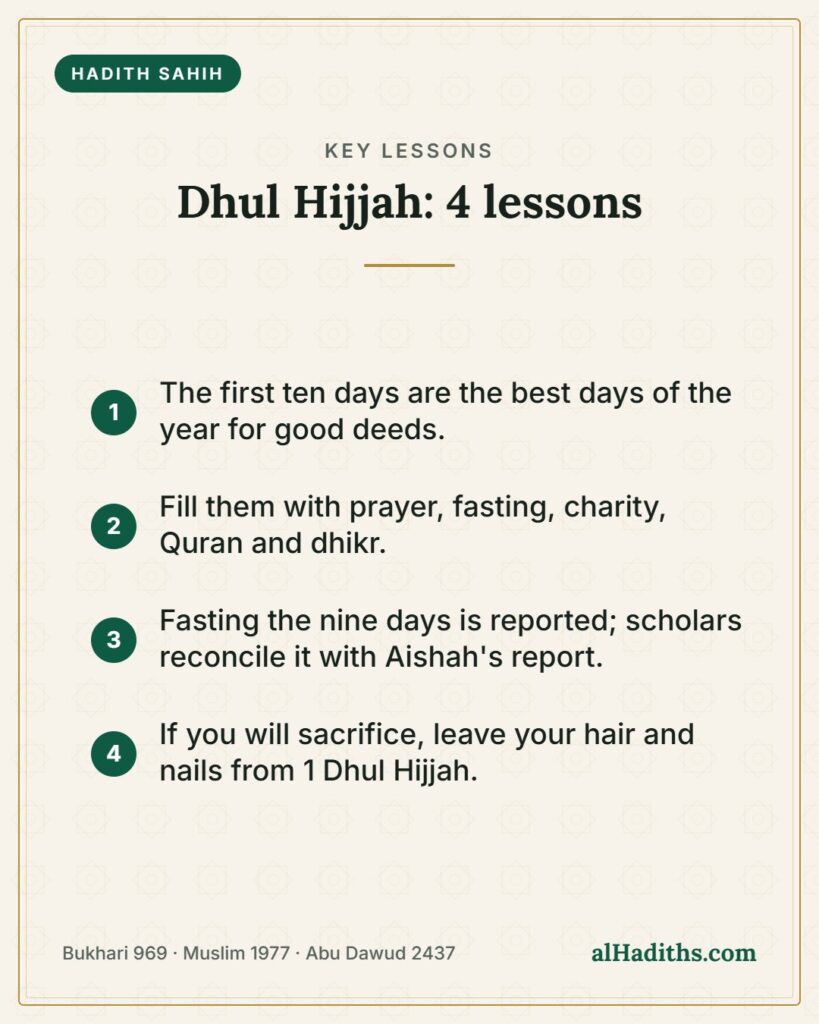
- The first 10 days of Dhul Hijjah are the best days of the year for good deeds.
- “Good deeds” is general: salah, Quran, dhikr, charity and fasting all count.
- A narration in Abu Dawud reports the Prophet ﷺ fasting the first nine days; an-Nawawi reconciled it with Aishah’s report.
- Whoever intends to offer a sacrifice leaves his hair and nails from 1 Dhul Hijjah until the sacrifice.
May Allah let us reach the ten days of Dhul Hijjah in good health, and accept from us whatever we manage to do in them.
Save this to Pinterest so you can plan the ten days before they begin
Share the reward. Send this article to someone who needs it today — teaching a hadith or dua can become a lasting good deed for you, in shaa Allah.