The Blood of a Muslim Is Sacred: Hadith 14 of an-Nawawi
How much is a Muslim’s life worth in Islam? In Hadith 14 of Imam an-Nawawi’s collection, the Prophet ﷺ answered with a clear rule: the blood of a Muslim is not lawful except in three cases, and he named them. Here is the hadith as it was narrated, the same words from ‘Uthman ibn ‘Affan on the day his house was besieged, and how the scholars explain it.
At a glance
- Source: Sahih Muslim 1676a and Sahih al-Bukhari 6878 (Hadith 14 of an-Nawawi’s 40)
- Narrated by: ‘Abdullah ibn Mas’ud (may Allah be pleased with him)
- Grade: Sahih (recorded by both al-Bukhari and Muslim)
- Topic: The sanctity of a Muslim’s life and the three cases the hadith names
- Put it into practice: Treat every Muslim’s life, wealth and honor as sacred
The hadith
‘Abdullah ibn Mas’ud (may Allah be pleased with him) reported that the Messenger of Allah ﷺ said:
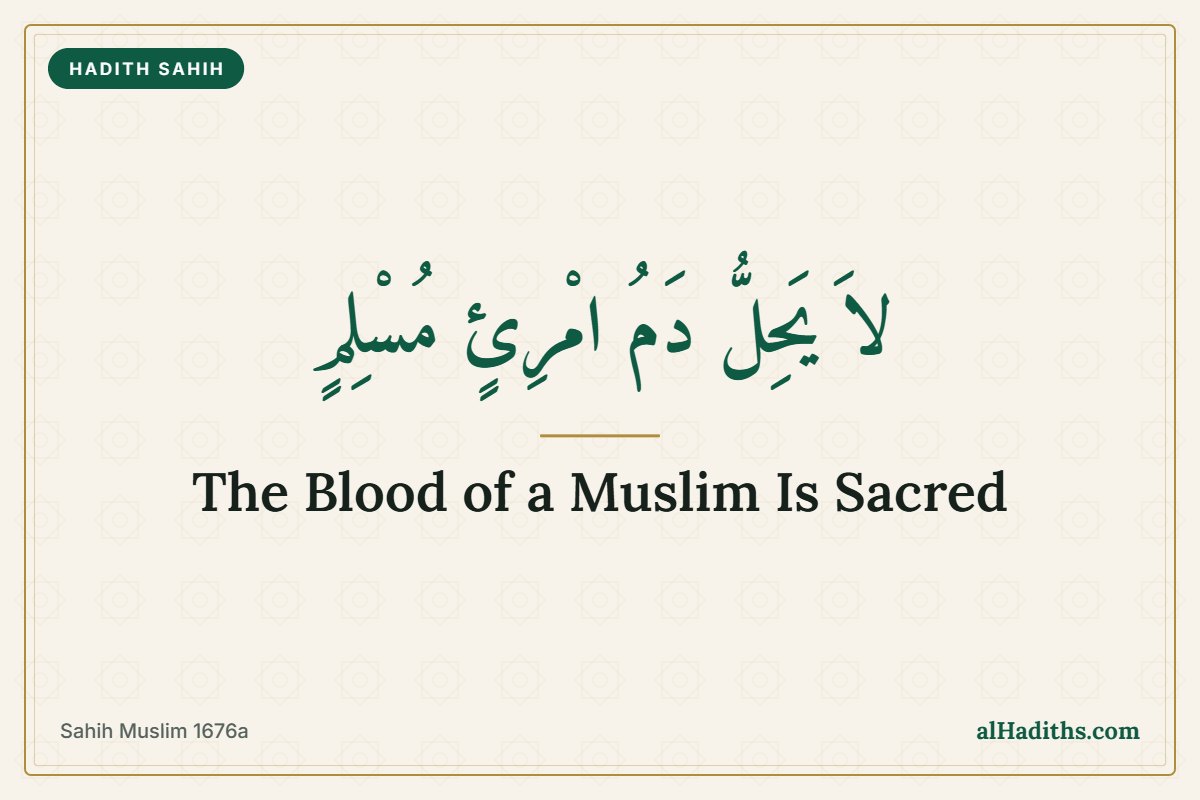
لاَ يَحِلُّ دَمُ امْرِئٍ مُسْلِمٍ يَشْهَدُ أَنْ لاَ إِلَهَ إِلاَّ اللَّهُ وَأَنِّي رَسُولُ اللَّهِ إِلاَّ بِإِحْدَى ثَلاَثٍ الثَّيِّبُ الزَّانِ وَالنَّفْسُ بِالنَّفْسِ وَالتَّارِكُ لِدِينِهِ الْمُفَارِقُ لِلْجَمَاعَةِ
“It is not permissible to take the life of a Muslim who bears testimony (to the fact) that there is no god but Allah, and I am the Messenger of Allah, but in one of the three cases: the married adulterer, a life for life, and the deserter of his Din (Islam), abandoning the community.”
Sahih Muslim 1676a · Narrated by ‘Abdullah ibn Mas’ud · Translation adapted from Sunnah.com
Al-Bukhari recorded it too (Sahih al-Bukhari 6878), listing a life for a life first and describing the third person as one who goes out of the religion and leaves the community. Imam an-Nawawi placed it as Hadith 14 of his 40 Hadith.
‘Uthman and the same three cases
The same rule was on the lips of ‘Uthman ibn ‘Affan (may Allah be pleased with him) when rebels surrounded his house. Abu Umamah ibn Sahl reported that ‘Uthman looked out over the people and reminded them that the Messenger of Allah ﷺ said:
لاَ يَحِلُّ دَمُ امْرِئٍ مُسْلِمٍ إِلاَّ بِإِحْدَى ثَلاَثٍ زِنًا بَعْدَ إِحْصَانٍ أَوِ ارْتِدَادٍ بَعْدَ إِسْلاَمٍ أَوْ قَتْلِ نَفْسٍ بِغَيْرِ حَقٍّ فَقُتِلَ بِهِ
“The blood of a Muslim man is not lawful, except for one of three (cases): Illegitimate sexual relations after Ihsan (having been married), or apostasy after Islam, or taking a life without right, for which he is killed.”
Jami’ at-Tirmidhi 2158 · Grade: Sahih (Darussalam) · Translation adapted from Sunnah.com
‘Uthman then swore that he had done none of the three, and asked them on what grounds they would kill him. At-Tirmidhi called the narration hasan, Darussalam grades it Sahih, and Abu Dawud recorded the same account (Sunan Abi Dawud 4502, Sahih per al-Albani).
What the blood of a Muslim hadith means
The Encyclopedia of Translated Prophetic Hadiths (HadeethEnc) explains that the Prophet ﷺ made clear a Muslim is inviolable unless he commits one of these three:
- The married adulterer: one who commits zina after being lawfully married. HadeethEnc states that it is lawful for him to be stoned to death.
- A life for a life: one who deliberately and unlawfully kills a person whose life is protected is killed in return, with the conditions that apply.
- The one who leaves the religion and the community: HadeethEnc explains this as leaving Islam altogether through apostasy, or splitting from the community by abandoning part of it without apostasy, such as those who commit highway robbery and rebels like the Kharijites.
Among the benefits it lists:
- The hadith shows that Muslims must be respected and that their blood is inviolable.
- It is forbidden to do any of these three acts, and whoever does deserves the death penalty, either for disbelief (the apostate) or as a legal punishment (the married adulterer and the deliberate killer).
- Allah legislated these punishments to deter criminals and to protect society from crime.
- Carrying out the legal punishments lies within the authority of the ruler.
- We are urged to stay with the Muslim community and not to separate from it.
The details of these rulings, such as their conditions and how they are proven, belong to the scholars of fiqh and the courts. For questions about them, ask a qualified scholar.
A Muslim’s life is sacred
Other authentic narrations make the same point from the other side: what is protected, and how seriously. The Prophet ﷺ said:
كُلُّ الْمُسْلِمِ عَلَى الْمُسْلِمِ حَرَامٌ دَمُهُ وَمَالُهُ وَعِرْضُهُ
“All things of a Muslim are inviolable for his brother in faith: his blood, his wealth and his honour.”
Sahih Muslim 2564a · Narrated by Abu Hurairah · Translation from Sunnah.com
In his sermon on the Day of Nahr he said that our blood, property and honor are as sacred to one another as that day, that month and that city (Sahih al-Bukhari 67). He also said that a believer remains at liberty regarding his religion unless he kills somebody unlawfully (Sahih al-Bukhari 6862). And Allah says:
وَلَا تَقْتُلُوا۟ ٱلنَّفْسَ ٱلَّتِى حَرَّمَ ٱللَّهُ إِلَّا بِٱلْحَقِّ ۗ وَمَن قُتِلَ مَظْلُومًا فَقَدْ جَعَلْنَا لِوَلِيِّهِۦ سُلْطَـٰنًا فَلَا يُسْرِف فِّى ٱلْقَتْلِ ۖ إِنَّهُۥ كَانَ مَنصُورًا
“And do not kill the soul [i.e., person] which Allāh has forbidden, except by right. And whoever is killed unjustly – We have given his heir authority, but let him not exceed limits in [the matter of] taking life. Indeed, he has been supported [by the law].”
Surah al-Isra 17:33 · Translation: Saheeh International, from Quran.com
Reflection: the hadith opens with “it is not permissible”. Its starting point is that a Muslim’s life is protected, and only three named cases lift that protection. ‘Uthman (may Allah be pleased with him) understood it that way. Facing men who wanted his life, he did not argue from his status. He argued from this hadith.
How to put it into practice
The hadith does not give a routine, so these are suggestions:
- Treat every Muslim’s life, wealth and honor as sacred, in what you say about them as well as what you do.
- Leave punishments to the lawful authority. HadeethEnc notes that carrying them out lies with the ruler.
- Stay with the Muslim community and keep away from what splits it.
- Keep far from the sins the hadith names, and from what leads to them.
- Ask a qualified scholar about the rulings of these punishments, rather than relying on social media.
Key lessons
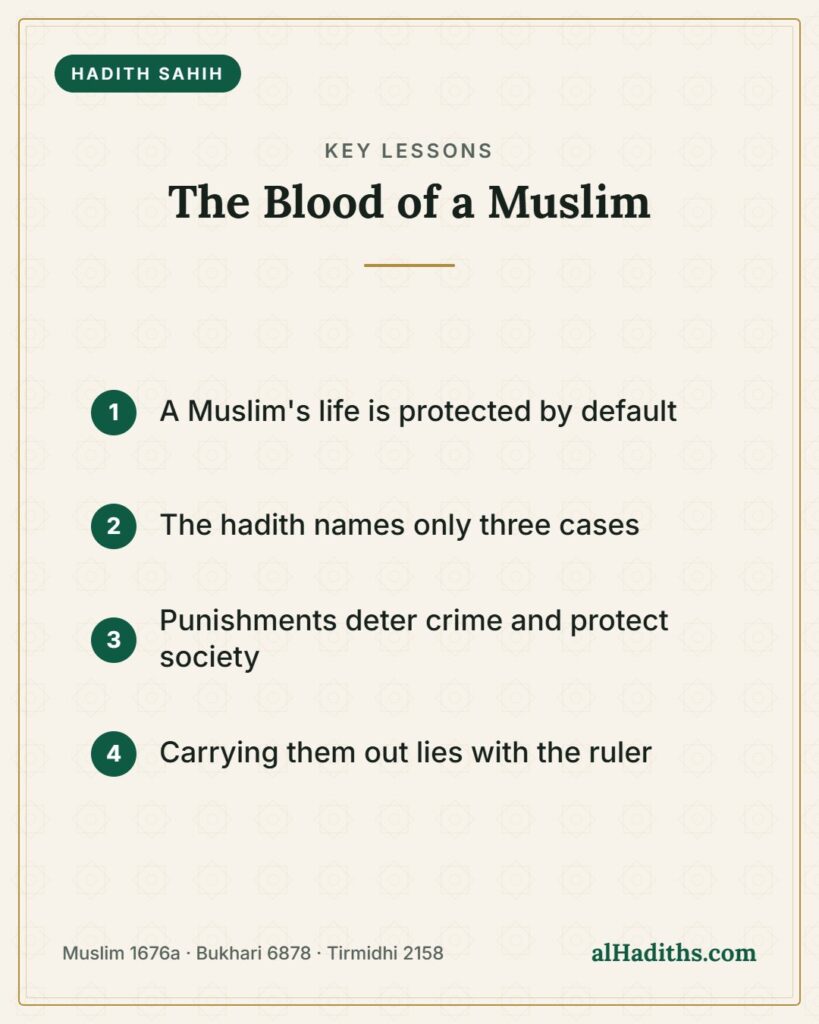
- A Muslim’s blood is inviolable; that is the starting point.
- The hadith names three cases: the married adulterer, a life for a life, and the one who leaves the religion and the community.
- These punishments were legislated to deter crime and protect society.
- Carrying them out lies with the ruler.
- ‘Uthman (may Allah be pleased with him) cited the same three cases when his own life was threatened.
Questions people ask
In which three cases does the hadith say a Muslim’s blood becomes lawful?
The married adulterer, a life for a life, and the one who leaves his religion and separates from the community (Sahih Muslim 1676a). The Encyclopedia of Translated Prophetic Hadiths (HadeethEnc) explains each one. For the details of these rulings, ask a qualified scholar.
Who carries out these punishments?
HadeethEnc states that carrying out the legal punishments lies within the authority of the ruler (Encyclopedia of Translated Prophetic Hadiths (HadeethEnc)).
Is the hadith on the blood of a Muslim authentic?
Yes. It is narrated by ‘Abdullah ibn Mas’ud and recorded by both al-Bukhari (Sahih al-Bukhari 6878) and Muslim (Sahih Muslim 1676a). ‘Uthman ibn ‘Affan narrated it as well (Jami’ at-Tirmidhi 2158, Sahih per Darussalam). It is Hadith 14 of an-Nawawi’s 40.
A question to carry with you today: if the Prophet ﷺ guarded a Muslim’s blood this carefully, how carefully do we guard each other’s honor and wealth in the way we speak and deal with one another?
Save this to Pinterest so you can come back to this hadith.
Share the reward. Send this article to someone who needs it today — teaching a hadith or dua can become a lasting good deed for you, in shaa Allah.