Mistakes, Forgetting and Coercion: Hadith 39 of an-Nawawi
Will Allah hold me to account for something I did by mistake, forgot, or was forced into? Hadith 39 of Imam an-Nawawi’s collection answers this in one short line. Known as the Allah has pardoned my ummah hadith, it lifts the sin in three situations, and its explanation also shows what it does not lift.
At a glance
- Source: Sunan Ibn Majah 2045; also Hadith 39 of an-Nawawi’s 40
- Narrated by: Ibn ‘Abbas (may Allah be pleased with him)
- Grade: Sahih (Darussalam); an-Nawawi called it hasan
- Topic: No sin for mistakes, forgetting or coercion
- Put it into practice: When you realize a mistake, put it right; don’t carry guilt for it
The hadith
Ibn ‘Abbas (may Allah be pleased with him) reported that the Prophet ﷺ said:
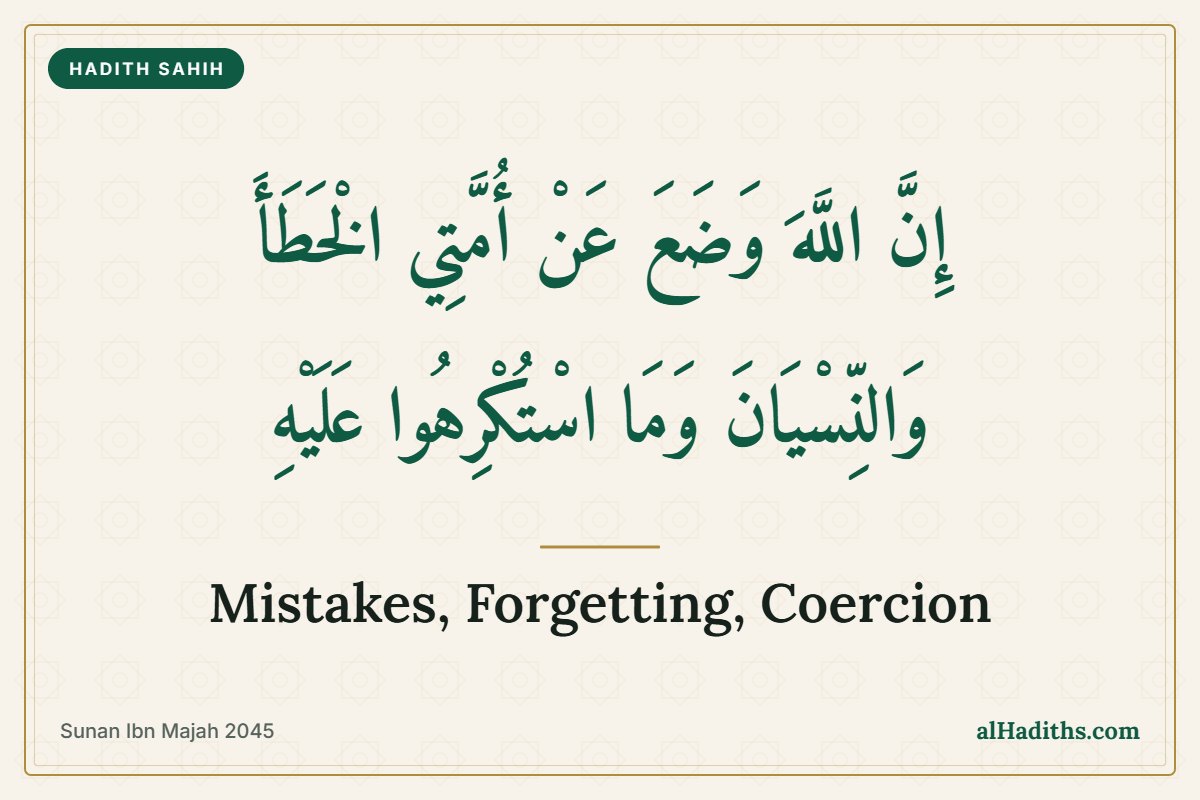
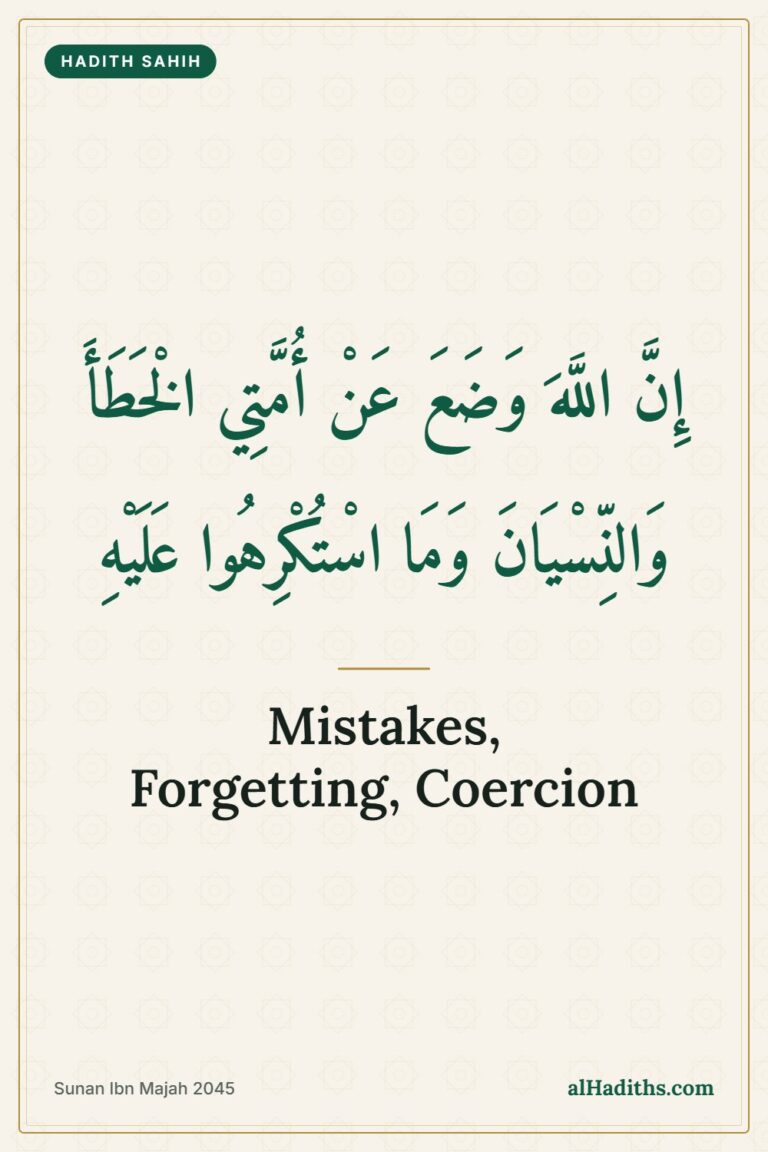
إِنَّ اللَّهَ وَضَعَ عَنْ أُمَّتِي الْخَطَأَ وَالنِّسْيَانَ وَمَا اسْتُكْرِهُوا عَلَيْهِ
“Allah has forgiven my nation for mistakes and forgetfulness, and what they are forced to do.”
Sunan Ibn Majah 2045 · Sahih (Darussalam) · Translation from Sunnah.com
We quote Ibn Majah’s wording, وَضَعَ (“removed from my ummah”). Imam an-Nawawi’s text reads تَجَاوَزَ لِي (“pardoned for me”), and he graded the hadith hasan. The meaning is the same.
What the hadith means: three situations
Based on HadeethEnc‘s explanation:
- A mistake. You meant to do one thing and ended up doing another, without intending it.
- Forgetting. You knew something, but it slipped your mind at the moment you acted.
- Coercion. Someone forced you, and you had no way to push the force away.
In all three, there is no sin on the person. HadeethEnc calls this a sign of Allah’s vast mercy, and a favor He gave to the Prophet ﷺ and his ummah.
What it does not mean
HadeethEnc is clear that the hadith is about the sin between a servant and his Lord. It does not cancel everything else:
- A forgotten duty still has to be done. HadeethEnc’s example: someone forgets he has no wudu and prays. There is no sin on him, but he makes wudu and prays again. See also what the Prophet ﷺ did when Fajr was missed through sleep.
- Other people’s rights stay. If a mistake harms someone, their right is not dropped. HadeethEnc mentions blood money for killing by mistake, and paying for a car damaged by mistake.
- Coercion has conditions, such as the one forcing you being able to carry out his threat.
For your own situation, please ask a qualified scholar.
The dua at the end of al-Baqarah
The same three themes appear in the last verse of Surah al-Baqarah, where the believers ask Allah not to blame them if they forget or err. Read more in the last two verses of Surah al-Baqarah.
لَا يُكَلِّفُ ٱللَّهُ نَفْسًا إِلَّا وُسْعَهَا ۚ لَهَا مَا كَسَبَتْ وَعَلَيْهَا مَا ٱكْتَسَبَتْ ۗ رَبَّنَا لَا تُؤَاخِذْنَآ إِن نَّسِينَآ أَوْ أَخْطَأْنَا ۚ رَبَّنَا وَلَا تَحْمِلْ عَلَيْنَآ إِصْرًا كَمَا حَمَلْتَهُۥ عَلَى ٱلَّذِينَ مِن قَبْلِنَا ۚ رَبَّنَا وَلَا تُحَمِّلْنَا مَا لَا طَاقَةَ لَنَا بِهِۦ ۖ وَٱعْفُ عَنَّا وَٱغْفِرْ لَنَا وَٱرْحَمْنَآ ۚ أَنتَ مَوْلَىٰنَا فَٱنصُرْنَا عَلَى ٱلْقَوْمِ ٱلْكَـٰفِرِينَ
“Allāh does not charge a soul except [with that within] its capacity. It will have [the consequence of] what [good] it has gained, and it will bear [the consequence of] what [evil] it has earned. ‘Our Lord, do not impose blame upon us if we have forgotten or erred. Our Lord, and lay not upon us a burden like that which You laid upon those before us. Our Lord, and burden us not with that which we have no ability to bear. And pardon us; and forgive us; and have mercy upon us. You are our protector, so give us victory over the disbelieving people.'”
Surah Al-Baqarah 2:286 · Translation: Saheeh International, from Quran.com
Reflection: some of us carry guilt for years over things we never chose: a slip of the tongue, a promise we honestly forgot, something done under pressure we could not resist. This hadith lets that weight go. But it is not a loophole. The same mercy asks us to be honest with ourselves: was it really a mistake, or did we simply not care? And when we realize, we put it right.
How to put it into practice
The hadith does not set any particular steps, so these are suggestions:
- Put it right when you remember. Make up what you missed, and fix or pay for any harm.
- Apologize when someone was hurt, even if you did not mean it.
- Let go of guilt over what was truly a mistake or forgotten. Allah has lifted it.
- Don’t use it as an excuse. Carelessness by choice is not a mistake.
- Make the dua of 2:286, especially at night, asking Allah not to blame us if we forget or err.
Key lessons
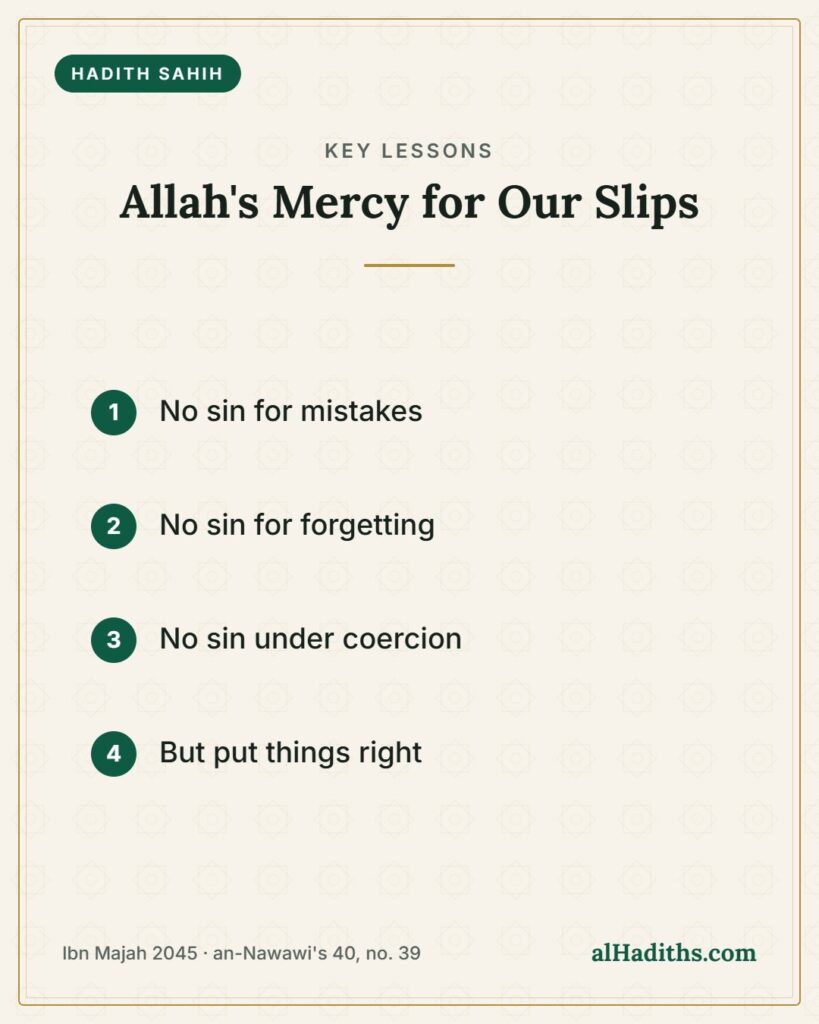
- Allah does not count mistakes, forgetting or coercion as sins.
- This is a special mercy for the ummah of the Prophet ﷺ.
- The sin is lifted, but a missed duty still has to be done.
- Other people’s rights are not dropped by a mistake.
- Allah does not burden a soul beyond its capacity (2:286).
Questions people ask
Is a sin done by mistake forgiven?
Yes. In this hadith (Ibn Majah 2045), the Prophet ﷺ said Allah has forgiven his ummah for mistakes, forgetting and what they are forced to do. HadeethEnc explains there is no sin in these cases.
If I forget a prayer or a duty, do I still have to do it?
According to HadeethEnc, the sin is lifted but the duty is not. Its example is a person who prays without wudu by forgetting: he makes wudu and prays again. Ask a qualified scholar about your case.
Does this hadith cancel the rights of other people?
No. HadeethEnc says that if a mistake harms someone, that person’s right remains, such as compensation for damage done by mistake.
One thing for today: think of one mistake you still feel guilty about. If it harmed someone, put it right. If it didn’t, ask Allah’s forgiveness and let it go.
Save this to Pinterest so you can come back to this hadith later.
Share the reward. Send this article to someone who needs it today — teaching a hadith or dua can become a lasting good deed for you, in shaa Allah.