Seek Knowledge Even in China: Is This Hadith Authentic?
Contents
You have probably heard it in a school assembly, a graduation speech or a forwarded message: “Seek knowledge even in China.” It is quoted so often as a hadith that few people stop to ask where it comes from. The short answer: scholars of hadith do not accept it as the words of the Prophet ﷺ. The good news is that we do not need it. Below is how the line was graded, and four authentic hadith about seeking knowledge that we can quote with confidence.
At a glance
- Popular wording: “Seek knowledge even if it be in China”
- Status: Not authentic: graded very weak to fabricated
- Authentic alternative: Sahih Muslim 2699 (and three more below)
- Topic: Seeking knowledge
- Do today: Learn one authentic hadith and check its source
Is “seek knowledge even in China” a hadith?
No, not an authentic one. The line “Seek knowledge even if it be in China” (utlubu al-ʿilm wa law bis-Sin) is attributed to the Prophet ﷺ through Anas ibn Malik (may Allah be pleased with him), usually joined to a second sentence: “for seeking knowledge is a duty upon every Muslim.” It is not in Sahih al-Bukhari, Sahih Muslim or the other four of the six books. It appears in later works such as al-Bayhaqi’s Shuʿab al-Iman, and al-Bayhaqi himself said its text is famous but its chain is weak (Irsyad al-Hadith no. 18, from the office of the Mufti of the Federal Territories, Malaysia).
Because it is not authentic, we give no Arabic card for it here. If grading terms are new to you, our guide to sahih, hasan and weak hadith explains them.
How scholars graded it
The Mufti’s office collected the verdicts of the hadith scholars (Irsyad al-Hadith no. 18):
- Ibn Hibban: false, with no basis (al-Majruhin).
- Ibn al-Jawzi: listed it among the fabricated narrations (al-Mawduʿat).
- Al-Bayhaqi: the text is well known, but the chain is weak (Shuʿab al-Iman).
- As-Sakhawi: weak (al-Maqasid al-Hasanah).
- Ash-Shawkani: fabricated (al-Fawaʾid al-Majmuʿah).
- As-Suyuti: a lone, more lenient view, that its several routes from Anas might raise it to hasan.
The Mufti’s office concludes that the narration is very weak. Among later scholars, Shaykh al-Albani graded it fabricated in Daʿif al-Jamiʿ, no. 906 (IslamQA 13637). So the verdicts run from “very weak” to “fabricated”, and none of these scholars calls it Sahih. A line like that should not be passed on as “the Prophet ﷺ said”.
1. The authentic hadith: a path to Paradise
What the Prophet ﷺ did say about seeking knowledge is greater than any distance. Abu Hurairah (may Allah be pleased with him) narrated it as part of a longer hadith.
وَمَنْ سَلَكَ طَرِيقًا يَلْتَمِسُ فِيهِ عِلْمًا سَهَّلَ اللَّهُ لَهُ بِهِ طَرِيقًا إِلَى الْجَنَّةِ
“And whoever treads a path in search of knowledge, Allah will make easy for him a path to Paradise.”
Sahih Muslim 2699 · Narrated by Abu Hurairah · Translation adapted from Sunnah.com
This is one sentence from a longer hadith, which we cover in full in Hadith 36 of an-Nawawi. Notice that it names no country at all. The promise is tied to the path, whether that path is a flight overseas or a walk to the local mosque. HadeethEnc lists encouraging the seeking of knowledge and the study of the Quran among the benefits of this hadith (HadeethEnc 4801).
Try this: the next time you want to encourage a student, quote this hadith instead of the China line. It is authentic, and its promise is Paradise.
2. He traveled from Madinah to Damascus for one hadith
If you like the “travel far for knowledge” spirit of the China line, there is an authentic story that shows it. Kathir ibn Qays said he was sitting with Abu ad-Dardaʾ (may Allah be pleased with him) in the mosque of Damascus when a man arrived and said he had come all the way from Madinah for a single hadith, and for no other purpose. Abu ad-Dardaʾ then told him what he had heard from the Prophet ﷺ.
مَنْ سَلَكَ طَرِيقًا يَطْلُبُ فِيهِ عِلْمًا سَلَكَ اللَّهُ بِهِ طَرِيقًا مِنْ طُرُقِ الْجَنَّةِ وَإِنَّ الْمَلاَئِكَةَ لَتَضَعُ أَجْنِحَتَهَا رِضًا لِطَالِبِ الْعِلْمِ وَإِنَّ الْعَالِمَ لَيَسْتَغْفِرُ لَهُ مَنْ فِي السَّمَوَاتِ وَمَنْ فِي الأَرْضِ وَالْحِيتَانُ فِي جَوْفِ الْمَاءِ وَإِنَّ فَضْلَ الْعَالِمِ عَلَى الْعَابِدِ كَفَضْلِ الْقَمَرِ لَيْلَةَ الْبَدْرِ عَلَى سَائِرِ الْكَوَاكِبِ وَإِنَّ الْعُلَمَاءَ وَرَثَةُ الأَنْبِيَاءِ وَإِنَّ الأَنْبِيَاءَ لَمْ يُوَرِّثُوا دِينَارًا وَلاَ دِرْهَمًا وَرَّثُوا الْعِلْمَ فَمَنْ أَخَذَهُ أَخَذَ بِحَظٍّ وَافِرٍ
“If anyone travels on a road in search of knowledge, Allah will cause him to travel on one of the roads of Paradise. The angels will lower their wings in their great pleasure with one who seeks knowledge. The inhabitants of the heavens and the earth, and the fish in the deep waters, will ask forgiveness for the learned man. The superiority of the learned man over the devout is like that of the moon, on the night when it is full, over the rest of the stars. The learned are the heirs of the Prophets, and the Prophets leave neither dinar nor dirham, leaving only knowledge, and he who takes it takes an abundant portion.”
Sunan Abi Dawud 3641 · Sahih (al-Albani) · Narrated by Abu ad-Dardaʾ · Translation adapted from Sunnah.com
HadeethEnc explains that the “path” can be a physical one, such as walking to a class, or an intangible one, such as attending lessons or reading books; and that the scholar is ranked above the worshipper because worship benefits the worshipper alone, while knowledge benefits others too (HadeethEnc 6267).
A note on its grading: Sunnah.com shows this hadith as Sahih (al-Albani) in Abu Dawud. The same hadith through other chains, in Jami‘ at-Tirmidhi 2682 and Sunan Ibn Majah 223, is marked Daʿif (Darussalam), and HadeethEnc lists it as a good (hasan) hadith. Its opening sentence is supported by the Sahih Muslim hadith above.
Try this: pick one class, book or lecture series this month and treat the trip to it, or the time set aside for it, as your road to Paradise.
3. A sign that Allah wants good for you
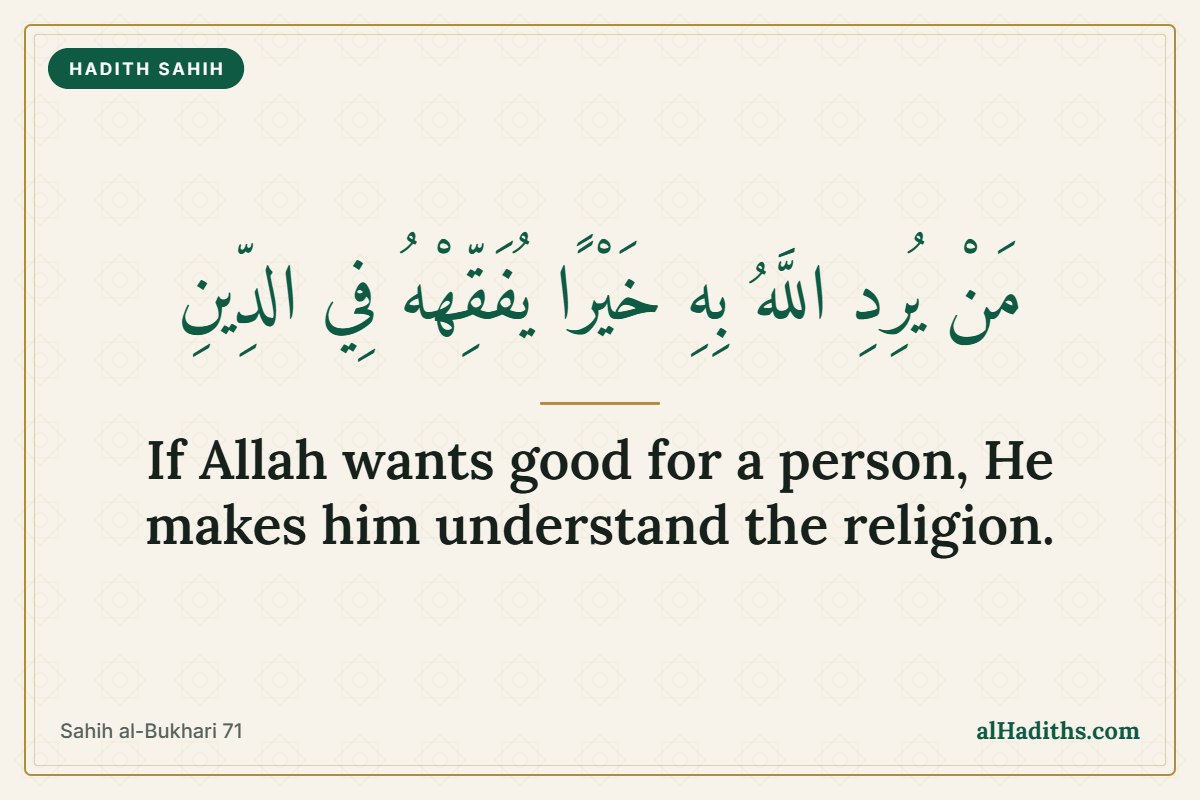
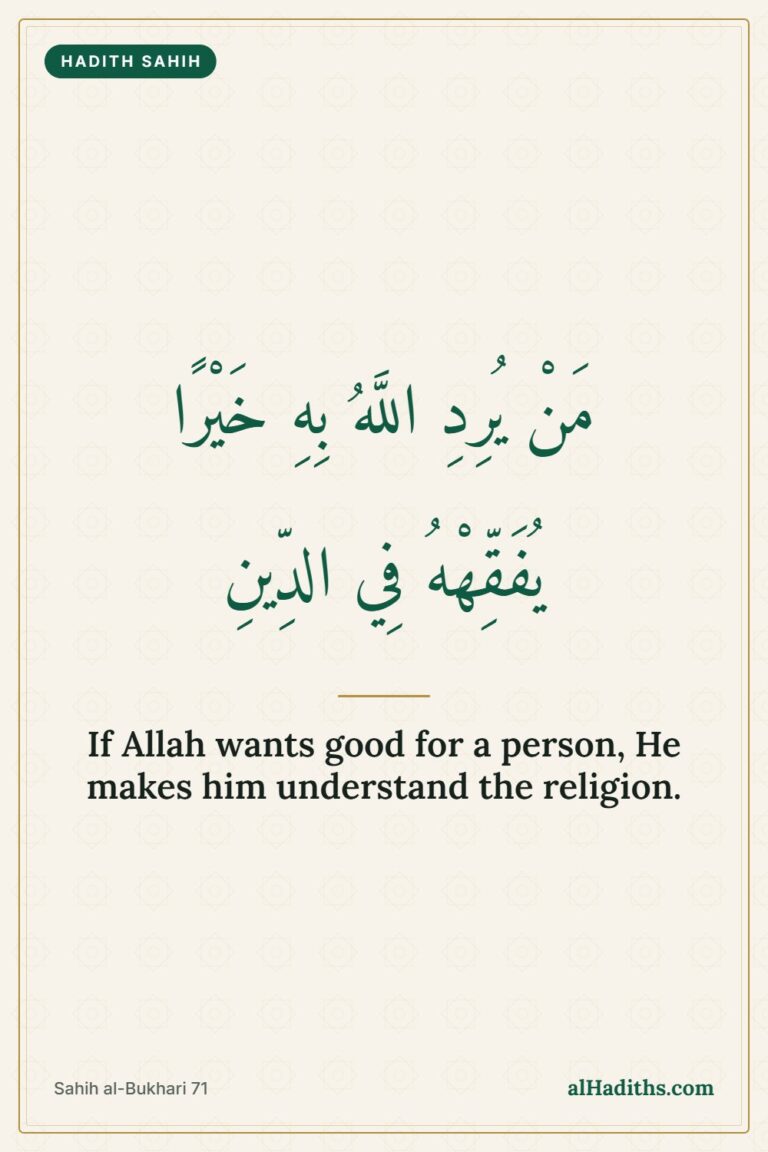
Muʿawiyah (may Allah be pleased with him) said in a sermon that he heard the Prophet ﷺ say:
مَنْ يُرِدِ اللَّهُ بِهِ خَيْرًا يُفَقِّهْهُ فِي الدِّينِ
“If Allah wants to do good to a person, He makes him comprehend the religion.”
Sahih al-Bukhari 71 · Narrated by Muʿawiyah · Translation adapted from Sunnah.com
This is the opening sentence of the hadith. HadeethEnc lists among its benefits that learning Islamic knowledge is highly valued and encouraged, and that understanding the religion is part of Allah’s goodwill toward a servant (HadeethEnc 5518). The wish to learn our religion properly, including checking whether a famous line is really a hadith, is itself something to thank Allah for.
Try this: when you learn something new about the religion this week, say alhamdulillah for it, then act on it once.
4. Where to begin: the Quran
ʿUthman ibn ʿAffan (may Allah be pleased with him) narrated that the Prophet ﷺ said:
خَيْرُكُمْ مَنْ تَعَلَّمَ الْقُرْآنَ وَعَلَّمَهُ
“The best among you are those who learn the Qur’an and teach it.”
Sahih al-Bukhari 5027 · Narrated by ʿUthman ibn ʿAffan · Translation adapted from Sunnah.com
The hadith puts learning and teaching side by side. We do not have to cross the world to begin: the Book of Allah is already in our homes and on our phones. Knowledge that is learned and then shared keeps giving after us.
Try this: learn one verse with its meaning today, then teach it to one person in your home.
Bringing it together: seek knowledge with the right words
Allah taught His Messenger ﷺ a short dua for more knowledge:
فَتَعَـٰلَى ٱللَّهُ ٱلْمَلِكُ ٱلْحَقُّ ۗ وَلَا تَعْجَلْ بِٱلْقُرْءَانِ مِن قَبْلِ أَن يُقْضَىٰٓ إِلَيْكَ وَحْيُهُۥ ۖ وَقُل رَّبِّ زِدْنِى عِلْمًا
So high [above all] is Allāh, the Sovereign, the Truth. And, [O Muḥammad], do not hasten with [recitation of] the Qur’ān before its revelation is completed to you, and say, “My Lord, increase me in knowledge.”
Surah Taha 20:114 · Translation: Saheeh International, from Quran.com
Reflection: The China line became popular because its message feels right: knowledge is worth a long journey. The authentic hadith already say so, and they promise more than the slogan does: an easier path to Paradise, angels lowering their wings, and the inheritance of the prophets. Seeking knowledge also means checking what we pass on. Next time, quote Sahih Muslim 2699, and let the famous line go.
Questions people ask
Is “seek knowledge even in China” in Sahih al-Bukhari?
No. It is not in Sahih al-Bukhari, Sahih Muslim or the other four of the six books. It is found in later works such as al-Bayhaqi’s Shuʿab al-Iman, and scholars graded it from very weak to fabricated (Irsyad al-Hadith no. 18; IslamQA 13637).
Is “seeking knowledge is a duty upon every Muslim” authentic?
That sentence is on firmer ground. It is in Sunan Ibn Majah 224. Sunnah.com marks that chain as very weak (Darussalam), but notes that the sentence “Seeking knowledge is a duty upon every Muslim” is authentic through many sources, while the rest of that narration is not accepted. Shaykh al-Albani also graded the sentence Sahih (IslamQA 13637). The China wording is not part of it.
Why does it matter, if the meaning is good?
Because a hadith is a claim about what the Prophet ﷺ said. He warned: “Whoever tells a lie against me (intentionally), then (surely) let him occupy his seat in Hell-fire” (Sahih al-Bukhari 110). Someone who shared the China line in good faith did not lie on purpose, but once we know its grading, we should stop presenting it as a hadith.
Can I still use the phrase as a saying?
The verdicts above are about attributing the line to the Prophet ﷺ. If it is repeated at all, it should be as a common saying about the value of learning, never as a hadith. For a ruling on your own situation, ask a qualified local scholar. When you want a hadith, the authentic ones above say it better.
Is there a hadith that seeking knowledge is “in the path of Allah”?
A narration with that wording, “Whoever goes out seeking knowledge is in Allah’s cause until he returns”, is in Jami‘ at-Tirmidhi 2647, graded Daʿif (Darussalam), so we do not use it. The authentic hadith is that whoever treads a path in search of knowledge, Allah makes easy for him a path to Paradise (Sahih Muslim 2699).
Key lessons
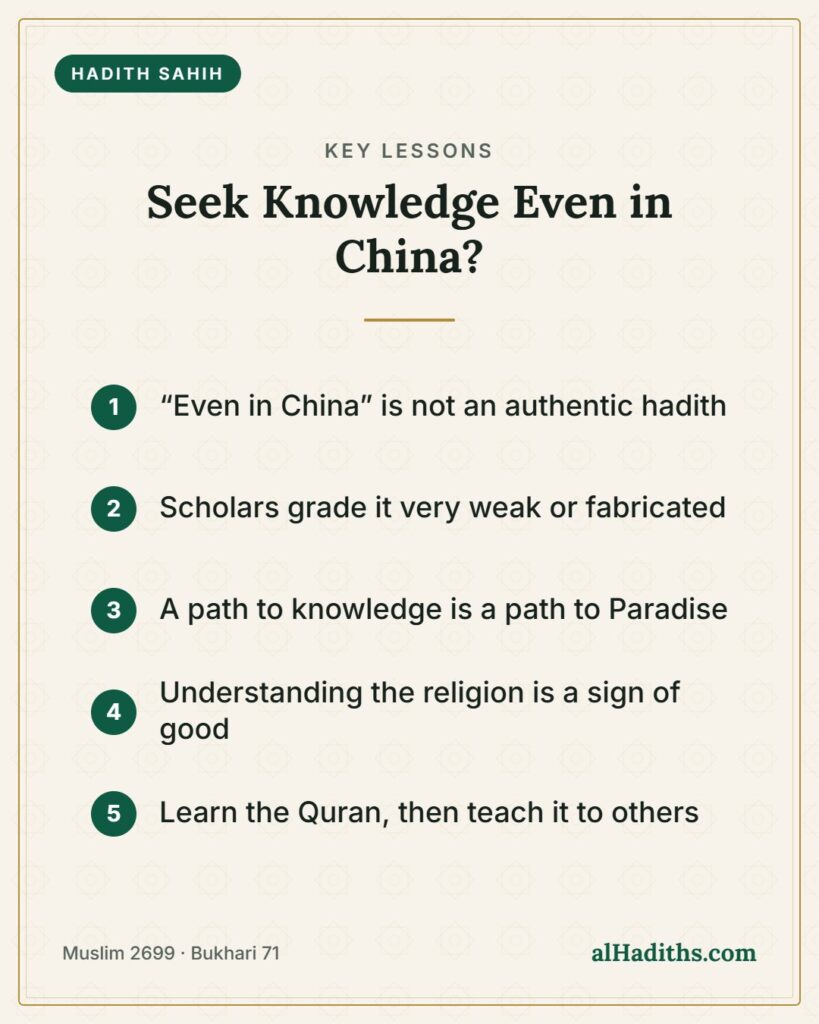
- “Seek knowledge even in China” is not an authentic hadith; scholars grade it from very weak to fabricated.
- The authentic hadith: whoever treads a path in search of knowledge, Allah makes easy for him a path to Paradise (Sahih Muslim 2699).
- A man once traveled from Madinah to Damascus for a single hadith; angels lower their wings for the seeker of knowledge.
- Understanding the religion is a sign that Allah wants good for a person.
- Start with the Quran: learn it, then teach it.
May Allah increase us in knowledge that benefits, make it easy for us to act on it, and open for us, through it, a path to Paradise.
Save this to Pinterest so you can quote an authentic hadith about seeking knowledge.
Share the reward. Send this article to someone who needs it today — teaching a hadith or dua can become a lasting good deed for you, in shaa Allah.