Your Mother, Your Mother, Your Mother: The Hadith About Mother
A man once asked the Prophet ﷺ a simple question: of all people, who deserves my best treatment? The answer came three times before anyone else was named: your mother. This is the best-known hadith about mother in Islam, recorded by both al-Bukhari and Muslim. Here is the hadith, why the mother is mentioned three times, and what honoring her looks like today, whether she is still with us or has passed away.
At a glance
- Source: Sahih al-Bukhari 5971 and Sahih Muslim 2548b
- Narrated by: Abu Hurairah (may Allah be pleased with him)
- Grade: Sahih (al-Bukhari and Muslim)
- Topic: The rights of the mother and dutifulness to parents
- Put it into practice: Call or visit your mother today; if she has passed away, make dua for her
The hadith about mother
Abu Hurairah (may Allah be pleased with him) narrated that a man came to the Messenger of Allah ﷺ and said, “O Allah’s Messenger! Who is more entitled to be treated with the best companionship by me?” The Prophet ﷺ said, “Your mother.” The man said, “Who is next?” He said, “Your mother.” The man asked, “Who is next?” He said, “Your mother.” The man asked a fourth time, “Who is next?” He said, “Your father.” (Sahih al-Bukhari 5971, translation adapted from Sunnah.com)
In Sahih Muslim, the Prophet ﷺ gave the whole answer at once:
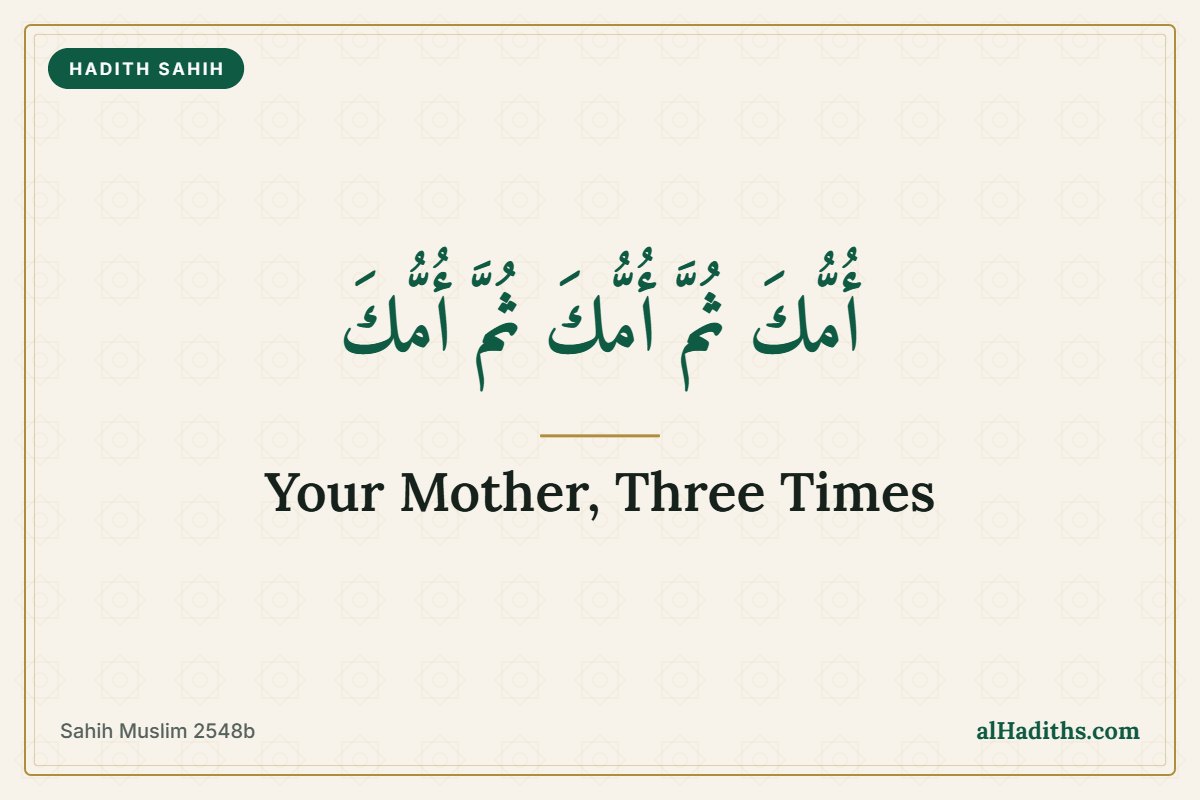
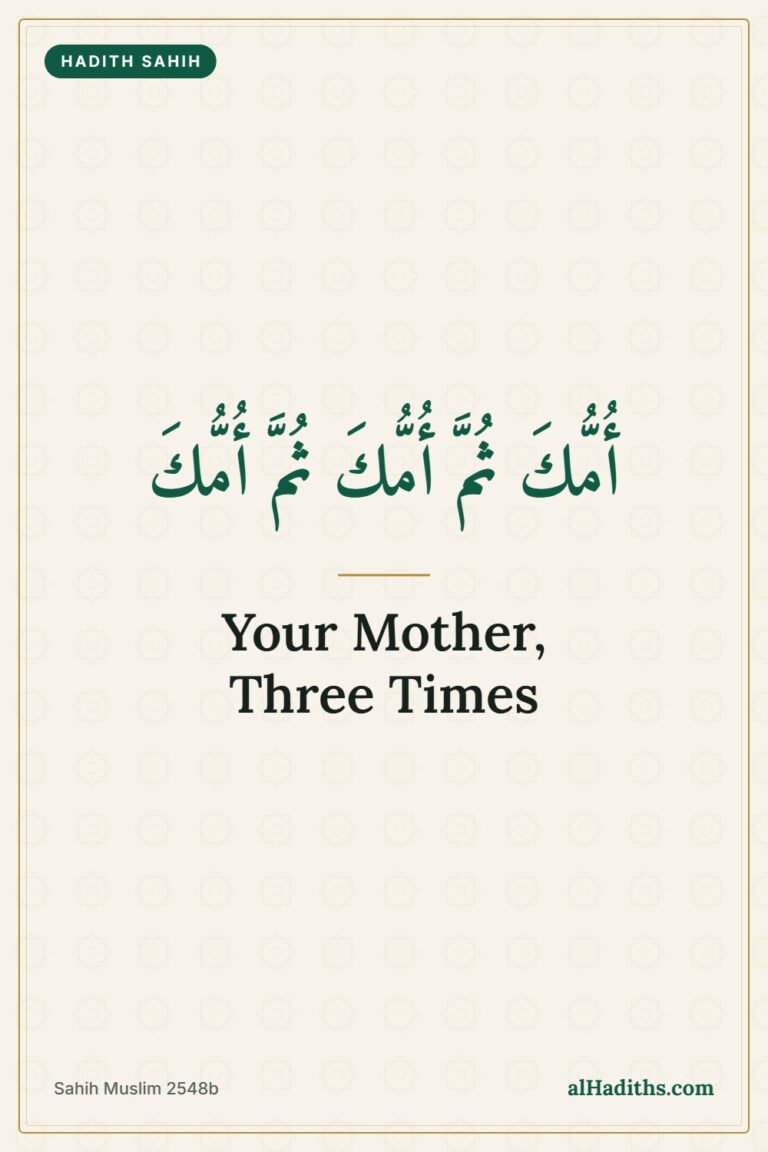
أُمُّكَ ثُمَّ أُمُّكَ ثُمَّ أُمُّكَ ثُمَّ أَبُوكَ ثُمَّ أَدْنَاكَ أَدْنَاكَ
“Your mother, again your mother, again your mother, then your father, then your nearest relatives according to the order (of nearness).”
Sahih Muslim 2548b · Narrated by Abu Hurairah · Translation from Sunnah.com
Why “your mother” three times?
The Encyclopedia of Translated Prophetic Hadiths (HadeethEnc) explains that both parents have a right to good companionship, but the mother’s right comes far ahead, which is why the father is only mentioned after she is named three times. She carries the child for months with growing weakness, gives birth in great pain, and nurses and cares for the child through sleepless nights. The Quran points to exactly these hardships:
وَوَصَّيْنَا ٱلْإِنسَـٰنَ بِوَٰلِدَيْهِ إِحْسَـٰنًا ۖ حَمَلَتْهُ أُمُّهُۥ كُرْهًا وَوَضَعَتْهُ كُرْهًا ۖ وَحَمْلُهُۥ وَفِصَـٰلُهُۥ ثَلَـٰثُونَ شَهْرًا ۚ حَتَّىٰٓ إِذَا بَلَغَ أَشُدَّهُۥ وَبَلَغَ أَرْبَعِينَ سَنَةً قَالَ رَبِّ أَوْزِعْنِىٓ أَنْ أَشْكُرَ نِعْمَتَكَ ٱلَّتِىٓ أَنْعَمْتَ عَلَىَّ وَعَلَىٰ وَٰلِدَىَّ وَأَنْ أَعْمَلَ صَـٰلِحًا تَرْضَىٰهُ وَأَصْلِحْ لِى فِى ذُرِّيَّتِىٓ ۖ إِنِّى تُبْتُ إِلَيْكَ وَإِنِّى مِنَ ٱلْمُسْلِمِينَ
“And We have enjoined upon man, to his parents, good treatment. His mother carried him with hardship and gave birth to him with hardship, and his gestation and weaning [period] is thirty months. [He grows] until, when he reaches maturity and reaches [the age of] forty years, he says, ‘My Lord, enable me to be grateful for Your favor which You have bestowed upon me and upon my parents and to work righteousness of which You will approve and make righteous for me my offspring. Indeed, I have repented to You, and indeed, I am of the Muslims.'”
Surah al-Ahqaf 46:15 · Translation: Saheeh International, from Quran.com
The Office of the Mufti of the Federal Territories (Al-Kafi #1203) in Malaysia gives the same reasons. It quotes Imam an-Nawawi that the mother bears most of the hardship of raising a child, from pregnancy through feeding and upbringing, and Mulla ‘Ali al-Qari, who links the three mentions to three hardships: pregnancy, labor and nursing.
What good companionship looks like
HadeethEnc explains that good companionship with parents includes providing their food, drink, housing and clothing, especially when they are in need, and even raising their standard of living to match your own. It also means gentle words: the Quran forbids even a word of irritation toward parents in their old age (Quran 17:23). Being dutiful to parents is among the deeds most beloved to Allah, right after praying on time (Sahih al-Bukhari 5970).
Parents in old age: a door to Paradise
The Prophet ﷺ said three times, “Let him be humbled into dust.” He was asked who, and he said:
مَنْ أَدْرَكَ أَبَوَيْهِ عِنْدَ الْكِبَرِ أَحَدَهُمَا أَوْ كِلَيْهِمَا فَلَمْ يَدْخُلِ الْجَنَّةَ
“He who sees either of his parents during their old age or he sees both of them, but he does not enter Paradise.”
Sahih Muslim 2551a · Narrated by Abu Hurairah · Translation from Sunnah.com
Elderly parents are not a burden in this hadith; they are an opportunity. Serving them with patience is one of the clearest paths to Paradise a person will ever be given.
Reflection: the man asked “then who?” three times, and three times the answer did not change. Much of what a mother does is never seen: the nights awake, the worry, the meals no one thanks her for. This hadith makes sure it is not forgotten. Before we give our best time and patience to anyone else, she has the first claim on it.
How to put it into practice
The hadith does not give a routine, so these are suggestions:
- Call or visit her regularly, and give her your full attention when you do.
- Look after her needs: food, health, housing and comfort, especially as she grows older.
- Speak gently, even when you disagree, and never raise your voice at her.
- Put her first when your time and money are stretched; then your father, then your nearest relatives.
- If she has passed away, keep making dua for her and give charity on her behalf. A man told the Prophet ﷺ that his mother had died suddenly and asked if he could give charity for her; he said, “Yes! Give in charity on her behalf” (Sahih al-Bukhari 2760). See giving sadaqah on behalf of the deceased.
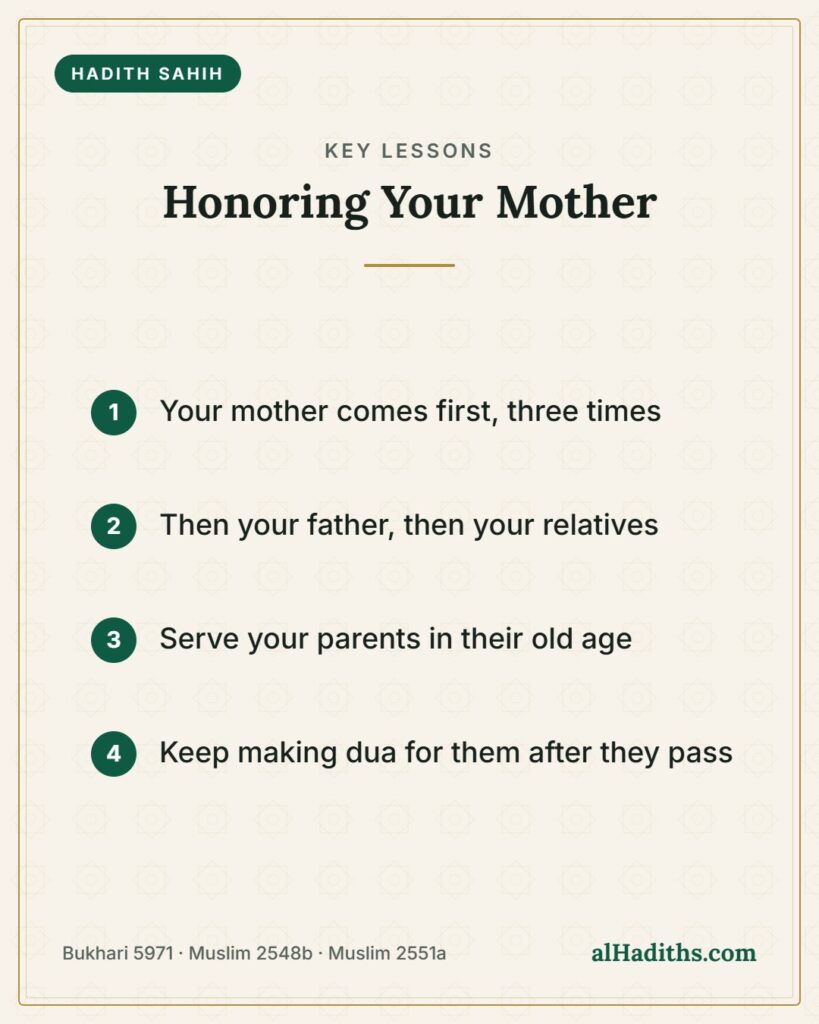
Key lessons
- The mother is named three times before the father.
- Then comes the father, then the nearest relatives in order.
- Her right comes from the hardship of pregnancy, birth and nursing.
- Serving parents in old age is a path to Paradise.
- Our duty to her continues after she passes away, through dua and charity.
Questions people ask
Why did the Prophet ﷺ say “your mother” three times?
To show that the mother’s right to good treatment comes well ahead of the father’s. Scholars link the three mentions to the hardships she alone bears: pregnancy, giving birth and nursing (Encyclopedia of Translated Prophetic Hadiths (HadeethEnc); Office of the Mufti of the Federal Territories (Al-Kafi #1203)).
Is the hadith “your mother, your mother, your mother” authentic?
Yes. It is in Sahih al-Bukhari 5971 and Sahih Muslim 2548b, narrated by Abu Hurairah.
How can I honor my mother after she has passed away?
Make dua for her, and give charity on her behalf: the Prophet ﷺ told a man whose mother had died suddenly to give in charity for her (Sahih al-Bukhari 2760). A righteous child who prays for a parent is also among the deeds that continue after death; see 3 deeds that continue after death.
A personal request
alHadiths.com is a sadaqah jariyah for my late mother. If this article has benefited you, please make a short dua of forgiveness for her. Here is one the Prophet ﷺ made for a deceased person. It is short enough to memorize, and you can use it for your own loved ones too:
اللَّهُمَّ اغْفِرْ لَهُ وَارْحَمْهُ وَعَافِهِ وَاعْفُ عَنْهُ
Allahumma-ghfir lahu warhamhu wa ‘afihi wa’fu ‘anhu
“O Allah! Forgive him, have mercy upon him, give him peace and absolve him.”
Sahih Muslim 963a · Narrated by ‘Awf ibn Malik · Translation adapted from Sunnah.com
The Prophet ﷺ said this in the funeral prayer for a man. When making it for a woman, people change the pronoun: Allahumma-ghfir laha warhamha wa ‘afiha wa’fu ‘anha. This is an adaptation of the wording, not stated in the hadith. The full dua is in the janazah dua.
Save this to Pinterest so you can come back to this hadith.
Share the reward. Send this article to someone who needs it today — teaching a hadith or dua can become a lasting good deed for you, in shaa Allah.