Dua for the Deceased in the Funeral Prayer (Janazah Dua)
The imam says Allahu akbar, the rows fall silent, and many of us are not sure what to say for the person in front of us. The Prophet ﷺ left us the words. This article covers the janazah dua he made for the deceased, two shorter duas you can start with, and where each one comes in the funeral prayer.
At a glance
- Source: Sahih Muslim 963a; also Sunan Ibn Majah 1498 and Sunan Ibn Majah 1499
- Narrated by: ‘Auf bin Malik (may Allah be pleased with him)
- Grade: Sahih Muslim; the two shorter duas: Hasan (Darussalam), Sahih (al-Albani) in Abu Dawud
- Topic: Dua, the funeral prayer (salat al-janazah)
- Practise it: Learn the first line now, then add a little more each week
The janazah dua from Sahih Muslim
Jubair bin Nufair said he heard ‘Auf bin Malik (may Allah be pleased with him) say that the Prophet ﷺ prayed over a deceased person, and ‘Auf memorised his dua:
اللَّهُمَّ اغْفِرْ لَهُ وَارْحَمْهُ وَعَافِهِ وَاعْفُ عَنْهُ وَأَكْرِمْ نُزُلَهُ وَوَسِّعْ مُدْخَلَهُ وَاغْسِلْهُ بِالْمَاءِ وَالثَّلْجِ وَالْبَرَدِ وَنَقِّهِ مِنَ الْخَطَايَا كَمَا نَقَّيْتَ الثَّوْبَ الأَبْيَضَ مِنَ الدَّنَسِ وَأَبْدِلْهُ دَارًا خَيْرًا مِنْ دَارِهِ وَأَهْلاً خَيْرًا مِنْ أَهْلِهِ وَزَوْجًا خَيْرًا مِنْ زَوْجِهِ وَأَدْخِلْهُ الْجَنَّةَ وَأَعِذْهُ مِنْ عَذَابِ الْقَبْرِ أَوْ مِنْ عَذَابِ النَّارِ
Allāhummaghfir lahu warḥamhu, wa ‘āfihi wa’fu ‘anhu, wa akrim nuzulahu, wa wassi’ mudkhalahu, waghsilhu bil-mā’i wath-thalji wal-barad, wa naqqihi minal-khaṭāyā kamā naqqaytath-thawbal-abyaḍa minad-danas, wa abdilhu dāran khayran min dārihi, wa ahlan khayran min ahlihi, wa zawjan khayran min zawjihi, wa adkhilhul-jannah, wa a’idhhu min ‘adhābil-qabri aw min ‘adhābin-nār
“O Allah! forgive him, have mercy upon him, give him peace and absolve him. Receive him with honour and make his grave spacious; wash him with water, snow and hail. Cleanse him from faults as Thou wouldst cleanse a white garment from impurity. Requite him with an abode more excellent than his abode, with a family better than his family, and with a mate better than his mate. Admit him to the Garden, and protect him from the torment of the grave and the torment of the Fire.”
Sahih Muslim 963a · Narrated by ‘Auf bin Malik
After hearing it, ‘Auf said: “I earnestly desired that I were this dead body.” The dua was so complete that he wished it had been said for him.
What the words of this dua mean
Here is the dua in parts. The meanings follow the Sunnah.com translation above.
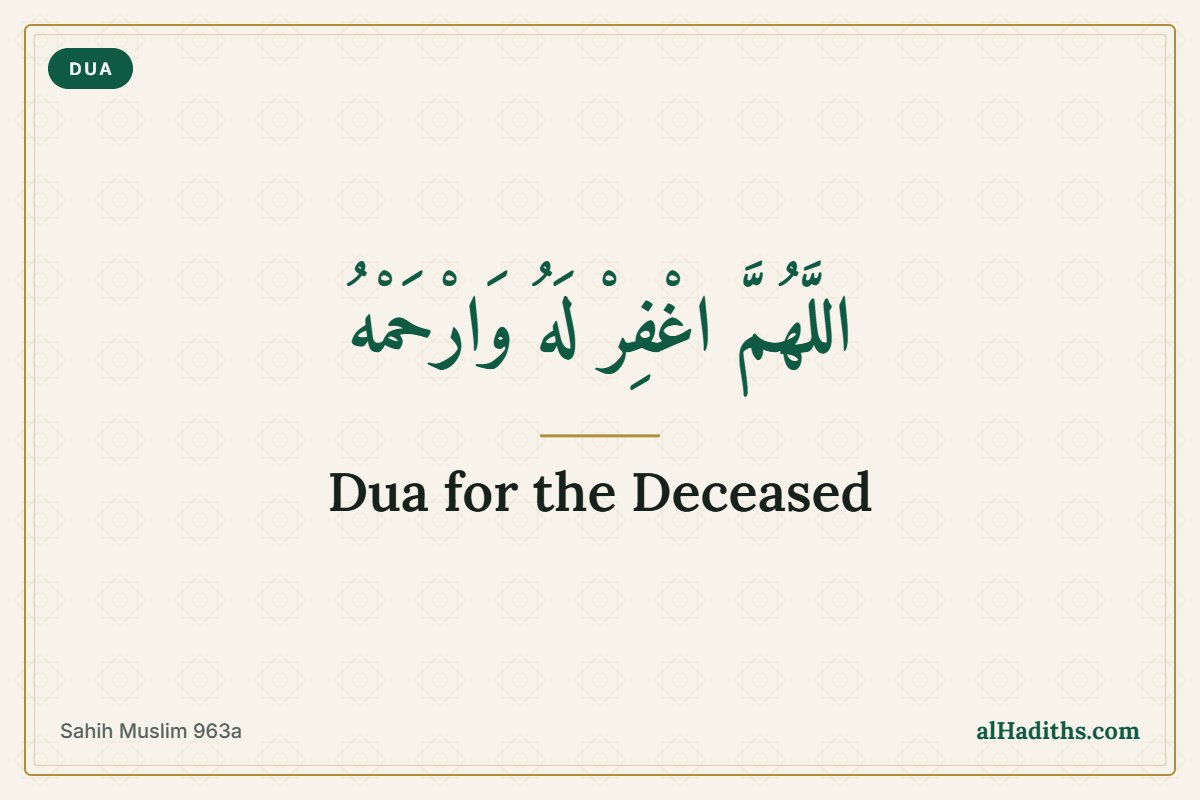
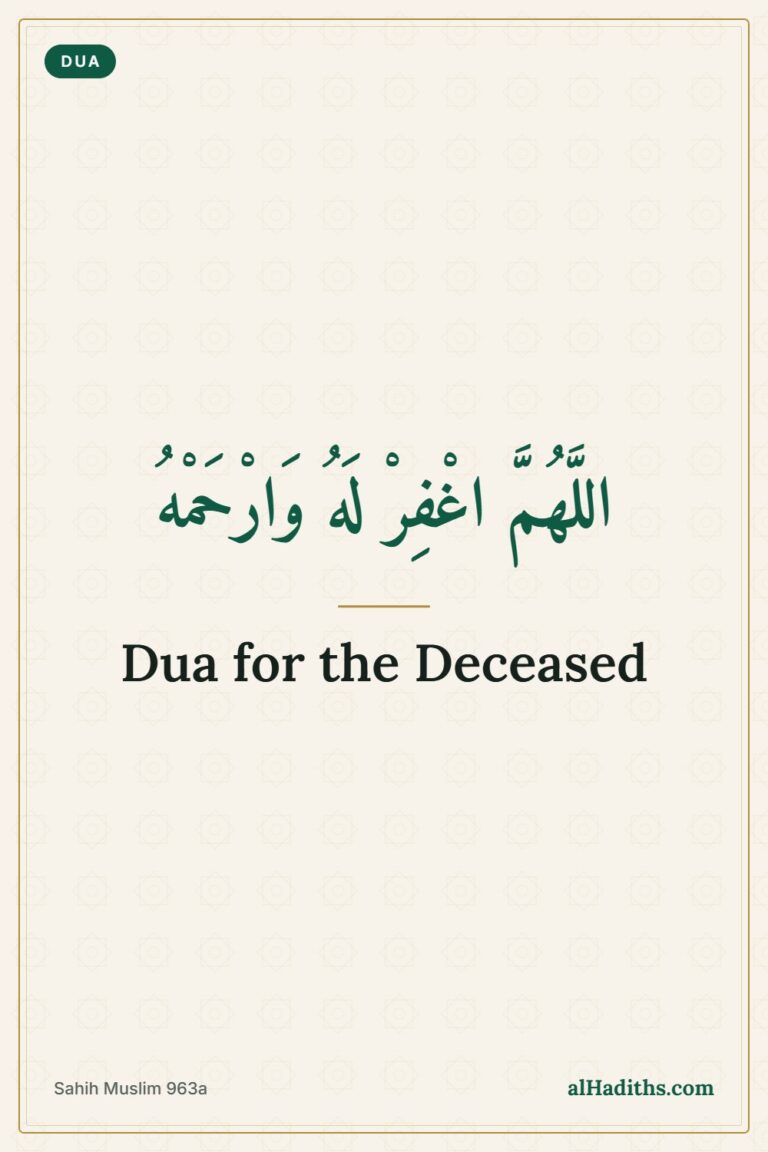
- Allāhummaghfir lahu warḥamhu (اللَّهُمَّ اغْفِرْ لَهُ وَارْحَمْهُ): “O Allah, forgive him and have mercy upon him.” If you only learn one line, learn this one.
- Wa ‘āfihi wa’fu ‘anhu (وَعَافِهِ وَاعْفُ عَنْهُ): “give him peace and absolve him.”
- Wa akrim nuzulahu wa wassi’ mudkhalahu (وَأَكْرِمْ نُزُلَهُ وَوَسِّعْ مُدْخَلَهُ): “receive him with honour and make his grave spacious.” We ask Allah to make his arrival honourable and his resting place wide.
- Waghsilhu bil-mā’i wath-thalji wal-barad (وَاغْسِلْهُ بِالْمَاءِ وَالثَّلْجِ وَالْبَرَدِ): “wash him with water, snow and hail,” and cleanse him of his faults the way a white garment is cleaned of dirt.
- Wa abdilhu dāran khayran min dārihi (وَأَبْدِلْهُ دَارًا خَيْرًا مِنْ دَارِهِ): “give him an abode better than his abode,” and a better family and a better spouse.
- Wa adkhilhul-jannah (وَأَدْخِلْهُ الْجَنَّةَ): “admit him to the Garden,” and protect him from the torment of the grave and of the Fire. In the Arabic, the last part reads aw min ‘adhābin-nār (“or from the torment of the Fire”), which the English renders as “and”.
Reflection: ‘Auf (may Allah be pleased with him) wished he were the one on the bier. One day each of us will be the one in front of the rows, and others will stand and ask Allah to forgive us. The duas we learn and say for others now are the same duas we will hope to receive then.
Where the dua comes in the funeral prayer
The funeral prayer is said standing, with four takbirs and no ruku’ or sujud. In the way it is commonly taught:
- First takbir: recite al-Fatihah quietly. Ibn ‘Abbas (may Allah be pleased with him) recited it at a funeral and said it is the Sunnah (Sahih al-Bukhari 1335; Sunan an-Nasa’i 1989).
- Second takbir: send salawat on the Prophet ﷺ. Many people use the salawat Ibrahimiyyah they already say in the tashahhud.
- Third takbir: make dua for the deceased. This is where the duas in this article are said.
- Fourth takbir: then the salam. Abu Umamah (may Allah be pleased with him) described the Sunnah as reciting al-Fatihah quietly after the first takbir, then three more takbirs, then the taslim after the last one (Sunan an-Nasa’i 1989).
The details differ a little between the madhhabs. Follow your imam, and ask a qualified local scholar if you are unsure.
Two shorter duas from the Sunnah
If the long dua feels like a lot, start with one of these. Both are also from the Prophet’s ﷺ funeral prayers.
For our living and our dead
اللَّهُمَّ اغْفِرْ لِحَيِّنَا وَمَيِّتِنَا وَشَاهِدِنَا وَغَائِبِنَا وَصَغِيرِنَا وَكَبِيرِنَا وَذَكَرِنَا وَأُنْثَانَا اللَّهُمَّ مَنْ أَحْيَيْتَهُ مِنَّا فَأَحْيِهِ عَلَى الإِسْلاَمِ وَمَنْ تَوَفَّيْتَهُ مِنَّا فَتَوَفَّهُ عَلَى الإِيمَانِ اللَّهُمَّ لاَ تَحْرِمْنَا أَجْرَهُ وَلاَ تُضِلَّنَا بَعْدَهُ
Allāhummaghfir li-ḥayyinā wa mayyitinā, wa shāhidinā wa ghā’ibinā, wa ṣaghīrinā wa kabīrinā, wa dhakarinā wa unthānā. Allāhumma man aḥyaytahu minnā fa-aḥyihi ‘alal-Islām, wa man tawaffaytahu minnā fa-tawaffahu ‘alal-īmān. Allāhumma lā taḥrimnā ajrahu wa lā tuḍillanā ba’dah
“O Allah, forgive our living and our dead, those who are present and those who are absent, our young and our old, our males and our females. O Allah, whomever of us You cause to live, let him live in Islam, and whomever of us You cause to die, let him die in (a state of) faith. O Allah, do not deprive us of his reward, and do not let us go astray after him.”
Sunan Ibn Majah 1498 · Hasan (Darussalam) · Narrated by Abu Hurairah
Abu Dawud narrates it too, graded Sahih by al-Albani, with “Islam” and “iman” in the opposite order (Sunan Abi Dawud 3201). This dua is generous: it includes everyone, the living and the dead, young and old.
“So-and-so, son of so-and-so”
اللَّهُمَّ إِنَّ فُلاَنَ بْنَ فُلاَنٍ فِي ذِمَّتِكَ وَحَبْلِ جِوَارِكَ فَقِهِ مِنْ فِتْنَةِ الْقَبْرِ وَعَذَابِ النَّارِ وَأَنْتَ أَهْلُ الْوَفَاءِ وَالْحَقِّ فَاغْفِرْ لَهُ وَارْحَمْهُ إِنَّكَ أَنْتَ الْغَفُورُ الرَّحِيمُ
Allāhumma inna fulānabna fulānin fī dhimmatika wa ḥabli jiwārika, fa-qihi min fitnatil-qabri wa ‘adhābin-nār, wa anta ahlul-wafā’i wal-ḥaqq, faghfir lahu warḥamhu, innaka antal-Ghafūrur-Raḥīm
“O Allah, so-and-so the son of so-and-so is in Your care and under Your protection. Protect him from the trial of the grave and the torment of the Fire, for You are the One Who keeps the promise and You are the Truth. Forgive him and have mercy on him, for You are the Oft-Forgiving, Most Merciful.”
Sunan Ibn Majah 1499 · Hasan (Darussalam) · Narrated by Wathilah bin al-Asqa’ · Translation adapted from Sunnah.com
In place of fulānabna fulān (“so-and-so, son of so-and-so”), the name of the deceased is said. Abu Dawud also narrates it, graded Sahih by al-Albani (Sunan Abi Dawud 3202).
How to practise the janazah dua
- Make it sincere. The Prophet ﷺ said: “When you pray over the dead, make a sincere supplication for him” (Sunan Abi Dawud 3199, Hasan, al-Albani).
- Learn it in stages. Start with Allāhummaghfir lahu warḥamhu, then add one line at a time until you know the whole dua from Sahih Muslim.
- Keep it on your phone. Save the pin below so you can revise it on the way to a funeral.
- Attend funerals when you can. Each one is a chance to pray for a fellow Muslim, and a reminder for our own hearts.
- Keep praying after the funeral. A pious child who prays for a parent is one of the three things whose benefit continues after death (Sahih Muslim 1631).
Key lessons
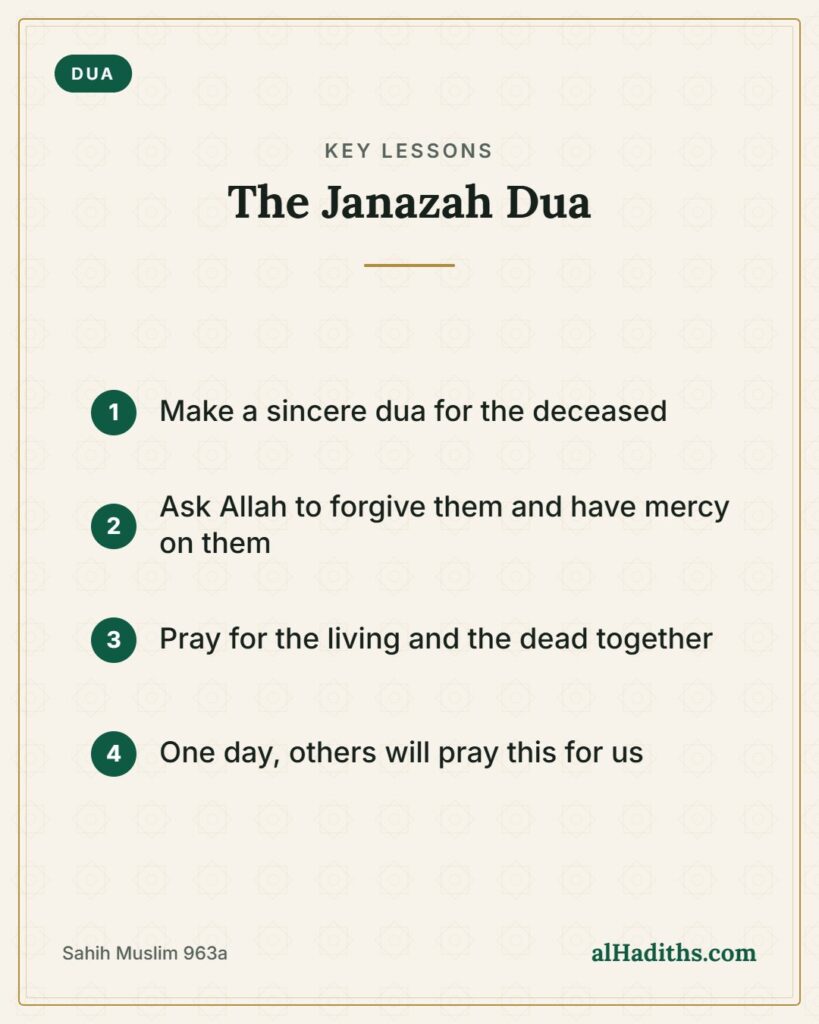
- The Prophet ﷺ made a long, complete dua for the deceased in the funeral prayer (Sahih Muslim 963a).
- It asks for forgiveness, mercy, a spacious grave, cleansing from sins, a better home and Jannah.
- Shorter duas from the Sunnah pray for the living and the dead together (Sunan Ibn Majah 1498, 1499).
- The dua should be sincere (Sunan Abi Dawud 3199), and making dua for our parents continues after they are gone (Sahih Muslim 1631).
Questions people ask
How do I say the janazah dua for a woman?
The wording in Sahih Muslim 963a uses “him” (lahu, warḥamhu) because the Prophet ﷺ said it over a man. Many people change the pronouns for a woman, for example Allāhummaghfir lahā warḥamhā. This is an adaptation and is not stated in the hadith itself, so if you want certainty, please ask a qualified local scholar.
What if I have not memorised the dua yet?
The Prophet ﷺ said: “When you pray over the dead, make a sincere supplication for him” (Sunan Abi Dawud 3199). Start with a short line such as Allāhummaghfir lahu warḥamhu (O Allah, forgive him and have mercy on him), or one of the shorter duas in this article. Scholars differ on making dua in other languages inside the prayer, so ask a local scholar about that.
After which takbir is the dua for the deceased said?
In the way the prayer is commonly taught, it comes after the third takbir: al-Fatihah after the first, salawat on the Prophet ﷺ after the second, and the dua for the deceased after the third, followed by the fourth takbir and the salam.
Can I say this dua for my parents outside the funeral prayer?
These words come from the funeral prayer, but making dua for those who have passed away is not limited to it. The Prophet ﷺ said that a pious child who prays for a parent is one of the three things whose benefit continues after death (Sahih Muslim 1631).
A small request from me. I started alHadiths.com as a sadaqah jariyah for my late mother. If this article helped you learn the janazah dua, please say a short dua for her too: Allāhummaghfir lahā warḥamhā, “O Allah, forgive her and have mercy on her.” And may Allah forgive and have mercy on every parent we have lost.
One thing for today: memorise Allāhummaghfir lahu warḥamhu, so the words are ready the next time you stand in the rows of a janazah.
Save this to Pinterest so you can learn it before the next janazah you attend
Share the reward. Send this article to someone who needs it today — teaching a hadith or dua can become a lasting good deed for you, in shaa Allah.