Paradise Lies at the Feet of Your Mother: Is It a Hadith?
Contents
“Paradise lies at the feet of your mother” appears on Mother’s Day cards, on posters, and in almost every talk about parents. It is usually quoted as a hadith. So is it one? The short answer: the meaning is authentic, but the famous wording is not. Below is where the popular line comes from, how it is graded, and the Sahih hadith that says the same thing in the Prophet’s own words ﷺ.
At a glance
- Popular wording: “Paradise lies at the feet of mothers”
- Status: Not established with this wording (weak chain)
- Authentic version: Sunan an-Nasa’i 3104, Sahih (Darussalam)
- Topic: Honoring your mother
- Do today: Call or visit your mother, or make dua for her if she has passed away
Is “Paradise lies at the feet of your mother” a hadith?
Not with those exact words. The sentence “Paradise lies at the feet of mothers” (al-jannatu taht aqdam al-ummahat) is reported through Anas ibn Malik in later collections, not in the six main books of hadith. Islamweb’s fatwa centre explains that it is not confirmed that the Prophet ﷺ said it with this wording; what is confirmed is the hadith in which he told a man to stay with his mother, because Paradise is beneath her feet (Islamweb fatwa 89177).
So the idea is true and taught by the Prophet ﷺ. What we should change is how we quote it.
Where the popular wording comes from
The short version is found in books such as Musnad al-Shihab by al-Qudaʿi and works by al-Khatib al-Baghdadi and ad-Dulabi, all through a chain to Anas (may Allah be pleased with him). A 2022 study that traced every source of this wording found it in six later books, all through Anas, and concluded that this chain is weak, while the version narrated by Muʿawiyah ibn Jahimah is authentic (Riwayah: Jurnal Studi Hadis, 2022).
Because it is weak, we give no Arabic card for it here. If grading terms are new to you, our guide to sahih, hasan and weak hadith explains them.
1. The authentic hadith: “Stay with her”
Muʿawiyah ibn Jahimah as-Sulami (may Allah be pleased with him) reports what happened when his father Jahimah came to the Prophet ﷺ for advice.
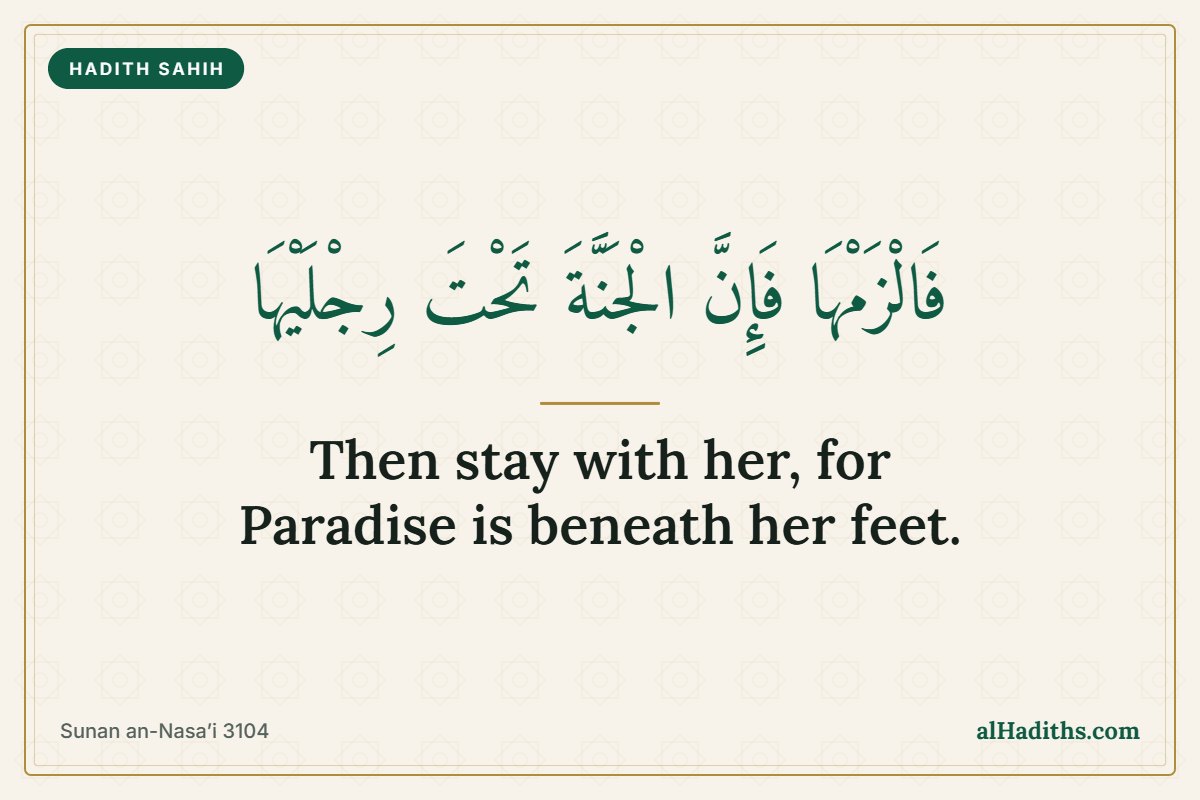
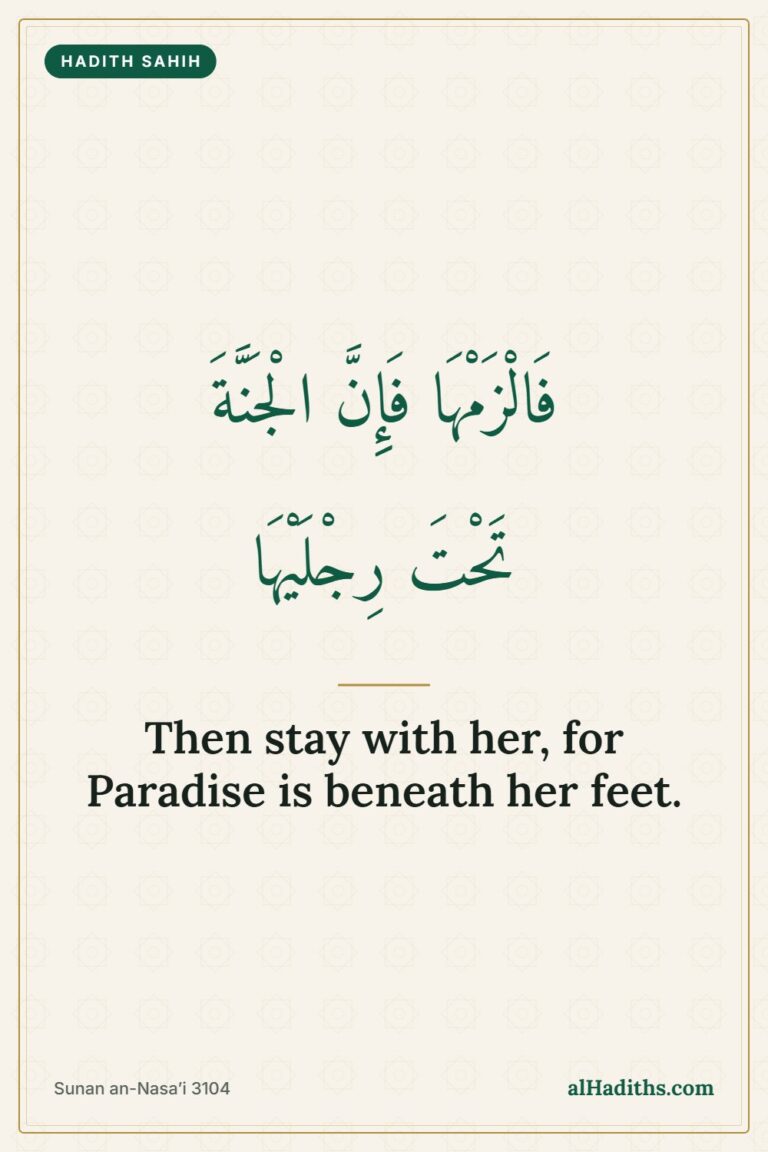
جَاهِمَةَ، جَاءَ إِلَى النَّبِيِّ صلى الله عليه وسلم فَقَالَ يَا رَسُولَ اللَّهِ أَرَدْتُ أَنْ أَغْزُوَ وَقَدْ جِئْتُ أَسْتَشِيرُكَ. فَقَالَ هَلْ لَكَ مِنْ أُمٍّ. قَالَ نَعَمْ. قَالَ فَالْزَمْهَا فَإِنَّ الْجَنَّةَ تَحْتَ رِجْلَيْهَا
Jahimah came to the Prophet ﷺ and said: “O Messenger of Allah! I want to go out and fight (in Jihad) and I have come to ask your advice.” He said: “Do you have a mother?” He said: “Yes.” He said: “Then stay with her, for Paradise is beneath her feet.”
Sunan an-Nasa’i 3104 · Sahih (Darussalam) · Narrated by Muʿawiyah ibn Jahimah · Translation adapted from Sunnah.com
Jahimah wanted to join a military expedition, one of the most praised deeds in Islam. The Prophet ﷺ first asked about his mother, then sent him back to her. Staying with her and serving her was his road to Paradise. Islamweb explains the phrase “Paradise is beneath her feet” as meaning that serving her and being dutiful to her brings you close to Paradise (Islamweb fatwa 89177).
Try this: before you sign up for a good deed far from home, ask yourself the Prophet’s question: “Do you have a mother?” Then see what she needs from you first.
2. Sent back three times: “Go back and honor her”
Ibn Majah records a fuller version of the same story, again from Muʿawiyah ibn Jahimah, in which the question is asked three times.
أَتَيْتُ رَسُولَ اللَّهِ صلى الله عليه وسلم فَقُلْتُ يَا رَسُولَ اللَّهِ إِنِّي كُنْتُ أَرَدْتُ الْجِهَادَ مَعَكَ أَبْتَغِي بِذَلِكَ وَجْهَ اللَّهِ وَالدَّارَ الآخِرَةَ. قَالَ وَيْحَكَ أَحَيَّةٌ أُمُّكَ. قُلْتُ نَعَمْ. قَالَ ارْجِعْ فَبَرَّهَا. ثُمَّ أَتَيْتُهُ مِنَ الْجَانِبِ الآخَرِ فَقُلْتُ يَا رَسُولَ اللَّهِ إِنِّي كُنْتُ أَرَدْتُ الْجِهَادَ مَعَكَ أَبْتَغِي بِذَلِكَ وَجْهَ اللَّهِ وَالدَّارَ الآخِرَةَ. قَالَ وَيْحَكَ أَحَيَّةٌ أُمُّكَ. قُلْتُ نَعَمْ يَا رَسُولَ اللَّهِ قَالَ فَارْجِعْ إِلَيْهَا فَبَرَّهَا. ثُمَّ أَتَيْتُهُ مِنْ أَمَامِهِ فَقُلْتُ يَا رَسُولَ اللَّهِ إِنِّي كُنْتُ أَرَدْتُ الْجِهَادَ مَعَكَ أَبْتَغِي بِذَلِكَ وَجْهَ اللَّهِ وَالدَّارَ الآخِرَةَ. قَالَ وَيْحَكَ أَحَيَّةٌ أُمُّكَ. قُلْتُ نَعَمْ يَا رَسُولَ اللَّهِ. قَالَ وَيْحَكَ الْزَمْ رِجْلَهَا فَثَمَّ الْجَنَّةُ
I came to the Messenger of Allah ﷺ and said: ‘O Messenger of Allah, I want to go for Jihad with you, seeking thereby the Face of Allah and the Hereafter.’ He said: ‘Woe to you! Is your mother still alive?’ I said: ‘Yes.’ He said: ‘Go back and honor her.’ Then I approached him from the other side and said: ‘O Messenger of Allah, I want to go for Jihad with you, seeking thereby the Face of Allah and the Hereafter.’ He said: ‘Woe to you! Is your mother still alive?’ I said: ‘Yes.’ He said: ‘Go back and honor her.’ Then I approached him from in front and said: ‘O Messenger of Allah, I want to go for Jihad with you, seeking thereby the Face of Allah and the Hereafter.’ He said: ‘Woe to you! Is your mother still alive?’ I said: ‘Yes.’ He said: ‘Go back and serve her, for there is Paradise.’
Sunan Ibn Majah 2781 · Sahih (Darussalam) · Narrated by Muʿawiyah ibn Jahimah · Translation adapted from Sunnah.com
Three times the man asked, from three directions, and three times the answer was the same. His intention was good: he wanted “the Face of Allah and the Hereafter.” The Prophet ﷺ showed him that the same reward was waiting at home. In the Arabic, the last line tells him to hold on to her foot, “for there is Paradise.”
Try this: do one thing for your mother this week that she did not ask for: a meal, a lift, an hour of your time without your phone.
3. Parents: the middle gate of Paradise
Abu ad-Dardaʾ (may Allah be pleased with him) was asked for advice by a man whose mother had told him to do something hard. He answered with a hadith he heard from the Prophet ﷺ.
الْوَالِدُ أَوْسَطُ أَبْوَابِ الْجَنَّةِ فَإِنْ شِئْتَ فَأَضِعْ ذَلِكَ الْبَابَ أَوِ احْفَظْهُ
The father is the middle gate to Paradise. So if you wish, then neglect that door, or protect it.
Jami‘ at-Tirmidhi 1900 · Hasan (Darussalam) · Narrated by Abu ad-Dardaʾ · Translation adapted from Sunnah.com
Sunnah.com translates it as “the father”, and the man’s question in this report was about his mother. Either way, the message for both parents is clear: honoring them is one of the main gates into Paradise, and each of us decides whether to guard that gate or lose it.
Try this: if your relationship with a parent is strained, take one small step to repair it today: a message, a visit, or a dua for them.
Bringing it together: honor her with the right words
Allah Himself reminds us what a mother carried for us:
وَوَصَّيْنَا ٱلْإِنسَـٰنَ بِوَٰلِدَيْهِ حَمَلَتْهُ أُمُّهُۥ وَهْنًا عَلَىٰ وَهْنٍ وَفِصَـٰلُهُۥ فِى عَامَيْنِ أَنِ ٱشْكُرْ لِى وَلِوَٰلِدَيْكَ إِلَىَّ ٱلْمَصِيرُ
And We have enjoined upon man [care] for his parents. His mother carried him, [increasing her] in weakness upon weakness, and his weaning is in two years. Be grateful to Me and to your parents; to Me is the [final] destination.
Surah Luqman 31:14 · Translation: Saheeh International, from Quran.com
Reflection: We do not need a weak line to honor our mothers. The authentic hadith says more than the poster does: a man ready to fight for Allah was sent home three times, because his mother was his Paradise. Next time you write a card or give a talk, quote it as the Prophet ﷺ said it: “Stay with her, for Paradise is beneath her feet” (Sunan an-Nasa’i 3104). Then live it.
Questions people ask
Is “Paradise lies at the feet of mothers” in Sahih al-Bukhari?
No. It is not in Sahih al-Bukhari or Sahih Muslim. The authentic version, “Stay with her, for Paradise is beneath her feet”, is in Sunan an-Nasa’i 3104 and Sunan Ibn Majah 2781, both graded Sahih (Darussalam).
Can I still say “Paradise lies at the feet of mothers”?
Islamweb says there is no harm in using the phrase as a title or saying, as long as you do not present it as the Prophet’s exact words (Islamweb fatwa 89177). When you quote a hadith, use the authentic wording from an-Nasa’i.
What does “Paradise is beneath her feet” mean?
It does not describe a place. Islamweb explains it as serving your mother and being dutiful to her bringing you close to Paradise (Islamweb fatwa 89177). In the hadith, it was the reason the Prophet ﷺ sent a man home to his mother instead of to battle.
Is there a hadith like this about fathers?
Yes. The Prophet ﷺ said the parent is “the middle gate to Paradise” (Jami‘ at-Tirmidhi 1900, Hasan, Darussalam). Our article on the hadith about mother explains why the mother is named three times before the father.
What can I do if my mother has passed away?
The Prophet ﷺ said that when a person dies, their deeds end except three, one of them a righteous child who prays for them (Sahih Muslim 1631). A popular hadith listing other ways to honor parents after death is graded Da’if (al-Albani) (Sunan Abi Dawud 5142). Making dua for her is the authentic way to keep honoring her.
Key lessons
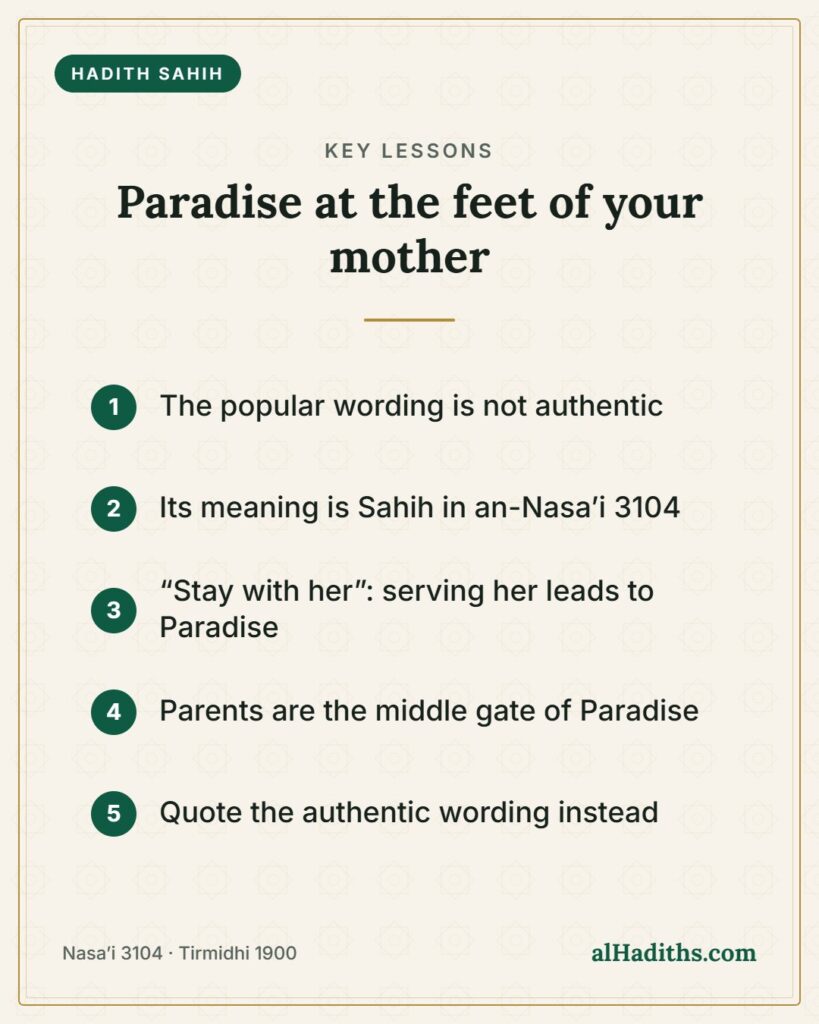
- “Paradise lies at the feet of mothers” is not authentic with this exact wording.
- Its meaning is authentic: “Stay with her, for Paradise is beneath her feet” (Sunan an-Nasa’i 3104).
- A man who wanted jihad was sent back three times to serve his mother instead.
- Parents are the middle gate of Paradise; we choose whether to guard it.
- Quote the authentic wording, and show it in how we treat our mothers.
Before you close this page, pause and make one dua for your mother, whether she is beside you or has already returned to Allah. Ask Allah to have mercy on her as she had mercy on you when you were small.
Save this to Pinterest so you can quote the authentic wording about mothers
Share the reward. Send this article to someone who needs it today — teaching a hadith or dua can become a lasting good deed for you, in shaa Allah.