Leave What Makes You Doubt: Hadith 11 of an-Nawawi
Most of us know the feeling: something does not sit right, and we are not sure whether it is fine or not. In just a few words, the Prophet ﷺ gave a rule for those moments: leave what makes you doubt for what does not make you doubt. He also explained why it works: truth brings calm, and falsehood brings unease.
At a glance
- Source: Jami’ at-Tirmidhi 2518
- Narrated by: Al-Hasan ibn ‘Ali (may Allah be pleased with him and his father)
- Grade: Sahih (Darussalam); at-Tirmidhi called it hasan sahih
- Topic: Leaving what is doubtful, and the peace that truth brings
- Put it into practice: When unsure, choose the option you are certain is good
The hadith
Abu al-Hawra’ as-Sa’di asked al-Hasan ibn ‘Ali, the Prophet’s ﷺ grandson, what he had memorized from the Messenger of Allah ﷺ. He said he memorized:
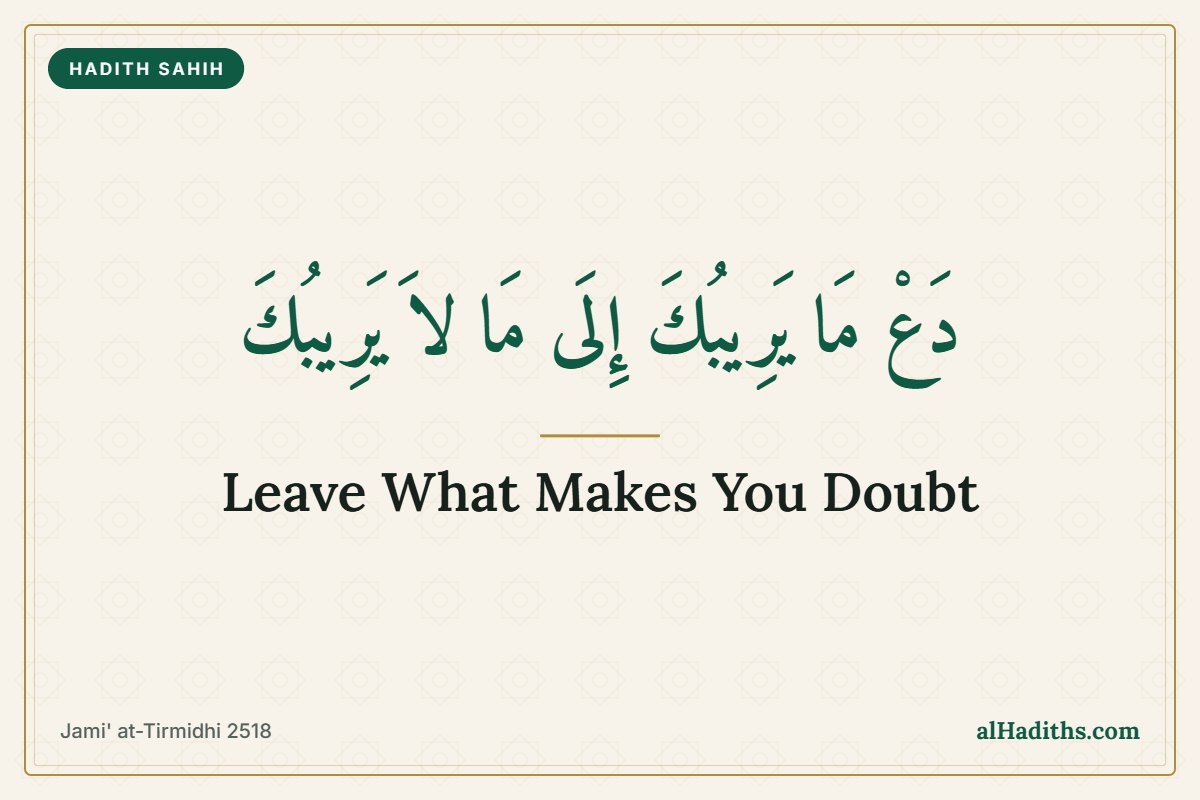
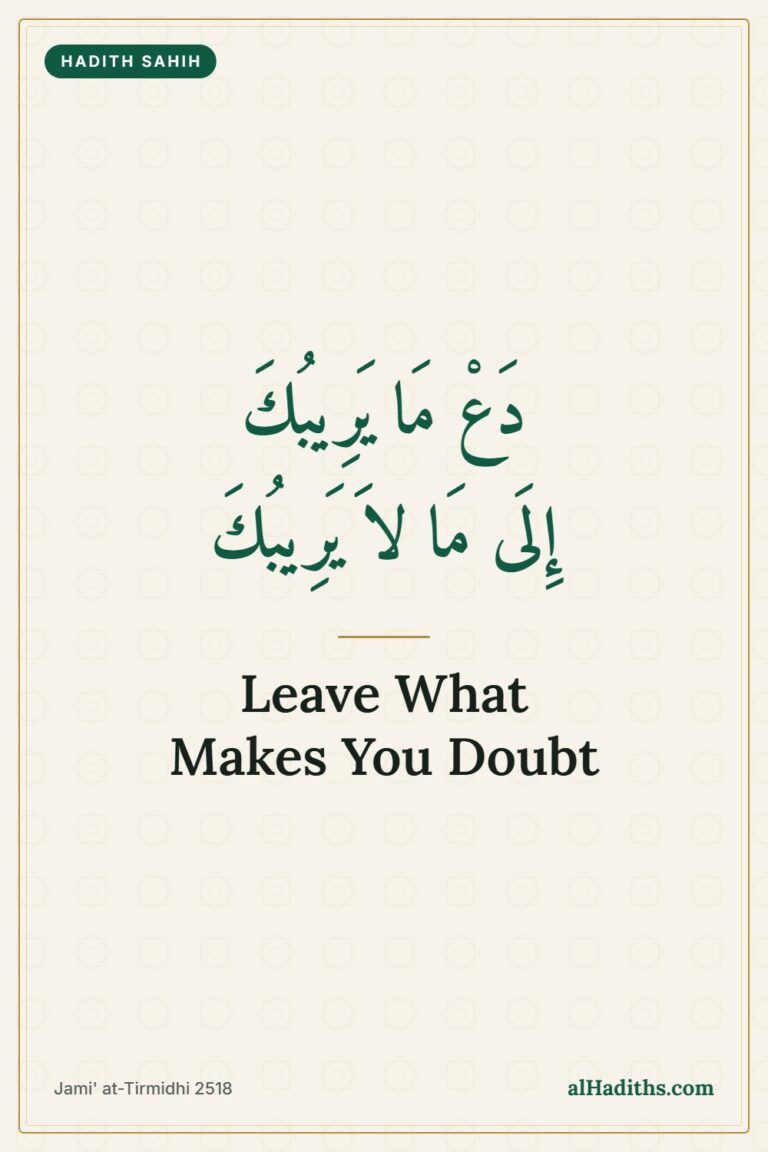
دَعْ مَا يَرِيبُكَ إِلَى مَا لاَ يَرِيبُكَ فَإِنَّ الصِّدْقَ طُمَأْنِينَةٌ وَإِنَّ الْكَذِبَ رِيبَةٌ
“Leave what makes you in doubt for what does not make you in doubt. The truth brings tranquility while falsehood sows doubt.”
Jami’ at-Tirmidhi 2518 · Narrated by al-Hasan ibn ‘Ali · Grade: Sahih (Darussalam) · Translation from Sunnah.com
At-Tirmidhi said it is hasan sahih, and Imam an-Nawawi placed its first sentence as Hadith 11 of an-Nawawi’s 40 Hadith. At-Tirmidhi recorded it in his chapters on al-wara’, being careful in matters of religion.
What “leave what makes you doubt” means
The Encyclopedia of Translated Prophetic Hadiths (HadeethEnc) explains that the Prophet ﷺ commanded us to leave whatever words or deeds we are unsure about, and to choose instead “things whose goodness and lawfulness he is certain about”. Those bring tranquility and comfort to the heart, while what is doubtful “sows anxiety and confusion in the heart.”
Among the benefits it lists:
- A Muslim should build his affairs on certainty and leave what is doubtful.
- If you are seeking tranquility and comfort, abandon what is doubtful and leave it aside.
- Allah is Merciful to His servants: He commanded what brings comfort to the soul and mind, and forbade what causes anxiety and confusion.
Truth brings calm, falsehood brings unease
The second half of the hadith is easy to skip, but it gives the reason. Truthfulness is tuma’ninah, tranquility; lying is ribah, unease and doubt. A person who is honest has nothing to hide and nothing to keep track of. A person who bends the truth carries that weight with them.
The same idea runs through Hadith 6 on doubtful matters: whoever avoids doubtful things protects his religion and his honor. Hadith 11 adds the inner side of it: the peace of mind that comes with choosing what is clear.
The Prophet ﷺ and the date on the road
The Prophet ﷺ lived this hadith in a small, everyday moment. Anas (may Allah be pleased with him) said the Prophet ﷺ passed a date that had fallen on the road and said:
لَوْلاَ أَنِّي أَخَافُ أَنْ تَكُونَ مِنَ الصَّدَقَةِ لأَكَلْتُهَا
“Were I not afraid that it may be from a Sadaqa (charitable gifts), I would have eaten it.”
Sahih al-Bukhari 2431 · Narrated by Anas ibn Malik · Translation from Sunnah.com
Charity was not for the Prophet ﷺ and his family. Al-Hasan, the narrator of this hadith, learned that as a child: he once put a date from the charity in his mouth, and the Prophet ﷺ told him to spit it out, saying, “Don’t you know that we do not eat a thing which is given in charity?” (Sahih al-Bukhari 1491).
So when he could not be sure where a fallen date came from, he left it. It was a single date, but the principle was the same. It also connects to Hadith 10: Allah is Good and accepts only what is good.
Reflection: doubt is rarely loud. It is usually a small hesitation we talk ourselves out of. This hadith teaches us to listen to that hesitation, and to treat certainty as a gift rather than a burden.
How to put it into practice
The hadith does not give a routine, so these are suggestions:
- Pause before you act when something does not sit right, and ask yourself what is making you unsure.
- Choose the clear option when there is one, even if it is less convenient.
- Stay truthful in small things too; the hadith ties honesty to peace of heart.
- Ask someone who knows: take questions about what is halal or haram to a qualified scholar.
- Keep it balanced; Islam asks within your ability. If doubts keep coming back, especially about your worship, ask a qualified scholar for guidance on your situation.
Key lessons
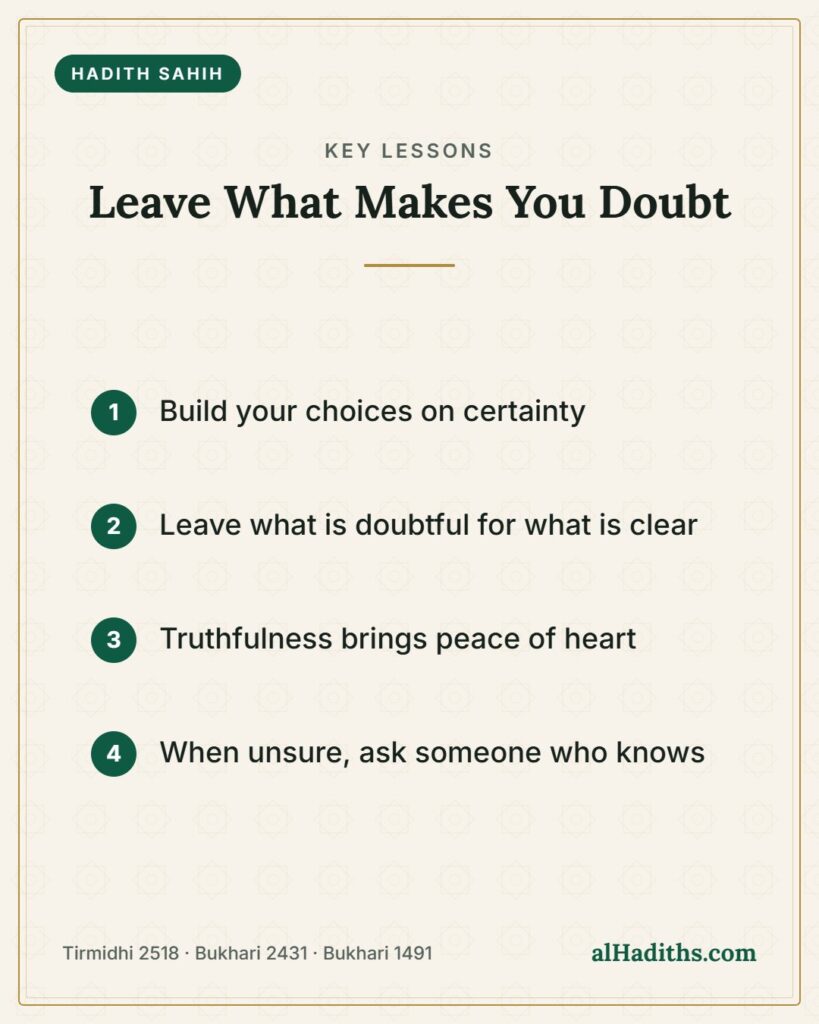
- Leave words and actions you are unsure about for those you know are good.
- Building our choices on certainty brings calm to the heart.
- Truthfulness brings tranquility, and falsehood brings unease.
- The Prophet ﷺ practiced this himself, even with a single date.
Questions people ask
What does “leave what makes you doubt” mean?
It means leaving words or actions you are unsure about, and choosing instead what you are certain is good and lawful. This brings tranquility to the heart, while what is doubtful brings anxiety (Encyclopedia of Translated Prophetic Hadiths (HadeethEnc)).
Is the hadith “leave what makes you doubt” authentic?
Yes. It is narrated by al-Hasan ibn ‘Ali and recorded by at-Tirmidhi, who called it hasan sahih; Sunnah.com lists it as Sahih (Darussalam) (Jami’ at-Tirmidhi 2518). It is Hadith 11 of an-Nawawi’s 40.
What does “truthfulness is tranquility” mean?
It is the second part of the same hadith: “The truth brings tranquility while falsehood sows doubt” (Jami’ at-Tirmidhi 2518). Being truthful brings peace of mind, while lying leaves a person uneasy.
One thing to do today: think of one thing you have been unsure about, and either leave it or ask someone knowledgeable about it.
Save this to Pinterest so you can remember to choose what is clear
Share the reward. Send this article to someone who needs it today — teaching a hadith or dua can become a lasting good deed for you, in shaa Allah.