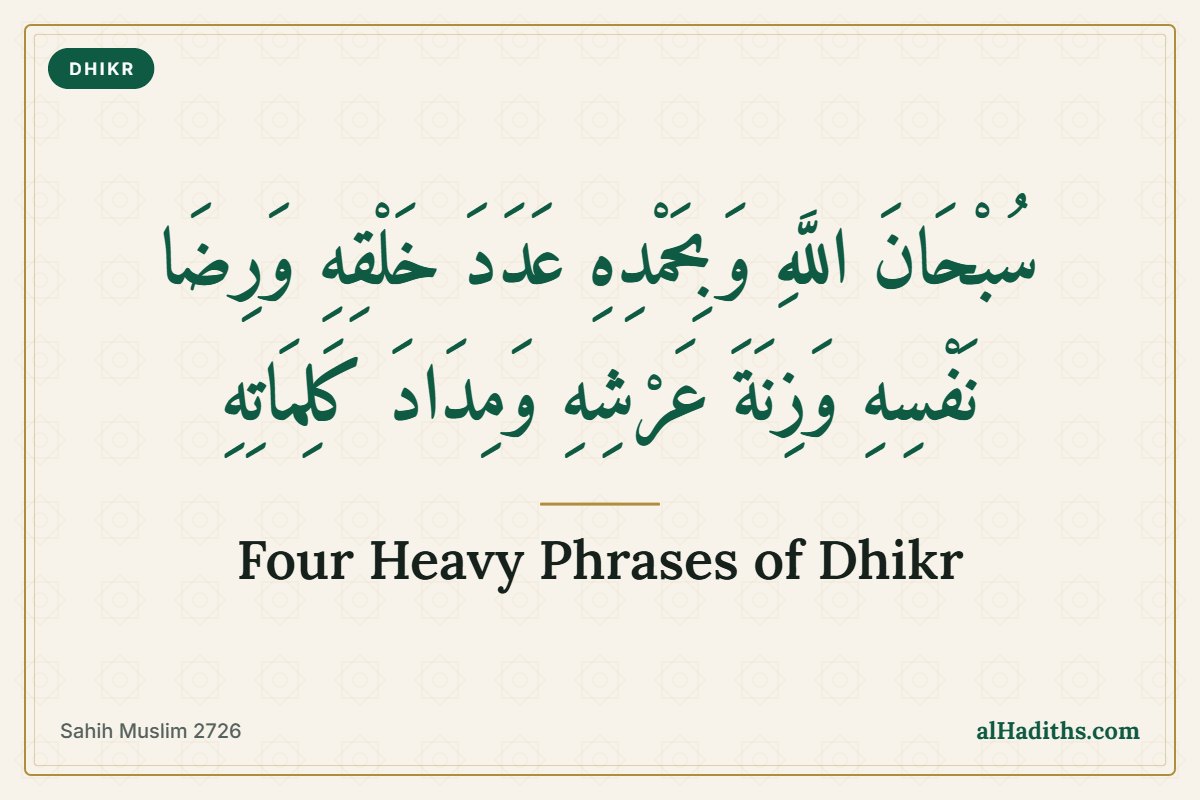
Subhanallahi wa Bihamdihi ‘Adada Khalqihi: 4 Heavy Dhikr Phrases
Dhikr (also spelled dzikir or zikir) simply means remembering Allah. One morning, the Prophet ﷺ showed his wife Juwayriyah (may Allah be pleased with her) that a few well-chosen words can weigh more than hours of remembrance. These are the four heavy phrases of dhikr, Subhanallahi wa bihamdihi ‘adada khalqihi, with the Arabic, the English meaning and the story behind them.
At a glance
- Source: Sahih Muslim 2726a
- Narrated by: Juwayriyah bint al-Harith (may Allah be pleased with her)
- Grade: Sahih (Muslim)
- Topic: Short dhikr with a heavy reward
- Practise it: Say the four phrases three times after Fajr, or at any time of day
The hadith of Juwayriyah
The Prophet ﷺ left Juwayriyah’s room early in the morning, after she had prayed Fajr and was sitting in her place of prayer. He came back in the forenoon and found her still sitting there, doing dhikr. He asked whether she had been in the same place since he left, and she said yes. Then he said:
لَقَدْ قُلْتُ بَعْدَكِ أَرْبَعَ كَلِمَاتٍ ثَلاَثَ مَرَّاتٍ لَوْ وُزِنَتْ بِمَا قُلْتِ مُنْذُ الْيَوْمِ لَوَزَنَتْهُنَّ سُبْحَانَ اللَّهِ وَبِحَمْدِهِ عَدَدَ خَلْقِهِ وَرِضَا نَفْسِهِ وَزِنَةَ عَرْشِهِ وَمِدَادَ كَلِمَاتِهِ
“I recited four words three times after I left you and if these are to be weighed against what you have recited since morning these would outweigh them and (these words) are: Hallowed be Allah and praise is due to Him according to the number of His creation and according to the pleasure of His Self and according to the weight of His Throne and according to the ink (used in recording) words (for His Praise).”
Sahih Muslim 2726a · Narrated by Juwayriyah bint al-Harith · Translation from Sunnah.com
The same story is in Sunan Abi Dawud 1503 (Sahih, al-Albani), and Jami` at-Tirmidhi 3555 and Sunan an-Nasa’i 1352 (both Sahih, Darussalam) narrate a version where he teaches her to say each phrase three times.
The four phrases in Arabic and English
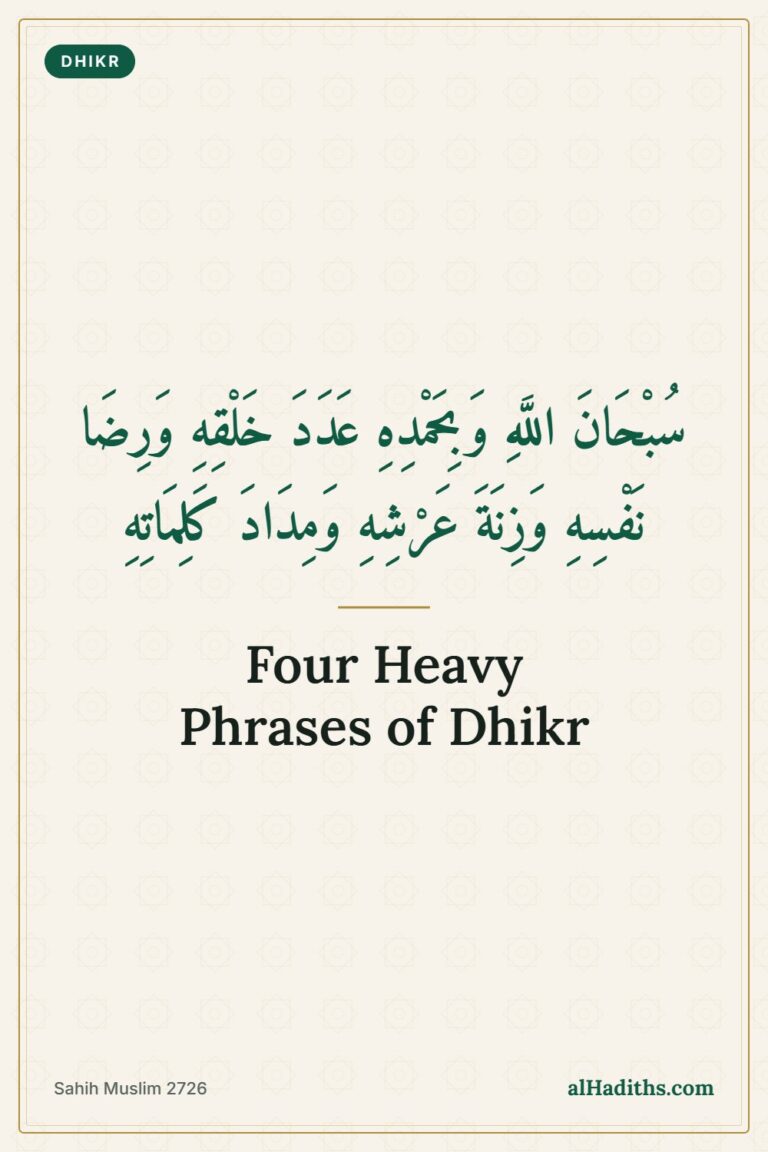
سُبْحَانَ اللَّهِ وَبِحَمْدِهِ عَدَدَ خَلْقِهِ وَرِضَا نَفْسِهِ وَزِنَةَ عَرْشِهِ وَمِدَادَ كَلِمَاتِهِ
Subhanallahi wa bihamdihi, ‘adada khalqihi, wa rida nafsihi, wa zinata ‘arshihi, wa midada kalimatihi
Glory be to Allah and praise be to Him, as many times as the number of His creation, as much as pleases Him, as much as the weight of His Throne, and as much as the ink of His words.
Sahih Muslim 2726a · Translation adapted from Sunnah.com
- ‘Adada khalqihi: as many as the number of His creation, past, present and future.
- Wa rida nafsihi: as much as pleases Him.
- Wa zinata ‘arshihi: as much as the weight of His Throne.
- Wa midada kalimatihi: as much as the ink needed to write His words, which never run out.
Reflection: Juwayriyah’s long dhikr was not wasted; the Prophet ﷺ found her still at it and taught her something more. The lesson is not to do less, but to think about the meaning of what we say. Each phrase stretches our praise beyond anything we could count.
Why short dhikr can be heavy on the scale
The idea of light words weighing a lot appears in another famous hadith too. The Prophet ﷺ said:
كَلِمَتَانِ خَفِيفَتَانِ عَلَى اللِّسَانِ، ثَقِيلَتَانِ فِي الْمِيزَانِ، حَبِيبَتَانِ إِلَى الرَّحْمَنِ، سُبْحَانَ اللَّهِ الْعَظِيمِ، سُبْحَانَ اللَّهِ وَبِحَمْدِهِ
“There are two expressions which are very easy for the tongue to say, but they are very heavy in the balance and are very dear to The Beneficent (Allah), and they are, ‘Subhan Allah Al-‘Azim’ and ‘Subhan Allah wa bihamdihi.'”
Sahih al-Bukhari 6406 · Narrated by Abu Hurairah · Translation from Sunnah.com
Both hadiths share the same words, Subhanallahi wa bihamdihi. They are easy on the tongue, but their weight on the Day of Judgement is something only Allah measures. That is a good reason never to look down on a short dhikr.
How to practise it
In Muslim’s narration the Prophet ﷺ said the phrases three times in the morning, after Fajr. You can follow that, and also use them at other times:
- After Fajr, say the four phrases three times before you start your day.
- Learn them in parts: start with Subhanallahi wa bihamdihi, then add one phrase a day.
- Think of the meaning as you say each one: the number of creation, His pleasure, His Throne, His words.
- Use them when time is short, on a commute or between tasks.
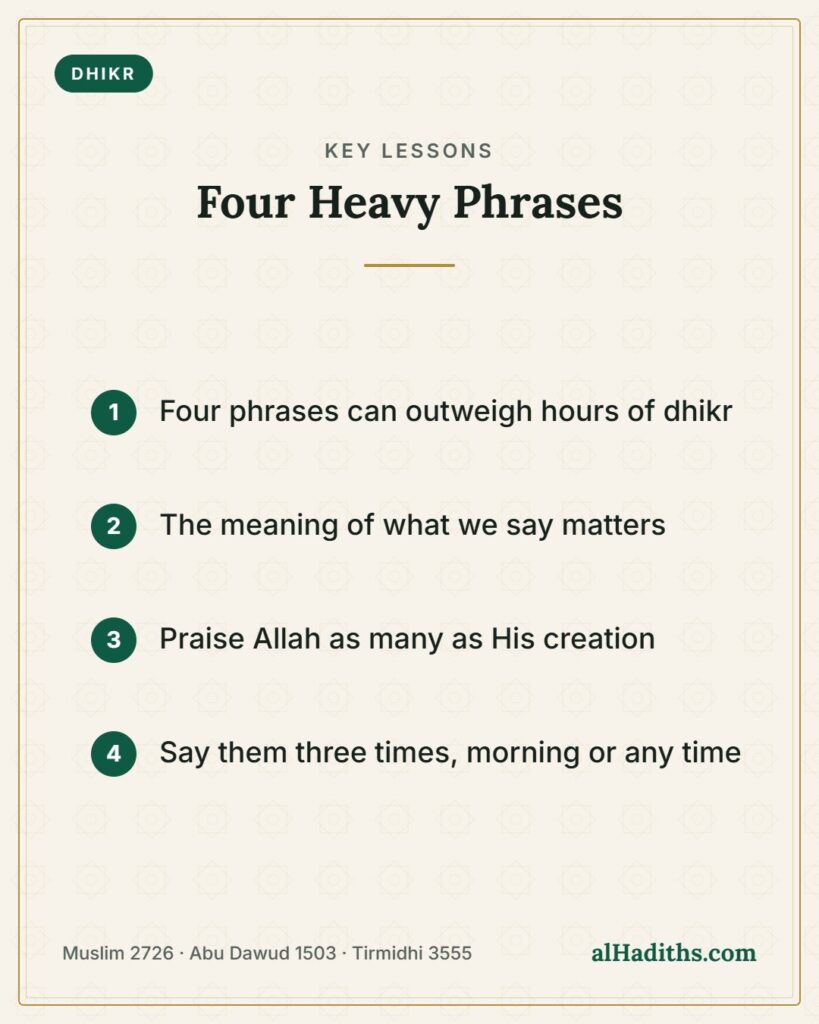
Key lessons
- Four phrases said three times can outweigh a whole morning of dhikr.
- The meaning and quality of our dhikr matter, not only the number.
- We can praise Allah as many as His creation and the weight of His Throne.
- The Prophet ﷺ taught his family dhikr gently and practically.
Questions people ask
What is dhikr (dzikir) in English?
Dhikr, also spelled dzikir or zikir, means remembrance of Allah: praising and glorifying Him with words the Prophet ﷺ taught, such as Subhanallah, Alhamdulillah and La ilaha illallah.
What are the four phrases that outweigh all other dhikr?
Subhanallahi wa bihamdihi ‘adada khalqihi, wa rida nafsihi, wa zinata ‘arshihi, wa midada kalimatihi. The Prophet ﷺ said them three times and told Juwayriyah they would outweigh everything she had said since the morning (Sahih Muslim 2726a).
When should I say these four phrases?
The Prophet ﷺ said them in the morning after Fajr (Sahih Muslim 2726a). The hadith does not limit them to that time, so you can also say them at other times of the day.
Remembrance of Allah is something each one of us can do day and night, whether by salah, dua or dhikr. Allah has made many ways for His servants to remember Him; let’s start with these four phrases tomorrow morning.
Save this to Pinterest so you can memorize these four phrases
Share the reward. Send this article to someone who needs it today — teaching a hadith or dua can become a lasting good deed for you, in shaa Allah.

One Comment