Tie Your Camel and Trust in Allah: The Hadith Explained
Contents
“Trust in Allah, but tie your camel” is one of the most quoted Islamic sayings, and it is often shared like a proverb. Many people search for “tie your camel and trust in Allah” to find where it really comes from. It comes from a short hadith, and it answers a question every believer asks at some point.
At a glance
- Source: Jami‘ at-Tirmidhi 2517
- Narrated by: Anas ibn Malik
- Grade: Hasan (Darussalam; al-Albani), see the note on its grading below
- Topic: Tawakkul (reliance on Allah)
- Practise it: Do your part properly, then leave the outcome to Allah
The tie your camel hadith
Anas ibn Malik (may Allah be pleased with him) narrated that a man asked the Prophet ﷺ about his camel:
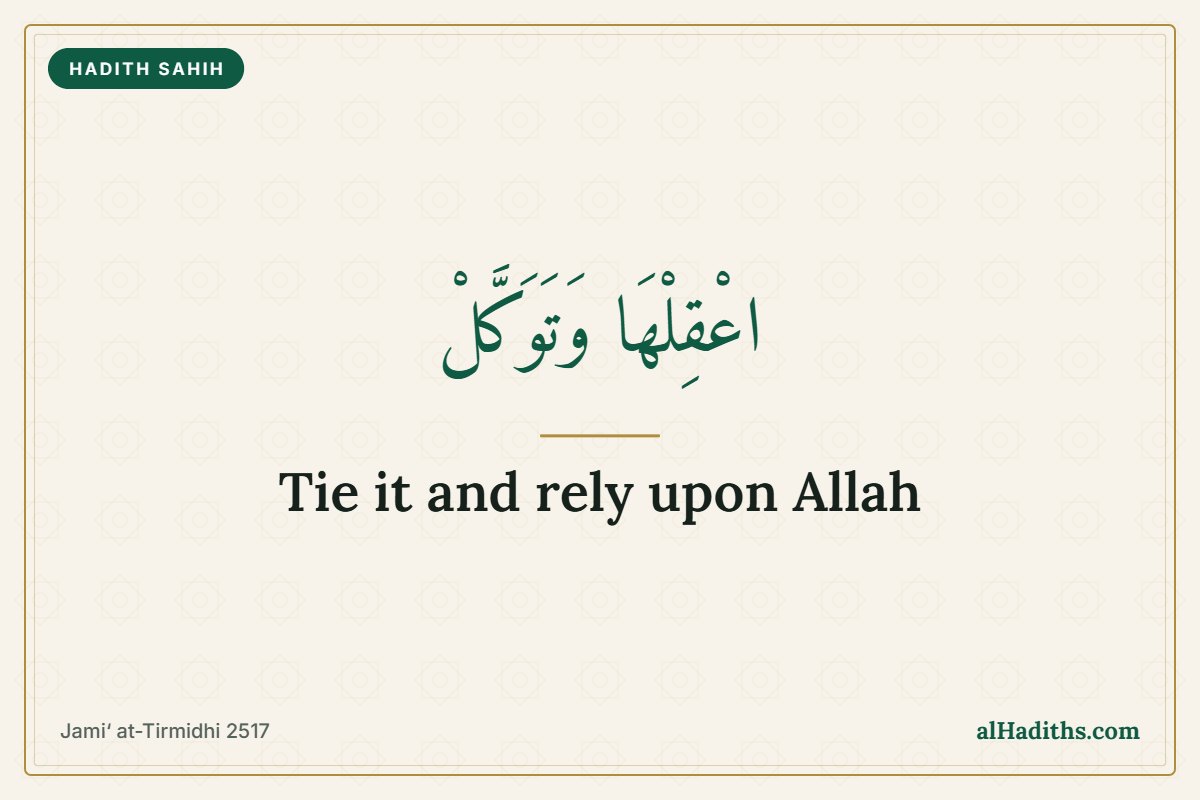
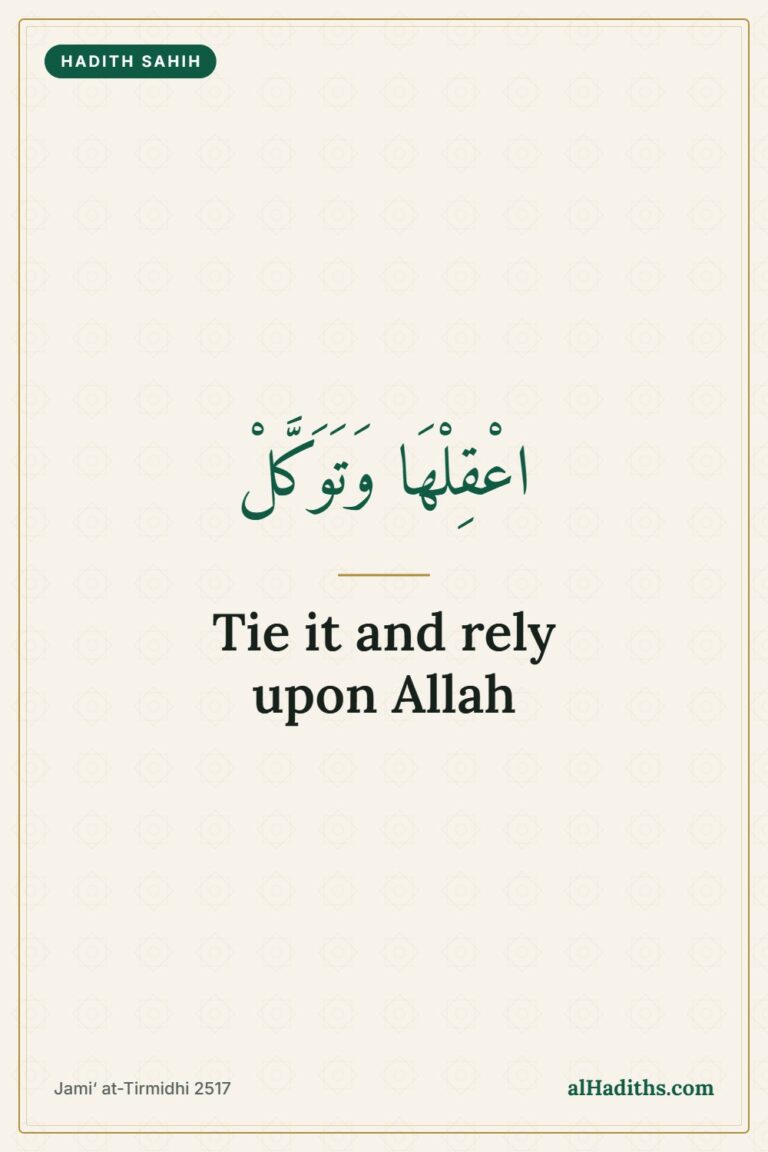
يَا رَسُولَ اللَّهِ أَعْقِلُهَا وَأَتَوَكَّلُ أَوْ أُطْلِقُهَا وَأَتَوَكَّلُ قَالَ اعْقِلْهَا وَتَوَكَّلْ
“O Messenger of Allah! Shall I tie it and rely (upon Allah), or leave it loose and rely (upon Allah)?” He said: “Tie it and rely (upon Allah).”
Jami‘ at-Tirmidhi 2517 · Hasan (Darussalam) · Narrated by Anas ibn Malik · Translation adapted from Sunnah.com
The answer is just two words in Arabic: i‘qilha wa tawakkal, “tie it and rely (upon Allah)”. The popular line “Trust in Allah, but tie your camel” is a paraphrase of this answer, not its exact wording.
A note on its grading
Sunnah.com shows this hadith as Hasan (Darussalam), and al-Albani also graded it Hasan (Sahih al-Jami‘ 1068). Scholars did discuss its chain, though. In the same entry, at-Tirmidhi reports that the early critic Yahya ibn Sa‘id al-Qattan called it munkar (an objectionable narration), and at-Tirmidhi himself called it gharib from Anas: known only through this one chain.
At-Tirmidhi adds that a similar narration comes from Amr ibn Umayyah ad-Damri. Ibn Hibban recorded it in his Sahih (731), and Shu‘ayb al-Arna’ut graded that chain Hasan (details). So the meaning is supported by more than one route, and the graders above count it as Hasan.
Provision like the birds
Umar ibn al-Khattab (may Allah be pleased with him) narrated a second hadith on reliance on Allah:
لَوْ أَنَّكُمْ كُنْتُمْ تَوَكَّلُونَ عَلَى اللَّهِ حَقَّ تَوَكُّلِهِ لَرُزِقْتُمْ كَمَا تُرْزَقُ الطَّيْرُ تَغْدُو خِمَاصًا وَتَرُوحُ بِطَانًا
“If you were to rely upon Allah with the required reliance, then He would provide for you just as a bird is provided for, it goes out in the morning empty, and returns full.”
Jami‘ at-Tirmidhi 2344 · Hasan (Darussalam) · Narrated by Umar ibn al-Khattab · Translation adapted from Sunnah.com
At-Tirmidhi called this hadith hasan sahih. The explanation on HadeethEnc points out that the birds do not wait in their nests: they fly out in the morning and come back full. True reliance, it explains, does not cancel going out to seek provision.
What the Quran says about tawakkul in Islam
In Surah at-Talaq, Allah promises a way out to whoever fears Him, and continues:
وَيَرْزُقْهُ مِنْ حَيْثُ لَا يَحْتَسِبُ ۚ وَمَن يَتَوَكَّلْ عَلَى ٱللَّهِ فَهُوَ حَسْبُهُۥٓ ۚ إِنَّ ٱللَّهَ بَـٰلِغُ أَمْرِهِۦ ۚ قَدْ جَعَلَ ٱللَّهُ لِكُلِّ شَىْءٍ قَدْرًا
“And will provide for him from where he does not expect. And whoever relies upon Allāh – then He is sufficient for him. Indeed, Allāh will accomplish His purpose. Allāh has already set for everything a [decreed] extent.”
Surah at-Talaq 65:3 · Translation: Saheeh International, from Quran.com
Reflection: tying the camel takes a minute; worrying about it can take all night. The hadith puts each in its place. The rope is our part, and we do it properly. What happens after that is Allah’s part, and the heart can rest there.
How to practise it
- Before a big step (an exam, an interview, a journey), prepare properly, then hand the result to Allah.
- Locking the door, saving your work and wearing a seatbelt are “tying the camel”, not a lack of trust.
- When you leave home, say the dua for leaving home, which includes “I place my trust in Allah”.
- When worry returns after you have done your part, read Quran 65:3 again.
- Don’t use tawakkul as a reason to skip work, study or treatment.
Questions people ask
Is “tie your camel” a real hadith?
Yes. It is in Jami‘ at-Tirmidhi 2517, graded Hasan by Darussalam and by al-Albani. Early scholars discussed its chain (see the note on its grading), and the popular wording “Trust in Allah, but tie your camel” is a paraphrase.
What does tie your camel and trust in Allah mean?
It means taking the practical steps within our control, then relying on Allah for the result. Taking these means does not contradict tawakkul.
Does tawakkul mean doing nothing?
No. In the birds hadith (Tirmidhi 2344), the birds go out in the morning and return full: they move, and Allah provides for them.
Key lessons
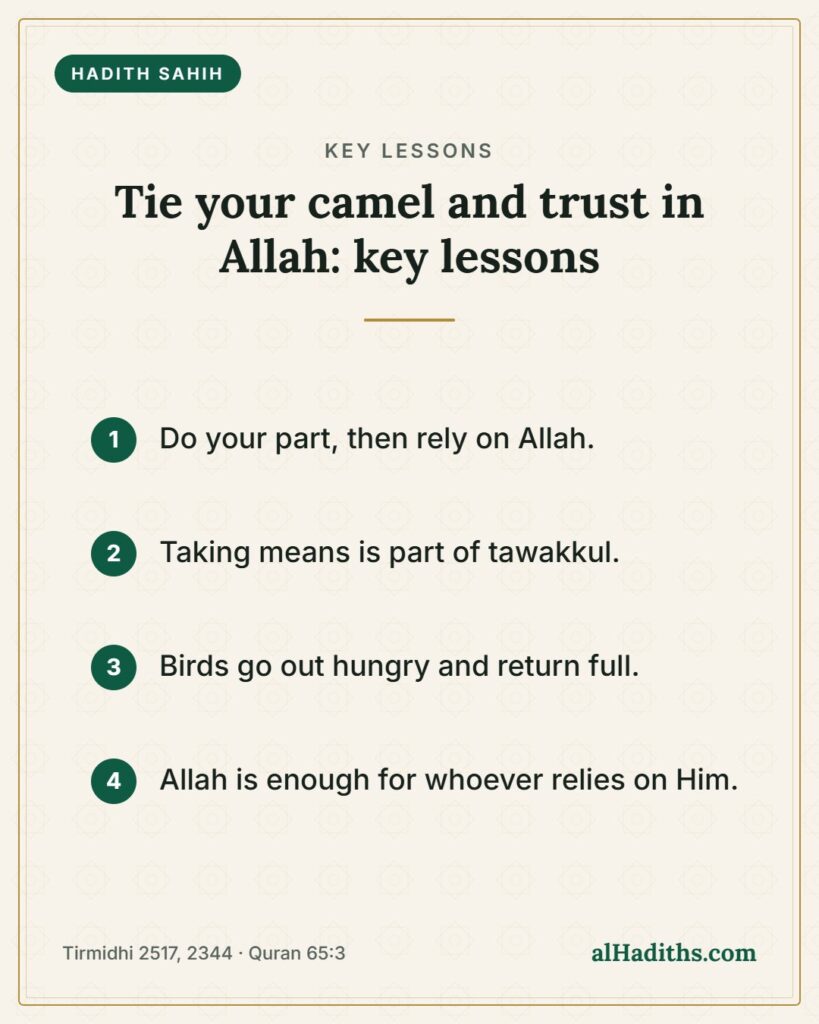
- Tie your camel and trust in Allah: do your part, then rely on Him.
- Taking practical steps is part of tawakkul, not against it.
- Allah provides for those who truly rely on Him, as He provides for the birds.
- Whoever relies upon Allah, He is sufficient for him (Quran 65:3).
Think of one worry you are carrying today. What is the rope, the one practical step you can take? Take it, then hand the rest to Allah.
Save this to Pinterest so you remember to do your part and leave the rest to Allah
Share the reward. Send this article to someone who needs it today — teaching a hadith or dua can become a lasting good deed for you, in shaa Allah.