Dua for Jannah: 4 Authentic Duas to Ask for Paradise
We all want Jannah, but how often do we actually ask for it, in words, by name? The Prophet ﷺ taught his family to ask for Paradise, told us what happens when we ask three times, and told us which part of it to ask for. Here are 4 authentic duas for Jannah, from the Sunnah and the Quran, with simple ways to make them part of your day.
In this article:
- A complete dua the Prophet ﷺ taught ‘A’ishah, asking for Paradise and the deeds that lead to it
- What Paradise itself says for those who ask three times
- Asking for al-Firdaus, and the dua of the wife of Pharaoh from the Quran
At a glance
- Duas: 4 (Sunan Ibn Majah, Jami‘ at-Tirmidhi, Sahih al-Bukhari, the Quran)
- Collections: Sunan Ibn Majah, Jami‘ at-Tirmidhi, Sahih al-Bukhari, Surah At-Tahrim
- Grade: Sahih (Darussalam; al-Bukhari)
- Topic: Asking Allah for Paradise
- Do it today: Ask Allah for Paradise three times after one of your prayers
1. The complete dua for Paradise
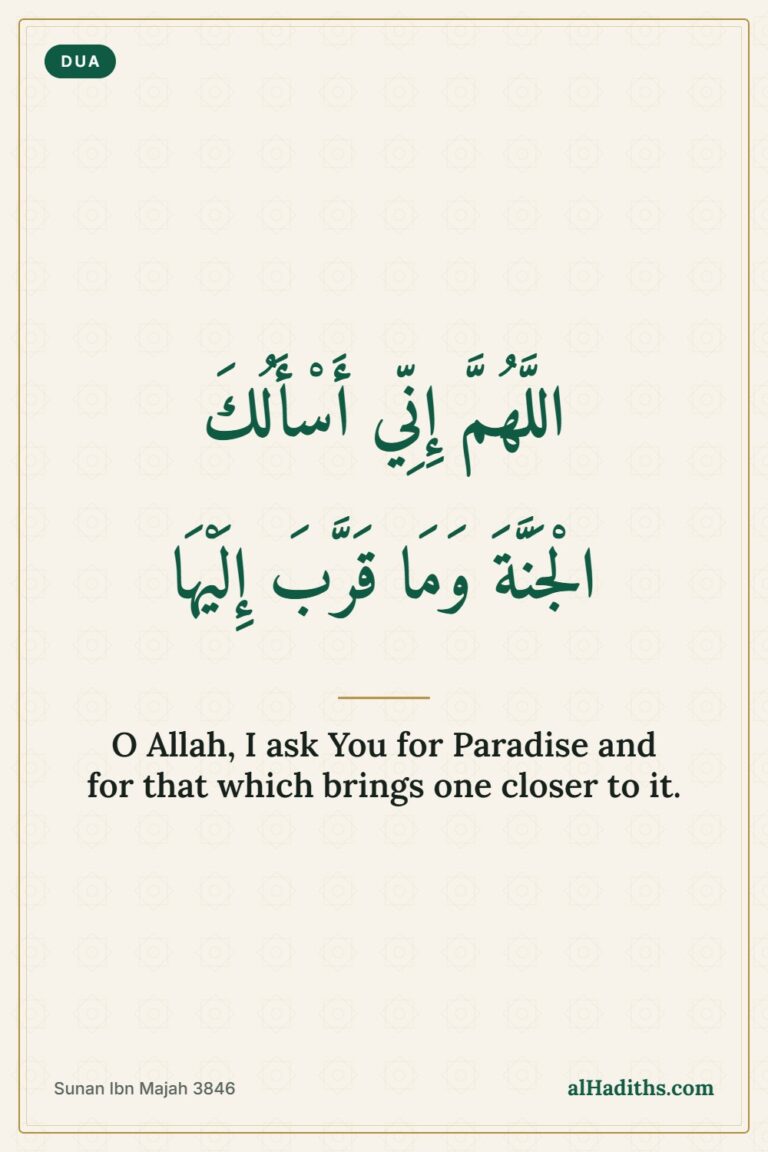
The Prophet ﷺ taught this dua to ‘A’ishah (may Allah be pleased with her). It asks for all good, seeks refuge from all evil, and then asks directly for Jannah and for every word and deed that brings us closer to it.
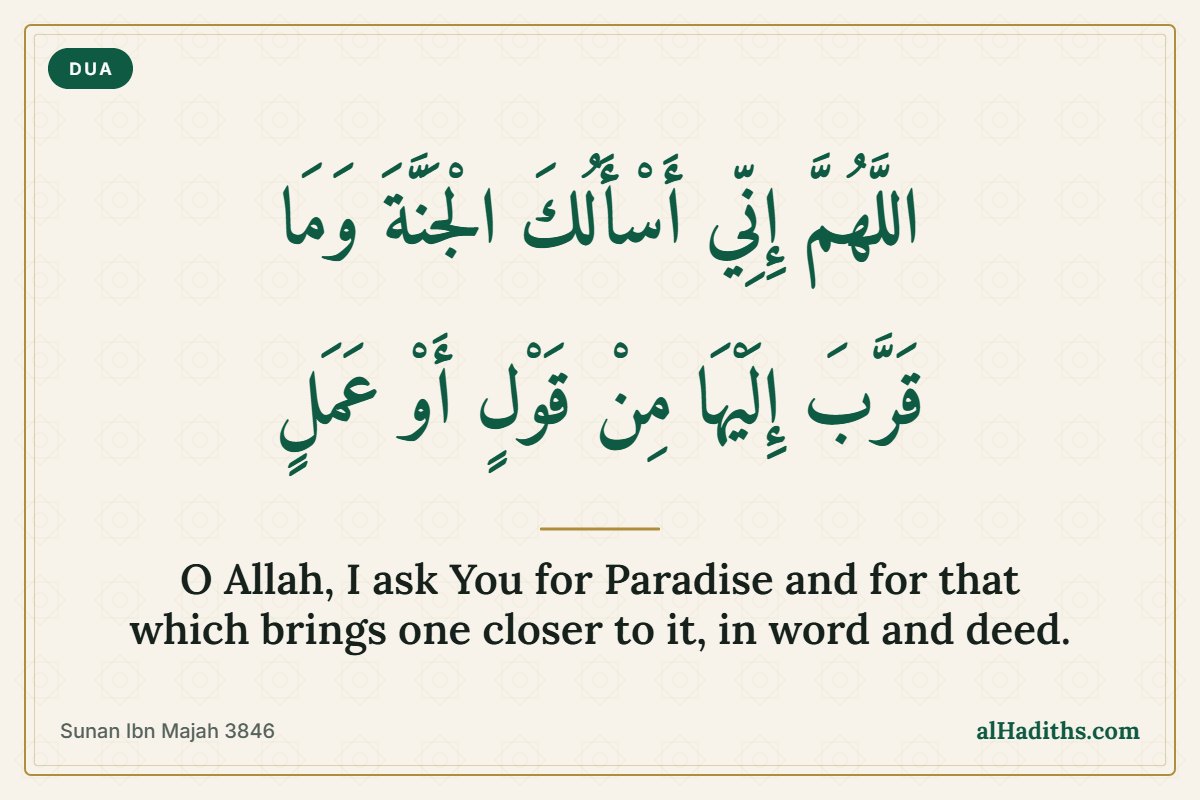
اللَّهُمَّ إِنِّي أَسْأَلُكَ مِنَ الْخَيْرِ كُلِّهِ عَاجِلِهِ وَآجِلِهِ مَا عَلِمْتُ مِنْهُ وَمَا لَمْ أَعْلَمْ وَأَعُوذُ بِكَ مِنَ الشَّرِّ كُلِّهِ عَاجِلِهِ وَآجِلِهِ مَا عَلِمْتُ مِنْهُ وَمَا لَمْ أَعْلَمْ اللَّهُمَّ إِنِّي أَسْأَلُكَ مِنْ خَيْرِ مَا سَأَلَكَ عَبْدُكَ وَنَبِيُّكَ وَأَعُوذُ بِكَ مِنْ شَرِّ مَا عَاذَ بِهِ عَبْدُكَ وَنَبِيُّكَ اللَّهُمَّ إِنِّي أَسْأَلُكَ الْجَنَّةَ وَمَا قَرَّبَ إِلَيْهَا مِنْ قَوْلٍ أَوْ عَمَلٍ وَأَعُوذُ بِكَ مِنَ النَّارِ وَمَا قَرَّبَ إِلَيْهَا مِنْ قَوْلٍ أَوْ عَمَلٍ وَأَسْأَلُكَ أَنْ تَجْعَلَ كُلَّ قَضَاءٍ قَضَيْتَهُ لِي خَيْرًا
Allahumma inni as’aluka minal-khayri kullihi, ‘ajilihi wa ajilihi, ma ‘alimtu minhu wa ma lam a‘lam. Wa a‘udhu bika minash-sharri kullihi, ‘ajilihi wa ajilihi, ma ‘alimtu minhu wa ma lam a‘lam. Allahumma inni as’aluka min khayri ma sa’alaka ‘abduka wa nabiyyuk, wa a‘udhu bika min sharri ma ‘adha bihi ‘abduka wa nabiyyuk. Allahumma inni as’alukal-jannata wa ma qarraba ilayha min qawlin aw ‘amal, wa a‘udhu bika minan-nari wa ma qarraba ilayha min qawlin aw ‘amal, wa as’aluka an taj‘ala kulla qada’in qadaytahu li khayra.
“O Allah, I ask You for all that is good, in this world and in the Hereafter, what I know and what I do not know. O Allah, I seek refuge with You from all evil, in this world and in the Hereafter, what I know and what I do not know. O Allah, I ask You for the good that Your slave and Prophet has asked You for, and I seek refuge with You from the evil from which Your slave and Prophet sought refuge. O Allah, I ask You for Paradise and for that which brings one closer to it, in word and deed, and I seek refuge in You from Hell and from that which brings one closer to it, in word and deed. And I ask You to make every decree that You decree concerning me good.”
Sunan Ibn Majah 3846 · Narrated by ‘A’ishah · Grade: Sahih (Darussalam) · Translation from Sunnah.com; transliteration adapted
Notice that it does not stop at asking for Paradise. It also asks for what brings us closer to it, in what we say and what we do. The explanation on HadeethEnc notes that the dua gathers all good and leaves the details to Allah’s knowledge, and that asking with the words the Prophet ﷺ used protects us from going too far in our duas.
Try this: Learn the third part first (“Allahumma inni as’alukal-jannata wa ma qarraba ilayha…”), then add the rest a line at a time.
2. Ask for Paradise three times
مَنْ سَأَلَ اللَّهَ الْجَنَّةَ ثَلاَثَ مَرَّاتٍ قَالَتِ الْجَنَّةُ اللَّهُمَّ أَدْخِلْهُ الْجَنَّةَ. وَمَنِ اسْتَجَارَ مِنَ النَّارِ ثَلاَثَ مَرَّاتٍ قَالَتِ النَّارُ اللَّهُمَّ أَجِرْهُ مِنَ النَّارِ
“Whoever asks Allah for Paradise three times, Paradise says: ‘O Allah, admit him into Paradise,’ and whoever seeks refuge from the Fire three times, the Fire says: ‘O Allah, save him from the Fire.’”
Jami‘ at-Tirmidhi 2572 · Narrated by Anas ibn Malik · Grade: Sahih (Darussalam) · Translation adapted from Sunnah.com
Anas ibn Malik (may Allah be pleased with him) narrated this from the Prophet ﷺ. Paradise itself joins in our dua. The hadith gives no set time or wording, only the number: three. A short dua such as the one in Dua for Protection From Hellfire covers both halves.
Try this: After one prayer a day, ask Allah for Paradise three times and seek refuge from the Fire three times. The timing is a suggestion; the hadith does not set one.
3. When you ask, ask for al-Firdaus
فَإِذَا سَأَلْتُمُ اللَّهَ فَاسْأَلُوهُ الْفِرْدَوْسَ، فَإِنَّهُ أَوْسَطُ الْجَنَّةِ وَأَعْلَى الْجَنَّةِ
“So, when you ask Allah (for something), ask for Al-firdaus which is the best and highest part of Paradise.”
Sahih al-Bukhari 2790 · Narrated by Abu Hurairah · Translation from Sunnah.com (part of the hadith)
Paradise has levels, and the Prophet ﷺ did not want us to aim low. He told us to ask for the highest one, al-Firdaus. We explain the levels in Levels of Jannah and al-Firdaus.
Try this: When you ask for Jannah, name al-Firdaus, in Arabic or in your own words. A simple wording such as “O Allah, I ask You for al-Firdaus” is our suggestion; the hadith tells us what to ask for, not exact words.
4. The dua of the wife of Pharaoh
وَضَرَبَ ٱللَّهُ مَثَلًا لِّلَّذِينَ ءَامَنُوا۟ ٱمْرَأَتَ فِرْعَوْنَ إِذْ قَالَتْ رَبِّ ٱبْنِ لِى عِندَكَ بَيْتًا فِى ٱلْجَنَّةِ وَنَجِّنِى مِن فِرْعَوْنَ وَعَمَلِهِۦ وَنَجِّنِى مِنَ ٱلْقَوْمِ ٱلظَّـٰلِمِينَ
“And Allāh presents an example of those who believed: the wife of Pharaoh, when she said, “My Lord, build for me near You a house in Paradise and save me from Pharaoh and his deeds and save me from the wrongdoing people.””
Surah At-Tahrim 66:11 · Translation: Saheeh International, from Quran.com
Allah holds her up as an example for all believers. She lived in the palace of a tyrant, yet she asked for a house in Paradise near Allah, and for rescue from Pharaoh and his deeds. She asked for the home and for the company, not only the reward.
Try this: On a hard day, pray with her words: “Rabbi-bni li ‘indaka baytan fil-jannah” (My Lord, build for me near You a house in Paradise).
What it takes: asking, and walking toward it
Reflection: The first dua asks for Paradise and for the words and deeds that bring us closer to it. That is the whole picture. A dua for Jannah is not a replacement for prayer, honesty and kindness; it is the request that Allah makes those deeds easy for us. The 8 gates of Jannah open for people known for deeds like prayer, fasting and charity. So we ask, and then we walk toward what we asked for.
Questions people ask
What is the best dua for Jannah?
No hadith names one single best dua for Jannah. The dua the Prophet ﷺ taught ‘A’ishah (Sunan Ibn Majah 3846, Sahih) is one of the most complete: it asks for Paradise and for every word and deed that brings us closer to it. The Prophet ﷺ also told us to ask for al-Firdaus (Sahih al-Bukhari 2790).
How do I ask for Jannatul Firdaus?
The Prophet ﷺ said that when you ask Allah, ask for al-Firdaus, the best and highest part of Paradise (Sahih al-Bukhari 2790). He did not give fixed words for it, so you can ask in Arabic or your own language, for example, “O Allah, I ask You for al-Firdaus.”
How many times should I ask for Paradise?
Whoever asks Allah for Paradise three times, Paradise says, “O Allah, admit him into Paradise” (Jami‘ at-Tirmidhi 2572, Sahih). The hadith does not set a time, so many people make it a daily habit, for example after a prayer.
Key lessons
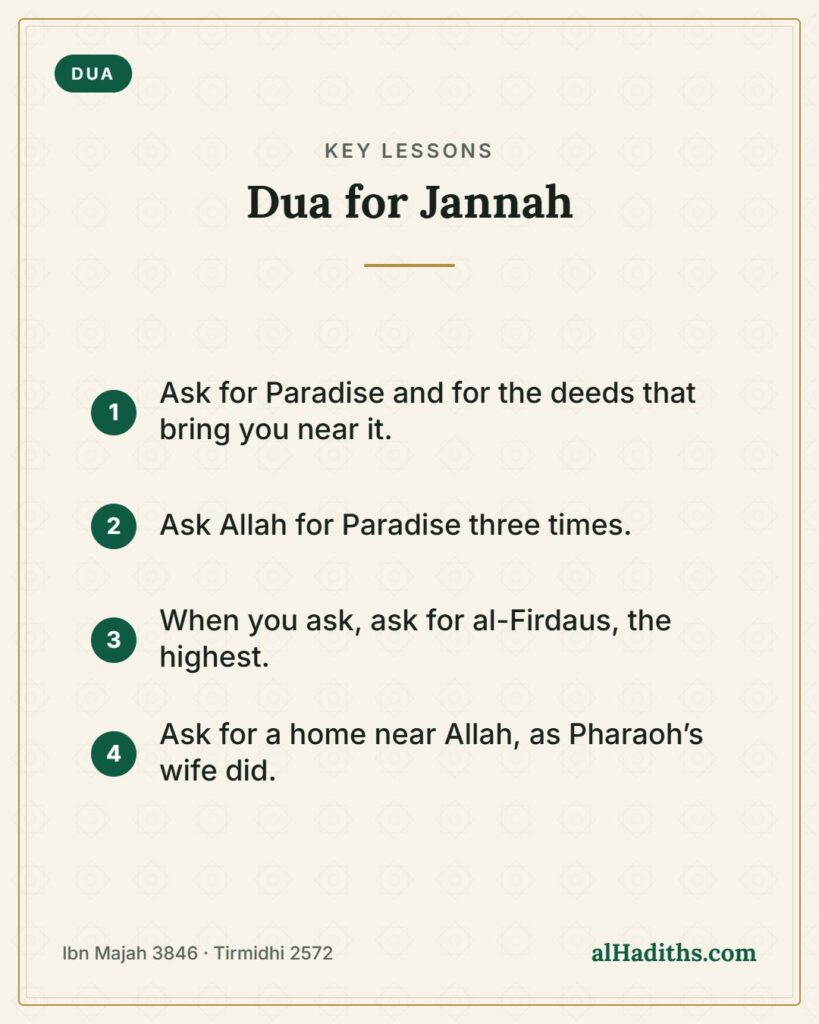
- Ask for Paradise and for the words and deeds that bring you close to it (Ibn Majah 3846).
- Asking three times is a Sunnah with a promise: Paradise asks for you (Tirmidhi 2572).
- Aim high: ask for al-Firdaus (Bukhari 2790).
- Ask for a home near Allah, as the wife of Pharaoh did (Quran 66:11).
Pick one of these duas and say it today, three times. May Allah grant you, your parents and those you love al-Firdaus, and make every step you take one that brings you closer to it.
Save this to Pinterest so you can come back to these duas and make them part of your day
Share the reward. Send this article to someone who needs it today — teaching a hadith or dua can become a lasting good deed for you, in shaa Allah.