Praying on Time: 6 Authentic Hadith on Salah at Its Time
The adhan sounds on your phone in the middle of a meeting, a drive or a deadline, and a quiet voice says later. The Prophet ﷺ answered that voice clearly. Here are six authentic hadith about praying on time: why it is among the deeds Allah loves most, what Allah promised to those who guard it, and how serious it is to let a prayer slip past its time.
In this article
- The deed most beloved to Allah, and why the start of the time is best
- Allah’s promise to those who guard the five prayers
- The warnings about missing Asr and delaying salah, and what to do when others delay
At a glance
- Hadith: 6 hadith cards, plus Surah an-Nisa 4:103
- Collections: Sahih al-Bukhari, Sahih Muslim, Jami` at-Tirmidhi and Sunan Abi Dawud
- Grade: Sahih, grader named for the Sunan
- Topic: Salah: praying each prayer at its time
- Put it into practice: Check today’s prayer times and plan your next task around the next prayer
1. The deed most beloved to Allah
‘Abdullah ibn Mas‘ud (may Allah be pleased with him) asked the Prophet ﷺ which deed Allah loves most:
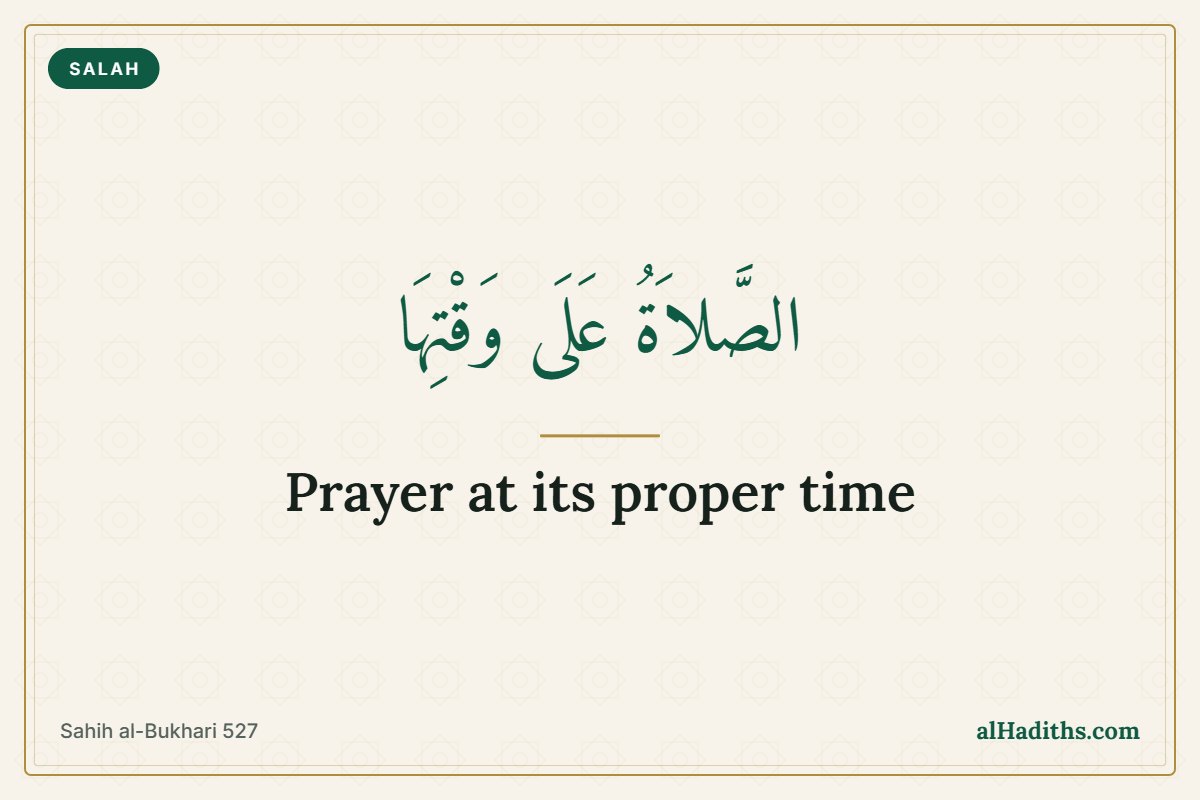
سَأَلْتُ النَّبِيَّ صلى الله عليه وسلم أَىُّ الْعَمَلِ أَحَبُّ إِلَى اللَّهِ قَالَ الصَّلاَةُ عَلَى وَقْتِهَا. قَالَ ثُمَّ أَىُّ قَالَ ثُمَّ بِرُّ الْوَالِدَيْنِ. قَالَ ثُمَّ أَىُّ قَالَ الْجِهَادُ فِي سَبِيلِ اللَّهِ. قَالَ حَدَّثَنِي بِهِنَّ وَلَوِ اسْتَزَدْتُهُ لَزَادَنِي
“I asked the Prophet ﷺ: ‘Which deed is the dearest to Allah?’ He replied: ‘To offer the prayers at their early stated fixed times.’ I asked: ‘What is the next (in goodness)?’ He replied: ‘To be good and dutiful to your parents.’ I again asked: ‘What is the next (in goodness)?’ He replied: ‘To participate in Jihad (religious fighting) in Allah’s cause.’” ‘Abdullah added: “I asked only that much, and if I had asked more, the Prophet ﷺ would have told me more.”
Sahih al-Bukhari 527 · Narrated by ‘Abdullah ibn Mas‘ud · Translation adapted from Sunnah.com
Notice what comes first. Not a long night prayer or a large charity, but the ordinary five prayers, offered at their time. HadeethEnc explains that deeds differ in rank, that prayer at its appointed time is the dearest of them to Allah, and that it is followed by kindness to parents and striving in Allah’s cause.
Try this: when the next adhan comes, treat it as an appointment with the deed Allah loves most, not as an interruption.
2. Best at the start of its time
Umm Farwah (may Allah be pleased with her), one of the women who gave the pledge to the Prophet ﷺ, narrated:
سُئِلَ النَّبِيُّ صلى الله عليه وسلم أَىُّ الأَعْمَالِ أَفْضَلُ قَالَ الصَّلاَةُ لأَوَّلِ وَقْتِهَا
“The Prophet ﷺ was asked: ‘Which deed is the best?’ He said: ‘Salah at the beginning of its time.’”
Jami` at-Tirmidhi 170 · Sahih (Darussalam) · Narrated by Umm Farwah · Translation adapted from Sunnah.com
This narration adds a detail: the best is not just “within the time” but early in it. Each prayer has a window, and the hadith points us to its opening rather than its closing minutes. A few prayers have their own timing in the Sunnah, so for the details of each one, ask a qualified scholar.
Try this: for one week, aim to pray within the first part of each prayer’s time, and notice how the rest of the day settles around it.
3. A promise from Allah
‘Ubadah ibn as-Samit (may Allah be pleased with him) said that he heard the Messenger of Allah ﷺ say:
خَمْسُ صَلَوَاتٍ افْتَرَضَهُنَّ اللَّهُ تَعَالَى مَنْ أَحْسَنَ وُضُوءَهُنَّ وَصَلاَّهُنَّ لِوَقْتِهِنَّ وَأَتَمَّ رُكُوعَهُنَّ وَخُشُوعَهُنَّ كَانَ لَهُ عَلَى اللَّهِ عَهْدٌ أَنْ يَغْفِرَ لَهُ وَمَنْ لَمْ يَفْعَلْ فَلَيْسَ لَهُ عَلَى اللَّهِ عَهْدٌ إِنْ شَاءَ غَفَرَ لَهُ وَإِنْ شَاءَ عَذَّبَهُ
“Allah, the Exalted, has made five prayers obligatory. If anyone performs ablution for them well, offers them at their (right) time, and observes perfectly their bowing and submissiveness in them, it is the guarantee of Allah that He will pardon him; if anyone does not do so, there is no guarantee for him on the part of Allah; He may pardon him if He wills, and punish him if He wills.”
Sunan Abi Dawud 425 · Sahih (al-Albani) · Narrated by ‘Ubadah ibn as-Samit · Translation adapted from Sunnah.com
Praying on time is one part of a set: good wudu, the right time, a complete bowing and real humility. Together they come with a covenant from Allah to forgive. Without them, the matter is left to Allah: He may forgive or He may punish.
Try this: before your next prayer, slow down your wudu and your ruku‘. Time, wudu and humility belong together.
4. Missing Asr: a loss like losing family and wealth
‘Abdullah ibn ‘Umar (may Allah be pleased with him) reported that the Messenger of Allah ﷺ said:
الَّذِي تَفُوتُهُ صَلاَةُ الْعَصْرِ كَأَنَّمَا وُتِرَ أَهْلَهُ وَمَالَهُ
“Whoever misses the ‘Asr prayer (intentionally), then it is as if he lost his family and property.”
Sahih al-Bukhari 552 · Narrated by ‘Abdullah ibn ‘Umar · Translation adapted from Sunnah.com
Asr falls in the busiest part of many people’s day, at work, on the road or with the children. The Prophet ﷺ described missing it as a loss as heavy as losing one’s family and everything one owns. We looked at this warning, with others, in Hadith About Leaving Salah.
Try this: set a fixed point for Asr in your working day, like a meeting you never move.
5. The prayer of the hypocrite
Al-‘Ala’ ibn ‘Abd ar-Rahman visited Anas ibn Malik (may Allah be pleased with him) in Basra soon after Dhuhr. Anas told them to pray Asr straight away, and when they finished he said he had heard the Messenger of Allah ﷺ say:
تِلْكَ صَلاَةُ الْمُنَافِقِ يَجْلِسُ يَرْقُبُ الشَّمْسَ حَتَّى إِذَا كَانَتْ بَيْنَ قَرْنَىِ الشَّيْطَانِ قَامَ فَنَقَرَهَا أَرْبَعًا لاَ يَذْكُرُ اللَّهَ فِيهَا إِلاَّ قَلِيلاً
“This is how the hypocrite prays: he sits watching the sun, and when it is between the horns of the devil, he rises and strikes the ground four times (in haste), mentioning Allah only a little during it.”
Sahih Muslim 622 · Narrated by Anas ibn Malik · Translation adapted from Sunnah.com
The hadith describes two faults together: waiting until the very end of the time, and then rushing the prayer so that little of Allah is remembered in it. Anas did not wait to explain this; he had his guests pray first and taught them afterwards.
Try this: if you catch yourself watching the clock to see how late you can leave a prayer, take it as your cue to get up and pray now.
6. Pray on time, even when others delay
Abu Dharr (may Allah be pleased with him) reported that the Messenger of Allah ﷺ said to him:
كَيْفَ أَنْتَ إِذَا كَانَتْ عَلَيْكَ أُمَرَاءُ يُؤَخِّرُونَ الصَّلاَةَ عَنْ وَقْتِهَا أَوْ يُمِيتُونَ الصَّلاَةَ عَنْ وَقْتِهَا. قَالَ قُلْتُ فَمَا تَأْمُرُنِي قَالَ صَلِّ الصَّلاَةَ لِوَقْتِهَا فَإِنْ أَدْرَكْتَهَا مَعَهُمْ فَصَلِّ فَإِنَّهَا لَكَ نَافِلَةٌ
“How would you act when you are under rulers who delay the prayer beyond its prescribed time, or make prayer a dead thing as far as its proper time is concerned?” I said: “What do you command?” He said: “Observe the prayer at its proper time, and if you can say it along with them, do so, for it would be a supererogatory prayer for you.”
Sahih Muslim 648a · Narrated by Abu Dharr · Translation adapted from Sunnah.com
The Prophet ﷺ foresaw a time when people in charge would push the prayer past its time. His answer was simple: pray it on time yourself, and if you then find them praying, join them and it counts as an extra prayer for you. Other people’s delay is never a reason for ours.
Try this: if your workplace, class or gathering does not stop for salah, quietly step away and pray at its time.
Bringing it together
Allah Himself tells us that salah is tied to set times:
فَإِذَا قَضَيْتُمُ ٱلصَّلَوٰةَ فَٱذْكُرُوا۟ ٱللَّهَ قِيَـٰمًا وَقُعُودًا وَعَلَىٰ جُنُوبِكُمْ ۚ فَإِذَا ٱطْمَأْنَنتُمْ فَأَقِيمُوا۟ ٱلصَّلَوٰةَ ۚ إِنَّ ٱلصَّلَوٰةَ كَانَتْ عَلَى ٱلْمُؤْمِنِينَ كِتَـٰبًا مَّوْقُوتًا
“And when you have completed the prayer, remember Allāh standing, sitting, or [lying] on your sides. But when you become secure, re-establish [regular] prayer. Indeed, prayer has been decreed upon the believers a decree of specified times.”
Surah an-Nisa 4:103 · Translation: Saheeh International, from Quran.com
Reflection: the six hadith move from love to loss. Prayer on time is what Allah loves most, the start of the time is best, and guarding it brings His promise of forgiveness; letting it slip, especially Asr, is a real loss, and rushing it at the last minute is the mark of the hypocrite. The good news is that this is one of the easiest deeds to begin today: it asks for a few minutes, five times a day, at the right moment.
Questions people ask
What does the hadith say about praying on time?
The Prophet ﷺ named prayer at its time as the deed most beloved to Allah (Sahih al-Bukhari 527), said the best is at the beginning of its time (Jami` at-Tirmidhi 170, Sahih), and said Allah promised to forgive whoever guards the five prayers at their time with good wudu and humility (Sunan Abi Dawud 425, Sahih).
Is it a sin to delay salah?
The hadith warn strongly against letting a prayer pass its time, against missing Asr (Sahih al-Bukhari 552), and against leaving a prayer to the last moment and rushing it (Sahih Muslim 622). How the rulings apply to different situations, such as travel, illness or a genuine excuse, is a matter for a qualified local scholar.
What should I do if I missed a prayer?
The Prophet ﷺ taught that whoever forgets a prayer or sleeps through it should pray it as soon as they remember (Sahih al-Bukhari 597). We cover this in Slept Through Fajr?.
Key lessons
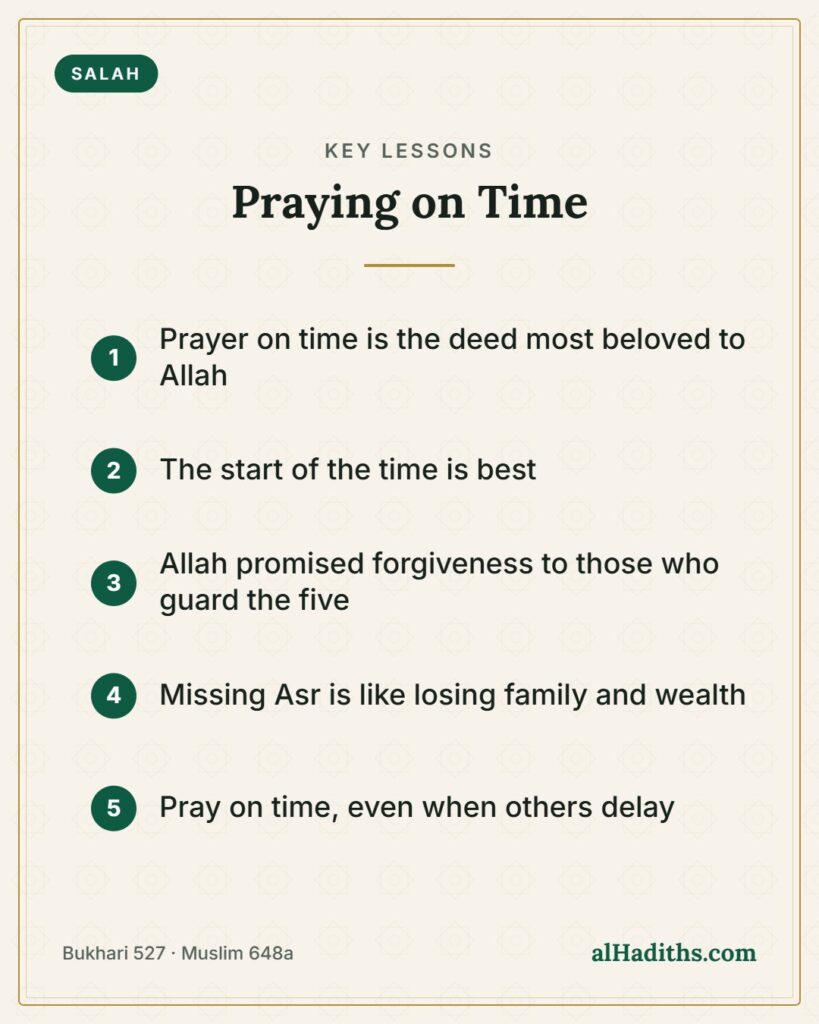
- Prayer at its time is the deed most beloved to Allah.
- The beginning of each prayer’s time is best.
- Allah promised forgiveness to those who guard the five prayers with good wudu, the right time and humility.
- Missing Asr is described as a loss like losing one’s family and wealth.
- Pray on time even when others around you delay.
Before you close this page, look up when the next prayer begins where you are, and decide now where you will be when it does. May Allah make us among those who guard their prayers at their times.
Save this to Pinterest so you can remember to guard each prayer at its time
Share the reward. Send this article to someone who needs it today — teaching a hadith or dua can become a lasting good deed for you, in shaa Allah.