Dua Qunoot: The Witr Dua the Prophet ﷺ Taught al-Hasan
Contents
Many of us say “Ameen” behind the imam in witr without knowing what is being asked. That supplication is dua qunoot (also written dua e qunoot or qunoot dua), and the Prophet ﷺ taught its words to his grandson al-Hasan ibn Ali (may Allah be pleased with him). Here is the authentic wording in Arabic, transliteration and English, what each line asks for, and how the popular “Allahumma inna nasta’inuka” wording fits in.
At a glance
- Source: Sunan Abi Dawud 1425 (also at-Tirmidhi 464, an-Nasa’i 1745, Ibn Majah 1178)
- Narrated by: al-Hasan ibn Ali
- Grade: Sahih (al-Albani)
- Topic: The qunoot supplication in the witr prayer
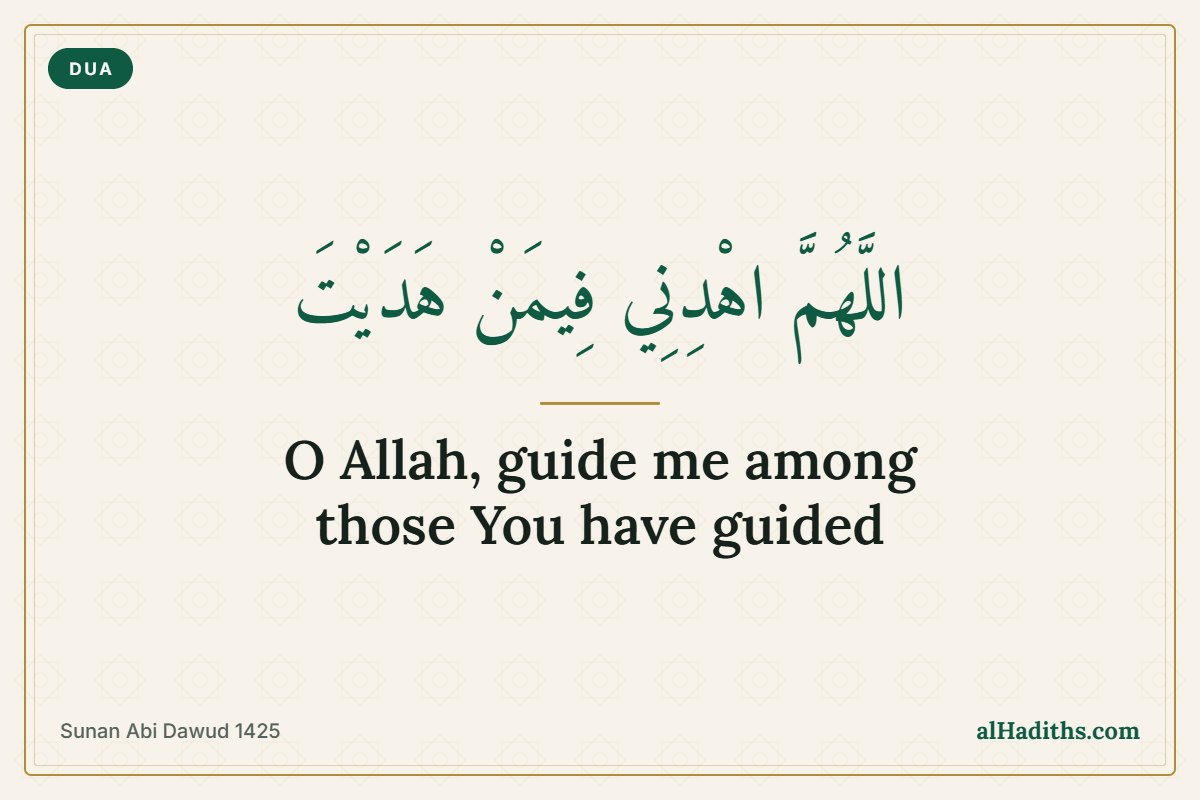
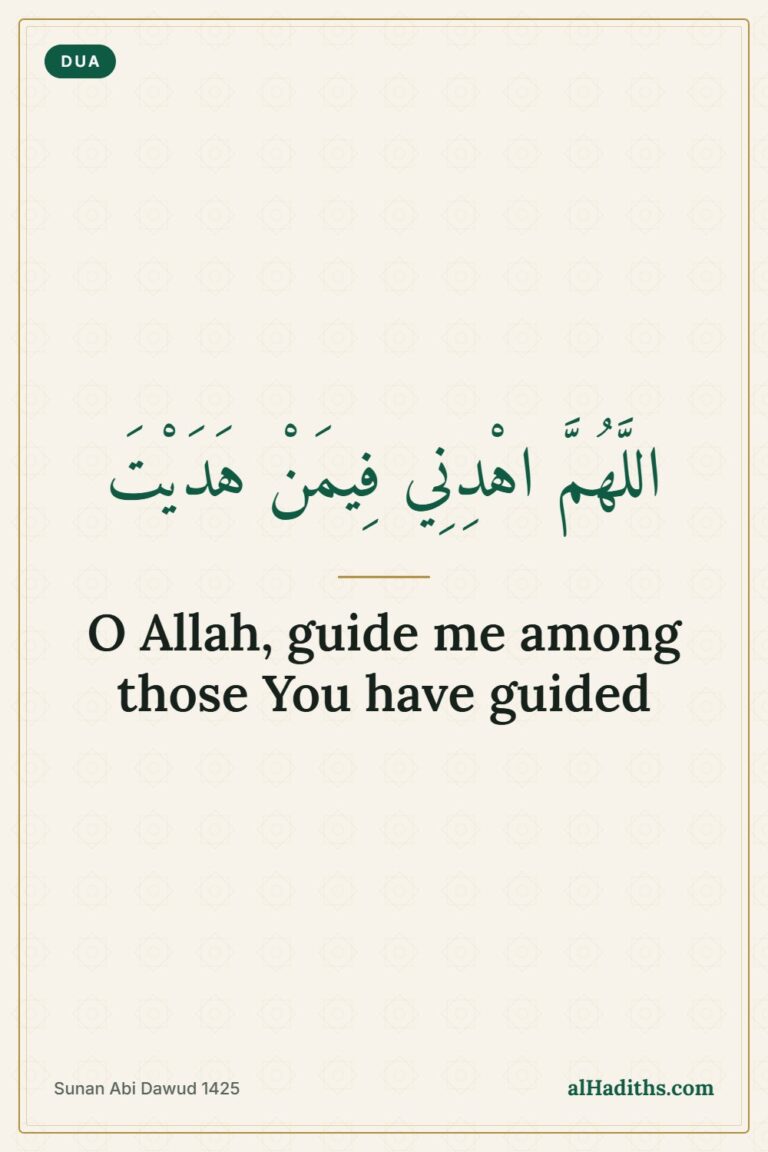
- Practise it: Learn the first line, “Allahumma-hdini fiman hadayt”, tonight
Dua qunoot in Arabic and English
Al-Hasan ibn Ali said that the Messenger of Allah ﷺ taught him words to say in witr. In one narrator’s wording, he said them “in the qunut of witr”.
اللَّهُمَّ اهْدِنِي فِيمَنْ هَدَيْتَ وَعَافِنِي فِيمَنْ عَافَيْتَ وَتَوَلَّنِي فِيمَنْ تَوَلَّيْتَ وَبَارِكْ لِي فِيمَا أَعْطَيْتَ وَقِنِي شَرَّ مَا قَضَيْتَ إِنَّكَ تَقْضِي وَلاَ يُقْضَى عَلَيْكَ وَإِنَّهُ لاَ يَذِلُّ مَنْ وَالَيْتَ وَلاَ يَعِزُّ مَنْ عَادَيْتَ تَبَارَكْتَ رَبَّنَا وَتَعَالَيْتَ
Allāhumma-hdinī fīman hadayt, wa ʿāfinī fīman ʿāfayt, wa tawallanī fīman tawallayt, wa bārik lī fīmā aʿṭayt, wa qinī sharra mā qaḍayt, innaka taqḍī wa lā yuqḍā ʿalayk, wa innahu lā yadhillu man wālayt, wa lā yaʿizzu man ʿādayt, tabārakta rabbanā wa taʿālayt.
“O Allah, guide me among those You have guided, grant me well-being among those You have granted well-being, take me into Your care among those You have taken into Your care, bless me in what You have given, and protect me from the evil of what You have decreed. For You decree, and nothing is decreed against You. The one You befriend is never humbled, and the one You take as an enemy is never honored. Blessed and Exalted are You, our Lord.”
Sunan Abi Dawud 1425 · Sahih (al-Albani) · Narrated by al-Hasan ibn Ali · Translation adapted from Sunnah.com (the line “the one You take as an enemy is never honored” is in the Arabic but missing from Sunnah.com’s English)
The same dua is in Jami’ at-Tirmidhi 464 (Sahih, Darussalam), Sunan an-Nasa’i 1745 (Sahih, Darussalam) and Sunan Ibn Majah 1178 (Sahih, Darussalam). Those versions end at “man walayt” and do not have the line about enemies; Ibn Majah’s has the lines in a different order and adds “Subhanaka”.
Context: why this is the best-known qunoot
In Ibn Majah’s version, al-Hasan calls the Prophet ﷺ “my grandfather”, so this is a dua passed from the Prophet ﷺ to his own grandson. After narrating it, Imam at-Tirmidhi wrote that nothing better is known from the Prophet ﷺ about qunut in witr than this hadith. That is why most witr guides, and most imams, use this wording.
What each line asks for
- Guidance: “guide me among those You have guided” asks to be counted with people Allah has already guided.
- Well-being: “ʿafini” covers safety in body, faith and life, not only health.
- Care: “tawallani” asks Allah to take charge of our affairs as a protector and friend.
- Blessing: “barik li fima aʿtayt” asks for barakah in what we already have.
- Protection: “qini sharra ma qadayt” asks to be shielded from the harm in what is decreed, then affirms that Allah decrees and nothing is decreed over Him.
- Praise: the dua closes by praising Allah as Blessed and Exalted.
Reflection: notice how little of this dua is about the world, and how much of it is about being looked after. Each request asks Allah to place us among people He has already favored. It is a humble way to ask: not “give me what I want” but “treat me as You treated them”.
Another dua the Prophet ﷺ said at the end of witr
Ali ibn Abi Talib (may Allah be pleased with him) reported a second supplication that the Prophet ﷺ used to say at the end of his witr.
اللَّهُمَّ إِنِّي أَعُوذُ بِرِضَاكَ مِنْ سَخَطِكَ وَبِمُعَافَاتِكَ مِنْ عُقُوبَتِكَ وَأَعُوذُ بِكَ مِنْكَ لاَ أُحْصِي ثَنَاءً عَلَيْكَ أَنْتَ كَمَا أَثْنَيْتَ عَلَى نَفْسِكَ
“O Allah, I seek refuge in Your pleasure from Your anger, and in Your pardon from Your punishment, and I seek refuge in You from You. I cannot count Your praise; You are as You have praised Yourself.”
Sunan Abi Dawud 1427 · Sahih (al-Albani) · Narrated by Ali ibn Abi Talib · Translation adapted from Sunnah.com (“I seek refuge in You from You” follows the Arabic)
The hadith says he said it “at the end of his witr”, without saying exactly where. Many people add it after the qunoot, but that placement is a common practice, not something this narration states.
Allahumma inna nasta’inuka: the qunoot of Umar
Many Muslims, especially those who follow the Hanafi school, know dua qunoot as “Allahumma inna nasta’inuka…”. This wording is reported from Umar ibn al-Khattab (may Allah be pleased with him). It is a statement of a Companion, not a hadith of the Prophet ﷺ, but its chain is authentic.
Statement of Umar (not a hadith of the Prophet ﷺ)
اللّهُـمَّ إِيّـاكَ نعْـبُدْ، وَلَـكَ نُصَلّـي وَنَسْـجُد، وَإِلَـيْكَ نَسْـعى وَنَحْـفِد، نَـرْجو رَحْمَـتَك، وَنَخْشـى عَـذابَك، إِنَّ عَـذابَكَ بالكـافرين ملْحَـق. اللّهُـمَّ إِنّا نَسْتَعـينُكَ وَنَسْتَـغْفِرُك، وَنُثْـنـي عَلَـيْك الخَـيْرَ، وَلا نَكْـفُرُك، وَنُـؤْمِنُ بِك، وَنَخْـضَعُ لَكَ وَنَخْـلَعُ مَنْ يَكْـفرُك
Allāhumma iyyāka naʿbud, wa laka nuṣallī wa nasjud, wa ilayka nasʿā wa naḥfid, narjū raḥmatak, wa nakhshā ʿadhābak, inna ʿadhābaka bil-kāfirīna mulḥaq. Allāhumma innā nastaʿīnuk, wa nastaghfiruk, wa nuthnī ʿalaykal-khayr, wa lā nakfuruk, wa nu’minu bik, wa nakhḍaʿu lak, wa nakhlaʿu man yakfuruk.
“O Allah, You alone do we worship, and to You we pray and bow down prostrate. To You we hasten to worship and to serve. Our hope is for Your mercy, and we fear Your punishment. Surely, Your punishment of the disbelievers is at hand. O Allah, we seek Your help and Your forgiveness, and we praise You beneficently. We do not deny You and we believe in You. We surrender to You and renounce whoever disbelieves in You.”
Hisn al-Muslim 118 · Statement of Umar ibn al-Khattab, not a hadith of the Prophet ﷺ · Al-Bayhaqi graded its chain authentic; al-Albani said its chain is authentic as a statement of Umar (Irwa’ al-Ghalil 2/170) · Translation from Sunnah.com
Both wordings are used in witr today. Which one to say, and whether to combine them, is a question of practice on which schools differ, so follow what your local scholar or masjid teaches.
How to practise it
- Learn it a line at a time. The dua has nine short phrases; one phrase a night means you know it in under two weeks.
- Say it in witr. The hadith ties it to witr. Whether qunoot is said all year or only in the second half of Ramadan, and before or after ruku’, are points scholars differ on: at-Tirmidhi lists the views of Ibn Mas’ud, Ali, ash-Shafi’i and Ahmad under hadith 464. Ask a qualified local scholar which to follow.
- Know what you are asking. Read the English once before you pray, so the “Ameen” behind the imam means something.
- After the salam, the Prophet ﷺ said “Subhanal-Malikil-Quddus” (Glory be to the King, the Most Holy), as in Sunan Abi Dawud 1430 (Sahih, al-Albani).
- Leading others: some imams switch to the plural (“ihdina”, guide us). That is an adaptation; the hadith’s wording is singular.
Questions people ask
Is dua qunoot in the Quran?
No. Dua qunoot comes from the Sunnah: the Prophet ﷺ taught it to al-Hasan ibn Ali, as recorded in Sunan Abi Dawud 1425 (Sahih, al-Albani), at-Tirmidhi 464, an-Nasa’i 1745 and Ibn Majah 1178.
Is dua qunoot mandatory in witr?
Scholars differ on how qunoot in witr is done: some say it all year, some only in the second half of Ramadan, and they differ on saying it before or after ruku’. Imam at-Tirmidhi records these views under hadith 464. We do not give a ruling here; ask a qualified local scholar.
Which dua qunoot is authentic?
The wording the Prophet ﷺ taught al-Hasan (“Allahumma-hdini fiman hadayt…”) is graded Sahih. “Allahumma inna nasta’inuka…” is an authentic statement of Umar, not a hadith of the Prophet ﷺ. A version that ends with sending blessings on the Prophet ﷺ (Sunan an-Nasa’i 1746) is graded Da’if (Darussalam), so we have not used it.
Key lessons
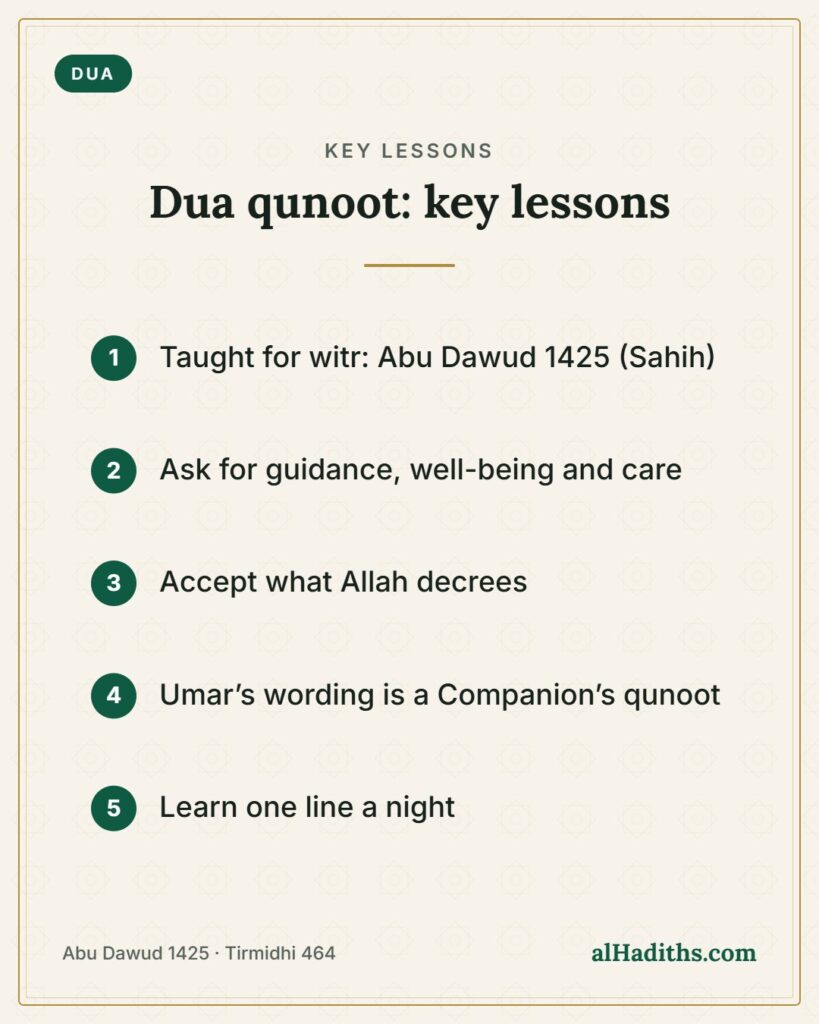
- Dua qunoot is the dua the Prophet ﷺ taught al-Hasan to say in witr (Abu Dawud 1425, Sahih).
- It asks for guidance, well-being, care, blessing and protection, then praises Allah.
- Abu Dawud 1427 gives a second dua the Prophet ﷺ said at the end of witr.
- “Allahumma inna nasta’inuka” is an authentic statement of Umar, not a hadith of the Prophet ﷺ.
- How and when qunoot is said differs between schools; ask a local scholar.
Part of our Dua series: see all our dua articles in one place.
Tonight, try the first line on its own after your witr: Allahumma-hdini fiman hadayt. May Allah place us all among those He has guided.
Save this to Pinterest so you can learn dua qunoot line by line.
Share the reward. Send this article to someone who needs it today — teaching a hadith or dua can become a lasting good deed for you, in shaa Allah.