Morning and Evening Dua for Protection from All Sides
Some duas are so complete that they cover almost everything we could ask for. This morning and evening dua for protection is one of them. Ibn ‘Umar said the Prophet ﷺ never left it, every morning and every evening. In a few lines it asks Allah for pardon and well-being, for our faith, family and wealth, and for protection from every side. Let’s take a look at the hadith together.
At a glance
- Source: Sunan Ibn Majah 3871; also Sunan Abi Dawud 5074
- Narrated by: Ibn ‘Umar (may Allah be pleased with him)
- Grade: Sahih (Darussalam); Sahih (al-Albani) in Abu Dawud
- Topic: Dua, morning and evening remembrance, protection
- Practise it: Say it once every morning and every evening
The hadith
Ibn ‘Umar (may Allah be pleased with him) said that the Messenger of Allah ﷺ never abandoned these supplications, every morning and evening:
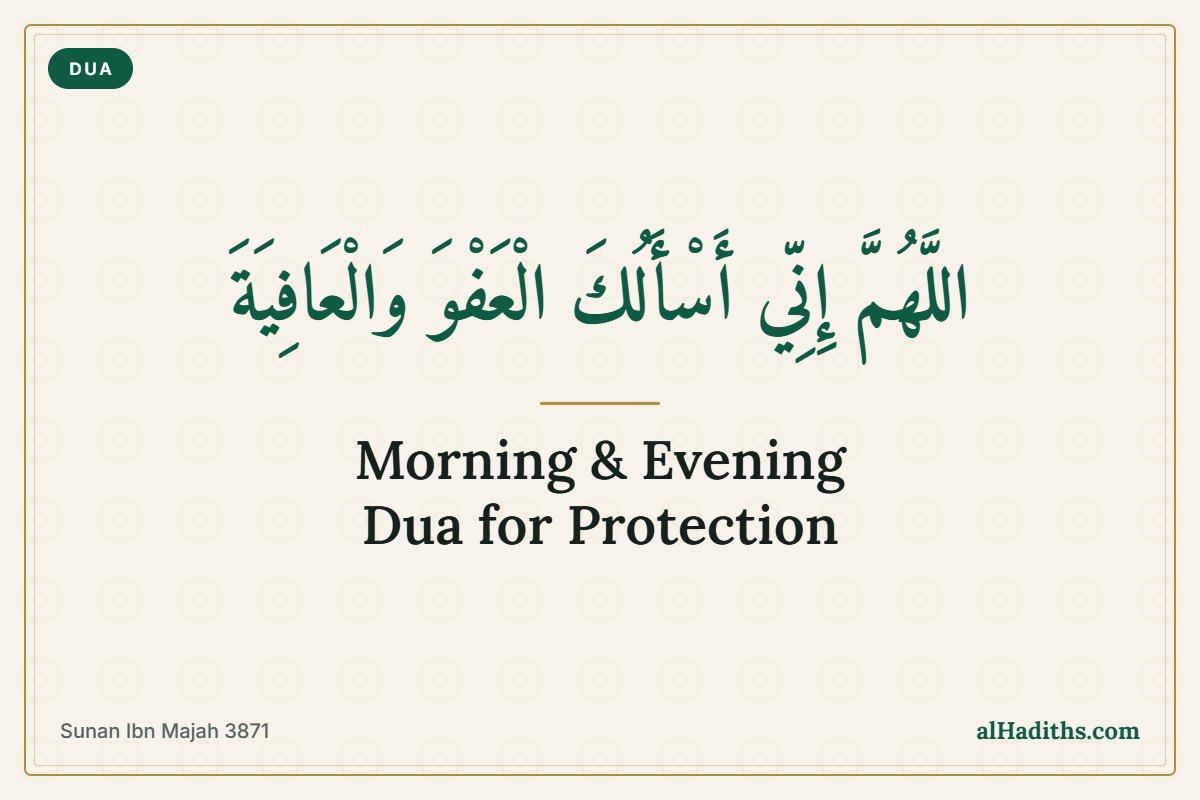
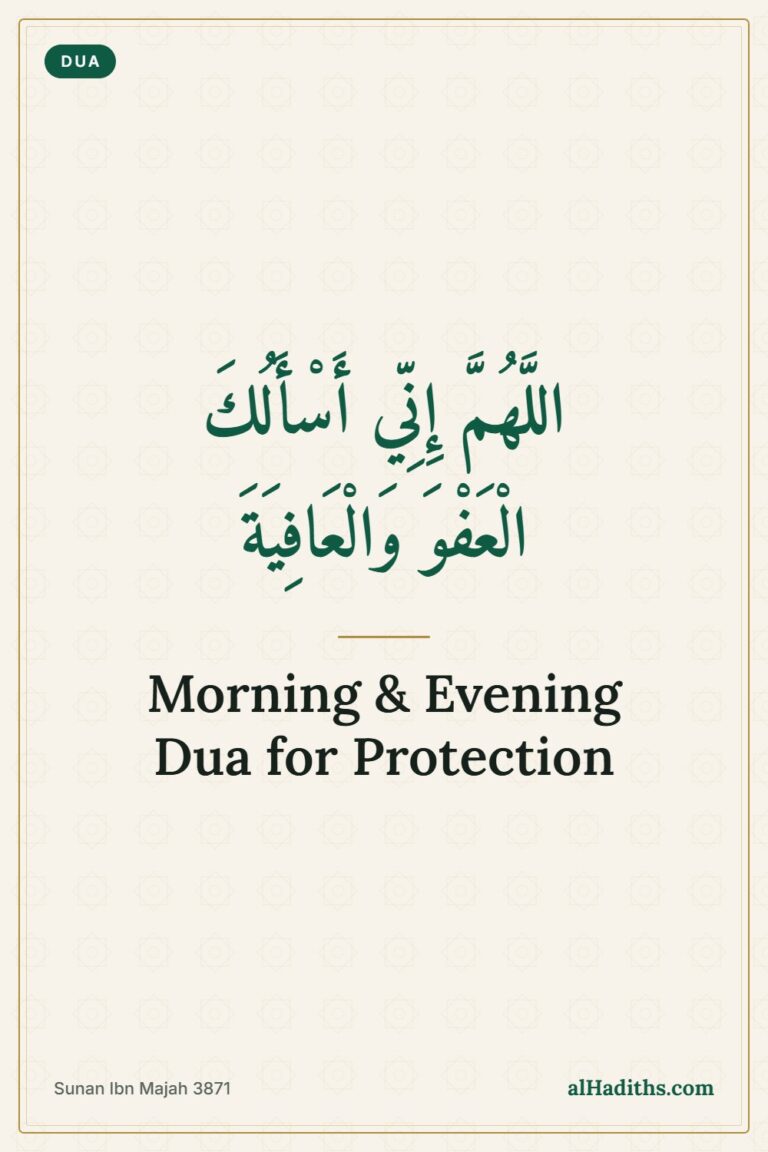
اللَّهُمَّ إِنِّي أَسْأَلُكَ الْعَفْوَ وَالْعَافِيَةَ فِي الدُّنْيَا وَالآخِرَةِ اللَّهُمَّ إِنِّي أَسْأَلُكَ الْعَفْوَ وَالْعَافِيَةَ فِي دِينِي وَدُنْيَاىَ وَأَهْلِي وَمَالِي اللَّهُمَّ اسْتُرْ عَوْرَاتِي وَآمِنْ رَوْعَاتِي وَاحْفَظْنِي مِنْ بَيْنِ يَدَىَّ وَمِنْ خَلْفِي وَعَنْ يَمِينِي وَعَنْ شِمَالِي وَمِنْ فَوْقِي وَأَعُوذُ بِكَ أَنْ أُغْتَالَ مِنْ تَحْتِي
Allāhumma innī as’aluka-l-‘afwa wa-l-‘āfiyah fi-d-dunyā wa-l-ākhirah. Allāhumma innī as’aluka-l-‘afwa wa-l-‘āfiyah fī dīnī wa dunyāya wa ahlī wa mālī. Allāhumma-stur ‘awrātī, wa āmin raw’ātī, wa-ḥfaẓnī min bayni yadayya, wa min khalfī, wa ‘an yamīnī, wa ‘an shimālī, wa min fawqī, wa a’ūdhu bika an ughtāla min taḥtī.
“O Allah, I ask You for forgiveness and well-being in this world and in the Hereafter. O Allah, I ask You for forgiveness and well-being in my religious and my worldly affairs, my family and my wealth. O Allah, conceal my faults, calm my fears, and protect me from before me and behind me, from my right and my left, and from above me, and I seek refuge in You from being taken unaware from beneath me.”
Sunan Ibn Majah 3871 · Sahih (Darussalam) · Narrated by Ibn ‘Umar · Translation adapted from Sunnah.com
The same hadith is in Sunan Abi Dawud 5074, graded Sahih by al-Albani. There, the narrator Waki’ explains the last line, being taken unaware from beneath, as being swallowed by the earth.
What the dua asks for, line by line
The meanings follow the Sunnah.com translations of Ibn Majah 3871 and Abu Dawud 5074.
- Al-‘afwa wa-l-‘āfiyah fi-d-dunyā wa-l-ākhirah (الْعَفْوَ وَالْعَافِيَةَ فِي الدُّنْيَا وَالآخِرَةِ): pardon and well-being in this world and the Hereafter.
- Fī dīnī wa dunyāya wa ahlī wa mālī (فِي دِينِي وَدُنْيَاىَ وَأَهْلِي وَمَالِي): in my religion, my worldly life, my family and my wealth.
- Allāhumma-stur ‘awrātī (اللَّهُمَّ اسْتُرْ عَوْرَاتِي): O Allah, conceal my faults.
- Wa āmin raw’ātī (وَآمِنْ رَوْعَاتِي): and calm my fears; keep me safe from the things I fear.
- Wa-ḥfaẓnī min bayni yadayya … wa min fawqī (وَاحْفَظْنِي مِنْ بَيْنِ يَدَىَّ وَمِنْ خَلْفِي وَعَنْ يَمِينِي وَعَنْ شِمَالِي وَمِنْ فَوْقِي): protect me from in front, behind, my right, my left and above.
- Wa a’ūdhu bika an ughtāla min taḥtī (وَأَعُوذُ بِكَ أَنْ أُغْتَالَ مِنْ تَحْتِي): and I seek refuge in You from being taken unaware from beneath me.
What is ‘āfiyah?
‘Āfiyah is often translated as well-being, but it is wider than good health. It means being kept safe and sound: in your body, your faith, your family and your affairs. The Prophet ﷺ placed it right after certainty of faith:
سَلُوا اللَّهَ الْعَفْوَ وَالْعَافِيَةَ فَإِنَّ أَحَدًا لَمْ يُعْطَ بَعْدَ الْيَقِينِ خَيْرًا مِنَ الْعَافِيَةِ
“Ask Allah for pardon and Al-‘Āfiyah (well-being). None of you is given anything after Yaqeen (certainty), anything better than Al-‘Āfiyah (well-being).”
Jami` at-Tirmidhi 3558 · Sahih (Darussalam) · Narrated by Abu Bakr as-Siddiq
Reflection: Notice how this dua moves from the biggest things to the smallest details. It starts with this life and the next, then our faith, family and wealth, then our hidden faults and private fears, and finally every direction around us. It is a reminder that there is nothing too big or too small to ask Allah about.
How to practise this morning and evening dua for protection
- Say it once in the morning and once in the evening. That is exactly what the hadith describes the Prophet ﷺ doing.
- Start with the first line if the full dua feels long. Personally, I recite the first line: Allāhumma innī as’aluka-l-‘afwa wa-l-‘āfiyah fi-d-dunyā wa-l-ākhirah. It is a good place to start, and you can add the next lines one at a time.
- Attach it to a routine you already have. For example, after Subuh and after Asr, together with your other morning and evening adhkar.
- Pair it with other morning and evening duas. Such as Sayyidul Istighfar and the dua for daily protection.
- Mean what you ask. When you reach “my family and my wealth”, think of the people and things you are placing in Allah’s care.
Key lessons
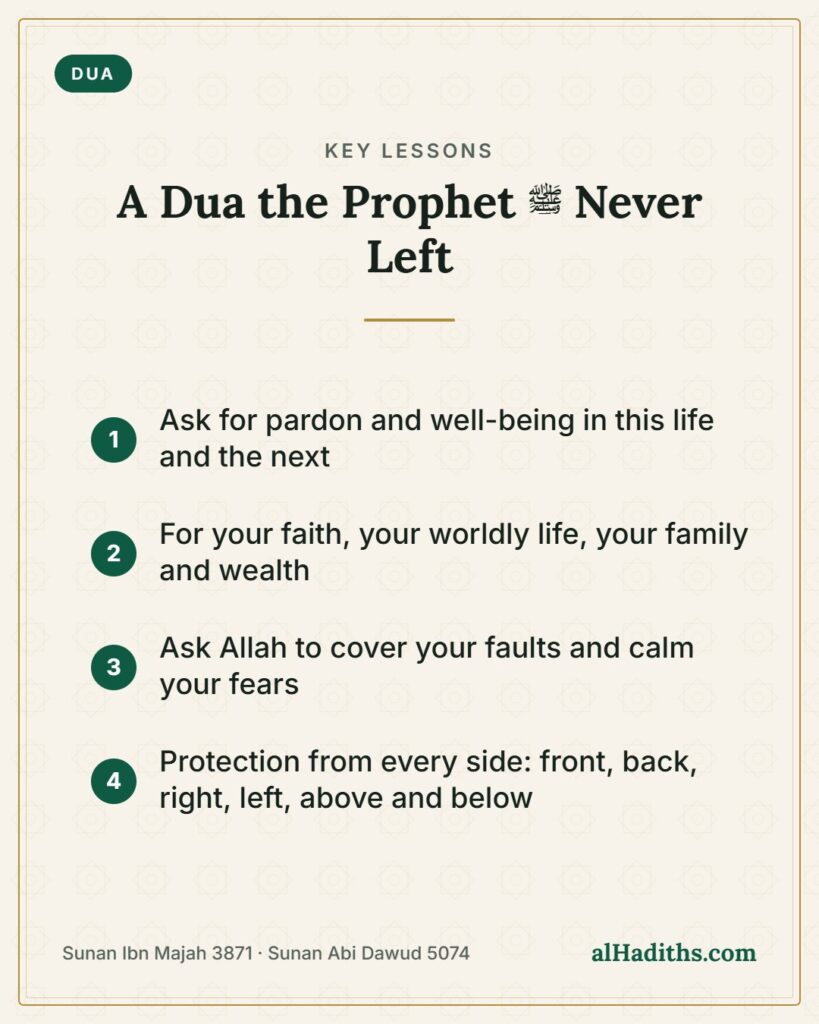
- The Prophet ﷺ never left this dua, morning or evening (Sunan Ibn Majah 3871, Sunan Abi Dawud 5074).
- It asks for pardon and ‘āfiyah in this world and the next, for our faith, family and wealth.
- It asks Allah to cover our faults, calm our fears and protect us from every side.
- Nothing after certainty of faith is better than ‘āfiyah (Jami` at-Tirmidhi 3558).
Questions people ask
When should I recite this dua?
Ibn ‘Umar said the Prophet ﷺ never left it in the evening and in the morning (Sunan Ibn Majah 3871, Sunan Abi Dawud 5074). Many people say it with their morning adhkar after Subuh and their evening adhkar after Asr or Maghrib.
What does ‘āfiyah mean?
‘Āfiyah means well-being and being kept safe: in body, faith, family and worldly affairs. The Prophet ﷺ said that no one is given anything better than ‘āfiyah after certainty of faith (Jami` at-Tirmidhi 3558).
Is it okay to recite only part of the dua?
The hadith describes the full set of supplications. Reciting part of it, such as the first line, is still asking Allah for good, and it is a helpful way to start learning it. For a detailed ruling, please ask a qualified local scholar.
I hope this dua becomes part of your mornings and evenings, even if you start with just the first line. May Allah grant us all pardon and ‘āfiyah in this world and the next. Ameen.
Save this to Pinterest so you can find the dua again.
Share the reward. Send this article to someone who needs it today — teaching a hadith or dua can become a lasting good deed for you, in shaa Allah.