Dua for Travel: 5 Authentic Duas for a Safe Journey
Contents
Before a drive, a flight or a long journey home, many Muslims look for the dua for travel. The Sunnah gives more than one: the Prophet ﷺ had words for setting out, for getting on his ride, for stopping on the way and for coming home, and words for seeing a traveler off. Here are five of them, with the Arabic, the meaning and the source for each.
At a glance
- Duas: 5 authentic duas for travel
- Sources: Sahih Muslim, Sahih al-Bukhari, Sunan Abi Dawud
- Grade: Sahih (and one Hasan hadith on the traveler’s dua)
- Topic: Travel and journeys
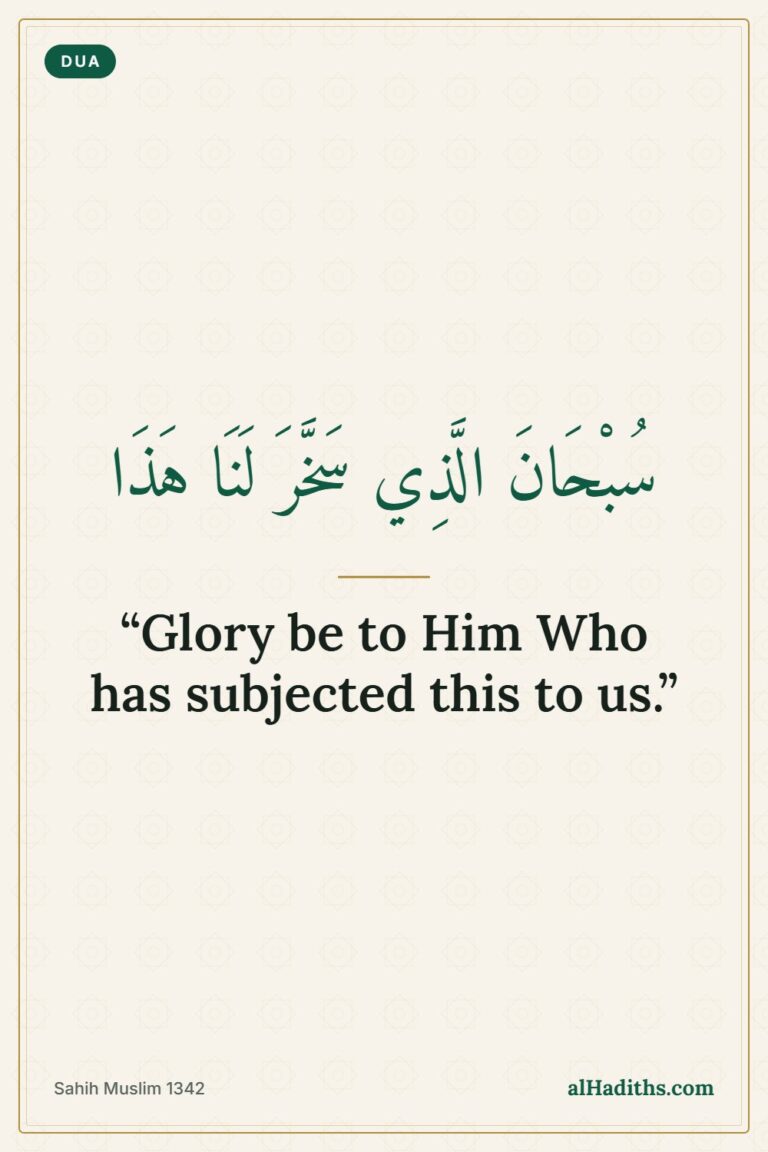
- Today: Learn the opening line: “Subhanalladhi sakhkhara lana hadha”
1. The dua for travel when setting out
Ibn Umar (may Allah be pleased with him) reported that whenever the Messenger of Allah ﷺ mounted his camel to set out on a journey, he said “Allahu akbar” three times, then said:
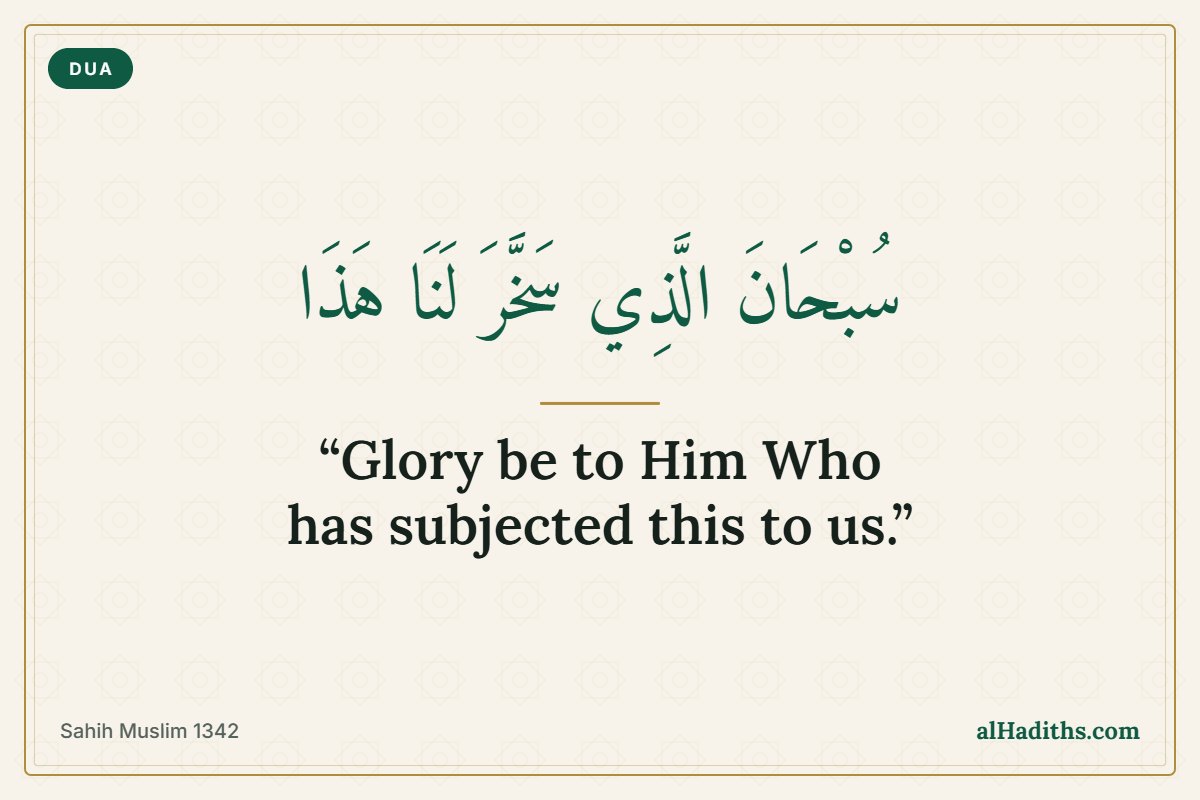
سُبْحَانَ الَّذِي سَخَّرَ لَنَا هَذَا وَمَا كُنَّا لَهُ مُقْرِنِينَ وَإِنَّا إِلَى رَبِّنَا لَمُنْقَلِبُونَ اللَّهُمَّ إِنَّا نَسْأَلُكَ فِي سَفَرِنَا هَذَا الْبِرَّ وَالتَّقْوَى وَمِنَ الْعَمَلِ مَا تَرْضَى اللَّهُمَّ هَوِّنْ عَلَيْنَا سَفَرَنَا هَذَا وَاطْوِ عَنَّا بُعْدَهُ اللَّهُمَّ أَنْتَ الصَّاحِبُ فِي السَّفَرِ وَالْخَلِيفَةُ فِي الأَهْلِ اللَّهُمَّ إِنِّي أَعُوذُ بِكَ مِنْ وَعْثَاءِ السَّفَرِ وَكَآبَةِ الْمَنْظَرِ وَسُوءِ الْمُنْقَلَبِ فِي الْمَالِ وَالأَهْلِ
Subhanalladhi sakhkhara lana hadha wa ma kunna lahu muqrinin, wa inna ila rabbina lamunqalibun. Allahumma inna nas’aluka fi safarina hadhal-birra wat-taqwa, wa minal-‘amali ma tarda. Allahumma hawwin ‘alayna safarana hadha watwi ‘anna bu‘dah. Allahumma antas-sahibu fis-safari wal-khalifatu fil-ahl. Allahumma inni a‘udhu bika min wa‘tha’is-safari wa ka’abatil-manzari wa su’il-munqalabi fil-mali wal-ahl.
“Glory be to Him Who has subjected this to us, and we could not have done it ourselves, and to our Lord we will surely return. O Allah, we ask You on this journey of ours for righteousness and piety, and for deeds that please You. O Allah, make this journey easy for us and shorten its distance for us. O Allah, You are the Companion on the journey and the One who looks after the family. O Allah, I seek refuge in You from the hardships of travel, from a distressing sight, and from an evil return to my wealth and family.”
Sahih Muslim 1342 · Narrated by Ibn Umar · Translation adapted from Sunnah.com
The dua opens with the words of the Quran (43:13-14), then asks for three things: piety on the road, an easy journey, and Allah’s care for the family left behind. In the same hadith, Ibn Umar adds that when the Prophet ﷺ came back, he said the same words and added: Ayibuna, ta’ibuna, ‘abiduna, li-rabbina hamidun, “Returning, repenting, worshipping, and praising our Lord.” The HadeethEnc explanation notes that the traveler entrusts his affairs to Allah and seeks His protection from the hardships of the road.
Try this: before your next trip, say “Allahu akbar” three times as you set off, then the dua, even if you read it from your phone.
2. Getting on your ride: Bismillah and Alhamdulillah
Ali ibn Rabi‘ah said he saw Ali (may Allah be pleased with him) being brought an animal to ride. As he put his foot in the stirrup he said “Bismillah”, and once seated he said “Alhamdulillah”, then the verse “Subhanalladhi sakhkhara lana hadha…”. He then said “Alhamdulillah” three times and “Allahu akbar” three times, and ended with:
سُبْحَانَكَ إِنِّي ظَلَمْتُ نَفْسِي فَاغْفِرْ لِي فَإِنَّهُ لاَ يَغْفِرُ الذُّنُوبَ إِلاَّ أَنْتَ
Subhanaka inni zalamtu nafsi faghfir li, fa’innahu la yaghfirudh-dhunuba illa ant.
“Glory be to You, I have wronged myself, so forgive me, for none forgives sins except You.”
Sunan Abi Dawud 2602 · Sahih (al-Albani) · Narrated by Ali ibn Abi Talib · Translation adapted from Sunnah.com
Then Ali laughed, and said he had seen the Prophet ﷺ do the same and laugh. When asked why, the Prophet ﷺ said that our Lord is pleased with His servant when he says “Forgive me my sins,” knowing that none forgives sins but Him. The same report is in Jami‘ at-Tirmidhi 3446 (Sahih, Darussalam).
Try this: say “Bismillah” as you sit down in the car or the plane, and “Alhamdulillah” once you are settled.
3. When you stop on the way
Khawlah bint Hakim (may Allah be pleased with her) said she heard the Messenger of Allah ﷺ say:
مَنْ نَزَلَ مَنْزِلاً ثُمَّ قَالَ أَعُوذُ بِكَلِمَاتِ اللَّهِ التَّامَّاتِ مِنْ شَرِّ مَا خَلَقَ. لَمْ يَضُرُّهُ شَىْءٌ حَتَّى يَرْتَحِلَ مِنْ مَنْزِلِهِ ذَلِكَ
“Whoever stops at a place and then says, ‘I seek refuge in the perfect words of Allah from the evil of what He has created,’ nothing will harm him until he moves on from that place.”
Sahih Muslim 2708 · Narrated by Khawlah bint Hakim · Translation adapted from Sunnah.com
The words to say are: A‘udhu bi kalimatillahit-tammati min sharri ma khalaq. The hadith speaks of stopping at any place on the way, so it fits a rest stop, a hotel room or a night with family in another town.
Try this: say it once when you arrive at your hotel or wherever you stay the night.
4. Seeing someone off on a journey
Qaza‘ah said that Ibn Umar (may Allah be pleased with him) told him, “Come, let me see you off as the Messenger of Allah ﷺ saw me off,” and said:
أَسْتَوْدِعُ اللَّهَ دِينَكَ وَأَمَانَتَكَ وَخَوَاتِيمَ عَمَلِكَ
Astawdi‘ullaha dinaka wa amanataka wa khawatima ‘amalik.
“I entrust to Allah your religion, your trusts and the last of your deeds.”
Sunan Abi Dawud 2600 · Sahih (al-Albani) · Narrated by Ibn Umar · Translation adapted from Sunnah.com
A parallel is in Jami‘ at-Tirmidhi 3443 (Hasan, Darussalam). The HadeethEnc explanation says the dua asks Allah to guard the traveler’s faith and the trusts placed in him, since a journey brings dealings with many people. In Sunan Ibn Majah 2825 (Sahih, Darussalam), Abu Hurairah reports that the Prophet ﷺ saw him off with: “I commend you to the keeping of Allah, Whose trusts are never lost.”
Try this: when a family member leaves for a trip, say this dua to them at the door.
5. Coming home
Abdullah ibn Umar (may Allah be pleased with him) reported that whenever the Messenger of Allah ﷺ returned from a battle, Hajj or Umrah, he said “Allahu akbar” three times at every rise in the ground, then said:
لاَ إِلَهَ إِلاَّ اللَّهُ وَحْدَهُ لاَ شَرِيكَ لَهُ، لَهُ الْمُلْكُ، وَلَهُ الْحَمْدُ، وَهُوَ عَلَى كُلِّ شَىْءٍ قَدِيرٌ، آيِبُونَ تَائِبُونَ عَابِدُونَ سَاجِدُونَ لِرَبِّنَا حَامِدُونَ، صَدَقَ اللَّهُ وَعْدَهُ وَنَصَرَ عَبْدَهُ وَهَزَمَ الأَحْزَابَ وَحْدَهُ
La ilaha illallahu wahdahu la sharika lah, lahul-mulku wa lahul-hamdu, wa huwa ‘ala kulli shay’in qadir. Ayibuna, ta’ibuna, ‘abiduna, sajiduna, li-rabbina hamidun. Sadaqallahu wa‘dahu, wa nasara ‘abdahu, wa hazamal-ahzaba wahdah.
“None has the right to be worshipped but Allah alone, without partner. His is the dominion and His is the praise, and He has power over all things. Returning, repenting, worshipping, prostrating, and praising our Lord. Allah fulfilled His promise, helped His servant and defeated the confederates alone.”
Sahih al-Bukhari 1797 · Narrated by Abdullah ibn Umar · Translation adapted from Sunnah.com
The same words are in Sahih Muslim 1344. The hadith names return from battle, Hajj and Umrah; the shorter return line in Muslim 1342 above is for any journey.
Try this: as your town comes into view, say “Ayibuna, ta’ibuna, ‘abiduna, li-rabbina hamidun.”
Bringing it together
The opening line of the dua for travel comes from the Quran, where Allah speaks of the rides He made for us:
لِتَسْتَوُۥا۟ عَلَىٰ ظُهُورِهِۦ ثُمَّ تَذْكُرُوا۟ نِعْمَةَ رَبِّكُمْ إِذَا ٱسْتَوَيْتُمْ عَلَيْهِ وَتَقُولُوا۟ سُبْحَـٰنَ ٱلَّذِى سَخَّرَ لَنَا هَـٰذَا وَمَا كُنَّا لَهُۥ مُقْرِنِينَ وَإِنَّآ إِلَىٰ رَبِّنَا لَمُنقَلِبُونَ
That you may settle yourselves upon their backs and then remember the favor of your Lord when you have settled upon them and say, “Exalted is He who has subjected this to us, and we could not have [otherwise] subdued it. And indeed we, to our Lord, will [surely] return.”
Surah az-Zukhruf 43:13-14 · Translation: Saheeh International, from Quran.com
And the time on the road is a time to ask. Abu Hurairah (may Allah be pleased with him) reported that the Prophet ﷺ said:
ثَلاَثُ دَعَوَاتٍ مُسْتَجَابَاتٌ لاَ شَكَّ فِيهِنَّ دَعْوَةُ الْوَالِدِ وَدَعْوَةُ الْمُسَافِرِ وَدَعْوَةُ الْمَظْلُومِ
“Three supplications are answered, there is no doubt about them: the supplication of a father, the supplication of a traveler, and the supplication of one who has been wronged.”
Sunan Abi Dawud 1536 · Hasan (al-Albani) · Narrated by Abu Hurairah · Translation adapted from Sunnah.com
Reflection: every journey ends with a return, and the travel dua keeps that in view from the first line: “to our Lord we will surely return.” A trip that starts with that reminder, and with time set aside for dua on the way, is never only about the destination.
Questions people ask
Is there a dua for traveling by plane or car?
No authentic hadith gives a separate dua for planes, cars or trains. Many Muslims say the travel dua from Sahih Muslim 1342 when they set off in any vehicle, since its opening verse speaks of what Allah has subjected to us. That use is an application of the hadith, not something it states.
Is the dua of a traveler accepted?
Yes. In Sunan Abi Dawud 1536 (Hasan, al-Albani), the Prophet ﷺ named the traveler’s dua among three supplications that are answered.
Is the farewell hadith where the Prophet ﷺ held the man’s hand authentic?
That version is in Jami‘ at-Tirmidhi 3442, graded Da‘if (Darussalam), so it is not used here. The farewell words themselves are authentic through Sunan Abi Dawud 2600 (Sahih, al-Albani).
Key lessons
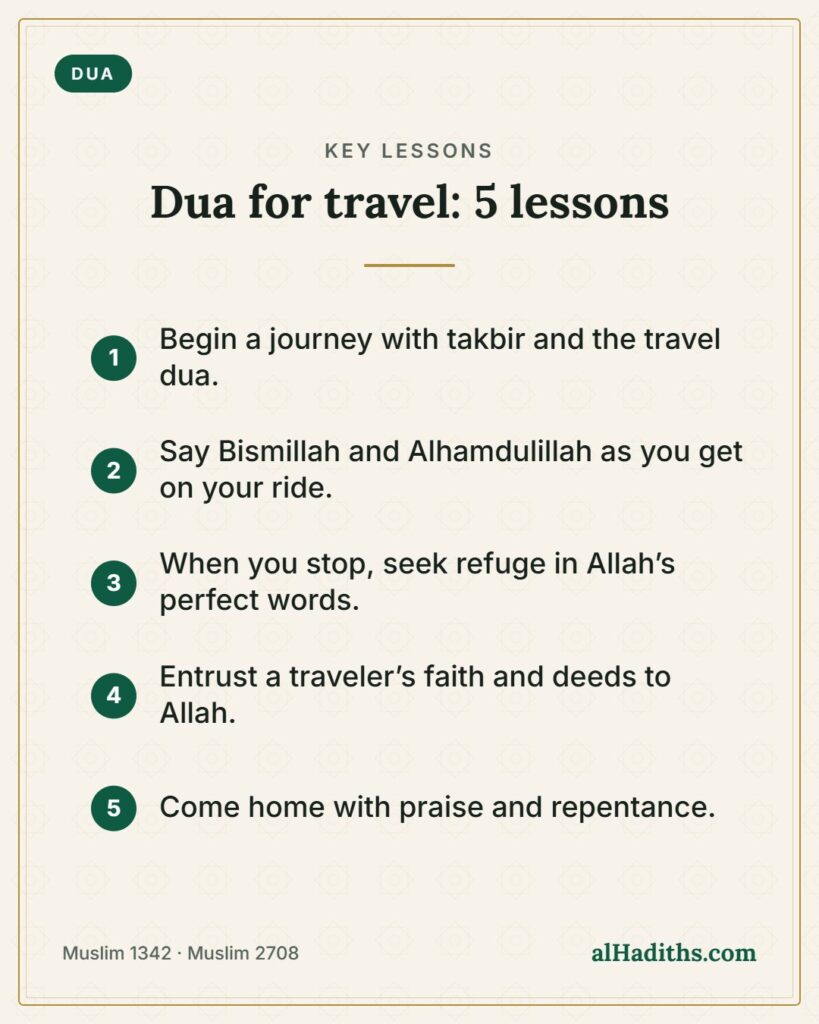
- Begin a journey with “Allahu akbar” three times and the travel dua.
- Say “Bismillah” and “Alhamdulillah” as you get on your ride.
- When you stop, seek refuge in the perfect words of Allah.
- Entrust a traveler’s faith, trusts and last deeds to Allah.
- Come home with praise and repentance: “Ayibuna, ta’ibuna.”
Part of our Dua series: see all our dua articles in one place.
May Allah make your journeys easy, keep your family safe while you are away, and bring you home in good health.
Save this to Pinterest so you can say it before your next journey
Share the reward. Send this article to someone who needs it today — teaching a hadith or dua can become a lasting good deed for you, in shaa Allah.