Bismillahilladhi La Yadurru: Dua for Protection from Harm
There is one dua for daily protection that, alhamdulillah, I practise most days after Fajr and after Asr: a single sentence, said three times in the morning and three times in the evening. The Prophet ﷺ said that whoever says it will not be struck by a sudden affliction until the next morning or evening. Here is the dua for protection from harm, Bismillahilladhi la yadurru, with its Arabic, meaning and a short story from one of its narrators.
At a glance
- Source: Sunan Abi Dawud 5088 (also Jami’ at-Tirmidhi 3388)
- Narrated by: ‘Uthman ibn ‘Affan (may Allah be pleased with him)
- Grade: Sahih (al-Albani)
- Topic: Morning and evening protection
- Practise it: Three times every morning and three times every evening
The hadith
مَنْ قَالَ بِسْمِ اللَّهِ الَّذِي لاَ يَضُرُّ مَعَ اسْمِهِ شَىْءٌ فِي الأَرْضِ وَلاَ فِي السَّمَاءِ وَهُوَ السَّمِيعُ الْعَلِيمُ ثَلاَثَ مَرَّاتٍ لَمْ تُصِبْهُ فَجْأَةُ بَلاَءٍ حَتَّى يُصْبِحَ وَمَنْ قَالَهَا حِينَ يُصْبِحُ ثَلاَثَ مَرَّاتٍ لَمْ تُصِبْهُ فَجْأَةُ بَلاَءٍ حَتَّى يُمْسِيَ
“Whoever says three times, ‘In the name of Allah, with whose name nothing on earth or in the heaven can cause harm, and He is the All-Hearing, the All-Knowing’, no sudden affliction will strike him until the morning. And whoever says it three times in the morning, no sudden affliction will strike him until the evening.”
Sunan Abi Dawud 5088 · Sahih (al-Albani) · Narrated by ‘Uthman ibn ‘Affan · Translation adapted from Sunnah.com
مَا مِنْ عَبْدٍ يَقُولُ فِي صَبَاحِ كُلِّ يَوْمٍ وَمَسَاءِ كُلِّ لَيْلَةٍ بِسْمِ اللَّهِ الَّذِي لاَ يَضُرُّ مَعَ اسْمِهِ شَيْءٌ فِي الأَرْضِ وَلاَ فِي السَّمَاءِ وَهُوَ السَّمِيعُ الْعَلِيمُ ثَلاَثَ مَرَّاتٍ فَيَضُرُّهُ شَيْءٌ
“There is no servant who says, in the morning of every day and the evening of every night, ‘In the name of Allah, with whose name nothing on earth or in the heaven can cause harm, and He is the All-Hearing, the All-Knowing’ three times, and then anything harms him.”
Jami’ at-Tirmidhi 3388 · Hasan (Darussalam) · Also Sunan Ibn Majah 3869 · Translation adapted from Sunnah.com
The dua to memorise
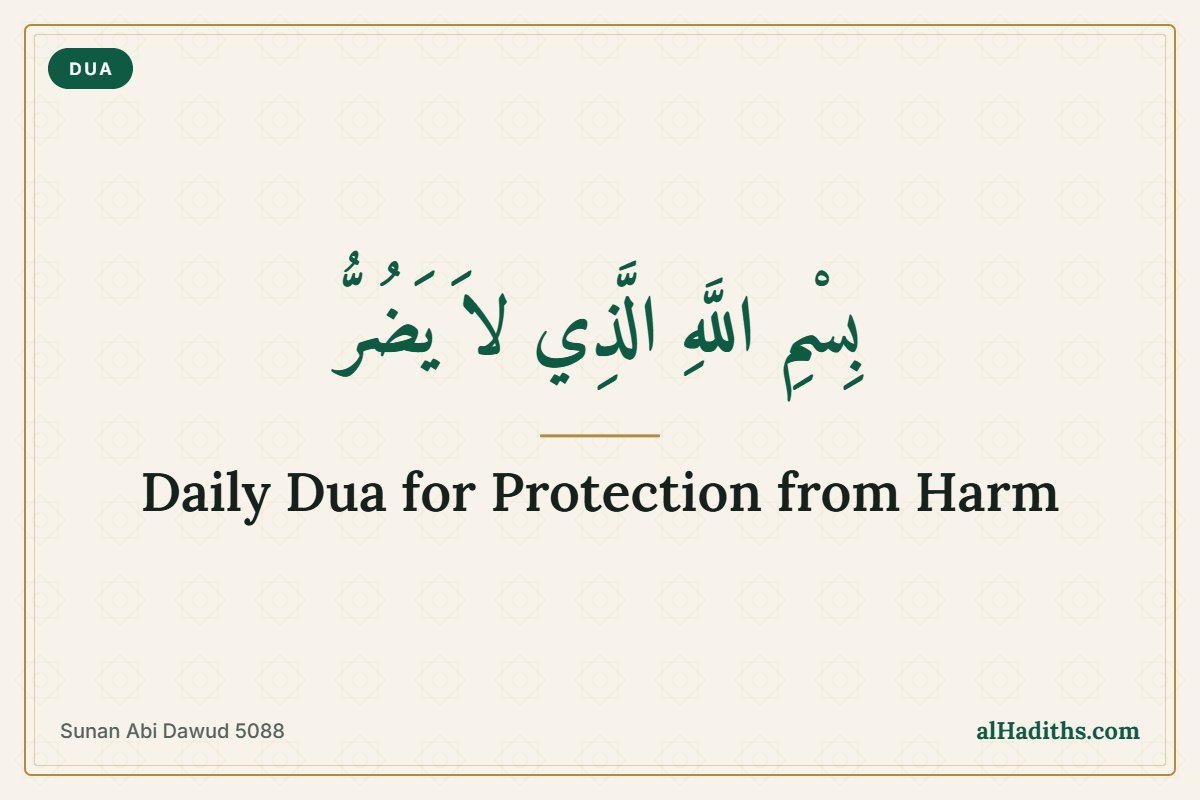
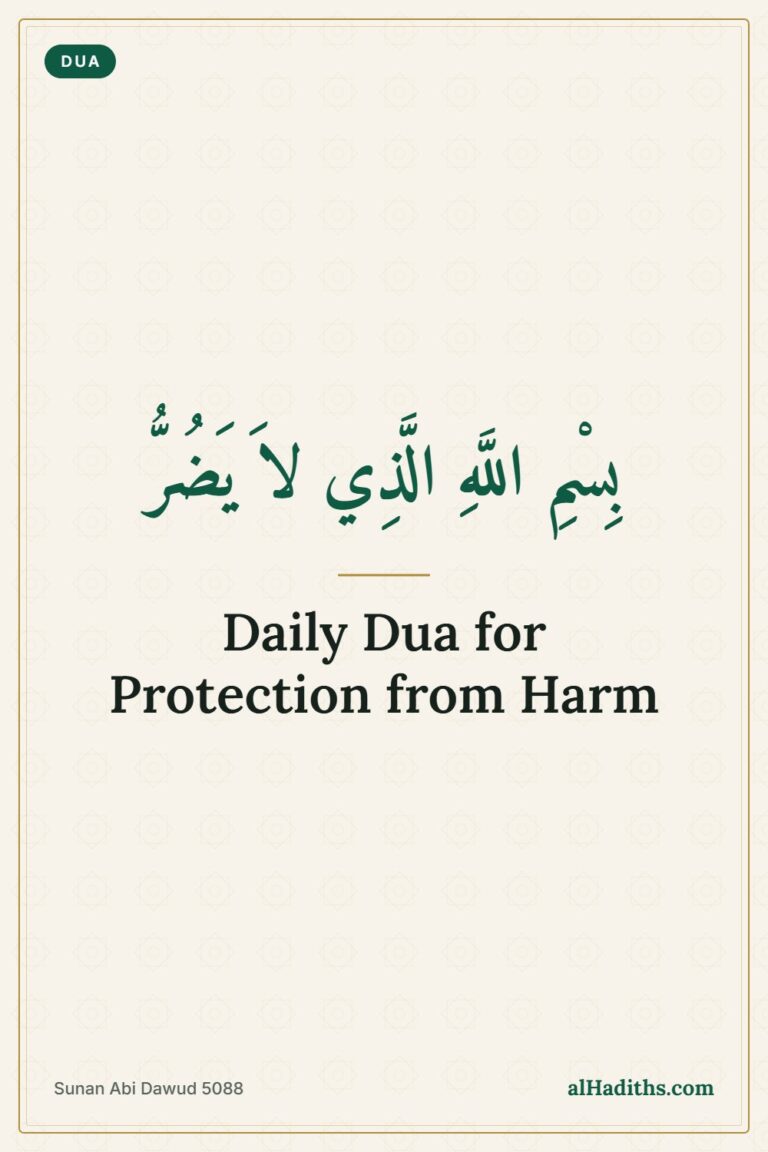
بِسْمِ اللَّهِ الَّذِي لاَ يَضُرُّ مَعَ اسْمِهِ شَىْءٌ فِي الأَرْضِ وَلاَ فِي السَّمَاءِ وَهُوَ السَّمِيعُ الْعَلِيمُ
Bismillāhil-ladhī lā yaḍurru ma’asmihī shay’un fil-arḍi wa lā fis-samā’, wa Huwas-Samī’ul-‘Alīm.
In the name of Allah, with whose name nothing on earth or in the heaven can cause harm, and He is the All-Hearing, the All-Knowing.
Sunan Abi Dawud 5088 · Say it three times · Translation adapted from Sunnah.com
The story of Aban
The hadith was passed on by Aban, the son of ‘Uthman ibn ‘Affan. Later in life Aban was struck by a partial paralysis. A man who had heard the hadith from him began to look at him, as if to ask how this could happen.
Aban told him the hadith was true, but that on that day he had not said the dua. In Abu Dawud’s narration he says he had become angry and forgot to say it. In at-Tirmidhi’s narration he says he did not say it that day, so Allah’s decree came to pass.
Reflection: the dua is not a charm. It is a request to Allah, and Allah’s decree is always above it. Aban’s story is a reminder of how easy it is to miss on the one day it matters.
What the words mean
- Bismillah: “In the name of Allah.” We begin the day, or the night, with His name.
- Alladhi la yadurru ma’asmihi shay’un: “With whose name nothing can cause harm.” Harm only reaches us if Allah allows it.
- Fil-ardi wa la fis-sama’: “On earth or in the heaven.” It covers every source of harm, seen and unseen.
- Wa Huwas-Sami’ul-‘Alim: “And He is the All-Hearing, the All-Knowing.” He hears the dua and knows what we need protection from.
How to practise it
- Three times in the morning, three times in the evening. In Abu Dawud’s wording, the evening dua covers you until the morning and the morning dua until the evening.
- Tie it to a prayer. The hadith does not fix an exact time. A simple habit is to say it after Fajr for the morning, and after Asr or Maghrib for the evening. I say it after Fajr and Asr.
- Count on your fingers so you know you have said it three times.
- Teach it to your children. It is one sentence, and it teaches them to rely on Allah for their safety.
- Add it to your other adhkar, such as Ayatul Kursi after each prayer.
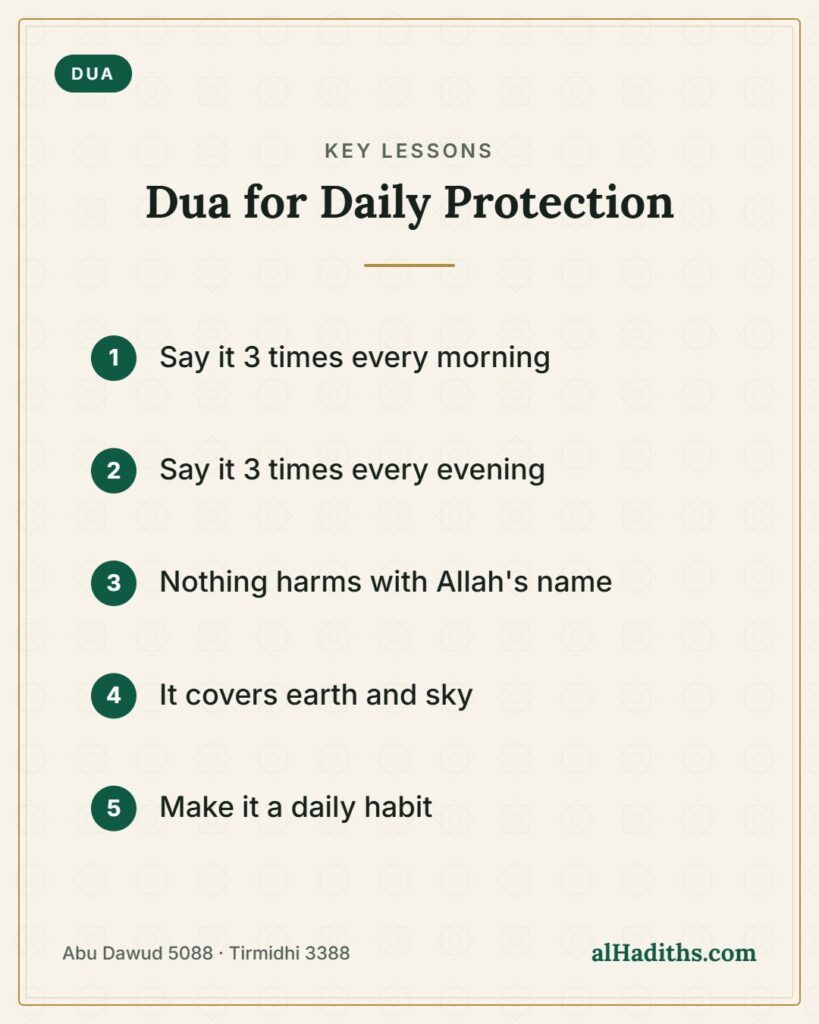
Key lessons
- Say this dua three times every morning and three times every evening.
- With Allah’s name, nothing on earth or in the heaven can harm.
- The dua is a request to Allah, not a charm; His decree is above it.
- Aban’s story shows how easy it is to miss it on the day it matters.
- One sentence is easy to teach to children.
Questions people ask
How many times should I say Bismillahilladhi la yadurru?
Three times in the morning and three times in the evening, as in Sunan Abi Dawud 5088 and Jami’ at-Tirmidhi 3388.
When is the morning and evening time for this dua?
The hadith says morning and evening without fixing a time. Many people say it after Fajr, and after Asr or Maghrib. For the details, ask a qualified scholar.
Is the hadith about Bismillahilladhi la yadurru authentic?
Yes. Sunan Abi Dawud 5088 is graded Sahih by al-Albani, and Jami’ at-Tirmidhi 3388 is graded Hasan by Darussalam.
Tomorrow after Fajr, say it three times. After Asr, three more. Six short sentences a day, and in shaa Allah you are under Allah’s protection.
Save this to Pinterest so you remember it every morning and evening.
Share the reward. Send this article to someone who needs it today — teaching a hadith or dua can become a lasting good deed for you, in shaa Allah.