Surah Ikhlas Benefits: 7 Authentic Hadith on When to Recite
Contents
Surah al-Ikhlas is only four short verses, and many of us learned it as children. Yet the authentic hadith show its place is far larger than its length. These are the Surah Ikhlas benefits confirmed in Sahih hadith, and the moments the Prophet ﷺ chose to recite it.
At a glance
- Hadith: 7, plus the surah itself (112:1–4)
- Collections: Bukhari, Muslim, Abu Dawud, Tirmidhi
- Grade: Sahih and Hasan
- Topic: Quran, daily recitation
- One thing to do: Recite it three times this evening with al-Falaq and an-Nas
1. Surah Ikhlas benefits: a third of the Quran
Abu Sa’id al-Khudri (may Allah be pleased with him) narrated that a man thought reciting this one surah over and over was not much. The Prophet ﷺ corrected him:
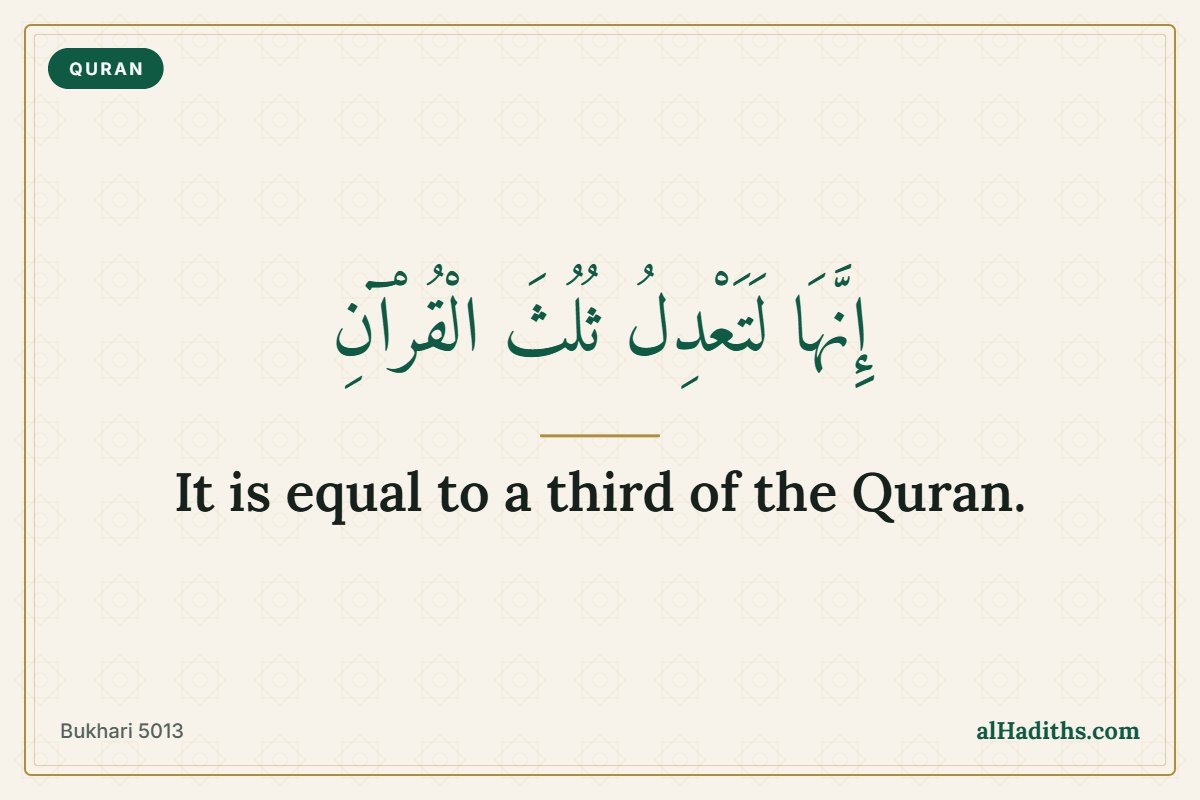
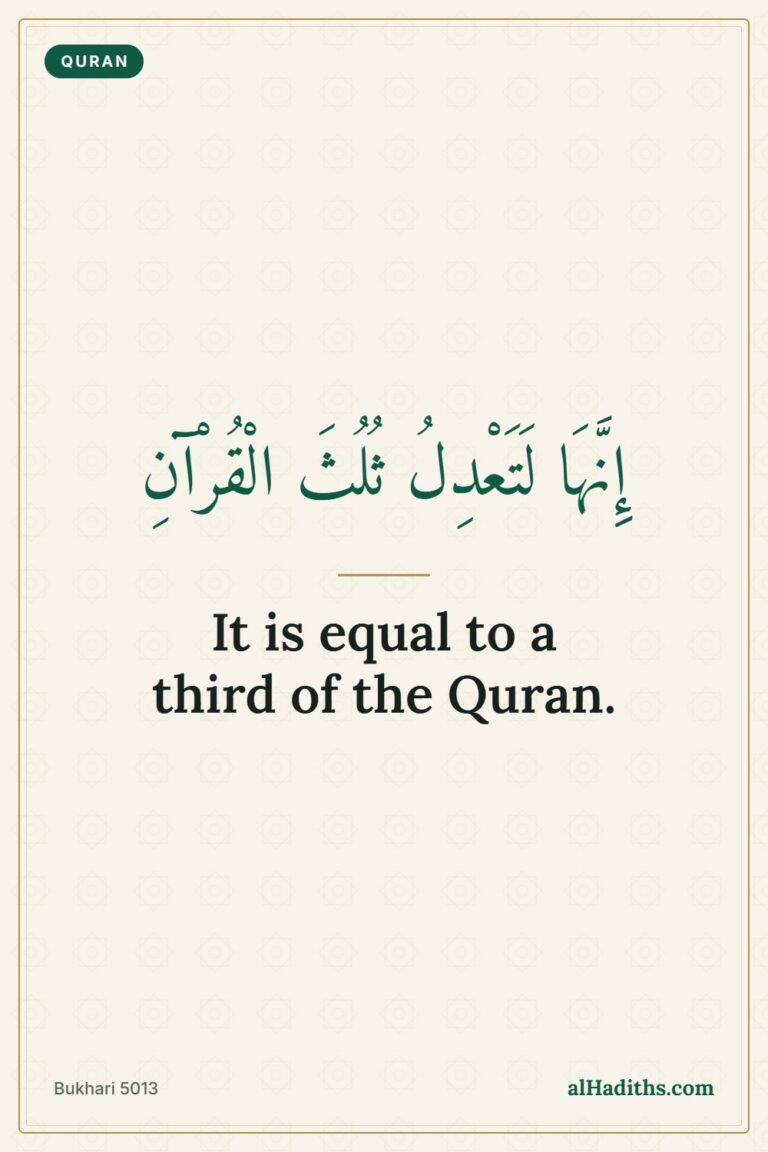
أَنَّ رَجُلاً، سَمِعَ رَجُلاً، يَقْرَأُ {قُلْ هُوَ اللَّهُ أَحَدٌ} يُرَدِّدُهَا فَلَمَّا أَصْبَحَ جَاءَ إِلَى رَسُولِ اللَّهِ صلى الله عليه وسلم فَذَكَرَ ذَلِكَ لَهُ وَكَأَنَّ الرَّجُلَ يَتَقَالُّهَا فَقَالَ رَسُولُ اللَّهِ صلى الله عليه وسلم وَالَّذِي نَفْسِي بِيَدِهِ إِنَّهَا لَتَعْدِلُ ثُلُثَ الْقُرْآنِ
“A man heard another man reciting ‘Say: He is Allah, the One’ over and over. The next morning he came to Allah’s Messenger ﷺ and told him about it, as if he thought it was too little. Allah’s Messenger ﷺ said: ‘By Him in Whose Hand my life is, it is equal to one third of the Quran.’”
Sahih al-Bukhari 5013 · Narrated by Abu Sa’id al-Khudri · Translation adapted from Sunnah.com
In Sahih Muslim 811, the Prophet ﷺ asked his Companions whether any of them could recite a third of the Quran in one night, then told them this surah equals it. HadeethEnc explains this hadith further.
Try this: recite Surah al-Ikhlas once before you sleep tonight, slowly, thinking about each verse.
2. Allah loves the one who loves it
Aishah (may Allah be pleased with her) narrated that the Prophet ﷺ sent a man to lead an expedition. In every prayer, he ended his recitation with Surah al-Ikhlas. When the men told the Prophet ﷺ, he asked them to find out why:
فَسَأَلُوهُ فَقَالَ لأَنَّهَا صِفَةُ الرَّحْمَنِ، وَأَنَا أُحِبُّ أَنْ أَقْرَأَ بِهَا. فَقَالَ النَّبِيُّ صلى الله عليه وسلم أَخْبِرُوهُ أَنَّ اللَّهَ يُحِبُّهُ
“They asked him, and he said: ‘Because it describes the Most Merciful, and I love to recite it.’ The Prophet ﷺ said: ‘Tell him that Allah loves him.’”
Sahih al-Bukhari 7375 · Narrated by Aishah · Translation adapted from Sunnah.com
The same report is in Sahih Muslim 813. The man loved the surah because it describes Allah, and that love was answered with Allah’s love for him. HadeethEnc has a fuller explanation.
Try this: learn the meaning of each of the four verses, so your recitation comes from knowing what you are saying.
3. Reciting Surah Ikhlas in every rakat
Anas bin Malik (may Allah be pleased with him) narrated that an imam from the Ansar at Masjid Quba’ began every recitation with Surah al-Ikhlas, then recited another surah after it, in every rak’ah. His people asked him to recite it alone or leave it, and he refused. When the Prophet ﷺ visited them, they told him:
يَا فُلاَنُ مَا يَمْنَعُكَ مِمَّا يَأْمُرُ بِهِ أَصْحَابُكَ وَمَا يَحْمِلُكَ أَنْ تَقْرَأَ هَذِهِ السُّورَةَ فِي كُلِّ رَكْعَةٍ. فَقَالَ يَا رَسُولَ اللَّهِ إِنِّي أُحِبُّهَا. فَقَالَ رَسُولُ اللَّهِ صلى الله عليه وسلم إِنَّ حُبَّهَا أَدْخَلَكَ الْجَنَّةَ
“‘O so-and-so, what stops you from doing what your companions ask, and what makes you recite this surah in every rak’ah?’ He said: ‘O Messenger of Allah, I love it.’ Allah’s Messenger ﷺ said: ‘Your love for it has admitted you into Paradise.’”
Jami` at-Tirmidhi 2901 · Sahih (Darussalam) · Narrated by Anas bin Malik · Translation adapted from Sunnah.com
Al-Bukhari also records this story in Sahih al-Bukhari 774b. The Prophet ﷺ did not tell the man to stop; he praised the love behind it.
Try this: if you only know a few short surahs, let Surah al-Ikhlas be one you recite with full attention in your prayers.
4. Three times in the morning and evening
Abdullah ibn Khubayb (may Allah be pleased with him) narrated that on a dark, rainy night the Prophet ﷺ told him three times to “say”, until he asked what he should say:
فَقُلْتُ يَا رَسُولَ اللَّهِ مَا أَقُولُ قَالَ { قُلْ هُوَ اللَّهُ أَحَدٌ } وَالْمُعَوِّذَتَيْنِ حِينَ تُمْسِي وَحِينَ تُصْبِحُ ثَلاَثَ مَرَّاتٍ تَكْفِيكَ مِنْ كُلِّ شَىْءٍ
“I said: ‘Messenger of Allah, what should I say?’ He said: ‘Say: “Say: He is Allah, the One” and al-Mu’awwidhatayn when you reach the evening and when you reach the morning, three times; they will suffice you against everything.’”
Sunan Abi Dawud 5082 · Hasan (al-Albani) · Narrated by Abdullah ibn Khubayb · Translation adapted from Sunnah.com
Al-Mu’awwidhatayn are Surah al-Falaq and Surah an-Nas. Jami` at-Tirmidhi 3575 (Hasan, Darussalam) has the same wording.
Try this: add the three surahs, three times each, to your morning and evening adhkar.
5. Before sleep, into cupped hands
Aishah (may Allah be pleased with her) described what the Prophet ﷺ did every night:
كَانَ إِذَا أَوَى إِلَى فِرَاشِهِ كُلَّ لَيْلَةٍ جَمَعَ كَفَّيْهِ ثُمَّ نَفَثَ فِيهِمَا فَقَرَأَ فِيهِمَا {قُلْ هُوَ اللَّهُ أَحَدٌ} وَ{قُلْ أَعُوذُ بِرَبِّ الْفَلَقِ} وَ{قُلْ أَعُوذُ بِرَبِّ النَّاسِ} ثُمَّ يَمْسَحُ بِهِمَا مَا اسْتَطَاعَ مِنْ جَسَدِهِ يَبْدَأُ بِهِمَا عَلَى رَأْسِهِ وَوَجْهِهِ وَمَا أَقْبَلَ مِنْ جَسَدِهِ يَفْعَلُ ذَلِكَ ثَلاَثَ مَرَّاتٍ
“Whenever the Prophet ﷺ went to bed every night, he would cup his hands together, blow into them and recite ‘Say: He is Allah, the One’, ‘Say: I seek refuge with the Lord of the daybreak’ and ‘Say: I seek refuge with the Lord of mankind’. Then he would wipe over as much of his body as he could, starting with his head, his face and the front of his body. He did that three times.”
Sahih al-Bukhari 5017 · Narrated by Aishah · Translation adapted from Sunnah.com
You can read the rest of his bedtime routine in Surahs to Recite Before Sleeping.
Try this: tonight, before you sleep, do it exactly as described: cupped hands, the three surahs, then wipe over your body, three times.
6. In the two rak’ahs before Fajr
Abu Hurairah (may Allah be pleased with him) narrated what the Prophet ﷺ recited in the sunnah prayer before Fajr:
أَنَّ رَسُولَ اللَّهِ صلى الله عليه وسلم قَرَأَ فِي رَكْعَتَىِ الْفَجْرِ { قُلْ يَا أَيُّهَا الْكَافِرُونَ} وَ { قُلْ هُوَ اللَّهُ أَحَدٌ}
“Allah’s Messenger ﷺ recited in the two rak’ahs of Fajr: ‘Say: O disbelievers’ and ‘Say: He is Allah, the One’.”
Sahih Muslim 726 · Narrated by Abu Hurairah · Translation adapted from Sunnah.com
These are the two short sunnah rak’ahs before the Fajr prayer: Surah al-Kafirun in the first and Surah al-Ikhlas in the second.
Try this: recite al-Kafirun and al-Ikhlas in your two rak’ahs before Fajr tomorrow.
7. In the witr prayer
Ubayy ibn Ka’b (may Allah be pleased with him) narrated the surahs the Prophet ﷺ recited in witr:
كَانَ رَسُولُ اللَّهِ صلى الله عليه وسلم يُوتِرُ بِـ { سَبِّحِ اسْمَ رَبِّكَ الأَعْلَى } وَ { قُلْ لِلَّذِينَ كَفَرُوا } وَاللَّهُ الْوَاحِدُ الصَّمَدُ
“Allah’s Messenger ﷺ used to pray witr with ‘Glorify the name of your Lord, the Most High’ (Surah 87), ‘Say: O disbelievers’ (Surah 109) and ‘Allah, the One, the Eternal Refuge’ (Surah 112).”
Sunan Abi Dawud 1423 · Sahih (al-Albani) · Narrated by Ubayy ibn Ka’b · Translation adapted from Sunnah.com
Witr is one of the daily sunnahs the Prophet ﷺ advised; see 3 Daily Sunnahs the Prophet ﷺ Advised.
Try this: if you pray three rak’ahs of witr, recite al-A’la, al-Kafirun and al-Ikhlas in them, in that order.
Bringing it together
Here is the surah itself, with its meaning:
قُلْ هُوَ ٱللَّهُ أَحَدٌ (١) ٱللَّهُ ٱلصَّمَدُ (٢) لَمْ يَلِدْ وَلَمْ يُولَدْ (٣) وَلَمْ يَكُن لَّهُۥ كُفُوًا أَحَدٌۢ (٤)
Say, “He is Allāh, [who is] One, Allāh, the Eternal Refuge. He neither begets nor is born, Nor is there to Him any equivalent.”
Surah al-Ikhlas 112:1–4 · Translation: Saheeh International, from Quran.com
Reflection: the Prophet ﷺ placed this surah at the edges of the day: in the morning and evening, before sleep, before Fajr and in the last prayer of the night. Four short verses about who Allah is, kept close at every turn, and loved by those who understood them.
Questions people ask
What are the benefits of Surah Ikhlas?
From authentic hadith: it equals a third of the Quran (Sahih al-Bukhari 5013), Allah loves the one who loves it (Sahih al-Bukhari 7375), and loving it leads to Paradise (Jami` at-Tirmidhi 2901, Sahih per Darussalam). Recited three times morning and evening with al-Falaq and an-Nas, it suffices against everything (Sunan Abi Dawud 5082, Hasan per al-Albani).
Can I recite Surah Ikhlas in every rakat?
A man from the Ansar recited it in every rak’ah at Masjid Quba’, and the Prophet ﷺ told him his love for it had admitted him into Paradise (Jami` at-Tirmidhi 2901; also Sahih al-Bukhari 774b). For questions about rulings, ask a qualified local scholar.
Why recite Surah Ikhlas 3 times?
The three-times practice in the authentic hadith is for the morning and evening: al-Ikhlas, al-Falaq and an-Nas, three times each, which suffice you against everything (Sunan Abi Dawud 5082). The Prophet ﷺ also blew into his hands with the three surahs three times before sleep (Sahih al-Bukhari 5017).
Does reciting Surah Ikhlas ten times build a palace in Jannah?
That narration (Mishkat al-Masabih 2185) is mursal, which is classed as weak, so we do not rely on it.
Is there a hadith about reciting Surah Ikhlas 100 or 200 times?
The narration about reciting it 200 times a day, or 100 times before sleep, is graded Da’if by Darussalam (Jami` at-Tirmidhi 2898), so it is not used here.
Key lessons
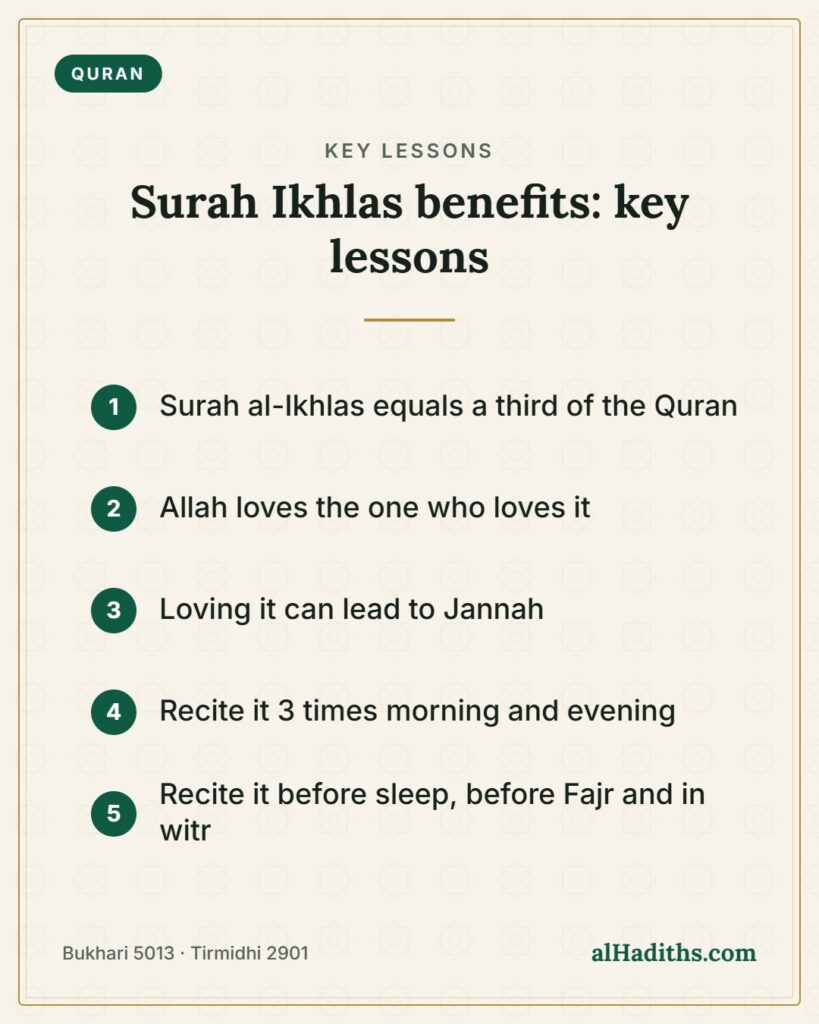
- Surah al-Ikhlas equals a third of the Quran (Bukhari 5013).
- Allah loves the one who loves it (Bukhari 7375).
- Loving it led a man of the Ansar to Paradise (Tirmidhi 2901).
- Recite it with al-Falaq and an-Nas three times morning and evening (Abu Dawud 5082).
- The Prophet ﷺ recited it before sleep, before Fajr and in witr.
Pick one of these moments today, whether it is the evening adhkar, your bedtime or your witr, and make Surah al-Ikhlas part of it.
Save this to Pinterest so you remember when to recite it
Share the reward. Send this article to someone who needs it today — teaching a hadith or dua can become a lasting good deed for you, in shaa Allah.