Abu Bakr’s Dua for Forgiveness: Allahumma Inni Zalamtu Nafsi
Abu Bakr as-Siddiq (may Allah be pleased with him) was the Prophet’s ﷺ closest companion from the very first days of Islam. Yet he still asked him: teach me a dua to make in my prayer. The answer was a short dua for forgiveness, Allahumma inni zalamtu nafsi, recorded in Sahih al-Bukhari and Sahih Muslim. Here it is with its Arabic, meaning and where to say it.
At a glance
- Source: Sahih al-Bukhari 834 (also Sahih Muslim 2705a)
- Narrated by: Abu Bakr as-Siddiq (may Allah be pleased with him), through ‘Abdullah ibn ‘Amr
- Grade: Sahih (al-Bukhari and Muslim)
- Topic: Dua for forgiveness in the prayer
- Practise it: Say it in your prayer, before the salam
The dua
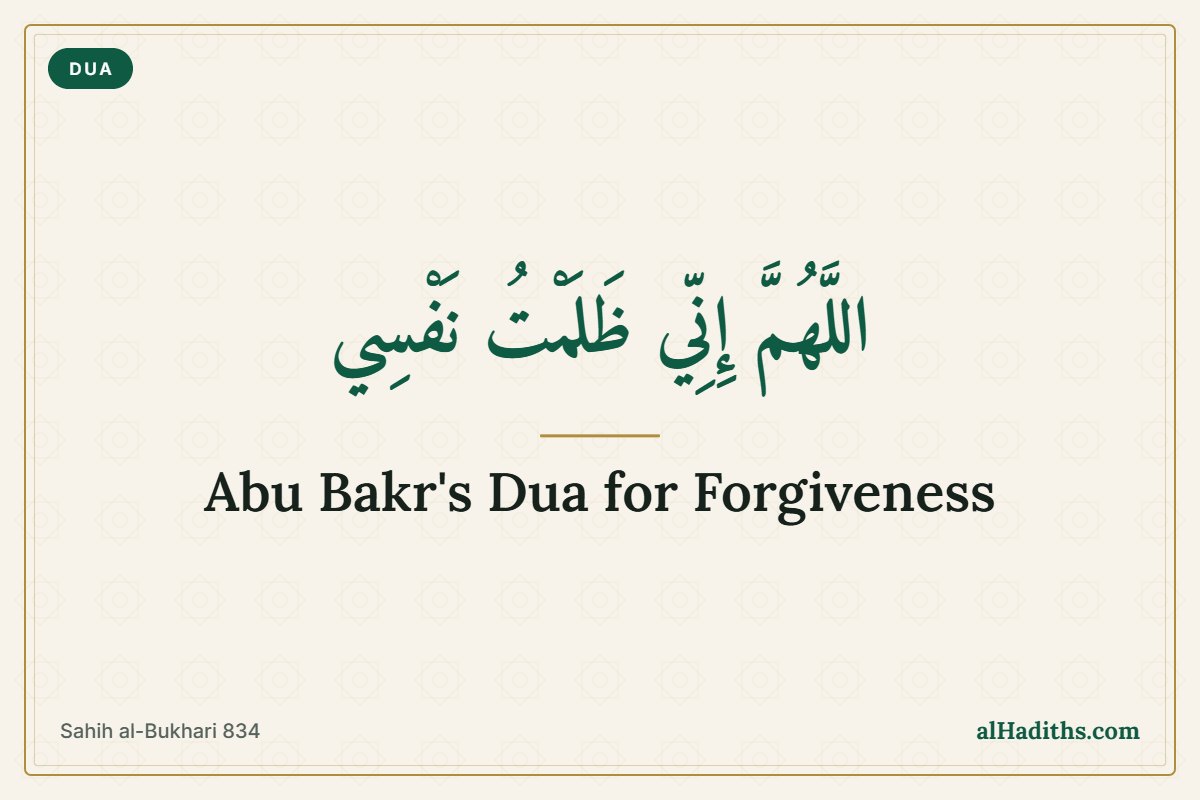
اللَّهُمَّ إِنِّي ظَلَمْتُ نَفْسِي ظُلْمًا كَثِيرًا وَلاَ يَغْفِرُ الذُّنُوبَ إِلاَّ أَنْتَ، فَاغْفِرْ لِي مَغْفِرَةً مِنْ عِنْدِكَ، وَارْحَمْنِي إِنَّكَ أَنْتَ الْغَفُورُ الرَّحِيمُ
Allāhumma innī ẓalamtu nafsī ẓulman kathīran, wa lā yaghfirudh-dhunūba illā anta, faghfir lī maghfiratan min ‘indika, warḥamnī, innaka antal-Ghafūrur-Raḥīm.
O Allah, I have greatly wronged myself, and no one forgives sins except You. So grant me forgiveness from You, and have mercy on me. You are the Oft-Forgiving, the Most Merciful.
Sahih al-Bukhari 834 · Also Sahih Muslim 2705a, Sahih al-Bukhari 6326 and Sunan an-Nasa’i 1302 (Sahih, Darussalam) · Translation adapted from Sunnah.com
Context
Abu Bakr said to the Prophet ﷺ: “Teach me an invocation with which I may invoke Allah in my prayer.” The Prophet ﷺ told him to say this dua (Sahih al-Bukhari 834).
Imam al-Bukhari recorded it in his Book of the Call to Prayer, under a chapter titled (in Sunnah.com’s translation) “Invocation before the Taslim”, the salam that ends the prayer. He recorded it again in his Book of Invocations under “Invocation during the Salat” (Sahih al-Bukhari 6326).
What the dua means, phrase by phrase
- Allahumma inni zalamtu nafsi zulman kathiran: “O Allah, I have greatly wronged myself.” We start by admitting our sins, without excuses. In Sahih Muslim the main wording is zulman kabiran (“a great wrong”), and one narrator, Qutaibah, reported kathiran (“much”), the wording in al-Bukhari.
- Wa la yaghfirudh-dhunuba illa anta: “No one forgives sins except You.” Only Allah can wipe a sin away, so we ask Him alone.
- Faghfir li maghfiratan min ‘indika: “So grant me forgiveness from You.” We ask for a forgiveness that comes from Him.
- Warhamni: “And have mercy on me.” Forgiveness covers what is past; mercy covers us from here on.
- Innaka antal-Ghafurur-Rahim: “You are the Oft-Forgiving, the Most Merciful.” The dua closes with the two names of Allah that match what we just asked for.
Reflection: if Abu Bakr, who stood by the Prophet ﷺ from the beginning, was taught to say “I have greatly wronged myself”, none of us can say we do not need this dua.
A personal note from me: I recite this dua from time to time, in sujud or before giving the salam.
How to practise it
- Learn it in five short phrases. Use the breakdown above: one phrase a day, and it is yours within a week.
- Say it in your prayer, before the salam. The hadith says “in my prayer” and Imam al-Bukhari placed it before the taslim, so many people say it in the last sitting, after the tashahhud. See also the dua to recite after tashahhud.
- Mean the words. When you say zalamtu nafsi, think of one real mistake you want Allah to forgive.
- Pair it with the best istighfar. Add Sayyidul Istighfar in the morning and evening.
- Ask a scholar for the details of where else in the prayer it may be said.
Key lessons
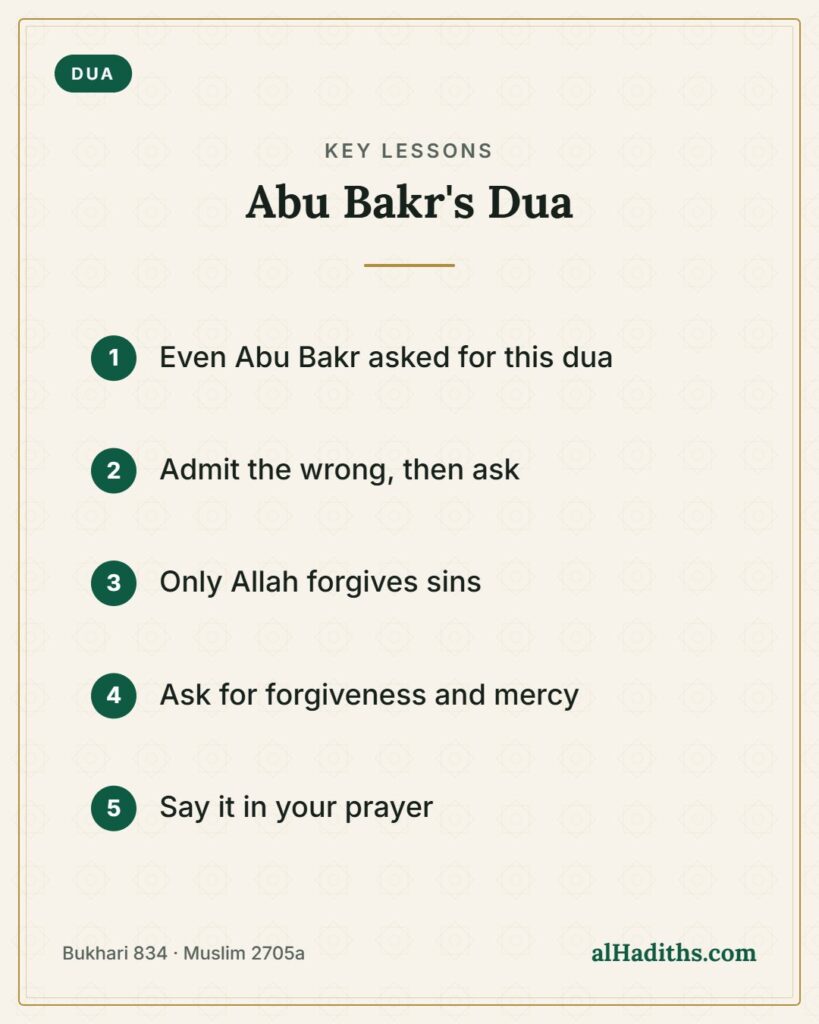
- Even Abu Bakr as-Siddiq asked to be taught a dua for forgiveness.
- Admitting our wrong is the start of seeking forgiveness.
- Only Allah forgives sins, so we ask Him alone.
- We ask for both forgiveness and mercy.
- The Prophet ﷺ taught it as a dua for the prayer.
Questions people ask
When should I recite Allahumma inni zalamtu nafsi?
Abu Bakr asked for a dua to say “in my prayer”, and Imam al-Bukhari placed it under the chapter on invocation before the taslim (Sahih al-Bukhari 834). Many people say it in the last sitting, after the tashahhud and before the salam.
Is it zulman kathiran or zulman kabiran?
Both are reported. Sahih al-Bukhari has kathiran (much). In Sahih Muslim 2705a the main wording is kabiran (great), and the narrator Qutaibah reported kathiran.
Is this dua in Sahih al-Bukhari?
Yes. It is in Sahih al-Bukhari 834, 6326 and 7387, and in Sahih Muslim 2705a.
Which mistake are you still carrying that you have not yet brought to Allah? In your next prayer, before the salam, say it in these words: Allahumma inni zalamtu nafsi.
Save this to Pinterest so you can learn it phrase by phrase.

Share the reward. Send this article to someone who needs it today — teaching a hadith or dua can become a lasting good deed for you, in shaa Allah.